



Solar company digital marketing: real strategies that work
Solar company digital marketing is the coordinated use of SEO, paid search, content, and email to attract homeowners and commercial buyers who are actively researching installation. When those channels work together, the result is a predictable flow of qualified leads, not a one-off spike from a single campaign. Solar adoption keeps climbing, which means more installers are competing for the same searches. Getting the fundamentals right separates companies that scale from those that plateau, and for most installers the plateau starts with the website: a site built to look credible rather than to turn research traffic into booked consultations caps every channel that points to it.
What digital marketing strategies work best for solar companies?
The most effective solar advertising strategies pair organic and paid channels. Organic search builds compounding lead volume over time. Paid search captures buyers who are ready to request a quote today. Email and social sustain the pipeline between those two.
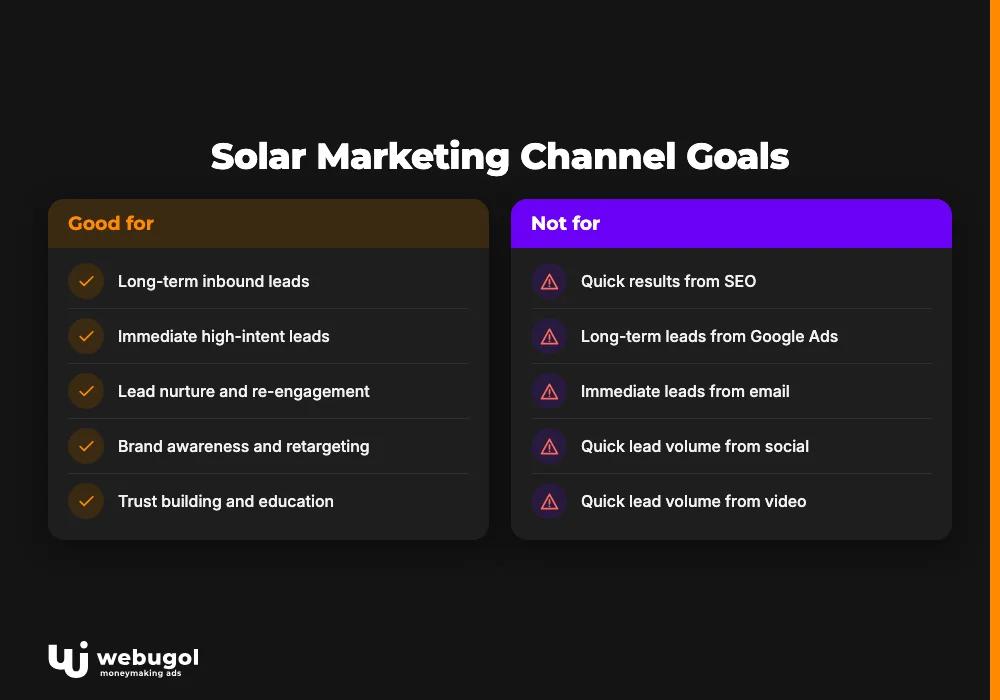
Here is how the core channels compare for a solar business:
| Channel | Primary goal | Speed to results |
|---|---|---|
| Solar panel SEO | Long-term inbound leads | 3 to 6 months |
| Google Ads for solar | Immediate high-intent leads | Days |
| Solar email marketing | Lead nurture and re-engagement | Weeks |
| Social media | Brand awareness, retargeting | Variable |
| Video | Trust building and education | Variable |
A solar business plateauing on lead volume is usually underinvesting in the first two rows. Creative content across social channels, including before-and-after installation videos and customer testimonials, extends organic reach without additional ad spend and improves digital marketing results across those channels.
How do solar companies generate leads online?
Leads come from three sources: search (organic and paid), referrals, and re-engaged past inquiries. Most solar companies over-rely on paid search, which keeps the cost per lead structurally high. Building organic and email into the channel mix lowers that cost over 12 to 18 months.
Solar panel SEO: building a durable lead source
The foundation is the service page. Each offering, whether residential installation, commercial projects, or financing options, needs its own page specific enough to match search intent and thorough enough to hold a reader.
Localized keywords matter most here. A person searching "solar installer [city]" is steps closer to buying than someone searching "how does solar work." Structuring service pages around those local queries, backed by consistent Google Business Profile data and positive reviews feeding local ranking signals, is what moves a solar business into the local pack.
Content extends the reach further. Solar incentive guides, real payback-period breakdowns, and FAQ-style posts on net metering capture early-stage researchers before they ever visit a competitor's page. Infographics and comparison tables make that content easier to scan and share. Explainer videos showing how panels convert sunlight into energy simplify complex ideas into formats that build trust with homeowners who are still evaluating whether solar makes sense for their property.
Local SEO for solar installers
A fully optimized Google Business Profile is one of the highest-leverage tasks in solar energy marketing. Accurate hours, service area, photos, and a stream of genuine reviews improve both map placement and credibility. Local citation consistency, with name, address, and phone number matching exactly across directories and the website footer, reinforces local authority and prevents ranking dilution.
Is Google Ads effective for solar businesses?
Yes. Google Ads for solar puts the business in front of buyers who are actively comparing providers at the exact moment they are ready to act. Search ads target high-intent queries; display campaigns keep the brand visible during the consideration phase. The cost per click is high in this category, so ad copy must lead with what moves the buyer: energy bill reduction, federal tax credit eligibility, or guaranteed installation timelines.
Social ads on Facebook and Instagram complement paid search by targeting homeowners in high-solar-potential areas with demographic and behavioral filters. Behavioral targeting focused on eco-conscious habits and demographic targeting of homeowners in regions with strong solar incentives both reduce wasted spend. For a detailed breakdown of building paid campaigns around specific conversion goals, see the guide on structuring Google Ads for measurable business results.
Display advertising and YouTube pre-rolls work for brand exposure. Build the bottom-of-funnel first.
What SEO tactics help solar companies rank higher?
Local competition in solar is intense and paid keywords are expensive, which makes organic search quality a durable cost advantage. Four priorities move the needle most:
- Page speed and mobile performance. A slow-loading page loses the visit before the pitch starts. Most solar quote researchers are on a phone, and mobile responsiveness is not optional. Every paid and organic channel delivers traffic to this same foundation. A site that underperforms technically raises the cost of every lead source across the board.
- Structured service pages. One page per service type, each with a local modifier in the title and H1, a logical FAQ block, and a single strong CTA. Thin or combined pages rank for nothing specific.
- Local citation consistency. Exact name, address, and phone number across Google Business Profile, directories, and the site footer. Discrepancies dilute local authority across all pages.
- Content depth that earns links. Each resource that earns backlinks lifts domain authority, which lifts the service pages that convert. Solar incentive explainers and local solar savings calculators are the content types that actually attract external links in this category.
Every element of solar company digital marketing, from page titles to citation data, feeds the local ranking signals that determine whether a solar installer appears in the top results or not. Solar energy marketing that ignores technical SEO leaves ranking potential unused, regardless of ad budget.
Solar email marketing: nurturing leads to close
Solar email marketing returns the most when used at two moments: immediately after a quote request and six to twelve months after a prospect went quiet.
A follow-up sequence after a solar quote answers the objections that delay decisions rather than kill them: pricing clarity, federal and state incentive timelines, and what the installation process actually looks like. Keep the sequence short and specific. Vague follow-ups get deleted.
Re-engagement campaigns to past inquiries cost almost nothing per send. They regularly close contracts from leads who were simply not ready six months earlier. That is solar lead generation with near-zero marginal cost per customer.
Segmenting by property type, residential versus commercial, allows for different messaging. The underlying problem is similar; the vocabulary and buying process are not. A homeowner email and a commercial property manager email solving the same problem should sound nothing alike.
How much does digital marketing cost for a solar company?
No single figure applies. Google Ads for solar keywords is among the more expensive in home services. SEO requires sustained investment over months before returns compound. The question that matters more is cost per acquired customer versus the value of a solar installation contract.
For example (illustrative numbers), a company paying $200 per qualified lead and closing 20% of those leads is paying $1,000 per customer. Against a typical residential contract value, that math works. The goal of a well-structured solar company digital marketing program is to lower that cost over time by layering organic and email alongside paid, so the pipeline does not stop when ad budgets get cut.
Tracking that number requires conversion tracking for form submissions and phone calls both. Without it, ad spend decisions rest on incomplete data and the wrong channels get the credit.
Solar company digital marketing: measuring what matters
Four numbers drive most decisions in solar digital marketing:
- Leads per channel per month: where volume is coming from and whether the channel mix is shifting in the right direction
- Call volume: calls from organic versus paid, broken out by source so over-attribution does not skew budget decisions
- Form fill rate: how well landing and service pages convert traffic into actual inquiries
- Return on ad spend: revenue attributed to paid campaigns divided by cost, measured against a real contract value baseline
Google Analytics and conversion tracking working together give a complete picture. Without both running in parallel, over-attribution to paid and underfunding of organic channels happens by default. Most solar companies running paid search alone are flying partially blind.
Ready to build a solar marketing system that scales
Solar companies that stop losing leads to better-ranked competitors do it by owning the full path: search visibility, paid capture, and lead nurturing working as one system. That is what Webugol builds for you: a site and the system that fills it, not a channel-by-channel checklist.
Contact us to identify where your current setup is leaking and what a full-channel solar marketing program looks like in practice.
FAQ
What digital marketing strategies work best for solar companies?
SEO and Google Ads form the core: organic search builds sustainable lead volume over time while paid search captures buyers who are ready to act today. Solar email marketing connects the two by keeping past inquiries engaged until they are ready to decide.
How do solar companies generate leads online?
Solar companies generate leads through optimized service pages targeting local search terms, paid search campaigns bidding on high-intent queries, and re-engagement email campaigns for prospects who requested quotes but did not sign. Each channel serves a different stage of the buying process.
Is Google Ads effective for solar businesses?
Yes, particularly for capturing buyers already comparing providers. Search ads put the business at the top of results at the moment of highest intent and can be adjusted based on seasonal demand, local competition, and available installation capacity.
What SEO tactics help solar companies rank higher?
Local SEO fundamentals drive most of the gains: specific service pages with local modifiers, a fully optimized Google Business Profile, consistent citation data across directories, and genuine customer reviews. Page speed and mobile performance compound all of the above.
How much does digital marketing cost for a solar company?
Costs vary by channel mix and local competition. The more useful frame is cost per acquired customer versus contract value. Most solar companies lower that cost over 12 to 18 months by gradually shifting budget from paid search toward solar panel SEO and email as those channels mature.

