



Multi-location marketing: why nobody can tell you which location is making money
Multi location marketing is the coordinated operation of paid, organic, and local acquisition across two or more physical or service locations under one brand. The practical problem is almost never creative or messaging. It is measurement granularity: by the third location, most networks cannot tell which location earned which dollar, because tracking, CRM, and reporting were built for a single site and quietly broke when the second one opened.
If you are reading this, you are probably running three or four locations, your billing team and your CRM disagree, and every monthly review ends with somebody saying the numbers look fine in aggregate. That is the symptom. The cause sits one layer below, in how your measurement stack was assembled. At Webugol we work with clinic and telehealth operators who have already outgrown the single-location playbook, and the pattern repeats in almost every diagnostic: numbers over opinions, once the plumbing is honest.
What is multi-location marketing?
Multi location marketing is the practice of coordinating acquisition, local presence, and conversion tracking across two or more locations operating under a shared brand. It includes paid media, organic search, local SEO, review management, and CRM workflows, but the defining discipline is attribution at the location level. The core challenge is not writing different ads per market. It is being able to answer, with the same confidence as a single-site operator, which location generated which booked revenue this week.
Most operators conflate multi location marketing with multi-market creative. The creative question is solved in an afternoon. The measurement question quietly compounds every time you add a location, a channel, or a vendor, until the CEO becomes the only person who can reconcile the picture.
Why attribution breaks when you expand past two locations
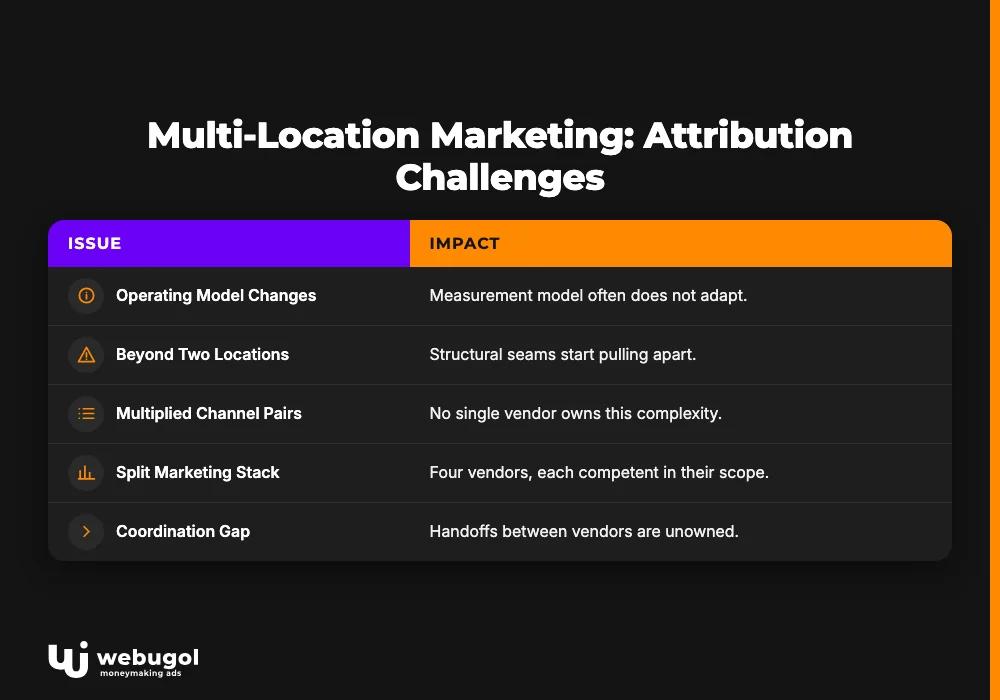
Attribution does not break because someone forgot to tag a campaign. It breaks because the operating model changes and the measurement model does not. With one location, everything funnels into one GA4 property, one call tracking pool, one CRM pipeline, and one ad account. The math works because there is only one answer to find.
Add a second location and the system still mostly holds. Add a third, and the structural seams start pulling apart. Each new location multiplies the number of channel-to-location pairs the stack has to keep clean, and no single vendor in your current roster is responsible for that multiplication.
| Execution model | Brand control | Local flexibility | Attribution risk | Typical reporting outcome |
|---|---|---|---|---|
| Brand-led (centralized) | High | Low | Moderate, blended metrics hide per-location variance | Network CPA; no location-level cost-to-revenue path |
| Location-led (decentralized) | Low | High | High, each location reports differently, no apples-to-apples | Inconsistent dashboards; brand equity dilution over time |
| Hybrid without integration layer | Medium | Medium | Very high, four vendors each correct in own scope; handoffs unowned | CEO becomes integration layer; diagnostic work takes weeks |
The coordination gap no one owns
In most multi-location networks past the second site, the marketing stack is split across four vendors. A media agency runs paid. A local SEO vendor runs Google Business Profiles and listings. A website shop maintains the site and landing pages. A CRM administrator or ops lead manages the pipeline. Each one is competent. Each one reports accurately inside their own scope.
The handoffs between them are not owned by anyone. When a lead comes in through a location-specific ad, hits a shared landing page, calls a pooled number, and lands in a CRM pipeline without a location field, four people can each prove their layer worked. The lead still cannot be attributed. The CEO ends up becoming the integration layer, running spreadsheets at the end of the month to stitch the picture together.
One GA4 property for the whole network
The single-property default is the most common structural fault we see. One GA4 property collects all traffic from all locations, which cross-contaminates session data at every level. Branded searches from one city attribute to pages serving another. Conversions fire without a clean location dimension. Cost data from ad platforms imports at the account level, not the location level.
The downstream effect is that there is no cost-to-revenue path per location. You can see network revenue, network sessions, and network cost. You cannot see which location is subsidizing which, which is the only question that matters when you are deciding where to open the next one.
How does attribution actually break across locations?
It is not a reporting error. It is a structural consequence of using single-site measurement tooling on a multi-site operation. The two most damaging break points sit inside call tracking and CRM, because those are the two systems that touch real revenue.
Shared call tracking pools: how one location steals another's credit
Dynamic number insertion with a shared pool was built for one location running several channels. In a multi-location setup, numbers rotate across visitors regardless of which location page they landed on. A caller who browsed the Austin page but was served a pool number also used last week for the Dallas page gets attributed to whichever rule fires first.
At two locations the distortion is tolerable. At five locations, with four channels each, the pool rotation creates CPA distortion large enough that location-level numbers stop being usable for budget decisions. Teams quietly stop trusting the dashboards and go back to gut feel, which is exactly the state the operator was trying to escape.
One CRM pipeline for all locations: why billing and CRM never agree
Most CRMs do not require a location ownership field at lead creation. New leads flow into a single pipeline, get worked by whichever intake coordinator picks them up, and are closed without a reliable location stamp. Billing, meanwhile, records revenue against the actual service location. The two systems are now measuring different things.
When the CFO asks which location drove the quarter, the CRM says one thing and billing says another, and neither can be reconciled without manual work. That is not a software problem. It is a design decision that was never made, because when the first location launched, there was nothing to reconcile.

What tracking setup do multi-location businesses actually need?
Three architectural decisions have to be made before the second location launches, not after the fourth. First, dedicated tracking numbers per channel per location, not a shared DNI pool. Second, separate GA4 data streams per location, or separate properties where privacy or compliance requires it. Third, a mandatory CRM location field captured at first touch, enforced at intake, not inferred later.
Each of these is straightforward in isolation. Together, they are the difference between a network you can scale with confidence and one where every new location adds measurement debt. Pair this with a proper offline conversion tracking setup so that booked revenue, not form fills, feeds back into the ad platforms that optimize your spend.
Running three or more locations on a shared measurement stack? A tracking audit identifies exactly which layer is collapsing attribution before it compounds further. Book a diagnostic call.
Per-location call tracking architecture
Dedicated numbers per channel per location means each location has its own set of tracking numbers assigned to paid search, paid social, organic, direct, and referral. Dynamic insertion still runs, but the pool is scoped to one location. Every number is tied to a location ID that flows into the CRM and the analytics stack.
The result is that a call from a Phoenix landing page cannot be credited to the Houston campaign, ever. That sounds obvious. It is not how most networks past three locations are configured today.
GA4 and CRM configuration for location-level visibility
Split GA4 streams, or separate properties for heavily regulated verticals, give each location a clean data boundary. Ad platform cost imports at the location level. Conversions carry a location dimension. The CRM enforces a location field at intake, either through the form, the routing logic, or the inbound call metadata.
Reconciliation between billing and CRM becomes a reporting task, not an investigation. That shift, from investigation to reporting, is what separates networks that can answer the "which location earns its budget" question in minutes from those that need a two-week project every quarter.
Multi-location healthcare marketing: what changes with HIPAA and platform policies?
For multi-location healthcare marketing, the answer is specific. A Business Associate Agreement has to be in place with every vendor that touches identifiable patient data, and ad platform health policies restrict the audiences and signals you can use. These are not post-launch cleanup tasks. They are architectural decisions made before the second location launches, because retrofitting compliance across a live network is painful and expensive.
HIPAA-compliant tracking across clinic and telehealth locations
A BAA has to be signed before patient data flows through any analytics, call tracking, CRM, or ad vendor. Remarketing pools cannot combine audiences across different health conditions, and in many cases cannot be built from clinical identifiers at all. Consent mode has to be configured per location, because telehealth and in-clinic flows often have different lawful bases and different user experiences.
None of this is optional, and none of it scales well if bolted on after the fact. Verify current ad platform health policies and HHS guidance before launch, because enforcement has been tightening and vendor BAAs vary in what they actually cover.
Compliance review in a distributed execution model
Most multi-location networks start with one compliance approver reviewing every asset. That workflow collapses when the network crosses three or four locations, because the approver becomes the bottleneck and distributed execution breaks the review chain. Location teams push for speed, the approver pushes back on risk, and campaigns either stall or ship without proper review.
This has to be designed at the network level before the second location launches. It is an operational design decision, not a legal one, and it is almost never on the agenda when expansion is being planned.

The operational triggers that expose a broken measurement system
Two events reliably expose the problem. The first is a new location launch, when the operator suddenly needs to isolate the new site's performance and discovers that the stack cannot do it cleanly. The second is a funding round or acquisition conversation, when investors ask which location earns its budget and the answer requires a spreadsheet instead of a dashboard.
Both triggers arrive at the worst possible time. You are either in growth mode or in diligence mode, and neither is a good moment to rebuild measurement from scratch.
Six things that break in your measurement stack at a new location launch:
- Call pool contamination: the new location's calls misrouted to existing numbers
- CRM pipeline merge: new leads enter the same funnel without location ownership
- GA4 session blending: new market traffic folds into existing property averages
- Ad audience overlap: the new location's campaigns compete with the established location's retargeting pools
- Compliance review bottleneck: a single approver now reviewing assets for more markets than the workflow was designed for
- Speed-to-lead baseline loss: intake staffing not ready at launch, but attribution still fires
If three or more of these show up at a launch, the measurement system was already past its design limit before the new location opened.
How to choose a multi-location marketing agency or platform
The practical question is simple. Does the agency or multi location marketing platform own attribution end-to-end, or does it hand off at the channel boundary? Everything else, including dashboards, creative, local SEO, and automation features, sits downstream of that one question. A marketing agency for multi location businesses that only manages media will produce clean media reports and leave the integration problem with you.
Six criteria for evaluating a multi location marketing agency or multi location marketing software platform:
- Attribution ownership: does the agency configure and own the full tracking stack, or manage media only
- Per-location CPA reporting: can they produce location-level cost-per-booking, or only blended network CPA
- Healthcare compliance readiness: do they have BAA-ready vendor relationships and health ad policy experience
- Offline conversion support: can call and form data be passed back to ad platforms as offline conversions
- CRM integration depth: does their reporting pull from the CRM, or stop at the ad platform
- Escalation accountability: is there one person accountable for the whole revenue path, or a hand-off chain
These criteria filter out vendors that are good at their layer but unwilling to own the seams. If you are evaluating multi location marketing services alongside AI-powered multi location marketing platforms, apply the same six criteria to both. The sales decks differ. The underlying accountability question does not. Pair the evaluation with a clear view of measuring actual returns across your full acquisition funnel, so that platform features are judged against revenue reality, not dashboard aesthetics.

Know which location is earning before you scale to the next one
The operators who scale cleanly past four locations are not the ones with the best creative or the most advanced multi location marketing automation. They are the ones who treat measurement as part of the operating model, not a reporting afterthought. Before opening the next site, they can tell you, by location, what a booked patient or customer costs, which channels produced them, and where the funnel leaks.
That is the posture the Healthcare Growth System is built around. Numbers over opinions, tracking and CRM and campaigns owned as one system, so that every expansion decision rests on a per-location cost-to-revenue view instead of a network average. If you are running three or more locations and planning the next one, a strategy call is the fastest way to find out whether your current stack can support it, or whether the measurement debt will surface at the worst possible moment.
FAQ
What is multi-location marketing?
Multi location marketing is the coordinated operation of paid, organic, and local acquisition across two or more locations under one brand. It covers creative, channels, local presence, and attribution at the location level. The defining discipline is being able to answer which location earned which dollar, not just producing consistent ads across markets.
How does multi-location marketing differ from national campaigns?
National campaigns optimize one message across one audience, with one P&L. Multi location marketing optimizes many channel-to-location pairs against many local P&Ls, with shared brand constraints. The hard part is not the creative variation, it is the measurement architecture that keeps each location's cost and revenue cleanly separable.
What tracking setup do multi-location businesses actually need?
Three things: dedicated call tracking numbers per channel per location, separate GA4 streams or properties per location, and a mandatory CRM location field captured at first touch. Together these make per-location CPA and cost-to-revenue calculable without manual reconciliation. Without them, network averages are the only number you can trust.
How do healthcare clinics manage multi-location ad compliance?
Compliance has to be designed before the second location launches. That means BAAs signed with every data-touching vendor, remarketing audiences scoped to avoid condition-based pools, consent mode configured per location, and a review workflow that does not depend on a single approver. Operators should verify current ad platform health policies and HHS guidance before launch.
Why do billing and CRM revenue numbers disagree across locations?
Billing records revenue against the actual service location, while most CRMs allow leads to be worked and closed without a reliable location ownership field. The two systems end up measuring different things, which is why the CFO's question about per-location revenue cannot be answered without manual work. Enforcing a location field at lead intake is the structural fix.

