



ROMI in marketing: what it is, how to calculate it, and why it matters
ROMI in marketing, or return on marketing investment, measures how much revenue a campaign earns for every dollar spent on it. The formula is straightforward: subtract marketing costs from campaign revenue, then divide by marketing costs. A result above 100% means the campaign earns more than it costs. Below 100% means your marketing budget is shrinking, not growing.
For a business owner spending on ads, email, or SEO without clear attribution, ROMI is the number that separates productive spend from waste. That blind spot holds back businesses at every revenue stage: when you cannot trace revenue back to specific channels, every budget decision relies on intuition rather than data.
What is ROMI in marketing?
ROMI stands for return on marketing investment. It measures the financial return generated specifically by marketing activity, expressed as a percentage relative to what was spent to produce it.
Where metrics like click-through rate or impressions describe campaign activity, ROMI describes campaign output: how much revenue came back compared to what went in. A marketing director reviewing budget performance needs ROMI to answer the question that matters most to leadership: is this spend earning its keep?
Unlike general ROI, ROMI isolates marketing costs specifically, which makes it the right metric for campaign planning and marketing budget allocation. It shows which channels, campaigns, and messages are pulling their weight.
| Metric | Scope | Primary use |
|---|---|---|
| ROI | Any investment: capital, hiring, software, marketing | Finance and strategy |
| ROMI | Marketing spend only | Campaign evaluation and budget allocation |
What is the difference between ROI and ROMI?
ROI measures net gain from any investment relative to its cost. ROMI narrows that calculation to marketing spend specifically. The romi vs roi distinction matters most when you are building separate reporting lines for marketing performance versus overall business returns: a CFO wants one number, while a marketing director needs the other to defend channel allocation.
In practice, a CFO calculating overall ROI might fold in product development, logistics, and capital costs. A marketing director running a romi calculation looks at ad spend, content production, agency fees, and platform costs, then measures only the revenue those activities generated. Same logic, different scope. That scope difference is what makes ROMI the right tool for evaluating campaigns rather than the broader ROI metric.
How do you calculate ROMI?
The ROMI formula is:
(Revenue from marketing – Marketing costs) / Marketing costs
The result is a decimal or percentage. A ROMI of 1.0 (100%) means you recovered your spend and broke even. A ROMI of 3.0 (300%) means every dollar returned three in revenue.
To calculate ROMI accurately, you need three inputs: revenue directly attributable to your marketing activity, the full campaign cost including ad spend, creative production, platform fees, and agency costs, and an attribution model that connects revenue to the right campaign. Without reliable attribution, the calculation is built on a shaky foundation.
What counts as a good ROMI percentage depends on margin structure. As a general floor, any ROMI below 100% depletes budget rather than growing it.
Variables that affect ROMI accuracy
Several factors can distort your romi calculation and lead to decisions based on incomplete data:
- Weak attribution models that credit only the first or last touchpoint miss the full conversion path and misstate each channel's real contribution.
- Underestimating customer lifetime value causes teams to cut campaigns that look unprofitable at first purchase but generate repeat revenue over time.
- Ignoring indirect effects like brand recognition and audience trust, which compound conversion rates in ways that do not appear in immediate revenue data.
- External seasonality can inflate or deflate revenue in ways unrelated to your campaigns, making it harder to isolate the actual marketing effect.
What factors influence ROMI in marketing?
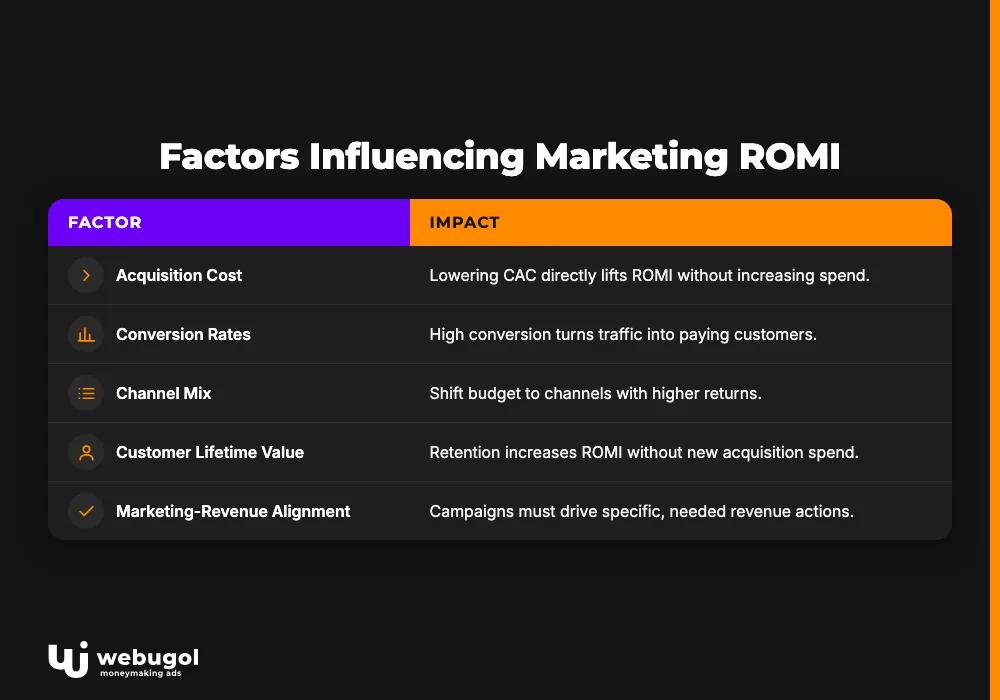
Five factors consistently move ROMI up or down, and understanding how they interact is what separates teams that deliberately improve romi in marketing from those who adjust budgets on intuition alone.
Customer acquisition cost is the most direct lever. High CAC compresses margin before the campaign earns a dollar. Improving lead quality and reducing friction in the acquisition process lowers CAC and lifts ROMI without increasing total spend.
Sales conversion rates determine how much campaign traffic becomes paying customers. High traffic with low conversion is a funnel problem, not a media problem. Fixing weak points in the landing page experience often yields faster ROMI gains than raising the ad budget. Websites that convert accurately are the foundation of any ROMI calculation worth trusting, and building that conversion foundation is what Webugol does.
Channel mix matters because different platforms generate different revenue per dollar spent. Tracking each channel separately allows you to shift budget from underperforming placements to those that consistently return above your ROMI floor.
Customer lifetime value determines what a first conversion is actually worth. A customer who buys once and never returns is worth far less than one who reactivates or refers others. Building retention into your marketing funnel increases ROMI without increasing acquisition spend.
Marketing-to-revenue alignment means making sure your campaigns drive the specific revenue actions your business needs, not just generating awareness that never converts.
What tools help track ROMI?
Three categories of tooling make accurate ROMI calculation possible.
Analytics platforms like Google Analytics 4 and HubSpot connect campaign data to revenue outcomes. They provide attribution reporting, channel-level performance, and funnel visibility that manual tracking cannot match. These platforms form the data layer for any reliable ROMI calculation.
Multi-touch attribution models distribute conversion credit across the channels a customer encountered before purchasing. Last-click and first-click models are simple but systematically undervalue mid-funnel activity. Platforms that support time-decay or data-driven attribution give a more complete picture of how paid campaigns contribute to your overall marketing returns.
Automation and AI reduce the manual work of pulling and reconciling ROMI data across sources. These tools consolidate performance across platforms, flag underperforming campaigns in real time, and model projected ROMI for budget scenarios. When a site and its analytics stack are built together as a single engagement, measurement is native from launch rather than retrofitted after the fact.
What one drawback comes with auditing ROMI across campaigns?
Attribution is the primary limitation. When a customer touches a social ad, clicks a retargeting email, reads a blog post, and then converts through paid search, crediting any single channel with that revenue distorts every ROMI figure in the data set.
Most attribution models simplify this complexity by crediting only one touchpoint. That is not a neutral measurement error: it systematically undervalues the channels doing mid-funnel work and overstates the value of the last-click channel. Fixing this requires a multi-touch attribution model matched to your actual customer journey, not the default model pre-set in your analytics tool.
Seasonal and market factors compound the problem. A revenue spike during a product launch or peak demand period can inflate ROMI for campaigns running at the same time, making those campaigns look stronger than they are. Accurate ROMI analysis requires isolating marketing-driven revenue from baseline or seasonal demand.
Turn your ROMI data into revenue growth
Most marketing teams already have the data to calculate ROMI. What they are missing is a system that connects campaign spend to attributable revenue across every channel. When that visibility exists, the budget decisions that have been guesses become data-backed calls. Webugol builds websites with measurement built in, so ROMI data exists from launch, not retrofitted later. If your current spend is generating unclear returns, start with a strategy session.
FAQ
What is ROMI in marketing?
ROMI stands for return on marketing investment. It measures how much revenue a marketing campaign generates relative to what it cost to run, expressed as a percentage. A ROMI above 100% means the campaign earned more than it cost.
How do you calculate ROMI?
The ROMI formula is revenue from marketing minus marketing costs, divided by marketing costs. To get an accurate result, you need reliable attribution data and the full campaign cost, including ad spend, production, platform fees, and any agency costs.
What is the difference between ROI and ROMI?
ROI measures the profitability of any investment, including capital equipment, staffing, and software. ROMI is scoped specifically to marketing spend, which makes it the right metric for evaluating campaigns and allocating marketing budgets.
What factors influence ROMI?
The main factors are customer acquisition cost, sales conversion rates, channel performance, customer lifetime value, and attribution model quality. Attribution has the largest effect: an oversimplified model systematically misstates how much revenue each channel actually generates.
What tools help track ROMI?
Google Analytics 4 and HubSpot are the most common platforms for ROMI tracking. Multi-touch attribution tools add channel-level accuracy, and automation platforms reduce the manual work of reconciling campaign data across sources.

