



Marketing trends 2026: what scaling businesses must act on
Marketing trends 2026 are defined by three compounding shifts: AI-driven personalization becoming infrastructure rather than a feature, first-party data replacing third-party tracking as the default, and short-form video formats completing transactions inside the content itself. Treat these as separate initiatives and you execute each one poorly. Connect them into one growth system and you outperform competitors. The divide between connected and disconnected stacks compounds every quarter.
The same structural gaps that confuse a first-time campaign manager are what keep a scaling business stuck at a revenue plateau: when channels don't share data, more tactics generate more noise instead of more growth.
What are the biggest marketing trends in 2026?
The leading digital marketing strategies for 2026 share one characteristic: they close the gap between customer intent signals and business response time. Here are the seven marketing trends 2026 has clarified with the strongest ROI evidence.
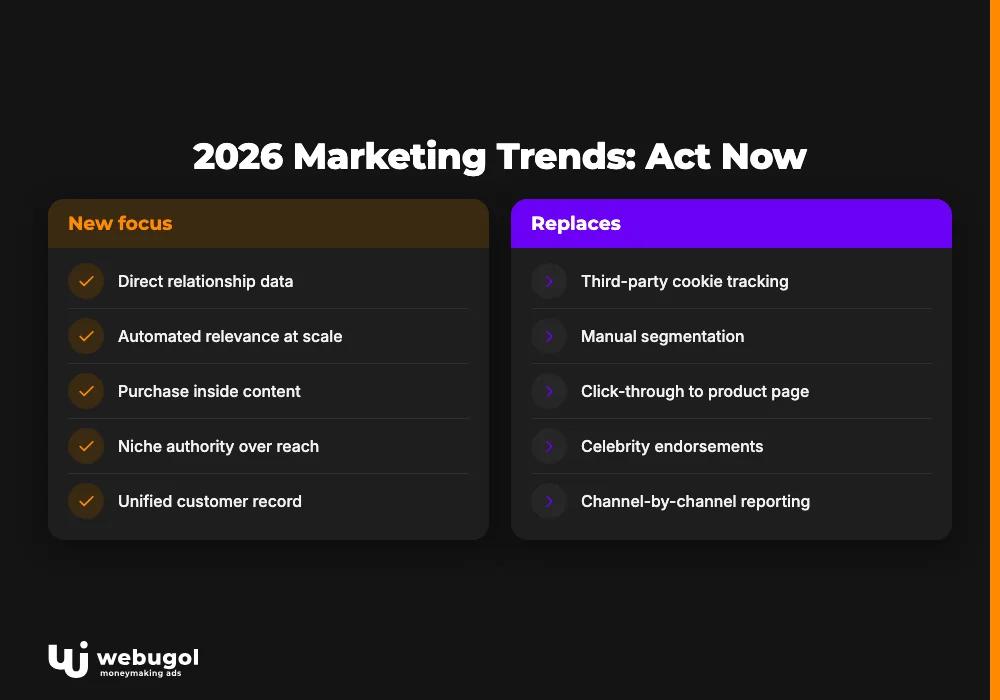
| Trend | Core shift | What it replaces |
|---|---|---|
| First-party data strategy | Direct relationship data | Third-party cookie tracking |
| AI in marketing | Automated relevance at scale | Manual segmentation |
| Short-form + shoppable video | Purchase inside content | Click-through to product page |
| Influencer marketing tips | Niche authority over reach | Celebrity endorsements |
| Purpose-driven branding | Verified actions over claims | Seasonal campaign positioning |
| Omnichannel marketing strategy | Unified customer record | Channel-by-channel reporting |
| Voice and visual search | Conversational indexing | Keyword-match indexing |
What is first-party data and why does it matter?
A first-party data strategy means collecting behavioral signals directly from customer interactions: purchase history, website behavior, email engagement, and account preferences. Zero-party data adds explicit intent through survey responses, quiz answers, and stated preferences. Together they let you personalize without depending on signals you no longer own.
GDPR and CCPA compliance are the floor here, not the goal. The business case is accuracy: behavioral data from your own channels predicts conversion better than modeled audiences purchased from a third-party data broker. The practical starting point is an audit. Map every customer touchpoint that currently generates a signal and check whether that signal feeds your CRM or disappears.
How is AI changing digital marketing strategies?
AI in marketing has moved past experimentation. It now operates as infrastructure: reading behavioral patterns, adjusting content and offers in real time, and routing customers across channels without manual triggers. The question for most teams is no longer whether to use AI. It's which layer to automate first.
Personalization that runs without manual input
The original personalization loop required an analyst to segment, a designer to create variants, and a developer to route traffic. AI collapses that cycle. Tools like Jasper and ChatGPT allow marketers to produce content variants at speed, while recommendation engines adjust what each visitor sees based on live session data.
For teams investing in search performance, see which AI-powered tools are reshaping SEO workflows right now. Keyword clustering, content gap analysis, and on-page optimization now run in a fraction of the time, freeing teams for judgment work.
Influencer marketing tips for the AI era
Influencer selection based on follower count alone no longer holds up. AI tools now assess reach, engagement rates, content style, and follower demographics before a contract is signed. The result is fewer wasted placements, better brand alignment, and measurable ROI.
The bigger shift is toward micro and nano-influencers. Smaller creators maintain closer relationships with their audiences. Their endorsements carry more credibility because followers treat them as peers, and cost-per-engagement is lower than broad-reach placements.
Video content marketing and the shoppable format shift
Short-form video dominates time-on-platform metrics across YouTube Shorts, Instagram Reels, and TikTok. The marketing trend of 2026 most underestimated by growth teams goes beyond raw production volume: completing the transaction inside the video itself.
Shoppable videos embed the purchase action directly into the content, eliminating the redirect step that causes drop-off. Live-stream commerce extends this further, holding attention while processing real-time transactions. For product-led businesses, these formats reduce funnel length and increase conversion by keeping intent and action in the same moment.
Interactive formats such as polls and quizzes serve a dual purpose in video content marketing: they generate zero-party data while increasing session depth. A viewer who answers a preference question responds more readily to a subsequent personalized offer.
Purpose-driven branding that holds up to scrutiny
Among marketing trends 2026, purpose-driven branding delivers a measurable benefit: consumers who trust a brand's stated values buy more frequently and churn less. The trap is performance without evidence.
Eco-conscious marketing that integrates recyclable materials, carbon-reducing supply decisions, and transparent sustainability reporting builds durable trust. Broad environmental claims without verification erode it. Consumers in 2026 are practiced at distinguishing committed action from positioning language, and brands that claim more than they do lose ground they cannot recover.
The same standard applies to social commitments. Brands that tie purpose to business operations rather than seasonal campaigns build associations that persist through ad-spend fluctuations.

Omnichannel marketing strategy for 2026
An omnichannel marketing strategy creates a single customer record across every touchpoint: web, email, in-store, social, and chat. The objective is consistent experience driven by shared data, not just channel presence.
A customer who browses a product on mobile, receives a relevant follow-up email based on that session, and completes the purchase in-store generates a connected signal chain your analytics can read. That same customer moving through disconnected silos generates three data points that no one acts on.
Understanding where email fits in the current channel mix matters for teams deciding where to invest in automation. Email remains a core touchpoint in this architecture, particularly for behavioral retargeting and post-purchase sequences.
The infrastructure layer matters for execution. Businesses that migrate to a headless CMS approach separate content management from delivery, letting the same content asset serve web, mobile, and in-store screens from one source without duplication. That architecture is what an omnichannel marketing strategy actually requires to function.
Which marketing channels deliver the best ROI in 2026?
Among marketing trends 2026, the channels with the strongest ROI are those that build durable assets: search-optimized content and owned email lists. These compound over time. Paid channels drive volume, but cost-per-acquisition continues to rise as more advertisers compete for the same audiences.
Retail media networks offer one exception. For brands selling through major retailers, targeted ads based on purchase data reach customers at the moment of decision and measure outcomes against actual sales, not proxy metrics.
The highest-performing teams combine channel-level tactics with a connected data layer. Reaching someone twice with a consistent, behavior-based message outperforms reaching ten people once with a generic one. That principle cuts across every channel on this list.

Ready to act on marketing trends 2026?
Marketing trends 2026 point in one direction: businesses that grow are those closing the gap between customer intent and business response. First-party data, AI, video commerce, and omnichannel integration are not separate projects. They are components of one growth system.
Webugol builds that system for businesses ready to move beyond channel tactics to compound growth. Contact us to discuss where your current stack has gaps and what it would take to close them.
FAQ
What are the biggest marketing trends in 2026?
The most significant marketing trends in 2026 are first-party data strategy replacing third-party tracking, AI personalization operating as infrastructure rather than a feature, and short-form video formats that complete transactions inside the content. Businesses that connect these into one system gain compounding performance advantages over those running each tactic separately.
How is AI changing digital marketing strategies?
AI in marketing now automates the full personalization cycle: reading behavioral signals, generating content variants, routing customers across channels, and adjusting offers in real time without manual intervention. The shift is from AI as an isolated tool to AI as the connective layer across your entire channel stack.
What is first-party data and why does it matter?
First-party data is behavioral information collected directly from your own customer interactions, including purchase history, email engagement, and site behavior. It matters because third-party tracking is being phased out, and first-party signals are more accurate predictors of conversion than modeled audiences from external data sources.
Which marketing channels deliver the best ROI in 2026?
Channels that build owned assets, specifically search-optimized content and email lists, deliver the most durable ROI because they compound over time. Retail media networks perform well for brands selling through major retailers due to purchase-data targeting. Paid social and display remain effective for volume but carry rising cost-per-acquisition.
How to build a sustainable brand marketing strategy?
A sustainable brand marketing strategy connects purpose to business operations rather than seasonal campaigns, so the message persists when ad budgets fluctuate. It requires a first-party data foundation for targeting accuracy, a consistent omnichannel experience, and clear attribution to show what is actually driving revenue.

