



Auto Repair Marketing: Proven Strategies to Grow Your Shop
Auto repair marketing is the system an independent shop uses to attract new drivers, convert them into regulars, and stay visible when competitors advertise on every corner. The core toolkit spans local SEO, paid search, social media, and structured retention programs. Use them consistently. Car count grows predictably rather than spiking after a single promotion and then fading.
Independent shop owners face the same bottleneck as any owner-operated business at a growth plateau: leads arrive, but without a repeatable system to convert and retain them, revenue stays flat regardless of how good the work is.
What marketing strategies work best for auto repair shops?
The most effective auto repair marketing combines two parts: local search visibility and a retention loop. Drivers who need a mechanic open Google first. If your shop does not appear in the local three-pack, a competitor takes the booking. Once a customer does come in, a structured follow-up determines whether they return or drift to whoever sends a timely reminder first.
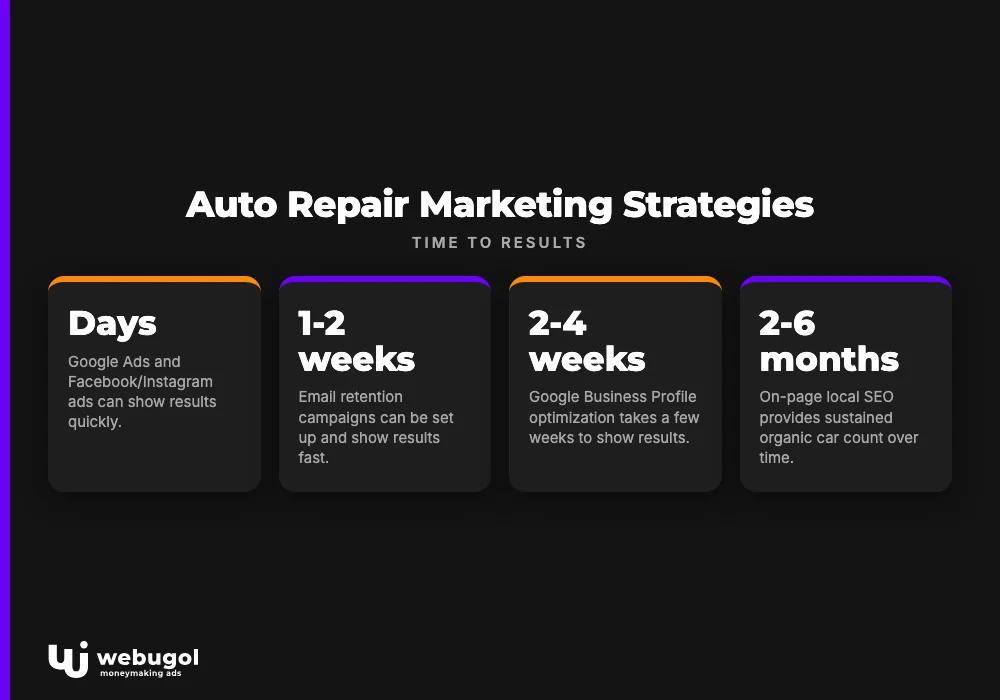
The strategies below build that two-part system. Some take weeks to show results; others pay off in days. Knowing which is which helps you sequence spending.
| Channel | Time to results | Primary use |
|---|---|---|
| Google Business Profile optimization | 2-4 weeks | Local three-pack visibility |
| On-page local SEO | 2-6 months | Sustained organic car count |
| Google Ads (search and LSA) | Days | High-intent "near me" traffic |
| Facebook and Instagram ads | Days to weeks | Awareness and retargeting |
| Email retention campaigns | 1-2 weeks setup | Repeat visits, declined-job recovery |
| Referral program | Ongoing | Word-of-mouth at low acquisition cost |
Build local search visibility before scaling ad spend. Paid traffic sent to a weak online presence wastes every dollar.
What is local SEO for auto repair shops?
Local SEO for auto repair shops is the practice of making your business appear when nearby drivers search for terms like "brake repair near me" or "oil change [city name]." It costs nothing per click and compounds month over month, making it the highest-ROI channel for most independent mechanics.
Auto shop local SEO runs on three signals: your Google Business Profile, your website's location-specific content, and the consistency of your business name, address, and phone number across the web.
The website is the foundation of all three. A slow or poorly converting site limits what local SEO can deliver, regardless of how well the GBP or citation profiles are maintained.
Google Business Profile
Your Google Business Profile (GBP) is the most important listing you control. Keep it complete: accurate hours, every relevant service category selected, photos of the shop interior and completed work, and a consistent NAP (name, address, phone) that matches your website exactly. Any discrepancy between the two reduces your ranking potential.
Reviews drive local rankings. After each service, send customers a text or email with a direct link to your Google review page. Responding to every review, positive or negative, signals to Google that the business is active. Every response counts. Prospective customers read how you handle complaints just as closely as they read the complaints.
Location pages and on-page signals
Your website needs location-specific content if you serve more than one neighborhood or city. Each page targets one location with its own headline, service description, and embedded map. Even single-location shops gain from mentioning their city and surrounding neighborhoods in page titles, headings, and body text.
Schema markup for LocalBusiness and AutoRepair types helps search engines confirm what your shop does and where. Most CMS platforms support schema via plugins. Get it in place and you gain a persistent edge over shops that skip it.
Blog content extends your local reach further. Posts on topics like "how often to rotate tires in [city]" or "what causes check engine lights in [local climate conditions]" attract area residents at the awareness stage and build topical authority over time.
Citation management
Beyond GBP and your website, citations across local directories reinforce NAP consistency. Yelp, Yellow Pages, and local chamber directories are common sources. Any inconsistency across these weakens your local ranking signals. A citation audit every six months keeps errors from accumulating and your auto repair marketing presence clean across the web.
How to attract more customers to an auto repair shop?
Attracting new customers requires being visible at the moment they need you. Organic search handles the passive, always-on side. Paid advertising fills the gap when you need faster results or want to target a specific segment right now. Structuring auto repair marketing around both ensures you capture demand whether a customer searches on Google today or responds to an ad next week.
Google Ads for mechanics
Search ads for auto repair target high-intent queries: "transmission repair near me," "cheap oil change [city]," "brake pad replacement cost." These are drivers who have already decided they need work done. The ad puts your shop in front of them before they click a competitor's organic listing.
Google Local Services Ads (LSAs) go further. They appear above standard paid results, show a "Google Guaranteed" badge, and charge per lead rather than per click. For shops without an established organic presence, LSAs generate verified phone calls faster than any other channel. Understanding how paid search drives results for local service businesses helps set realistic expectations before you scale spend.
For a mechanic shop, the right campaign targets a 10-20 mile radius, filters out DIY searches with negative keywords, and runs call extensions so customers can reach you without visiting the site first. Set conversion tracking before you spend. Without it, your campaign optimizes for clicks that may never turn into paying customers.
Facebook and Instagram ads
Social ads work differently from search. Drivers are not actively looking when they see your ad, so the creative needs to earn attention. Before-and-after repair photos, short diagnostic videos, and seasonal service reminders (pre-winter tire checks, summer AC service) outperform generic brand graphics.
Retargeting shows the highest return for auto repair social ads. Install Facebook Pixel on your website and serve follow-up ads to anyone who visited your booking page but did not schedule. This audience already knows your shop. The second impression converts at a significantly lower cost than cold traffic.
Paid social works best when layered. Start with broad local awareness ads targeting your service radius, then narrow to retargeting audiences built from website visitors and existing customer lists. The warm audience nearly always outperforms the cold one on cost per booked appointment.
Mechanic shop advertising through referrals
Referral programs generate new customers at low acquisition cost. Offer a discount to current customers who refer a friend. The cost per acquired customer typically drops well below what a click would cost.
Partnering with local driving schools, fleet managers, or car enthusiast communities adds referrals that carry social proof a paid ad cannot replicate. For genuine reach, work with local automotive content creators or neighborhood community pages rather than national accounts.
How do auto repair shops use social media to grow?
Auto repair shops that grow through social media use it for three jobs: proof, education, and connection.
Proof posts show finished work. A rusted undercarriage restored, a cracked windshield replaced, an engine bay before and after a full service. These perform well because car owners recognize the problem from their own vehicles and can picture the outcome.
Education posts build authority. A short video explaining why tire pressure drops in winter, or what the difference is between synthetic and conventional oil, positions your team as the knowledgeable local option. Customers who learn something from you are more likely to book with you than with an anonymous competitor.
Connection content builds familiarity. Team introductions and behind-the-scenes looks at a diagnostic process show the people behind the work. People bring their cars to mechanics they trust. Trust forms faster when customers feel they know the team.
The mechanics behind building a loyal local following on social media are covered in our breakdown of social media growth for service businesses: consistency and authentic content outperform ad-heavy feeds every time. Post two to three times per week, respond to every comment, and engage with other local businesses. These repair shop social media habits cost time, not ad budget, and they compound.
For auto repair specifically, posts timed for Fridays and Mondays tend to convert best. Drivers notice a problem over the weekend. A Friday reminder about seasonal services often captures the booking before the weekend makes the need urgent.
How much should an auto repair shop spend on marketing?
There is no universal figure. Budget depends on shop size, local competition, and growth stage. The allocation between channels matters as much as the total. For most shops, auto repair marketing investment shifts over time: early-stage shops spend more on acquisition, while established ones redirect more toward retention.
New shops building a customer base invest more aggressively than established ones maintaining a stable base. Awareness and first-visit trials cost more per customer than keeping someone who already trusts your work.
A practical allocation approach prioritizes channels by time-to-impact and return per dollar:
- Local SEO and GBP management gets the largest share because it builds lasting visibility that compounds every month you maintain it.
- Google search and LSA ads take the second-largest share for fast new-customer acquisition.
- Social media content and ads support brand familiarity and retargeting for website visitors who did not book.
- Email and loyalty tools return the most per dollar spent and typically require the smallest absolute investment.
Adjust the mix monthly based on booking data. If LSAs generate verified leads at an acceptable cost per acquisition, increase that share. If organic rankings improve and free traffic rises, pull back paid spend and redirect it toward retention.
Track two numbers above all else: cost per new customer acquired, and average lifetime value per customer. With both figures in hand, every reallocation becomes an investment decision rather than a guess.
Car repair customer retention: turning one-time visits into repeat business
A new customer who visits once and never returns represents lost revenue twice over: once from missed repeat business, and once from the acquisition cost that produced no long-term value. Without a retention layer, auto repair marketing only solves half the revenue problem.
Retaining an existing customer costs significantly less than acquiring a new one, and for independent shops, the retention loop is typically the highest-ROI place to invest after basic local visibility is established.
Loyalty programs for mechanics
A points-based loyalty program does not need to be complex. The simplest versions reward every dollar spent with a point and redeem points for discounts on future services. What matters is that customers have a concrete reason to return to your shop rather than try a competitor.
The milestone structure also works well for auto repair: "Get your 5th oil change at 20% off." Customers remember where they are in the sequence, which improves return rates even without an app or tracking system.
Email and SMS for follow-up
Email is the most cost-effective tool for automotive business promotion when focused on three jobs.
Service reminders. A 3,000-mile or 6-month follow-up based on the last visit date keeps your shop top of mind before the need becomes urgent. Timing these correctly requires storing basic service history in your shop management software.
Declined job follow-ups. When a customer declines a recommended repair, a follow-up at 30 and 60 days keeps that job in their consideration. These are the highest-converting leads in your existing customer base because the need already exists. The customer just needs a reason to act now.
Reactivation messages. Customers who have not visited in 12 or more months often respond to a simple "we miss your car" message paired with a small discount. These car repair customer retention campaigns cost almost nothing and reliably recover revenue from dormant relationships.
Reputation management as a retention tool
Your online reputation directly affects whether a satisfied customer recommends your shop or stays quiet. After each positive service interaction, ask for a review within 24 hours. Provide the direct link in a text. Requests sent within a day of the visit convert at a higher rate than ones sent days later.
Respond to every negative review publicly. Acknowledge the problem, offer a resolution, and move the conversation offline. Prospective customers read how you handle complaints just as closely as they read the complaints themselves.
Shops with higher average star ratings also rank better in local search results. Reputation management is not just a customer service function. It directly affects your organic visibility. Every review you earn is both a trust signal to prospective customers and a ranking signal to Google.
These garage marketing tips apply whether your shop has two bays or twenty. Reputation management, follow-up sequences, and loyalty offers scale with volume. The approach stays the same.

Ready to build an auto repair marketing system that fills your bays?
Auto repair marketing works when the parts connect: local search brings in new drivers, a credible online presence converts them into first-time customers, and a retention system brings them back. Without the connection between these layers, you are running tactics, not a growth system.
All these channels drive traffic somewhere. If that destination is a slow or poorly converting site, the marketing system leaks. Webugol builds the website and the growth system together.
If your shop's growth has plateaued despite consistent effort, the gap is usually structural, not tactical. Talk to Webugol about what a full-funnel approach looks like for your market and your car count goals.
FAQ
How to attract more customers to an auto repair shop?
Optimize your Google Business Profile with complete service categories, accurate hours, and regular photo updates. Run Google Local Services Ads to appear above organic results for high-intent searches. After each service visit, send customers a direct link to your Google review page so your rating builds authority in local rankings.
What marketing strategies work best for auto repair shops?
Local SEO and Google Ads produce the most consistent results for independent shops. Local SEO builds lasting visibility at no cost per click; search and Local Services Ads deliver fast results for high-intent buyers. Pairing both with an email retention program and a loyalty offer maximizes the value of every customer you bring in. Consistent auto repair marketing across all channels produces compounding results rather than isolated spikes.
How much should an auto repair shop spend on marketing?
Budget depends on growth stage and local competition. New shops building visibility invest a larger share of revenue than established shops focused on retention. Prioritize local SEO and paid search first, then add social content and email tools as your customer base grows.
How do auto repair shops use social media to grow?
The most effective approach rotates between proof posts (before-and-after repairs), educational content (maintenance tips, common warning signs), and connection posts (team introductions, behind-the-scenes content). Posting two to three times per week and responding to every comment builds the local trust that converts followers into booked appointments.
What is local SEO for auto repair shops?
Local SEO for auto repair shops is the process of optimizing your Google Business Profile, website, and online citations so your shop appears when nearby drivers search for repair services. It includes keyword-targeted location pages, schema markup, review generation, and consistent name, address, and phone information across all directories.

