



How long does it take to rank on Google Maps? Your new clinic's real timeline
The question every clinic owner asks after a quiet grand-opening week: how long does it take to rank on Google Maps, and why is it not working yet? A new location with no GBP history typically enters the local 3-pack within 6–10 weeks, and that range is almost entirely determined by what happens in the first seven days after verification, not by ad spend. The grand-opening budget commonly runs before the Google Business Profile is verified, before the first reviews are seeded, before the launch sequence is in the correct order. The broken sequence, not the ad account, is why the phone goes quiet in week two.
The honest answer, and why "how long?" is the wrong starting point
The question most clinic owners ask after a quiet opening week is "why isn't the ad account working?" The correct question is: did the launch sequence run in the right order?
A grand-opening paid budget cannot create local pack visibility. It can drive traffic to a verified, complete, review-rich listing, or it can burn through its budget against a GBP that Google does not yet trust. Those two outcomes look identical inside the ad account dashboard and very different on the phone.
The diagnostic runs backward from the symptom. Phone quiet in week two. Why? Because calls from the local pack require local pack placement. Local pack placement requires a verified, complete profile with an initial review base. If the GBP was claimed on launch day, verification arrived in week two or three, after paid traffic was already running against an unverified listing.
The pattern Webugol sees across telehealth and clinic launches is consistent: the launch-day playbook borrowed from the first clinic assumes verification, reviews, and tracking are already in place, and they never are. This is the same structural weakness that stalls a mature network's second or third location, not just a first-time operator.
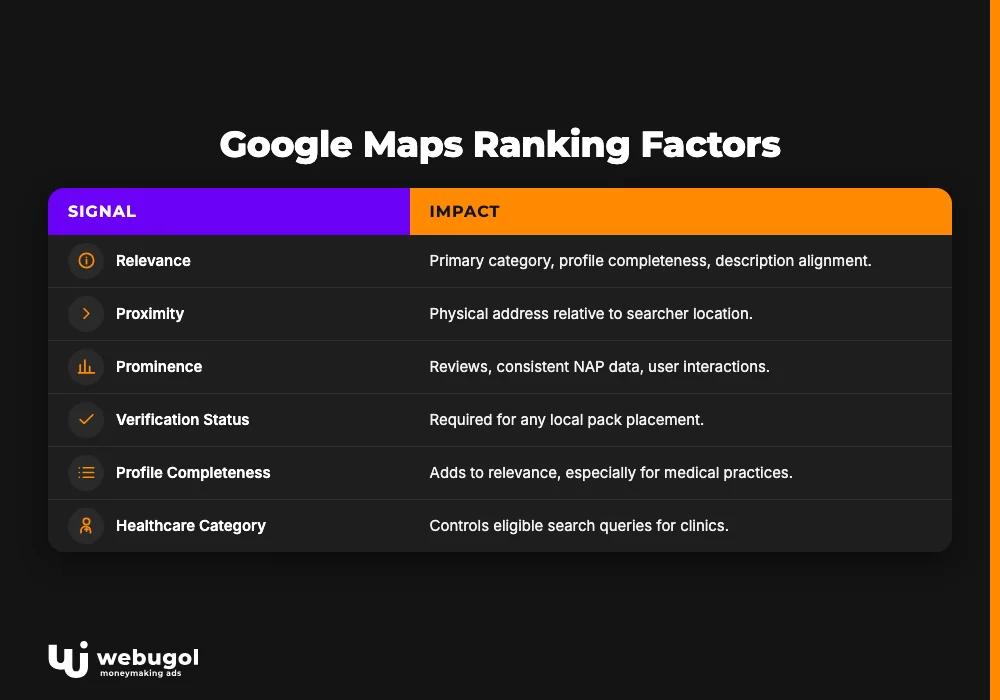
What drives your Google Maps ranking timeline
Google's local pack algorithm weights three signals: relevance, proximity, and prominence. For a new clinic, proximity is fixed and relevance is addressable in 48 hours. Prominence takes weeks to build.
- Relevance is determined by the primary GBP category, the completeness of profile fields, and whether the description aligns with the search query. Selecting the wrong primary category excludes the listing from entire query types regardless of location or reviews.
- Proximity reflects the physical address relative to the searcher. Accurate service area configuration matters for multi-location networks.
- Prominence accumulates through reviews, consistent name-address-phone data across citation directories, and behavioral signals from users who find and interact with the listing.
- Verification status is a gate. No local pack placement is possible until Google confirms the listing.
Profile completeness and healthcare category rules
Healthcare GBP listings carry additional verification requirements that generic local SEO guides skip. Selecting the correct primary category is the highest-stakes setup decision because it controls which search queries the listing is eligible to appear for. A clinic that selects "Medical Clinic" when "Weight Loss Center" or "Men's Health Clinic" is the accurate category will not rank for the searches that drive booked appointments.
Every profile field Google surfaces for medical practices adds to the relevance signal: services, hours, appointment links, insurance information, photos. Treatment-outcome language in the description can trigger compliance flags or category reclassification, so description copy requires legal or compliance review before it goes live.
Review velocity: what healthcare practices can and cannot do
Review count and recency are confirmed local pack ranking signals, and new locations start from zero. The compliant approach is to ask every patient at checkout and follow up after the visit, without filtering by satisfaction level before making the ask. Review gating, meaning asking only satisfied patients or suppressing negative feedback, violates both Google's review policies and FTC guidelines for healthcare.
New clinics should plan for a gradual review accumulation over the first 60 days. The specific rate depends on patient volume and ask consistency. The goal is a consistent upward trend, not a spike.
| Clinic type | Expected timeline to local pack | Key levers | What to measure at each stage |
|---|---|---|---|
| New clinic, no GBP history | 6–10 weeks | Verification speed, profile completeness, review accumulation, citation seeding | Verification confirmed; profile fields complete; review count vs. local competitors |
| Existing clinic, underoptimized | 3–6 weeks | Category correction, review response, NAP consistency | Pack position movement; call volume from GBP |
| New location in existing network | 8–12 weeks per new listing | Per-listing verification, isolated review strategy, launch sequence timing | Verification date; review count; first pack appearance |
How long does it take for a new medical clinic to rank on Google Maps?
A brand-new clinic with zero GBP history reaches the local 3-pack in 6–10 weeks when the launch sequence is executed correctly from day one. The range widens based on how quickly each step is completed. Market competition level is secondary to sequence discipline.
New clinic with no GBP history
A cold-start location has no reviews, no citation history, and no behavioral signals. The sequence that compresses the timeline:
Day 1: submit the GBP claim. The verification postcard takes 5–14 business days. That clock starts on day one, not on launch week.
Within 48 hours of verification: complete every profile field, add photos, configure the appointment link, and set accurate hours. An incomplete profile delays ranking even after verification is confirmed.
Week one: start the compliant review request process before the second patient visit, not after the first thirty. Review velocity in week two depends on the ask rate in week one.
Parallel: seed citations across the top directories with consistent NAP data. Inconsistent name-address-phone data across directories weakens the prominence signal.
Operators planning a multi-location rollout will find that the pre-launch operational sequence for a second clinic covers the GBP and marketing infrastructure that needs to be in place before launch day, including the go/no-go criteria before paid traffic starts.
Existing clinic with an underoptimized profile
A practice that has operated for 12 months or longer but ranks poorly faces a shorter correction timeline, typically 3–6 weeks to measurable pack movement, because verification is complete and some behavioral history already exists.
The highest-leverage corrections, in order: fix the primary category if it is wrong, respond to every unanswered review, audit NAP data across citation directories for inconsistencies, and add or update photos. These four changes address the majority of underperformance cases without any new paid spend.
Adding a new location to an existing network
Each new GBP listing starts its ranking clock from zero. The parent brand's prominence does not transfer to a new location. This is the most common misconception in multi-location rollouts, and it explains why a network's second or third clinic underperforms the first for 60–90 days even with matching ad spend.
The correct sequencing: submit the new listing's GBP claim at least 30 days before the grand opening, complete the profile before the opening date, and configure call tracking before any paid traffic goes live. The paid budget should follow GBP readiness, not precede it.
Why isn't my clinic showing in the Google Maps local pack?
When clinic owners still find themselves asking 'how long does it take to rank on Google Maps' after a quiet opening week, the most common reason a newly launched clinic does not appear in the local pack is not competition level or low ad spend. It is an unverified or miscategorized GBP combined with a review count below the competitive threshold in that market.
Five healthcare-specific blockers that delay local pack entry:
- Unverified GBP: the listing exists but the postcard was not actioned, so Google withholds local pack placement entirely.
- Miscategorized listing: the wrong primary category makes the listing ineligible for the searches that drive patient calls, regardless of review count.
- Review count below local threshold: the competitive minimum is not a fixed number; it is relative to the top-ranked competitors in that zip code.
- NAP inconsistency: conflicting name, address, or phone data across citation directories weakens the prominence signal Google uses to validate the listing.
- Compliance-restricted description: treatment-outcome language can trigger a category review flag and delay or suspend indexing.
Fixing these in sequence, verification first, category and profile second, reviews and citations third, produces ranking movement.
Does Google Maps ranking actually drive new patient appointments?
Ranking in the local pack drives calls and direction requests. Whether those convert to booked appointments depends on call tracking, intake speed, and show rate. None of those live inside Google Maps.
The pattern across telehealth and clinic engagements at Webugol: ranking improvements produce measurable call volume increases, but revenue stays flat because the attribution chain from call to booked consult to show to revenue was never connected. The clinic measures ranking and concludes the channel is not working. The channel is working. The intake is not.
Before scaling local visibility, confirm that calls from Google Maps are tagged in call tracking, routed to a staffed line during business hours, and attributed to booked appointments in the CRM. Without that chain, ranking data is a performance number with no revenue connection.
The gap between map visibility and booked patient consults is exactly where most clinic growth stalls after a successful GBP launch, and the adjacent guide covers the intake velocity benchmarks that separate ranking gains from revenue gains.
Your first 30 days: the launch sequence that prevents week-2 silence
If your new location is already past grand-opening week and the phone is quiet, a Healthcare Growth System audit identifies exactly where the sequence broke before the next budget cycle runs.
The correct launch sequence, in order:
- Day 1: Submit the GBP claim. Verification takes 5–14 business days. This is the first step, not a parallel task.
- Days 1–2: Configure call tracking with a tracking number on the GBP listing and the website. Paid traffic without call tracking produces unattributable spend.
- Days 1–3: Set up the compliant review request process, in-office ask at checkout or post-visit follow-up, before the first patients are seen.
- Within 48 hours of verification: Complete every GBP profile field: services, photos, hours, appointment link, insurance information.
- Weeks 1–2 (parallel): Seed citations across the top 15–20 directories with consistent NAP data.
- Go/no-go for paid traffic: Profile complete, verification confirmed, call tracking live, and review count at or above the local competitive minimum. Only then start the paid campaign.
The trigger for paid ads is GBP readiness. Not the opening date.
Understanding how patients move from that first search impression through intake to a kept appointment is a separate diagnostic from GBP ranking work. Mapping the acquisition path from first search click to show rate connects the launch-sequence decisions above to the downstream conversion rates that determine whether ranking translates to revenue.
Stop guessing at timelines: get a diagnosis before the next grand opening
If your new location is past grand-opening week and the phone is quiet, the problem is almost certainly in the launch sequence, not the ad account. Webugol's Healthcare Growth System starts with a full audit of GBP readiness, tracking configuration, and funnel sequencing before a single dollar moves in paid media. Book a strategy call to identify what broke before you spend the next week's budget repeating the same sequence.
FAQ
How long does it take for a new medical clinic to rank on Google Maps?
A brand-new clinic with no GBP history typically enters the local 3-pack within 6–10 weeks when the launch sequence is correct: verification submitted day 1, profile complete within 48 hours, and reviews accumulating at a compliant pace from week 1. Existing clinics with underoptimized profiles typically see pack movement in 3–6 weeks after addressing category, review, and citation gaps.
How long after adding a new clinic location will it appear on Google Maps?
The GBP verification postcard arrives in 5–14 business days after the listing is claimed. The location becomes eligible for local pack ranking once verified, but competitive placement typically requires an additional 4–8 weeks of review accumulation and profile completeness signals, because the parent brand's authority does not transfer to the new listing.
Why isn't my clinic showing in the Google Maps local pack?
The most common causes are an unverified or miscategorized GBP, a review count below the competitive threshold for that market, and inconsistent NAP data across citation directories. Fixing these in sequence, verification first, category and profile second, reviews and citations third, is what produces ranking movement.
Can you speed up Google Maps ranking for a healthcare practice?
The timeline compresses when the launch sequence is executed in the correct order from day 1: GBP claim and verification first, profile completion second, compliant review requests third, paid traffic last. Launching paid campaigns before the profile is verified does not speed up the timeline, because ad spend has no effect on organic local pack signals.
Does Google Maps ranking actually bring in new patient calls?
Local pack placement drives measurable increases in calls and direction requests, but converting those to booked appointments depends on call tracking, a staffed intake line, and speed-to-lead, none of which are inside the Google Maps channel. Clinics that rank but do not see revenue gains almost always have a gap in attribution or intake, not in the channel itself.

