



Why location 2 is not a copy of location 1: the launch system you still need to build
When a clinic owner starts opening a second business location expecting location 1 results at the same budget ratio, they are betting on conditions that no longer exist. Location 1's patient volume was built on 12 to 24 months of local search equity, GBP authority, and referral accumulation. Location 2 starts at zero in a different zip code, with no GBP ranking, no reviews, and no trained ad algorithm. The playbook was never written down because the first launch did not need one.
For clinic operators, each new address is a new local market with its own patient search intent, insurance referral patterns, and GBP ranking signals. What worked at location 1 does not transfer until it is extracted, documented, and rebuilt for the new zip code.
Why location 1's results don't transfer: a pre-launch post-mortem
Month-12 performance at location 1 reflects 18 months of accumulated demand: local search equity, branded search from patient retention and repeat visits, and a referral flywheel that grew without documentation. When you replicate the budget ratio for opening a second location for your business, you fund a sprint on a track that required a marathon to warm up.
What location 1 had at month 12 that location 2 starts without on day 1:
- A GBP with 50-plus reviews and an established local pack ranking
- Branded search volume from repeat patients and word-of-mouth referrals
- An ad account with six or more months of conversion data and audience signals
- A CRM pipeline with warm leads and win-back segments
- Staff who run intake without a written SOP because they learned it on the job
How do I know if I'm ready to open a second business location?
You are ready when location 1's core metrics have been stable for two full quarters without your direct involvement in daily ops. Readiness is specific numbers, not a feeling.
The revenue stability threshold
Five metrics that must hold before you sign a lease:
- CPA stable over six consecutive months without a deteriorating trend
- Show rate and intake close rate consistent across all staff members
- Paid campaigns generating consistent returns without weekly owner correction
- A written SOP covering intake, follow-up, and no-show recovery at location 1
- Revenue growing without the owner as the daily decision point
Operations that run without you
The delegation test: can location 1 run for two weeks without you as the integration layer between marketing, intake, and ops? If your patient acquisition system still depends on you to manage it daily, location 2 will split your attention and slow both locations. Staff handle routine campaign adjustments, CRM sequences run automatically, and reporting is reviewed by team, not owner.
How to read local demand before you sign the lease
Every competitor article says "assess market demand." None explains how. Four demand signals that matter for healthcare operators:
- Local search volume for your service category in the target zip code, checked in Google Keyword Planner
- GBP competitor density: how many established providers have 50-plus reviews within three miles
- Insurance referral network overlap and in-network coverage strength at the new address
- Review gap signal: low-review-count providers with average ratings below 4.2 often indicate an underserved or under-marketed area
What costs more than you expect when opening a second business location
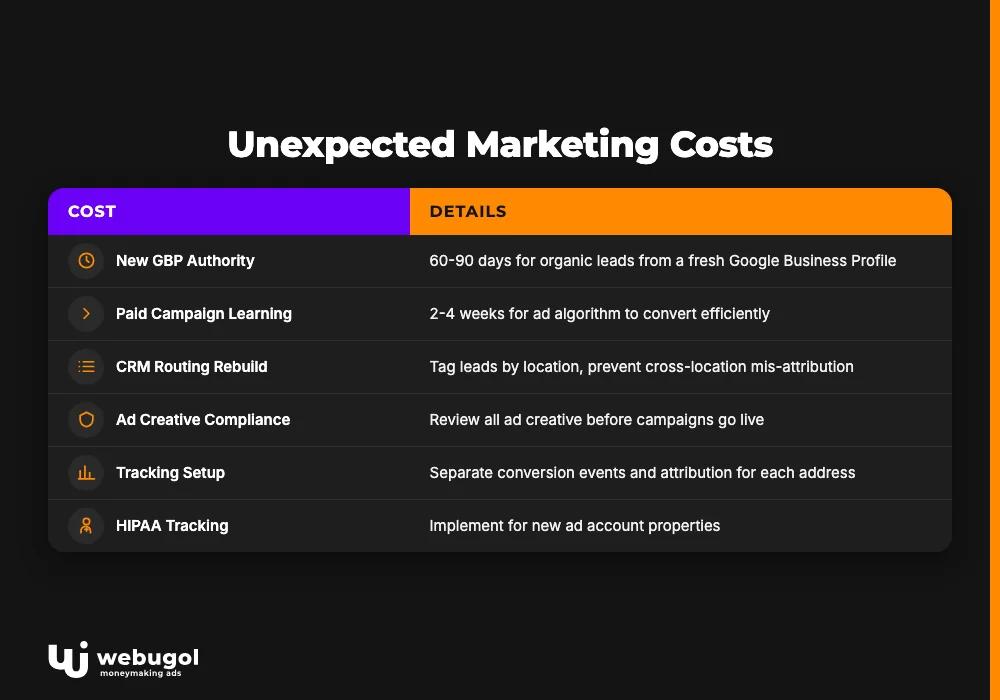
Hidden marketing ops costs that every guide on opening a second location small business skips:
- A fresh GBP with zero authority that needs 60 to 90 days before generating organic leads
- A paid campaign learning period of two to four weeks before the ad algorithm converts efficiently
- CRM routing rebuild to tag leads by location and prevent cross-location mis-attribution
- Compliance review for all ad creative before any campaign goes live at the new address
- Tracking setup from scratch: separate conversion events and attribution for each address
- HIPAA-compliant tracking implementation for new ad account properties
- State-level telehealth licensing review if the new address crosses a coverage boundary
If you are running a healthcare practice and planning a second location, the pre-launch acquisition program for multi-location clinics is built for this transition: tracking, campaigns, and intake ops designed as one system before you sign the lease.

How do I market a new business location before it opens?
Start Google Business Profile setup 90 days before opening, not on opening day. The operators who consistently get more patients from a new location treat those 90 days as a revenue decision, not a signage decision.
GBP timing: why the window opens 90 days out
GBP verification takes two to four weeks. Review accumulation and local pack ranking signals take 60 or more days to register meaningful authority. Steps in sequence: submit verification 90 days before opening, complete all profile fields including categories and service areas, run a citation consistency audit within two weeks, and request reviews from first patients within 48 hours of their appointment.
Running paid campaigns for location 2 without cannibalizing location 1
Shared campaigns and overlapping geo-targeting blend attribution data and inflate CPA for both locations. Build separate campaigns with location-only geo-targeting, create separate conversion actions for each location's booking funnel, exclude the new location's radius from location 1's existing campaigns, configure HIPAA-compliant tracking before the first campaign goes live, and budget for a 30-day learning period where conversion volume is the goal, not CPA.
What changes in your tracking and CRM when you add a second location
The section no competitor covers. Opening a second business location creates a tracking challenge most guides skip: when both locations share one CRM pipeline built for a single address, leads get mis-tagged and paid attribution blends two distinct markets into one optimization signal. The fix requires location-specific UTM parameters, separate conversion actions in every ad platform, and a routing rule that assigns leads by location at the point of form submission. Without that rebuild before launch, the first month of data is structurally unusable for spend decisions.
How long does it take to open a second business location?
Plan 10 to 12 weeks of pre-launch work before opening day, then 90 days to reach marketing equilibrium.
- Weeks 1 to 4: GBP verification, citation audit, compliance review, and tracking setup
- Weeks 5 to 10: awareness campaigns live and CRM routing tested end to end
- Day 30: tracking confirmed accurate and CPA benchmarks set for the new address
- Day 90: paid campaigns exit the learning phase and intake volume reaches steady state

3 mistakes that kill location 2 before it finds its footing
These are the structural errors most operators make when opening a second business location, long before the new address finds its footing.
1. Launching paid campaigns on or after opening day. Cold audiences and zero GBP authority produce high CPAs for two to four weeks minimum. Start campaigns four to six weeks before the target opening date so the algorithm has conversion data before you need patient volume.
2. Running one CRM pipeline for both locations without location-level routing or lead source tagging. When you cannot isolate location 2's cost per booking from location 1's, you cannot make accurate spend decisions for either location.
3. Benchmarking month-1 CPA at location 2 against location 1's current CPA instead of location 1's day-30 CPA. Location 1's current CPA reflects years of optimization. That comparison triggers premature budget cuts that prevent location 2 from ever building the data foundation it needs.
Stop building location 2 on a foundation that was never documented
Opening a second business location without a documented playbook means rebuilding first-location knowledge under time pressure. The work that made location 1 succeed needs to be extracted, documented, and rebuilt for a new local market before the lease locks you into a timeline. That means tracking infrastructure, campaign structure, and intake ops designed as a system before the doors open, not patched together after the first month of underperformance.
Webugol partners with clinic owners and marketing leads through this transition. The Healthcare Growth System is built for the moment when location 1 is proven and you need a partner who owns the revenue path from ad click to booked appointment across both addresses. Book a strategy call before you sign.
FAQ
How do I know if I'm ready to open a second business location?
You are ready when location 1's core marketing metrics, including CPA, show rate, and intake close rate, have been stable for at least two full quarters and operations run without you as the daily integration layer. Expanding before that stability exists means two locations compete for your attention and neither performs at its potential.
What is the biggest marketing mistake when opening a second location?
Starting paid advertising on or after opening day with no GBP authority and cold ad audiences. Build the GBP 90 days out, run awareness campaigns before opening, and treat the first 30 days of ads as a learning period with tracking that is completely separate from location 1.
Why does location 2 almost always have a higher CPA than location 1?
Location 1's lower CPA reflects 12 to 24 months of local search equity, GBP ranking, and referral volume that location 2 starts without. The CPA gap typically closes over six to nine months as the new address builds local authority, not from adjusting the ad budget ratio alone.
How far in advance should I start marketing a new business location?
Start Google Business Profile setup and local citation cleanup 90 days before opening. Begin paid campaigns four to six weeks before the opening date so the algorithm has a learning period before you need patient volume. Opening-day campaigns with no prior data perform poorly across every location type.
Do I need a separate legal entity for a second business location?
Requirements vary by state and business structure, so consult your attorney and accountant before deciding. Most multi-location operators use a single LLC with a DBA for each address, but liability exposure, state tax rules, and insurance requirements differ by state. This is not legal advice.

