



What kind of help do startups really need? (Complete guide)
The right resources to help startups succeed cover six interconnected areas: product development, marketing, HR, legal, PR, and finance. The right combination depends entirely on your stage. Pre-revenue founders need tech and legal first; seed-stage teams layer in marketing and HR; scaling companies add PR and financial infrastructure. As a development and growth studio that builds products and the systems to grow them, Webugol gives founders one engagement that covers both build and scale, with no technical co-founder required.
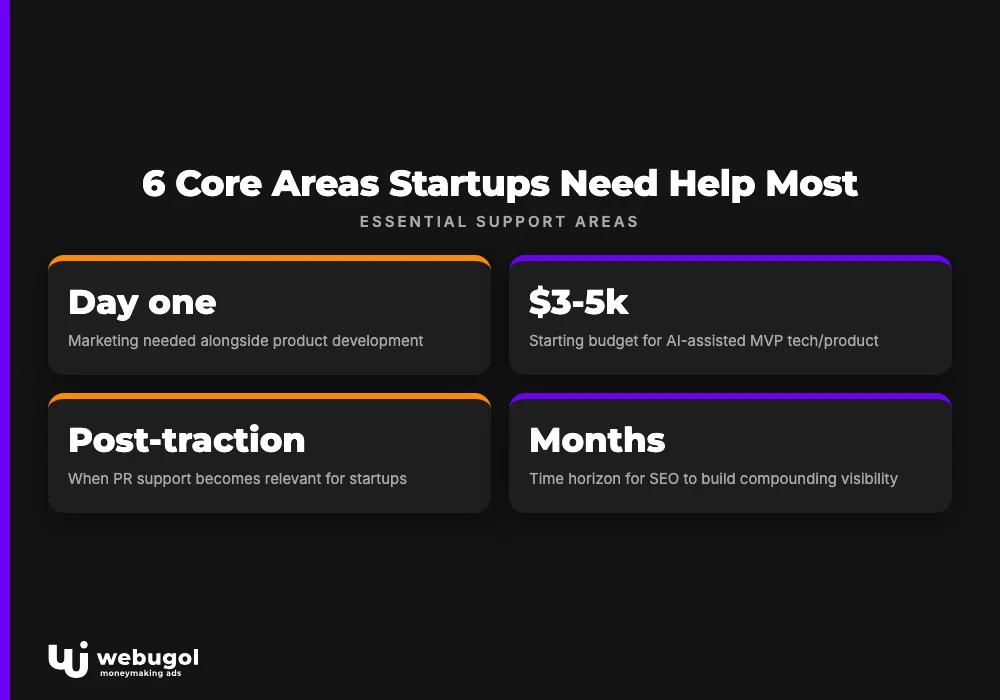
The 6 core areas where startups need help most
Buying support from six separate vendors creates coordination overhead that compounds quickly. Whether you are evaluating your first vendor or already have a freelance developer, a legal firm, and a marketing agency that never talk to each other, the structural gap is the same: a product that does not grow on its own and a marketing function that was bolted on too late.
Understanding the full taxonomy upfront helps you decide what to prioritize, what to bundle, and what to defer. Getting the sequencing right builds a system that compounds; getting it wrong builds a stack you will spend the next year retrofitting.
| Type of help | When you need it | Budget notes | What to look for |
|---|---|---|---|
| Marketing | Day one, alongside product | Scales with channel mix | Early-stage SEO and content track record |
| HR | From first hire onward | Per-seat SaaS platforms available | Remote and contractor compliance experience |
| Legal | Before any funding round | Fixed-fee startup services available | Startup-specific attorneys only |
| Tech / product | Pre-seed through seed | From $3-5k (AI-assisted MVP) | Full-stack with post-launch support |
| PR | Post-traction, not day one | Project-based or monthly retainer | Earned media and investor narrative experience |
| Finance | Seed stage and beyond | Neobank and SaaS tools widely available | Banking, liquidity visibility, expense management |
Marketing help for startups
Finding the right channels to help startups grow at the early stage comes down to three options: SEO, paid acquisition, and content. Each has a different time horizon. SEO builds compounding visibility over months. Paid channels deliver immediate traffic but stop the moment budget does. Content builds authority that outlasts any single campaign.
The window to establish organic rankings is widest in a category's early growth phase, which is exactly when most pre-seed founders are still building the product. Building marketing infrastructure from day one, specifically SEO-ready architecture, structured conversion flows, and a content plan, compounds faster than retrofitting it after launch.
When development and marketing are planned together, every product decision reinforces growth rather than just functionality. The retrofit costs both time and budget that early-stage companies cannot spare.
HR help for startups
HR help for startups concentrates first on the employee vs. contractor decision, which involves payroll taxes, equity, benefits, and legal exposure that differ significantly by state. Getting this wrong costs money and sometimes triggers compliance issues that take months to unwind. Misclassifying a contractor as an employee retroactively can trigger back payroll taxes, benefit contributions, and penalties that dwarf the original savings.
Platforms like Rippling help startups stay lean by handling payroll, benefits, and compliance from a single interface without a dedicated HR department. For founders who ask "can Atlas HXM help startups with remote teams?", the answer is yes: the platform manages employment compliance across jurisdictions, which is the structure most early-stage companies need before they can sustain a full people-ops function.
The goal at the pre-seed stage is not to build HR infrastructure. The goal is to make compliant first hires without slowing the product down.
Legal help for startups
Legal help for startups concentrates on four high-priority areas before seed funding: entity formation, IP protection, founder agreements, and terms of service. Getting the entity structure wrong early, mixing personal and business IP or choosing the wrong equity instrument, creates problems that require expensive counsel to untangle later.
The good news is that affordable legal services now help startups at the formation stage without full-retainer costs. Fixed-fee startup attorneys and specialized online legal services bring the highest-priority items into reach before funding arrives.
Avoid using a generalist attorney for early-stage startup legal work. Generalist counsel typically lacks the pattern recognition on cap tables, SAFE notes, and equity structures that pre-seed companies need most.
Tech and product development
Non-technical founders stall here more than anywhere else. The three options are in-house hiring, freelancers, and a development agency, each with a different risk profile. Hiring brings long ramp time and fixed cost before you know if the product works.
Freelancers move fast but leave coordination gaps when scopes expand or integrations become complex. Bundled development exists to help startups compete from day one without a technical co-founder, giving founders both a working product and the marketing foundation to grow it in a single engagement.
The build decision matters more than most founders realize. A product launched without SEO-ready architecture and conversion infrastructure is significantly harder and costlier to retrofit. The build-launch-figure-out-marketing-later pattern is the structural weakness that holds companies back well past initial launch, and it is exactly the gap that bundled development eliminates.
PR help for startups
Strategic PR can help startups raise their profile with investors and customers, but timing is the determining factor. PR before traction creates noise with nothing to amplify. PR after demonstrable traction, real users, real revenue, or a credible partnership, earns coverage that compounds.
An early-stage PR strategy does not require a full agency. Founder thought leadership in targeted publications, a few strategic media relationships in your vertical, and a clear company narrative are the foundation.
How PR helps startups raise venture capital works like this: investors encounter your name in relevant publications before the formal pitch, which reduces the credibility gap that cold outreach never fully closes. When founders ask "what AI-driven tools help VCs identify startups," the answer is platforms already embedded in standard dealflow processes. Relatedly, "which AI agents help VCs discover startups" points to automated screening tools that rank companies by signal strength before any human review, your company's digital footprint affects discoverability before you send a single cold email.
Finance and funding support
Finance support for early-stage companies breaks into three layers. First is banking: selecting the right account structure matters, particularly for specialized companies such as biotech startups, where the question "which banks help biotech startups manage expenses" has a real answer: banking partners that handle both account structure and the compliance requirements those sectors carry.
Second is liquidity: "What tools help manage liquidity in startups?", the answer is platforms that give founders real-time runway data without manual spreadsheet work. Third is funding structure: understanding the difference between inventory financing lenders who help startups bridge cash flow gaps and equity raises for SaaS companies scaling GTM helps founders choose the right capital source for their stage.
Finance infrastructure is not one-size-fits-all. "What investors help SaaS startups scale GTM?" looks different from what banking structure fits a pre-revenue hardware company.
What stage are you at? Match the right help to your startup phase
Pre-revenue founders need legal setup and a working product first; seed-stage founders add marketing and HR; scaling companies add PR and finance infrastructure. Each phase has a different leverage point, and spending out of sequence burns capital without compounding results.
Pre-revenue priorities:
- Entity formation and founder agreements (legal)
- MVP or functional prototype (tech/product)
- Basic content and landing page (marketing, minimal investment)
Seed-stage priorities:
- SEO and paid acquisition strategy (marketing)
- First hires and HR platform setup
- CRM adoption, "can CRM help startups in customer retention?", yes, the systems pay off from the first paying customers forward
- PR groundwork: founder presence and company narrative
Scaling priorities:
- Earned media and investor PR
- Finance infrastructure: banking, liquidity tools, funding structures
- Operations platforms for inventory-heavy businesses, including platforms like Uphance that help apparel startups scale operations across purchasing, production, and fulfillment
- Co-founder and strategic advisor search, where platforms like Connectd help startups find co-founders when the founding team has capability gaps
The most common sequencing mistake is committing a marketing budget before the product has a growth-ready architecture, or investing in PR before there is traction to amplify. Pre-revenue capital is best spent on the two things that unlock everything else: a working product and a legal structure that lets you take funding.
The sequence is consistent whether you are building a software product or a service-based healthcare practice: get the legal structure right, get a working product to market, then invest in growth.
How does web development help startups grow beyond launch?
A website built as a growth system compounds over time in a way a static brochure never does. Three structural decisions separate a launch that creates a foundation from one that creates a maintenance burden.
The first is SEO-ready architecture: URL structures, page hierarchies, schema markup, and site speed that search engines can index without ongoing technical intervention. Reading about what is MVP software development at the architecture level, not just the feature level, is where this planning starts. The second is conversion infrastructure: a clear above-the-fold value proposition, a contact flow that takes fewer than three clicks, and a CMS the team can update without developer involvement. The third is flexibility: the platform absorbs new features, integrations, and content without a rebuild every eighteen months.
A site launched without these three elements will need a replatform. The cost is not just the rebuild. It is the lost organic traffic, the missed conversions, and the team hours spent on a site that creates drag where it should help startups grow beyond their initial launch footprint.

How does AI-accelerated development help startups stay lean?
AI-assisted development cuts MVP timelines and brings the entry cost to $3-5k, making a custom product accessible before seed funding arrives. This changes what founders can afford to build and test at the pre-seed stage.
In practice, AI handles boilerplate and scaffolding: standard authentication flows, database schemas, API structures, and UI components that would take a developer days now take hours. Engineers focus on architecture, custom integrations, and business logic, which is where the actual product decisions live. The result is a faster timeline without compromising the production-grade foundation a scalable product requires.
Webugol used this approach building the platform for Valhalla Vitality, a health and wellness operator that needed a client-facing product without a full internal tech team. The engagement covered product build and growth infrastructure in one scope, so the team was acquiring customers at launch rather than rebuilding their marketing foundation months later.
Building a product without a tech team? Talk to Webugol about scope and timelines for your build.
For founders building AI-native products, specifically LLM integrations, RAG pipelines, or agent architectures, AI MVP development covers those builds from architecture through production deployment.
How to choose the right startup help provider (checklist)
Most vendor comparisons skip selection criteria entirely, which means founders make vendor decisions without a structured framework. Every question on this list is one that most vendors do not raise proactively. Six criteria separate a provider that works to help startups build a real, compounding business from one that delivers a scope and exits.
- Domain expertise in your product category. A developer with prior work in your vertical brings pattern recognition that reduces your decision load and catches edge cases before they cost money. Ask to see work in categories close to yours, not just generic portfolio screenshots.
- Pricing transparency. Fixed-fee or milestone-based pricing gives founders budget certainty. Open-ended hourly billing on undefined scope transfers risk to you, and the invoices always come in higher than estimated.
- Bundled vs. point-solution scope. A single provider covering both build and growth eliminates the coordination gap between the developer who ships and the marketer who inherits whatever was built. That gap is where launch momentum dies.
- Speed-to-launch track record. Ask for specific timelines on comparable projects, not estimates. The difference between six weeks and sixteen weeks is runway, and runway is what early-stage companies run out of.
- Post-launch support model. Products need updates, bug fixes, and new features after day one. Know what ongoing support costs before the engagement starts, not after the first incident.
- Communication cadence. Weekly syncs, async updates, and a defined escalation path reduce decision lag, which is what stalls early-stage momentum more reliably than any technical problem.

Ready to go from idea to working product? Let's talk.
Webugol bundles product development and growth infrastructure in one engagement, with AI-accelerated timelines and an entry point from $3-5k. No technical co-founder required. The process starts with a scoped discovery call: you bring the idea, we map what it takes to build and grow it, and you get a clear scope and timeline before work starts.
If you want development and marketing handled in one place, the starting point is a conversation. Book a discovery call and we can scope your build in one session.
FAQ
What kind of help do startups need most?
Most early-stage startups need product development, marketing, and legal setup simultaneously. The right priority depends on stage: pre-revenue founders should nail tech and legal before spending on marketing.
Can a dev agency replace a full tech team for a startup?
Yes, for most early-stage builds. A full-stack dev agency ships an MVP faster than in-house hiring and costs less than a salaried team when you factor in recruiting, benefits, and ramp time.
How much does it cost to get help building a startup product?
AI-assisted MVP development starts at $3-5k for a focused scope; more complex products run higher depending on feature count and integrations. Bundling marketing setup into the same engagement avoids a separate procurement cycle later.
What is the difference between a startup accelerator and a development partner?
An accelerator provides mentorship, network access, and sometimes capital in exchange for equity. A development partner builds your product for a fixed fee with no equity stake, which suits founders who have a clear product scope but no technical co-founder.
How does PR help startups raise venture capital?
Strategic PR builds investor credibility before a formal pitch by placing founders in relevant media and establishing a narrative around early traction. It works best once there is real product momentum to amplify, not at the idea stage.

