



What a digital marketer does and why it matters for business
A digital marketer is a professional who uses online channels to build brand awareness, attract target audiences, and convert that attention into measurable business results. The role spans strategy, content, search, paid media, email, and analytics. Every campaign produces traceable data. Unlike a traditional marketing role, the work can be adjusted in real time based on what the numbers show.
What does a digital marketer do?
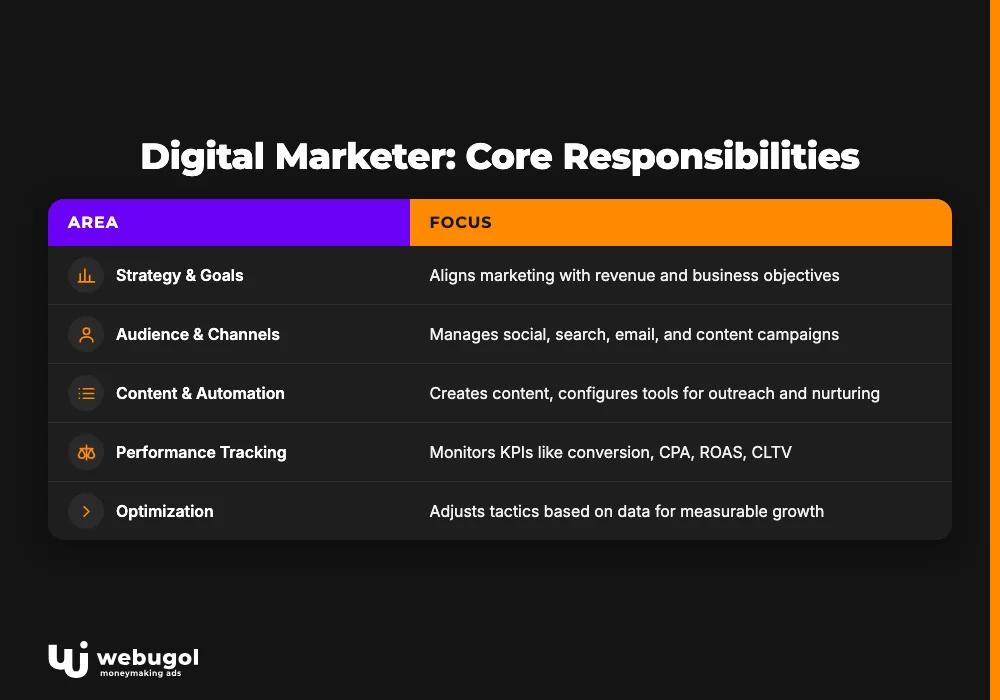
A digital marketer plans, launches, and optimizes campaigns across search, social, email, and content channels. They own the full cycle from audience research through performance reporting, adjusting tactics based on what the data shows. The goal is measurable growth, not just activity.
Core responsibilities typically include:
- Building a digital marketing strategy that aligns with revenue and business objectives
- Managing social media marketing across platforms relevant to the target audience
- Running SEO and coordinating paid search to cover the acquisition funnel
- Creating or directing content for websites, blog posts, and email sequences
- Configuring marketing automation tools to scale outreach and lead nurturing
- Tracking KPIs such as conversion rate, cost per acquisition, return on ad spend, and customer lifetime value
- Segmenting audiences and refining targeting based on behavioral and demographic data
At a small company, a single digital marketer often handles all of the above. At a larger organization, each area becomes its own specialist function. Coordination still matters. Someone needs to hold the overall approach together and ensure each channel contributes to the same outcome.
Why is digital marketing important for business growth?
Digital marketing gives businesses precise control over who sees their message, when they see it, and on which channel. That precision reduces wasted budget. It also creates a feedback loop that traditional advertising cannot replicate.
The business cases from the original article illustrate this concretely. Airbnb built a global brand by combining SEO, social media marketing, and content to connect homeowners with travelers through a platform others had not imagined. Dollar Shave Club used a viral video and a targeted approach to acquire customers at low cost, leading to a Unilever acquisition.
Neither outcome required a traditional ad budget. Both required a skilled digital marketer who understood the audience, the message, and the right channel.
Amazon's personalized recommendation engine shows how audience targeting becomes a direct revenue mechanism at scale. By analyzing each user's browsing and purchase history, the system increases purchase likelihood across millions of daily sessions. That is a quantifiable business outcome from digital marketing work, not a branding exercise.
The broader shift matters because consumers now research before they buy. They read reviews, compare products, and expect relevant content at every stage of the journey. A well-built digital marketing strategy addresses the full process, from first search through repeat purchase. For a closer look at how search and paid acquisition channels compare across the funnel, the tradeoffs between organic and paid are worth mapping early in any strategy.
Businesses that treat digital marketing as optional are not staying neutral. They are ceding ground to competitors who are not.
How does digital marketing differ from traditional marketing?
Traditional marketing uses fixed channels: print, broadcast, billboards, direct mail. Audiences are broad by design. Feedback arrives slowly, often weeks after a campaign ends, and adjustments are expensive.
Digital marketing reverses most of those constraints. A campaign can launch, run, and be modified within the same day. Budgets shift in real time. Every interaction generates traceable data. An online marketing specialist working in digital can see exactly which ad drove which conversion, which subject line outperformed, and which landing page variant produced more revenue.
The consumer side of this shift is equally significant. People now control the information flow. They search when they are ready, subscribe to sources they trust, and ignore messages that feel irrelevant. This is why inbound marketing has become a central framework for many digital teams: attract audiences through useful content rather than interrupting them with outbound messages.
The Coca-Cola "Share a Coke" campaign tracked social media mentions and user-generated content in real time to refine packaging and messaging decisions. That feedback loop does not exist in traditional media. The campaign produced measurable consumer engagement and a significant sales increase, according to the original case study. Real-time data. Immediate adjustments. Mid-flight optimization. These are capabilities that exist only in digital marketing.

What skills does a digital marketer need?
Digital marketing skills span strategy, creative work, data interpretation, and technical execution. No single practitioner is expert across all of them. But a capable digital marketer understands enough of each to lead campaigns, coordinate teams, and recognize when something is not working.
The skills that matter most:
- Digital marketing strategy and research. Every campaign starts with understanding the market: audience segments, competitor gaps, keyword demand, and channel mix. Without this foundation, campaigns generate activity but not results.
- Content creation. Writing, visual judgment, and platform fluency all matter. Content powers SEO, social media marketing, email, and inbound marketing simultaneously. It is the connective thread for most campaigns.
- Search engine optimization. SEO requires keyword research, on-page structure, technical site health, and link authority building. A digital marketer in this area needs to stay current with algorithm updates. A structured content audit often surfaces the fastest wins before investing in dedicated SEO services or launching a new content push.
- Marketing automation tools. Platforms like HubSpot, Marketo, and Mailchimp let teams run campaigns at scale without manual execution at every step. Segmentation, trigger logic, and A/B testing within these tools are now baseline operational skills.
- Data analysis. Analytics platforms translate campaign activity into decisions. KPIs like cost per lead, click-through rate, and lifetime value only matter if someone interprets them and acts. Someone who cannot read the data is running blind.
- Continuous learning. Platforms update their algorithms. Consumer behavior shifts. Someone who stops learning stops being effective.
These skills work as a system. Strategy sets direction. Content and SEO build organic reach. Automation scales communication. Data analysis closes the loop and drives the next iteration.

Work with a digital marketer focused on results
If your business needs a clearer digital marketing strategy, stronger organic search presence, or campaigns that convert rather than just accumulate impressions, contact the Webugol team to discuss your goals. We build around measurable outcomes: leads, conversions, and revenue. Get a plan built for your market and competitive position.
FAQ
What does a digital marketer actually do?
The role involves building and running campaigns across online channels including search, social media, email, and content. They track performance data, adjust strategy based on results, and work toward specific outcomes such as lead generation, brand visibility, or direct revenue growth.
What skills does a digital marketer need to succeed?
The most important digital marketing skills include strategic thinking, content creation, SEO, data analysis, and proficiency with marketing automation tools. Technical platform knowledge matters, but the ability to interpret performance data and act on it matters just as much.
How is digital marketing different from traditional marketing?
Digital marketing operates across measurable, adjustable online channels where campaigns can be modified in real time based on performance data. Traditional marketing uses fixed offline channels like print and broadcast, where audience targeting is broad and feedback arrives slowly.
What is inbound marketing and how does it relate to digital marketing?
Inbound marketing is a strategy within digital marketing focused on attracting audiences through useful content rather than outbound advertising. Someone using the inbound model creates blog posts, guides, and resources that draw people in during the research phase of their buying journey.