



Digital marketing services: a practical guide to growing online
Digital marketing services are the professional strategies businesses use to attract customers and drive revenue through online channels. The core disciplines are search engine optimization, pay-per-click advertising, and social media marketing. Each produces results on a different timeline and suits different goals. Choosing the right combination is what separates focused growth from scattered spend.
What are digital marketing services?
Digital marketing services cover every managed or paid strategy that promotes a business through digital channels: search engines, social platforms, display networks, and email. Unlike traditional advertising, each channel generates trackable data you can act on the same day.
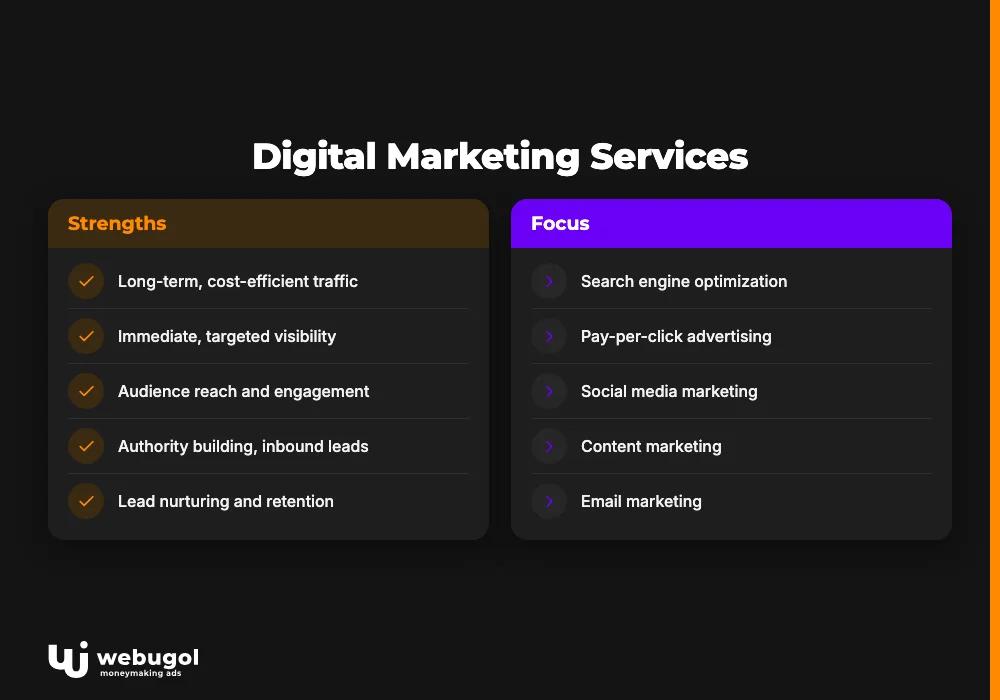
The table below outlines the six most common types and their primary strengths.
| Service | What it does | Best suited for |
|---|---|---|
| Search engine optimization | Improves unpaid rankings in search results | Long-term, cost-efficient traffic |
| Pay-per-click advertising | Buys ad placements in search and display | Immediate, targeted visibility |
| Social media marketing | Builds brand presence on social platforms | Audience reach and engagement |
| Content marketing | Creates articles, guides, and video | Authority building and inbound leads |
| Email marketing | Delivers messages directly to subscribers | Lead nurturing and retention |
| Conversion rate optimization | Improves website flow and UX | Amplifying all other channels |
Most businesses need more than one. The right combination depends on budget, competitive intensity, and whether speed or sustainability matters more right now.
Search engine optimization services: building the long-term foundation
Among all digital marketing services, search engine optimization tends to produce the most durable results over time. Professional search engine optimization services improve where a website appears in organic, unpaid search results. Higher rankings mean more clicks without a per-visit cost. For businesses focused on sustainable growth, SEO is the channel that compounds most consistently.
How organic rankings bring in targeted visitors
When a site ranks near the top of search results for a relevant query, the visitors arriving are actively looking for what the business offers. That intent is the core conversion advantage. A user who searched for a specific service and clicked an organic listing is far closer to a purchase decision than someone who encountered a display ad while browsing another site.
On-page optimization, technical improvements, and earned backlinks work together to raise a site's authority. None of this produces overnight movement. The compounding effect is real, though: a page ranking well in month six continues delivering traffic in month twenty-four without additional per-click spend.
Cost structure: why SEO pays off over time
PPC charges every click. SEO does not. The investment goes into technical fixes, content production, and link acquisition. Once rankings are established, the cost per acquired visitor drops well below what paid channels require at comparable traffic volumes.
That cost curve is why search engine optimization services attract businesses with an eighteen-month or longer planning horizon. Before content work begins, a structured site review that identifies technical and content gaps typically comes first. Site speed, crawlability, heading structure, and duplicate content all suppress rankings regardless of content quality. Addressing them early saves months of wasted effort.
Trust built by consistent ranking
Users trust high-ranking results. That pattern holds consistently across how people scan a search page. A business that ranks near the top for competitive queries appears credible to users who have never heard of the brand. Consistent rankings build familiarity over months, which reduces resistance during the sales process.
Search engines also factor in user experience signals including page load time, mobile responsiveness, and navigation clarity when setting rankings. Improving those elements benefits both rankings and conversion rates at the same time.
Competitive positioning through organic search
Some local markets have meaningful ranking gaps a well-executed SEO campaign can close within six months. National markets are more competitive and take longer. Either way, a business outranking competitors on relevant queries captures organic traffic those competitors must replace with paid advertising. That gap, once established, is difficult to close quickly without equivalent investment in search engine optimization services.
PPC advertising services: immediate reach, measurable spend
PPC advertising services place a business at the top of search results or across display networks the moment a campaign launches. Every click costs money. The advantage is complete control: budget, targeting, messaging, and timing are all adjustable in real time.
Precision targeting that reaches actual buyers
PPC lets advertisers define their audience by keyword, location, device, time of day, and demographic profile. A local service business can restrict spend to a fifteen-mile radius. A national brand can separate budgets by product line and region. This specificity is unavailable in organic SEO, where rankings determine who sees a page.
Keyword selection decides whether campaigns are profitable. Queries that signal buying intent convert at a higher rate than broad research terms. Choosing the right keywords for a PPC campaign before launch is one of the highest-leverage decisions in paid search strategy.
Get it right and the campaign pays for itself. Miss it and budget drains against traffic that was never going to convert.
Budget control and real-time optimization
Advertisers set daily and monthly caps, bid limits, and budget allocation across campaigns. No surprise charges. A campaign that underperforms pauses without loss of prior investment, unlike print or broadcast commitments.
Performance data is comprehensive and immediate. Clicks, impressions, conversion rates, and return on ad spend are all visible in real time. Businesses identify which ads drive actual leads and which consume budget without return. That feedback loop is one of the clearest practical advantages of ppc advertising services over traditional media buys.
Brand recognition as a byproduct of paid reach
A user who sees an ad without clicking still registers the brand name. Repeated exposure across search results and display placements builds recognition over weeks. That user may search for the brand directly later, feeding the organic or branded PPC campaign. In markets where organic reach is still limited, ppc advertising services accelerate brand awareness in ways that early-stage SEO cannot match on the same timeline.
Testing that informs strategy across channels
Running two versions of an ad headline reveals which message connects with the audience. Testing different landing page layouts shows which converts. This data shapes campaign optimization, content strategy, and offer framing across digital marketing services more broadly, not just the paid campaigns where the research was gathered.
What is the difference between SEO and PPC?
SEO generates unpaid traffic through improved organic rankings; PPC generates paid traffic immediately by purchasing ad placements. SEO does not charge per click but takes months to produce ranking results. PPC delivers traffic from launch day but stops when the budget runs out.
The cost structure is the sharpest practical difference. A business that needs leads this month benefits most from PPC. A business planning for a two-year horizon and managing ongoing spend carefully should invest in SEO. Most businesses benefit from running both simultaneously. PPC fills the demand gap while SEO develops. SEO reduces long-term dependence on paid traffic as rankings compound.
How organic and paid channels compare across cost structure and timeline is worth understanding before committing budget to either in isolation. Channel decisions made without that full picture often leave significant revenue unrealized.

Social media marketing agency services: audience and relationship at scale
A social media marketing agency builds and manages brand presence across platforms where customers spend time: Facebook, Instagram, LinkedIn, and YouTube. Billions of users are active on these platforms. The key is matching platform to objective and the audience's actual behavior.
LinkedIn drives B2B lead generation and professional credibility. Instagram works well for brands where strong visuals carry the message. YouTube builds authority through longer content. Facebook's advertising infrastructure offers one of the most granular audience targeting environments available to any online marketing agency, with segmentation by demographics, interests, behaviors, and custom audience lists.
Direct customer relationships that build trust
Social platforms give businesses a public, direct line to customers. Responding to comments, answering questions, and acknowledging problems builds trust that static advertising cannot replicate. A company that engages consistently is perceived as accessible and human. That perception affects purchase decisions, particularly for service businesses where trust precedes the transaction.
Community management is real work. It requires a content calendar, clear response protocols, and defined ownership of each channel. Businesses that treat social media as a one-way broadcast medium miss most of the relationship-building opportunity that the platform makes possible.
Paid social: creating demand before the search
Paid social reaches users who match the profile of an ideal customer but are not yet searching for the product. This is the fundamental distinction from PPC. Where PPC captures existing demand, paid social creates awareness that eventually becomes demand. A user who first encounters a brand through a paid social campaign may search for it later, bringing SEO or branded PPC into play.
The two channels are complementary. Used together, they cover the full path from first awareness to active search intent.
Social listening as competitive intelligence
Monitoring competitors' social accounts reveals their messaging priorities, their audience's concerns, and which content formats drive engagement. A capable seo marketing company incorporates social listening into its overall digital strategy. Intelligence gathered on social platforms informs content planning, ad creative, and positioning across all active channels.
Which digital marketing service works best for small businesses?
For most small businesses, local SEO combined with targeted PPC delivers the strongest return on a limited budget. Local SEO places the business in map results and location-specific searches without per-click costs. PPC fills the demand gap immediately and tests messaging before a longer content strategy is in place.
Social media makes sense where the audience is genuinely active on a specific platform and the business can commit to consistent content production. A small team spreading effort across four platforms weakens every channel. Concentration beats coverage.
Budget size often determines the right approach. At lower monthly spend levels, one channel managed well outperforms three channels managed poorly. A focused engagement with an online marketing agency typically delivers clearer attribution and better results than a scattered multi-channel contract where no individual channel receives enough investment to perform.
Content marketing and email compound well over time but require patience. They work best as secondary layers once a primary traffic channel produces a baseline audience and measurable results.

How long does it take to see results from digital marketing?
PPC can generate leads within the first week of launch, given proper setup and a landing page that converts. SEO shows measurable ranking movement in three to six months, with compounding results over twelve months and beyond. Paid social moves quickly. Organic social growth is slow and depends entirely on content quality and posting consistency.
These timelines assume competent execution. A poorly structured PPC campaign wastes budget from day one. SEO work that skips technical fundamentals fails to rank regardless of content quality. Timeline expectations should always account for execution quality, not just channel selection.
For a business starting its investment in digital marketing services, reasonable milestones are: visible progress within the first quarter, meaningful growth by month six, and clear demonstrated return by month twelve if both strategy and execution hold.
Build a digital marketing strategy that produces real results
Webugol is an online marketing agency that helps businesses grow through search engine optimization services, ppc advertising services, and managed social media marketing. Strategy starts with understanding which channels match your goals and what realistic results look like given your budget and timeline.
Contact us to get a clear picture of where your business stands today and what a focused approach to digital marketing services could achieve.
FAQ
What are digital marketing services?
Digital marketing services are professional strategies that promote a business across online channels including search engines, social platforms, paid advertising, and email. Each channel generates trackable data, which is the core distinction from traditional advertising. Businesses use these services to attract, convert, and retain customers in measurable ways.
How much do digital marketing services cost?
Cost depends on channel, scope, and competitive intensity in the industry. SEO retainers, PPC management fees, and social media programs all vary based on the effort required and the market. The clearest cost picture typically comes from a discovery audit that maps goals to channels and required investment before any commitment is made.
What is the difference between SEO and PPC?
SEO improves organic rankings over time without charging per click; PPC purchases ad placements and delivers traffic immediately but stops when the budget runs out. SEO has stronger long-term economics; PPC offers speed and precise audience targeting from the first day of a campaign.
Which digital marketing service works best for small businesses?
Local SEO combined with targeted PPC typically produces the strongest results for small businesses operating in a defined geographic area. Focus on the channel where customers are already searching, then expand to additional channels as budget and results allow.
How long does it take to see results from digital marketing?
PPC can deliver leads within the first week. SEO produces measurable movement in three to six months and compounds significantly over twelve to twenty-four months. Consistent execution and proper technical setup matter as much as channel selection when setting realistic timeline expectations.