



Marketing for urology practices: a patient acquisition guide
Marketing for urology practices means building a digital presence that converts patient searches into scheduled appointments. Urology carries a stigma that delays care. Patients research privately, hesitate, then search again before calling. The practice that answers their questions online, ranks in local results, and makes booking easy captures that patient. The one that doesn't loses them to the next result.
That gap is structural. According to Pew Research Center data on health search behavior, 77% of patients use search engines to find medical information and providers before scheduling an appointment. Your digital infrastructure either closes this gap or widens it.
What digital marketing strategies work best for urologists?
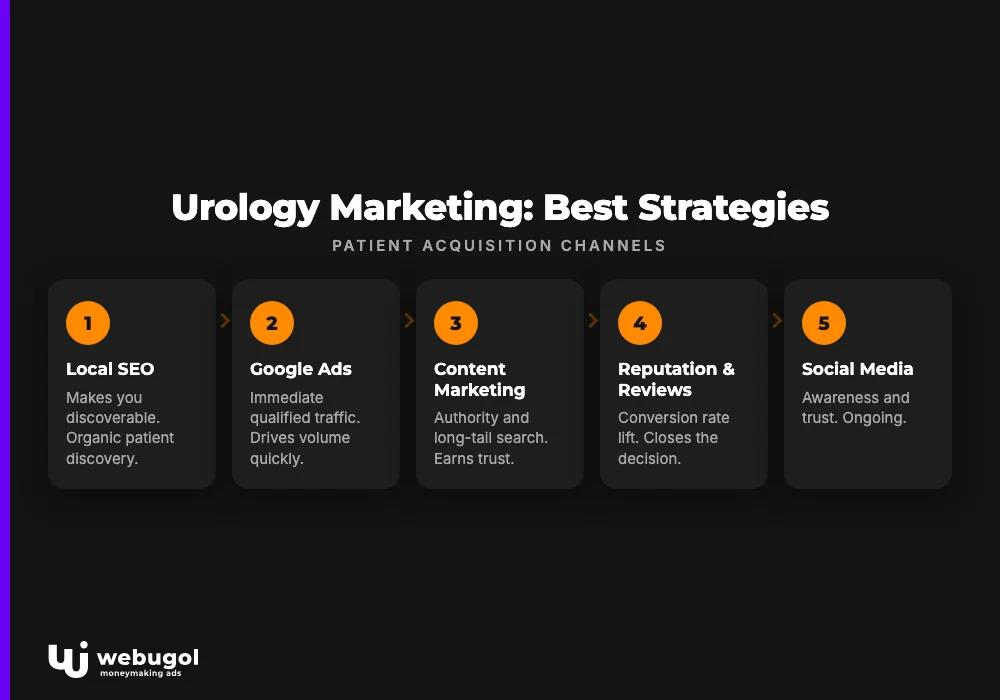
Effective marketing for urology practices combines local SEO, content, paid search, and reputation management into one system. No single tactic works alone. Local SEO makes you discoverable. Content earns trust before the first call. Paid ads drive volume quickly. Reviews close the decision when a patient is weighing two practices.
The channels that consistently drive urology patient acquisition:
| Channel | Primary outcome | Time to results |
|---|---|---|
| Local SEO | Organic patient discovery | 3–6 months |
| Google Ads | Immediate qualified traffic | Days to weeks |
| Content marketing | Authority and long-tail search | 3–12 months |
| Reputation and reviews | Conversion rate lift | Ongoing |
| Social media | Awareness and trust | Ongoing |
| Retention and reactivation | Weeks |
Starting local SEO and Google Ads in parallel gives short-term momentum while organic authority builds.
How does local SEO help urology practices get more patients?
Local SEO for urologists determines whether your practice appears in the top three map results when a patient types "urologist near me." Most patients never scroll past that map pack. Ranking outside it is nearly invisible.
The foundation is your Google Business Profile: verified, fully completed, with accurate hours, services, and recent photos. Your website then needs location-specific pages, consistent NAP data (name, address, phone) across all directories, and content targeting local search queries. Proximity matters in local search, but so does relevance and authority. A practice with detailed reviews and a well-structured site will outrank a closer competitor who has ignored these fundamentals.
For the full technical setup, the local SEO guide for urology and medical practices covers every layer from profile optimization to citation building.
Urology website optimization: what your site must do
Your website is your first clinical impression. Patients evaluate competence before they ever speak to staff. A slow, hard-to-navigate site loses patients who are already motivated to find care.
A urology website built for patient acquisition needs to accomplish five things:
- Load quickly on mobile, since most local searches happen on phones
- Show clear service pages for each condition or procedure you treat
- Include physician profiles with credentials, photos, and clinical focus areas
- Offer online appointment booking or a callback request form
- Display patient reviews prominently on the homepage and key service pages
SEO for urology also means structuring service pages around specific conditions: BPH, kidney stones, erectile dysfunction, urinary incontinence, prostate health. Each condition gets its own page with patient-facing language, not medical jargon. This is how you capture patients who search by symptom rather than by specialty, which is how most of them actually search.
For practices running on an outdated or slow site, conversion improvements start at the infrastructure level. No marketing layer compensates for a site that loses patients before the form loads.
How do I attract more patients to my urology practice?
Content marketing is the highest-leverage strategy for sustainable urology patient acquisition. Patients researching sensitive urological conditions spend significant time reading before they call. A blog or resource section that answers their questions accurately builds the trust that converts hesitant readers into booked appointments.
Effective content targets the questions patients actually type:
- "What are the symptoms of BPH?"
- "When should I see a urologist?"
- "Is kidney stone surgery necessary?"
Each article that ranks for these queries sends pre-educated, pre-warmed patients to your booking page. Short video content accelerates this further. Procedure explanations and brief doctor introductions help patients feel comfortable before they arrive, reducing no-shows and pre-appointment anxiety.
Should urology practices use paid advertising?
Yes. For high-value procedures with clear patient intent, paid advertising returns results faster than any other channel. Digital marketing for urologists through Google Ads lets you target specific conditions, zip codes, and search terms that signal a patient is ready to book. Organic SEO takes months. Paid search delivers traffic the week a campaign launches.
The strongest campaigns focus on specific, high-intent terms rather than broad keywords. "Vasectomy reversal [city]" converts better than "urologist." Geo-targeting keeps spend within your actual service area. Landing pages matched to the specific ad topic outperform sending all traffic to the homepage.
To understand how paid search fits into a broader practice growth strategy, this overview of Google Ads for driving practice inquiries is a useful starting point.
What content should a urology website include?
A urology website needs three content layers: clinical service pages, patient education content, and social proof. Most practices build the first. Few build all three.
Clinical service pages describe what you treat and how. Patient education content drives organic search traffic and answers questions before a patient calls, reducing front-desk volume. Social proof, primarily verified patient reviews, reduces the hesitation that urological stigma creates.
According to BrightLocal's annual consumer review survey, 84% of patients trust online reviews as much as personal recommendations when choosing a provider. That makes systematic review collection a direct growth lever. Ask every satisfied patient. Answer every review professionally and promptly. Responding thoughtfully to a negative review shows prospective patients more about your practice culture than any marketing copy can.
Patient retention: the other half of marketing for urology practices
Acquisition is only half the equation. Practices that go silent after a visit lose the easiest source of revenue: patients who already trust them.
Automated email sequences handle retention without staff overhead. A post-visit follow-up, an annual screening reminder, and a reactivation message for patients who haven't returned in eighteen months each serve different retention goals. Done well, these also generate referrals. A patient who feels looked after mentions your practice. For a practical breakdown of how this works for medical practices, see the guide on staying connected with patients through email.
Tracking what works in marketing for urology practices
Measure new patient volume by source: organic search, paid ads, referrals, social. Google Analytics 4 and call-tracking software connect marketing spend to actual booked appointments.
Watch conversion rate alongside traffic. A site receiving 2,000 monthly visitors but booking five appointments has a conversion problem, not a traffic problem. Fixing site structure and the booking flow often produces faster results than increasing ad spend. Monthly review of performance data lets you redirect budget from underperforming channels to what is actually working.
A strong urologist online presence is one tied to clear performance data, not assumptions.
Build a urology marketing system that compounds
A urology practice's digital presence either works around the clock or quietly costs you patients. Practices seeing consistent growth share one trait: they treat marketing as infrastructure.
As a web development and marketing agency, Webugol builds websites that grow, combining technical SEO, development, and paid acquisition into one system for healthcare practices. If your practice isn't generating the patient volume it should, reach out to discuss where the gaps are.
FAQ
How long does it take for digital marketing to bring in new urology patients?
Paid advertising can generate traffic within days of launching a campaign. Organic SEO and content marketing typically take three to six months to produce consistent results. A combined approach gives you immediate volume while building long-term search authority.
Is social media worth the effort for urology practices?
Social media builds awareness and humanizes your practice, which matters given the stigma around urological conditions. It rarely drives direct bookings but supports conversion when patients are researching providers. Consistent, patient-facing content on one or two platforms outperforms spreading thin across many.
How many online reviews does a urology practice need?
Recent reviews matter more than total count. A practice with 30 reviews from the past year outperforms one with 200 reviews spread over a decade. The priority is making review requests routine after every visit, not running one-time campaigns.
What is the most important first step in urology marketing?
Optimizing your Google Business Profile and ensuring your website is fast, mobile-friendly, and has clear service pages is the highest-impact starting point. These two elements affect every other channel because they determine whether patients can find you and what they see when they do.

