



Digital marketing for insurance brokers: the complete growth guide
Digital marketing for insurance brokers is the coordinated use of SEO, paid advertising, social media, and email nurturing to attract qualified prospects and convert them into clients. Unlike referral-based growth, it compounds: digital marketing insurance brokers see a well-ranked service page generating leads for years, while a consistent email sequence converts prospects who weren't ready to buy last quarter.
Run in isolation, each channel drains budget without building anything durable. That's the trap. Whether you're launching your first digital campaign or pushing past a referral-dependent plateau, the underlying challenge is the same: no unified system connects the website, search presence, and lead pipeline. Solving that gap separates agencies that grow from those that stall.
Build an insurance broker website that converts
Your insurance broker website is where every marketing channel sends its traffic. Slow load times and poor mobile layout neutralize ad spend before a prospect fills out a form.
Most web traffic now arrives from mobile devices. That single factor determines your SEO outcome. Google prioritizes mobile-friendly sites in rankings, so a site that underperforms on smartphones loses both traffic and conversions simultaneously.
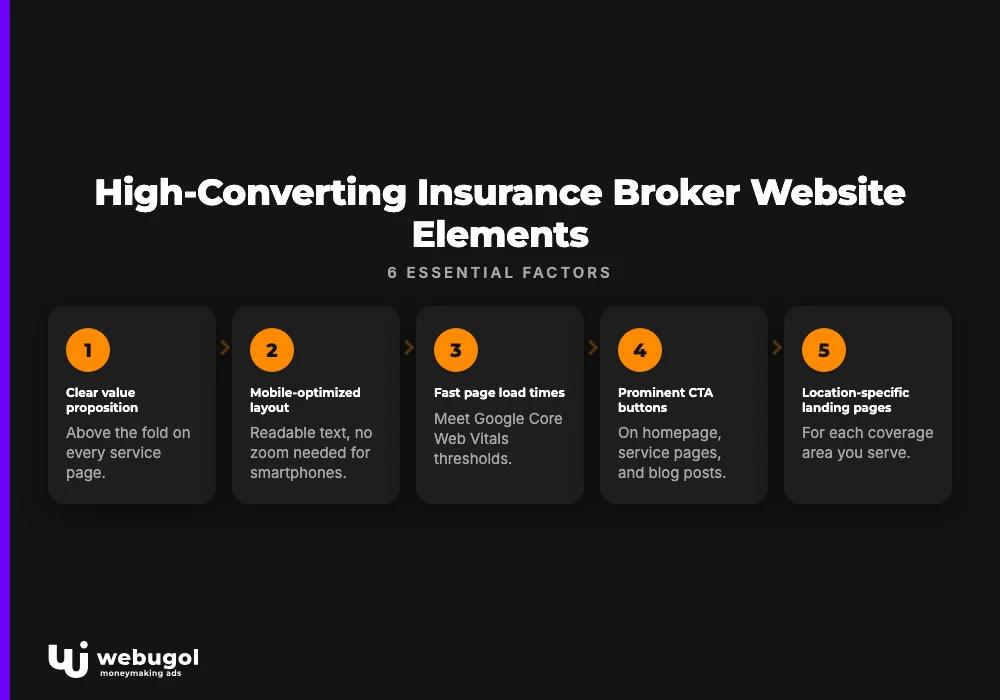
A high-converting broker site requires these six elements:
- A clear value proposition above the fold on every service page
- Mobile-optimized layout with readable text that requires no zoom
- Fast page load times that meet Google Core Web Vitals thresholds
- Prominent call-to-action buttons on the homepage, service pages, and blog posts
- Location-specific landing pages for each coverage area you serve
- Trust signals: professional licenses, carrier logos, and association memberships
Place CTA buttons where visitors make decisions. High-traffic blog posts and service pages consistently outperform footer placements for conversion.
What SEO strategies work best for insurance brokers?
Insurance broker SEO covers on-page keyword alignment, local search presence, and a content program that builds long-term authority. All three reinforce each other: local content drives local rankings, and authoritative content earns the links that lift overall visibility.
On-page SEO starts with keyword mapping. "Commercial liability insurance [city]" and "life insurance broker near me" pull very different buyers. Map your coverage types to the exact phrases each audience searches, then optimize title tags, headers, and page copy around those specific terms.
The local signals digital marketing insurance brokers must own
Local SEO is non-negotiable for brokers who serve a specific geography. Claim your Google Business Profile and verify accuracy across name, address, and phone. Add regular photo updates and respond to every review.
Positive reviews directly influence local rankings. Consistent new reviews signal ongoing relevance to Google's local algorithm. The same foundations that drive local SEO for service businesses apply directly to your brokerage's search presence.
Location-specific content amplifies local signals. Blog posts on regional weather risks, state-specific coverage requirements, or local industry conditions demonstrate expertise that national insurers cannot match.
This three-layer structure is what makes digital marketing for insurance brokers compound rather than plateau.
How can insurance brokers generate leads online?
Insurance agency lead generation at scale requires coordinated sources, not a single channel. SEO service pages capture high-intent searches. Paid ads deliver immediate visibility. Remarketing re-engages visitors who did not convert on their first visit.
Google Ads for online advertising for insurance puts your brokerage in front of buyers actively searching for coverage. Ad extensions showing your phone number, location, and service categories improve click-through rates. Structuring campaigns around specific coverage types rather than broad terms reduces cost per click and improves lead quality. A clear paid advertising strategy established before launch prevents wasted spend during the algorithm's learning period. Digital marketing insurance brokers who align ad creative with landing page messaging reduce bounce rates and increase quote requests from paid traffic.
Remarketing keeps your brand visible to high-intent visitors at a lower cost per interaction than prospecting campaigns. These audiences have already signaled interest by visiting your site.
Lead magnets convert visitors who are not yet ready to speak with a broker. A coverage checklist, risk assessment guide, or policy comparison chart gives prospects a reason to share contact information early. Tailoring resources to distinct buyer segments produces higher-quality contacts: first-time homebuyers, small business owners, and pre-retirees each respond to different content.
Which social media platforms work best for insurance agents?
Social media for insurance agents delivers the best return when platform choice matches the client mix. LinkedIn works best for commercial lines and business owner outreach. Facebook and Instagram reach personal-lines audiences, such as homeowners and families, more effectively.
Consistency matters more than volume. A content calendar with three to four posts per week, mixing industry updates, risk management guidance, and team content, outperforms irregular activity across multiple platforms. Respond to every comment and direct message. Platforms reward accounts that generate genuine interactions, and your responsiveness signals to prospects how you handle client communication.
Educate rather than sell. Insurance audiences respond to content that makes coverage decisions easier: plain-language explainers, questions to ask before choosing a broker, and brief descriptions of real client outcomes. Useful content positions your brokerage as a resource before it positions you as a vendor.
How do insurance brokers build trust online?
Client reviews and detailed testimonials are the fastest trust signals for prospects comparing brokers. Case studies add depth for buyers in the final decision stage, showing exactly how you handle coverage gaps and claims.
Ask satisfied clients to post reviews on Google, and respond professionally to every review. Prospects reading your responses to negative feedback see exactly how you handle problems. That communicates more credibility than any promotional copy can.
Video testimonials carry the most weight. A short clip of a client describing a specific claim outcome creates personal connection that text testimonials cannot replicate. Smartphone recordings work when the client speaks naturally about a concrete result rather than reading a prepared statement.
Email marketing for brokers sustains relationships across the months-long decision cycle many clients go through before choosing a brokerage. Sequences segmented by buyer type deliver relevant information at each stage without overwhelming subscribers. The same value-first approach that drives email sequences for professional services applies here: educate consistently before asking for a commitment.
Measure what your digital marketing for insurance brokers delivers
How much should insurance brokers spend on digital marketing?
Budget allocation depends on your growth stage and the specific gap you're closing, not a fixed percentage of revenue. Start by calculating your current cost per acquired client through referrals. That baseline tells you what a digitally sourced client can cost before marketing spend erodes your margin.
Brokers focused on immediate local visibility typically weight spending toward Google Ads and local SEO. Those building long-term pipelines invest more in content and email automation, since both assets compound over time.
Start with the channel that closes your most critical gap. Track cost per lead monthly and reallocate toward channels where lead cost decreases as volume grows.
Track these KPIs regardless of channel mix: website traffic by source, lead volume per channel, conversion rate from lead to client, and cost per acquired client. Monthly reviews reveal which channels compound and which absorb budget without return. Digital marketing insurance brokers who track these KPIs consistently can shift spend toward channels producing the lowest cost per acquired client before budget compounds in the wrong direction.
CRM automation removes the manual follow-up that lets warm leads go cold. Trigger-based sequences respond to prospect behavior and score leads by engagement level, directing personal attention toward the highest-intent prospects.
Stop losing leads to faster-moving competitors
Insurance brokers who build digital marketing for insurance brokers as a unified system stop losing prospects to competitors who rank higher, respond faster, and follow up more consistently. The problem is structural. Disconnected channels don't compound because no single system ties the website, SEO, content, and lead nurturing together.
Webugol builds websites and digital growth systems for professional service firms designed to capture, convert, and retain clients. If your current site is the weak link in your growth system, a performance-optimized website rebuild removes the technical friction that costs you leads before a single marketing channel reaches a prospect.
FAQ
How can insurance brokers generate leads online?
The most reliable approach combines SEO-optimized service pages that capture high-intent searches with Google Ads for immediate visibility and segmented email sequences for longer nurture cycles. A lead magnet such as a coverage checklist or risk assessment guide converts visitors not yet ready to speak with a broker into contactable prospects.
What SEO strategies work best for insurance brokers?
Insurance broker SEO prioritizes on-page optimization for the coverage terms your clients actually search, a fully optimized Google Business Profile for local intent, and regular content that answers the questions prospects ask before choosing a broker. Consistent execution across all three layers compounds traffic and lead quality over time.
Which social media platforms are best for insurance agents?
LinkedIn delivers the strongest results for commercial lines and business owner outreach, while Facebook and Instagram perform better for personal lines including home, auto, and life insurance. Consistent educational content on one or two well-chosen platforms outperforms scattered activity across many.
How do insurance brokers build trust online?
Client reviews on Google and detailed testimonials on your website are the fastest trust signals for prospects comparing brokers. Regular educational email content and social posts that answer real coverage questions build credibility over months and reduce resistance when prospects are ready to decide.

