



Digital Marketing for Energy Companies: Proven Strategies
Digital marketing for energy companies is how providers stop losing customers before the conversation even starts. Provider comparisons increasingly start online, before any sales conversation begins, and that research phase is where market share is decided. A coordinated strategy combining energy company SEO, targeted paid search campaigns, and educational content converts that research traffic into qualified leads and builds the brand authority that compounds over time.
How does digital marketing help energy companies?
Digital marketing puts energy providers in front of buyers at the exact moment they're comparing options and making decisions. The legacy approach of waiting for referrals or rate-driven inbound no longer works when customers can find competitors, read third-party reviews, and request quotes from multiple providers in minutes.
Here's what each channel delivers:
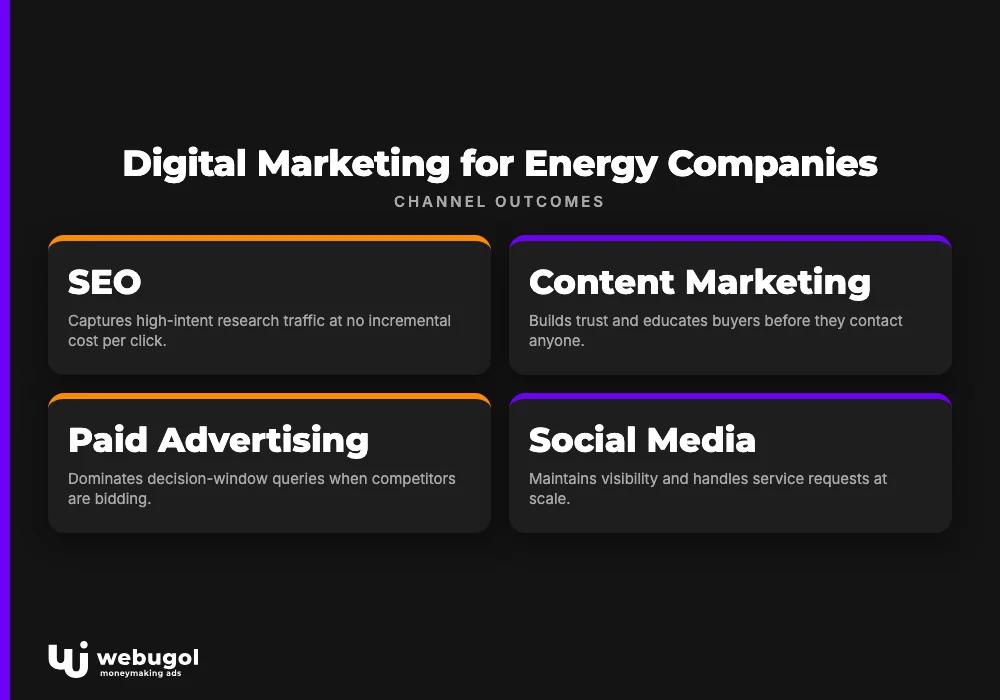
| Channel | Primary outcome |
|---|---|
| Energy company SEO | Captures high-intent research traffic at no incremental cost per click |
| Content marketing energy sector | Builds trust and educates buyers before they contact anyone |
| Paid advertising for utilities | Dominates decision-window queries when competitors are also bidding |
| Social media energy companies | Maintains visibility and handles service requests at scale |
| Email and lifecycle marketing | Reduces churn by keeping customers engaged between billing cycles |
No single channel wins alone. Energy companies that treat digital marketing for energy as one connected system, not a set of isolated tactics, consistently out-acquire and out-retain the field.
What SEO strategies work best for energy companies?
Energy company SEO works on two layers: capturing high-intent service queries and building topical authority through sustained content. Technical hygiene is the floor. The real leverage comes from matching what customers search to what they land on.
Start with intent-driven keyword research: service area combined with energy type, rate comparison queries, and sustainability-driven searches all drive qualified leads. Informational content covering energy efficiency and bill reduction builds the topical authority that lifts commercial pages in rankings over time.
Local SEO for regional energy providers
Most energy companies serve defined territories. Local SEO delivers the fastest path to verified leads because searches like "electricity provider [city]" carry clear purchase intent.
Claim and fully optimize your Google Business Profile. Keep your business name, service area, hours, and contact details accurate and consistent. Respond publicly to every review, both positive and critical, because prospects read those exchanges when evaluating providers. Consistent name, address, and phone data across directories reinforces local ranking signals and prevents confusion that costs you leads.
On-page and technical SEO essentials
Match page titles and H1s to actual user queries. Keep Core Web Vitals clean, especially load speed and layout stability, since Google uses them as ranking inputs. Build internal links between related content so authority flows toward your highest-priority conversion pages.
Content marketing in the energy sector
Content marketing is how digital marketing for energy companies reaches buyers in the research phase, before they're ready to contact anyone. A residential customer deciding whether to switch providers, or a commercial buyer evaluating renewable energy contracts, will read multiple pieces of content before making contact. Showing up in that research phase builds preference before the sales process begins.
Content that works for online marketing for utilities:
- Energy cost-saving guides tied to specific property types or usage patterns
- Comparisons between energy sources, such as solar versus grid or fixed versus variable rates
- Explainers on sustainability certifications and what they mean for customers
- FAQ content built around real objections buyers have before switching providers
Every piece should target a specific search query and answer it completely. Thin content that restates a question without resolving it does not rank.
Which social media platforms work best for energy brands?
LinkedIn and Facebook deliver the most consistent return for energy companies. LinkedIn reaches commercial buyers, facility managers, and procurement contacts who control larger energy decisions. Facebook reaches residential customers effectively, particularly for local service updates and community announcements.
Instagram and YouTube support renewable energy marketing specifically. Solar installation walkthroughs, wind project updates, and sustainability milestones perform well as visual and video content, reaching a values-driven audience that LinkedIn posts rarely attract. The same targeting principle from social media for industrial companies holds here: match each platform to its audience's actual intent rather than distributing identical content everywhere.
Across every platform, how your company handles service complaints publicly signals reliability to every prospect watching. Energy customers pay close attention to how providers handle problems.
Paid advertising for utilities: what actually moves the needle
Paid advertising for utilities delivers results when it targets buyers already in a decision window. Search campaigns built around queries like "switch electricity provider" or "commercial energy rates" put your offer in front of people ready to act.
Retargeting brings back visitors who left without converting. For energy companies with longer consideration cycles, this repeated exposure converts a meaningful share of leads that would otherwise go quiet. Display and social ads extend awareness during rate-change seasons or when entering new service areas.
The bigger question for these paid campaigns isn't total spend but which campaign type serves which goal. Understanding what each campaign structure delivers, from brand awareness to direct response, is covered in this guide to what Google Ads delivers across different campaign objectives. Continuous bid management, negative keyword hygiene, and landing pages matched to ad intent determine whether paid spend builds pipeline or burns budget.
How to generate leads for an energy company online?
Energy company lead generation online works by matching the right offer to the right stage of the buyer's journey. The structure is direct:
- Awareness: SEO content and social media reach researchers who don't yet have a provider in mind
- Consideration: Comparison tools, case studies, and savings calculators move them toward preference
- Decision: Landing pages with clear calls to action, trust signals, and fast mobile performance convert intent into contact
The conversion elements most energy companies overlook: short contact forms, clickable phone numbers on mobile, and a live chat option on high-traffic pages. When a buyer is comparing three providers simultaneously, removing friction at the contact step wins the lead before competitors respond.
Measuring what actually drives revenue
The metrics that matter in digital marketing for energy companies are cost per lead, conversion rate by channel, and customer lifetime value by acquisition source. Click-through rate and engagement data inform creative decisions. They don't tell you which channel is profitable.
Track lead volume against closed customers, not just form submissions. A channel that generates high traffic with low close rates is expensive regardless of how active it looks in a dashboard. Segment by customer profile to identify who converts and retains best. That data directs budget toward what actually grows the business.
Build a digital growth system for your energy company
Most energy companies run digital marketing as a collection of disconnected efforts: a website built years ago and rarely updated, a Google Ads account with stale campaigns, social profiles that post inconsistently. The result is unpredictable lead flow and slow growth. Whether you're a regional provider trying to gain market share or an established utility moving into new territory, the structural problem is the same: channels that don't reinforce each other don't compound. The same structural gap limits any SMB owner whose site is too slow or poorly built to convert the traffic those channels deliver.
Webugol builds and grows websites, treating technical development and digital marketing as one growth engine. Load speed, Core Web Vitals, and conversion-ready architecture are built alongside SEO, content, and paid campaigns. If your current setup isn't generating the pipeline your team needs, contact us for a performance review and a clear path forward.
FAQ
How to generate leads for an energy company online?
The most reliable approach combines high-intent SEO to capture research traffic and paid search to convert decision-ready queries. Optimized landing pages with short forms, mobile-friendly contact options, and fast load times turn that traffic into actionable leads. Reducing friction at the conversion step typically has more impact than simply increasing ad spend.
How much should an energy company spend on digital marketing?
There is no universal figure because it depends on market size, competition level, and growth objectives. A regional utility entering a competitive market needs more paid advertising to establish initial visibility; a provider focused on retention can allocate more toward content and SEO. The right starting point is to set a target cost per lead based on customer lifetime value and work backward to a channel mix.
What makes energy company SEO different from other sectors?
Energy company SEO operates in a trust-sensitive environment where credibility signals carry more weight than in most industries. Customers considering a switch need transparent pricing information, third-party reviews, and content that directly addresses reliability and service concerns. Local SEO is also more important for energy than for most national brands because service area determines eligibility and search intent is highly geographic.
Is social media worth the investment for utility companies?
Yes, but the return depends on platform selection and content quality. LinkedIn and Facebook consistently deliver measurable results when content addresses real customer concerns rather than promotional announcements. Social media also functions as a first-response channel for service issues, which directly affects retention and public perception. Companies that use it only for broadcast messaging see low engagement and little measurable return.

