



MVP software development agency: how to pick one that ships and grows
An MVP software development agency scopes, designs, and builds the first shippable version of your product, the version small enough to test a core hypothesis with real users but complete enough to prove demand. Most agencies define their job as done on launch day. The ones that move your business forward wire in SEO architecture, acquisition channels, and a performance baseline from day one, so the product is growing the moment it goes live. This article covers how to tell those agencies apart, what it costs, and what to ask before you sign.
What an MVP software development agency actually does
An MVP software development agency is a focused build partner that narrows scope to what a product must do to validate a hypothesis, as opposed to a generalist dev shop that builds to spec or a freelancer who executes tasks without product strategy. If you are still grounding yourself on what an MVP actually is and how it fits into a product roadmap, that context belongs before the agency search begins.
The core job is aggressive scoping. Where a full product builds for scale, an MVP builds for learning. That means cutting every feature that does not test the core value proposition, shipping fast enough for real user feedback, and designing the product to be iterable rather than just launchable.
The difference from a no-code consultant matters for founders thinking ahead. No-code consultants configure existing platforms; a custom MVP agency owns the architecture decisions that determine whether the product can scale past the tool ceiling. That structural difference shapes your options at the six-month mark.
MVP vs. prototype vs. full product: where the line is
A prototype tests whether a concept makes sense to users. It is typically non-functional or minimally functional, exists to gather feedback on a workflow or interface, and is not expected to handle real transactions or data. Prototypes are often discarded once the concept is validated.
An MVP tests whether real demand exists for a specific solution. It is functional, shippable, and handles real users and real data, but it delivers only the minimum feature set required to test that demand. Users do not know they are using a minimum product; they are evaluating whether it solves their problem.
A full product builds for scale, compliance, and feature completeness. It assumes demand is already validated and prioritizes reliability, performance, and the full feature roadmap. Skipping the MVP stage and going straight to a full product is expensive. It is also common among founders who over-build before confirming what the market actually wants.
The practical implication for founders comparing agencies is scope discipline. An agency that defaults to building the full product without a clear MVP phase is not saving you time. It is spending your budget on features that have not yet been validated.
How much does MVP development cost in 2026?
MVP development costs range from $3,000 to $50,000 or more depending primarily on the build method, not on agency brand or location. The most important pricing driver is whether the product requires custom engineering, an AI-hybrid approach, or a no-code/AI-assisted build.
| Tier | Price range | Timeline | Best for | Watch out for |
|---|---|---|---|---|
| No-code / AI-assisted | $3,000 to $5,000 | 2 to 4 weeks | Concept validation, nontechnical founders | Tool ceiling reached quickly at scale or with complex integrations |
| AI-hybrid | $8,000 to $15,000 | 4 to 8 weeks | Investor-ready products, early-stage SaaS | Requires experienced engineering judgment on what to build vs. generate |
| Custom | $25,000 to $50,000+ | 10 to 16 weeks | Complex integrations, compliance requirements, custom data models | Expensive to pivot if the initial hypothesis turns out to be wrong |
These ranges assume a single-founder or small-team product without enterprise compliance layers. Products requiring HIPAA, SOC 2, or financial-grade security add scope to the custom tier regardless of build method. Including growth infrastructure in scope, such as SEO architecture and first-90-days acquisition channel setup, should be scoped explicitly so the cost is known before discovery begins.
AI-accelerated MVP: why the entry price dropped
AI coding tools have collapsed one of the main cost drivers in the simpler-build segment: the hours required to scaffold standard functionality. Boilerplate authentication, basic CRUD interfaces, and common API integrations that once required multiple engineering days can now be generated in hours using LLM-based tooling and AI coding platforms.
That is what made the $3,000 to $5,000 price point real for nontechnical founders. It was not achievable two years ago outside of pure no-code platforms with significant feature constraints.
Where AI-assisted builds hit their ceiling is predictable. Custom data models that do not map to standard schema patterns require human engineering judgment. Security requirements such as HIPAA or SOC 2 compliance need architects who can reason about risk, not just generate code. Third-party integrations with poorly documented or private APIs require debugging that AI tools handle inconsistently. And mobile parity, where iOS and Android behavior must match exactly, still requires human QA and native expertise.
The $3,000 to $5,000 tier is real. It is also genuinely limited. Knowing where that limit sits before you start determines whether the lower price point is a fit for your product or a path to a mid-build rearchitect that costs more than the custom tier would have from the beginning.
When no-code and AI builders stop being enough
Bubble, Lovable, and similar platforms solve a real problem: they let nontechnical founders build working software without a dev team. For many founders, this is exactly the right starting point. The tool did its job. The product got built, early users came in, and the business started to show real signal.
The transition to a custom MVP software development agency is not a failure of the tool. It is the natural next step once the product has outgrown what a platform-bound architecture can support. The structural weaknesses that slow a growing no-code product are the same ones that limit a business owner trying to scale past a traction plateau. Both problems share the same root cause, and both need the same kind of solution.
The question is not whether to make the move, but when. The answer is usually earlier than founders expect.
Signs you've outgrown your no-code tool
- Third-party integrations the tool does not support natively. When a critical integration requires a workaround plugin or a webhook chain that breaks under load, the tool is no longer the right foundation for the product.
- Security or compliance requirements. HIPAA, SOC 2, PCI-DSS, and similar frameworks require architectural decisions that most no-code platforms cannot accommodate at the infrastructure level. These are structural problems, not configuration ones.
- Performance limits at scale. When a no-code app slows down as usage grows, the bottleneck is typically the platform runtime, not your configuration. No amount of optimization changes the underlying constraint.
- Need for custom data models. Relational data with non-standard relationships, hierarchical structures, or complex query requirements exceed what most no-code database layers support well.
- Mobile parity requirements. When iOS and Android behavior need to be identical and native, a web-wrapper approach stops being good enough for the user experience the product needs to deliver.
- Platform pricing that now exceeds custom development cost. At a certain scale, the monthly SaaS fee for the no-code platform plus the cost of workarounds exceeds what a purpose-built architecture would cost to maintain over the same period.
Any two of these triggers in combination is a clear signal to have a conversation with an MVP agency.

What should you look for in an MVP software development agency?
The standard criteria in most agency comparison guides cover tech stack compatibility, timeline estimates, and portfolio depth. Those matter, but they are table stakes for any agency worth evaluating. The criterion missing from most comparison lists is simpler: does the agency have a concrete plan for what happens to the product after launch day?
That question does more filtering work than portfolio reviews and reference calls combined. It surfaces whether the agency sees its responsibility as ending at delivery or continuing through growth.
Criteria checklist:
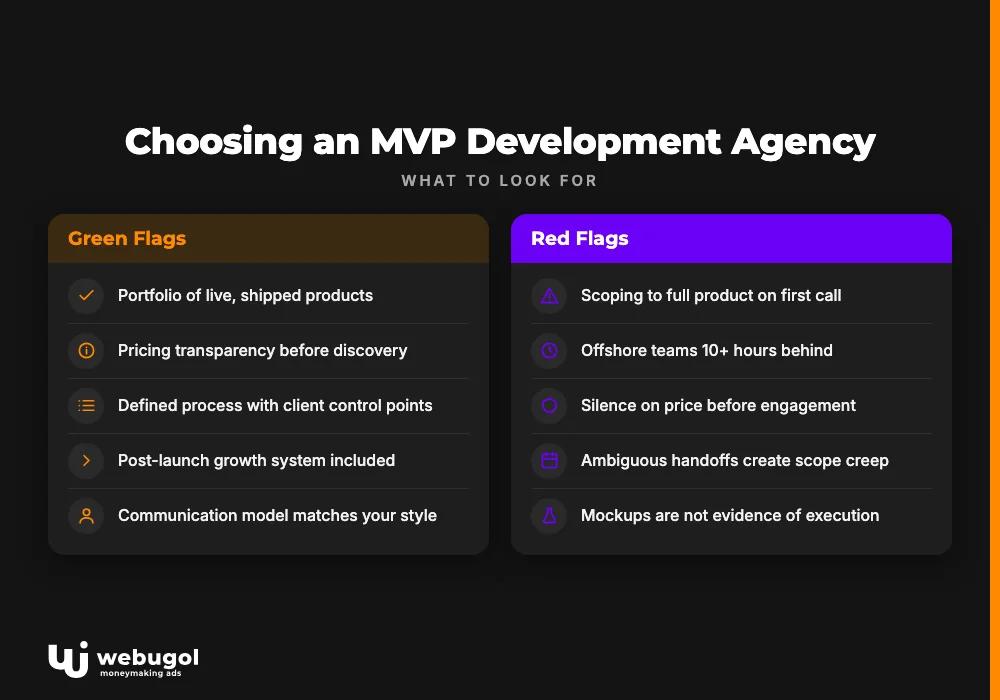
- A portfolio of shipped products, not just designed ones. Mockups and case study screenshots are not evidence of execution. Ask for live URLs you can test before forming an opinion on the work quality.
- Pricing transparency before discovery. A legitimate agency can give you a ballpark range before a formal scoping session. Silence on price before engagement is a process signal worth noting.
- A defined process with named client control points. You should know exactly when you review and approve work at each stage. Ambiguous handoffs produce scope creep and difficult conversations later.
- A post-launch growth system included in scope. Not a vague promise of ongoing support but a specific first-90-days plan covering acquisition channels, SEO architecture, and performance baselines.
- A communication model that matches your timezone and working style. Offshore teams operating 10 or more hours behind your timezone create revision cycles that add days to every iteration.
Red flags when evaluating an MVP agency:
- Scoping to a full product on the first call. If the discovery conversation quickly expands beyond MVP scope to building the full product roadmap, the agency is upselling rather than helping you validate efficiently.
- No pricing range before engagement. Agencies that refuse to give a range before discovery often want emotional investment in a scope before price becomes part of the conversation.
- No post-launch plan. When questions about the 90 days after launch are deferred to a later conversation, growth has already been deprioritized.
- A portfolio of mockups only. Design agencies and MVP agencies are not the same. If you cannot find live products in the portfolio, treat it as a design shop.
- No client references with outcomes. Logos prove past relationships. References with specific outcome data prove execution quality.
Questions to ask before signing:
- What does "done" mean in your process, and what are the specific deliverables at launch?
- What is the pricing model, and what triggers a scope change?
- What is included in the first 30 days after the product goes live?
- How do you define and measure success at the end of the engagement?
- Can you provide two client contacts who can speak to the work, not just approve a testimonial quote?
What happens after launch? The question most founders forget to ask
Most founders evaluate an MVP software development agency on its ability to build. The question they forget is what the agency is accountable for after the product ships.
When development and growth are treated as separate phases, the gap between them is expensive. An SEO architecture retrofitted after a product is live requires structural URL changes, redirects, and content rearchitecting that could have been avoided. A content and acquisition strategy that starts after launch begins with zero organic authority and no performance history. These are not theoretical costs; they are the reason many technically sound products get no organic traction in the first year.
The alternative is to treat day-one SEO architecture and acquisition planning as part of the MVP spec itself. That means URL structure, Core Web Vitals baseline, and first content cluster are defined during discovery, not handed off as future work. For a detailed walkthrough of how the build process can accommodate growth from the first line of code, see our guide to building an MVP with growth built in.
Before you sign with any agency, have a direct conversation about scope specifically on this point. Webugol reviews MVP requirements and flags growth infrastructure gaps before development starts, at no commitment. To see what that review covers, visit our MVP scope and growth discovery page.
How Webugol builds MVPs: dev and marketing as one system
Webugol is not a pure development agency. The model is built on a single premise: development and growth infrastructure are the same project, scoped together from discovery rather than handed off sequentially.
When an MVP engagement starts, the discovery phase scopes two things simultaneously: what gets built and how the product generates its first users. URL architecture is defined before the first component is written. Core Web Vitals thresholds are set as build spec requirements, not post-launch audit targets. The first 90 days of acquisition channels are planned alongside the product roadmap.
The practical outcome for the business owner is that growth infrastructure is not an add-on or a second vendor relationship. It is part of the original scope. What you stop losing is the cost of retrofitting, the time wasted on a launch that cannot be found, and the revenue gap between a shipped codebase and a product that generates its first bookings from day one.
From discovery to launch: our 5-step process
Step 1: Discovery. We scope both the product and its growth architecture together. What you are building, who it is for, what success looks like in 90 days, and how the product will reach its first users are all defined before design starts. Client control point: signed scope document with named deliverables and growth KPIs.
Step 2: Design. UI/UX design with performance and accessibility built into the component spec. Navigation and URL structure are finalized here, before engineering begins. Client control point: approved design system and prototype review.
Step 3: Build. Engineering against the approved spec, with Core Web Vitals as a build requirement and AI-assisted tooling used where it accelerates delivery without introducing architectural risk. Client control point: staged review sessions at functional milestones.
Step 4: Launch. QA, performance benchmarking, and go-live with analytics and conversion tracking active from day one. This is not a handoff; it is a transition. Client control point: pre-launch checklist sign-off before the product goes live.
Step 5: Grow. The phase pure dev agencies leave out of scope entirely. First-90-days acquisition framework, SEO content calendar, and performance monitoring are handed off alongside the codebase. This is part of the original engagement scope, not a retainer pitch added at launch.
The grow step is not a differentiator in name only. It changes what discovery looks like, what build decisions get made, and what you hold as the owner when the product is live.
What you get that pure dev agencies don't include
A dev-only MVP engagement delivers a codebase. What it does not deliver is a product that can be found, indexed, or measured from day one.
Webugol MVP engagements include SEO architecture baked into URL and content structure before the first page is built. Core Web Vitals are a build spec requirement, so the product passes performance thresholds at launch rather than failing its first audit. And the first-90-days acquisition framework is handed off alongside the codebase, so the owner knows exactly what to do with the product immediately after it goes live.
The difference in outcome is measurable in terms that matter to the business. When you stop paying to retrofit SEO structure after launch and stop losing early traction to a product that cannot be found in search, those savings compound from the first week the product is live. It is the difference between a product that starts growing immediately and one that starts with a growth backlog it has to work off before it can compete.

Is a US-based MVP agency worth the higher rate?
A US-based MVP software development agency typically charges more per hour than an offshore team. Whether that premium is justified depends on the specific project, not on a blanket preference for domestic vendors.
The cases where US-based is worth the rate difference are well defined. First, timezone alignment on iteration cycles. When a founder is iterating rapidly on scope and design decisions, an agency that is 10 or more hours ahead adds a full calendar day to every revision loop. For projects where fast feedback cycles determine the competitive outcome, that iteration cost is real and compounds across a multi-week build. Second, IP protection under US contract law. For founders building proprietary technology, the enforceability of NDAs and IP assignment clauses under a US jurisdiction is structurally stronger than cross-border agreements with offshore teams. Third, communication quality on ambiguous requirements. The problems that surface during MVP discovery are rarely fully specified from the start. Resolving them requires nuanced conversation, and that conversation is more effective when language and business-culture context are shared.
The cases where offshore makes sense are equally clear. A well-specified build with stable requirements and no ambiguous scope decisions benefits less from timezone proximity. A founder who has built with technical teams before and can write tight specs may find the per-hour cost difference more significant than the iteration speed benefit. Offshore teams with US-based project managers or overlap hours can close some of the communication gap for the right project type.
For the buyer actively comparing the best mvp software development agency in the US, the right question is not domestic versus offshore as a category. It is which specific project characteristics make proximity and jurisdiction matter enough to justify the rate difference. Products with high iteration frequency, proprietary IP, or compliance requirements in US-regulated industries typically answer that question in favor of a US-based team.
How we work with early-stage startups in Charleston and across the US
Webugol is based in Charleston, SC. For founders looking for an mvp software development agency near me or a Charleston mvp software development agency specifically, working with a local team means in-person discovery is possible and the agency has direct context on South Carolina business conditions and regional funding dynamics.
The national scope is genuine. Webugol works with founders from pre-seed through Series A across the US, covering both the technical build and the growth infrastructure as one engagement. Projects like Valhalla Vitality and Ways2Well are examples of the development-plus-growth model in practice, where development and acquisition architecture were scoped and built together rather than as two sequential vendor engagements.
For founders outside of South Carolina evaluating a us mvp software development agency, the Charleston base means US-based ownership, US contract and IP protection, and a team working in Eastern time with no offshore communication lag. The local anchor and national reach serve the same client type: a founder who needs an accountable build and growth partner, not just a development vendor who hands off a codebase.
The mvp software development agency Charleston search specifically attracts founders who want both the face-to-face relationship option and the technical depth of a team that builds for growth. That combination distinguishes a local partner from a national agency that simply lists a city name in its footer.

Ready to validate your idea with an MVP that grows?
If you are still evaluating MVP agencies and comparing scope documents, the most useful next step is a direct conversation about your specific product and whether the growth architecture is part of the plan from day one.
Webugol's discovery review is a no-commitment session on your MVP requirements. We flag scope gaps, identify where post-launch growth is not accounted for in the current plan, and give you a clear picture of what the engagement would actually include. Most founders who go through it walk away with a sharper scope document regardless of whether they engage. To start that conversation, book a discovery session through our MVP scope and growth program.
Frequently asked questions about MVP software development
What is an MVP software development agency?
An MVP software development agency scopes, designs, and builds the smallest shippable version of a product that lets founders test a core hypothesis with real users. It differs from a generalist dev shop by prioritizing speed, validated learning, and iteration over feature completeness. The agency's value is in narrowing scope aggressively, not in building more.
How long does it take to build an MVP?
AI-assisted MVPs can ship in 2 to 4 weeks; AI-hybrid builds typically take 4 to 8 weeks; fully custom products range from 10 to 16 weeks. The timeline depends on feature scope, the number of third-party integrations, and how much discovery work is completed before development starts.
How much does it cost to build an MVP with an agency?
Costs range from $3,000 to $5,000 for no-code or AI-assisted builds to $25,000 to $50,000 for fully custom products, with AI-hybrid builds in the $8,000 to $15,000 range. The right budget depends on integration complexity, compliance requirements, and whether growth infrastructure is included in scope.
Can an MVP agency help with marketing after launch?
Most agencies hand off the product at launch and exit the engagement. Webugol scopes SEO architecture, content structure, and first-90-days acquisition channels into the MVP build itself, so the product is designed to grow from the first day it is live.
What's the difference between AI-assisted and traditional MVP development?
AI-assisted development uses LLM tooling and AI coding platforms to collapse the build timeline and lower the entry cost to $3,000 to $5,000 for simpler products. Traditional custom development builds every component from scratch, which costs more and takes longer but provides full architectural control and no dependency on third-party AI tooling.

