



What React website design means and why it matters for business growth
React website design is the practice of building a business site using React's component-based UI system, where every interface element is a reusable, independently renderable piece. In practice, this means faster page loads, smoother interactions, and a codebase that stays manageable as the site scales. Whether you are exploring platform options for a new build or managing a WordPress site that has stopped converting, the same performance ceiling separates your current state from consistent organic growth.
What is React website design?
It structures every visible element on the page as a self-contained component: a navigation bar, a booking form, a card grid, each built once and reused across the site. When a user clicks or the content updates, only the affected component re-renders rather than the full page. The result is a site that loads fast for users and delivers measurable performance scores to search engines.
Why React is the right choice for modern business websites
For SMB owners and marketing directors who have outgrown their current platform, the question is rarely "what framework should we use?" It is "what stops us from growing?" Slow load times, rigid page templates, and plugin conflicts all show up as lost conversions and higher ad costs. React removes those ceilings.
Growth-focused businesses need a partner who owns the full path from architecture to revenue. Teams like Webugol that build and grow in one engagement handle development and marketing as a single system, so the site you launch is designed to rank, convert, and scale without handoff gaps between vendor siloes.
Speed, SEO, and interactivity: the business case
Three business outcomes separate React from plugin-dependent alternatives:
- Core Web Vitals improvement: Server-side rendered React sites consistently score 90+ on Google PageSpeed Insights, which directly influences organic rankings and paid search Quality Scores.
- Lower bounce rate: Component-level rendering delivers instant state changes without full page reloads, reducing the friction that causes visitors to leave before they convert.
- Richer interactive UI: Custom booking flows, filtered service menus, and real-time quote calculators are native to React, while equivalent functionality on a traditional CMS requires stacked third-party plugins that slow the site down.
React website design examples: what makes them work
Generic gallery lists (Facebook, Netflix, Airbnb) confirm that React scales. They do not explain what design decisions drive conversion for a business site. The Webugol portfolio offers more useful signal.
Healthcare: Valhalla Vitality and Ways2Well
Both healthcare clients arrived with WordPress sites that were slow on mobile and losing bookings at the top of the funnel. The redesigns replaced heavyweight page builders with a stripped React component tree, implemented lazy-loaded media for above-the-fold speed, and restructured the mobile layout hierarchy so the booking CTA reached users within the first screen.
Cut render-blocking requests. Reduce the initial payload. Those are the design choices, repeated across both projects, that moved conversion metrics.
If you want to see how that applies to your site, our react js development company scopes projects in a single call.

5 React design principles behind high-converting sites
No SERP competitor documents these. Each principle maps to a specific business metric.
- Component consistency for brand coherence: Reusing the same button, card, and form components across pages eliminates the visual drift that erodes trust, keeping conversion rates stable as the site scales.
- Targeted lazy loading for perceived speed: Loading only the assets in the visible viewport first drops Time to Interactive significantly, reducing bounce and improving the PageSpeed scores Google uses in ranking.
- Mobile-first layout hierarchy: Designing for the smallest screen first ensures the booking CTA and primary value proposition are never buried below the fold on mobile, where the majority of traffic arrives.
- Accessibility as an SEO layer: Semantic HTML structure and proper ARIA roles in React components improve Google's ability to crawl and interpret page content, which strengthens topical authority for target queries.
- Minimal initial payload strategy: Code-splitting routes keeps the JavaScript bundle small, so the first byte reaches the user faster and Core Web Vitals scores stay in the range that influences both rankings and Quality Score.
React vs WordPress vs no-code: which is right for your site?
| Criterion | React | WordPress | No-code |
|---|---|---|---|
| Page speed | Highest with SSR | Varies, often limited by plugins | Moderate |
| SEO potential | Full with SSR/SSG | Full with optimization | Limited |
| Customization ceiling | No ceiling | Plugin-limited | Low |
| Maintenance effort | Low with clean codebase | High (plugins, security updates) | Low |
| Estimated project cost | $3–5k MVP, $5–15k migration | Varies by scope | Low upfront |
For teams who want to keep an existing content library but stop sacrificing performance for it, the headless wordpress agency path keeps WordPress as the CMS while moving the front end to React.
When should you use React instead of WordPress?
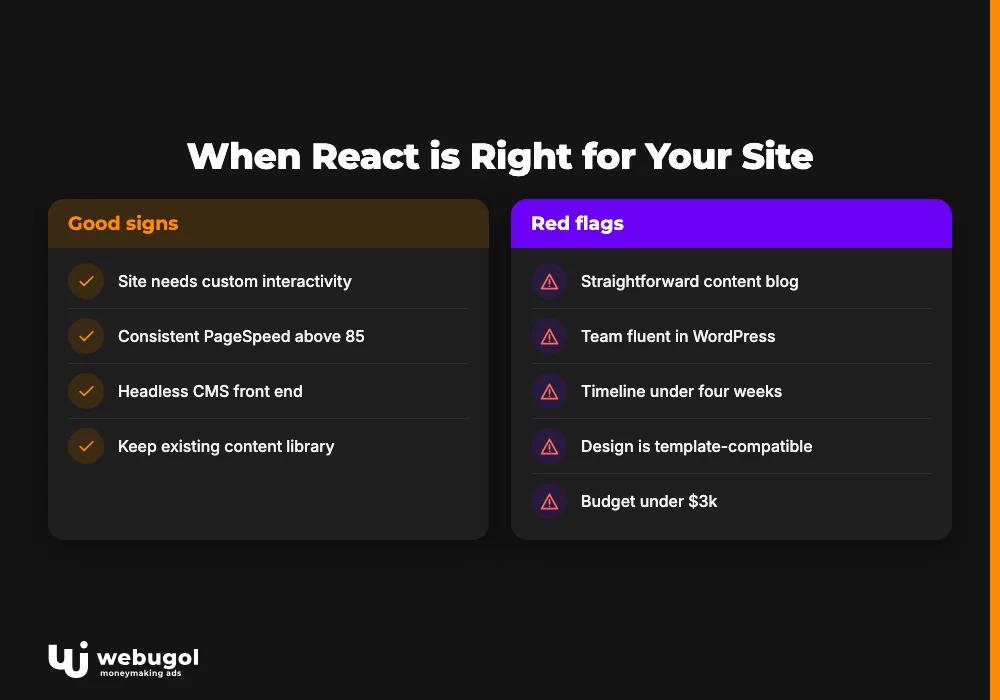
React fits when your site needs custom interactivity, consistent PageSpeed above 85, or a headless CMS front end. Here are cases where it adds complexity without proportional benefit:
- Your site is a straightforward content blog with no interactive components.
- Your internal team is already fluent in WordPress and performance complaints are minimal.
- Your timeline is under four weeks and the design spec is template-compatible.
- Budget is under $3k and growth requirements are limited.
If none of these apply, React is likely the right foundation.

How much does a React website design cost?
A focused React marketing site starts at $3–5k for MVP scope. A full migration from WordPress to a React-based front end runs $5–15k depending on complexity.
Five cost drivers determine where a project lands: design complexity, page count, third-party integrations, CMS setup, and the ongoing support model. Projects at the lower end of the range typically have a clear spec, limited integrations, and a small initial page count. Complexity compounds once custom animations, authenticated user flows, or multi-region content enter scope.
Is React SEO-friendly?
Yes, React is fully SEO-friendly when rendered server-side. The concern about Google crawling JavaScript-heavy pages applies specifically to client-side-only React, where the browser does all the rendering after the initial blank-page load.
Server-side rendering (SSR) and static site generation (SSG) deliver fully rendered HTML to the crawler on the first request, the same way a traditional CMS does. The architecture decision matters more than the framework. For a deeper look at how rendering strategy affects organic performance, headless cms seo covers the specific trade-offs between SSR and SSG for content-heavy sites.

Ready to see what React can do for your site?
If you have worked through the platform comparison and cost breakdown above and are ready to scope a project, the next step is a 30-minute call. The Webugol team reviews your current site, identifies the highest-impact changes, and maps a build plan tied to your acquisition goals.
Book a strategy call to start the scoping conversation.
FAQ
What is React website design?
React website design is the process of building websites using the React JavaScript library, which structures every UI element as a reusable component. This approach produces faster load times, more interactive experiences, and easier long-term maintenance compared to monolithic CMS platforms.
Is React good for business websites?
React is a strong choice for business websites that require fast load times, interactive UI, or custom functionality beyond what plugins can deliver. It performs best when paired with server-side rendering, which ensures full SEO indexability and consistent performance across page types.
How much does a React website design cost?
A focused React marketing site typically starts at $3–5k for MVP scope. A full migration from WordPress to a React-based front end runs $5–15k depending on content volume, integrations, and design complexity.
Is React SEO-friendly?
React is fully SEO-friendly when implemented with server-side rendering or static site generation. Client-side-only React can create indexing challenges, so the rendering strategy matters as much as the framework itself.
When should I use React instead of WordPress?
React is the right fit when your site needs custom interactions, consistent sub-2-second load times, or a headless CMS front end. WordPress remains appropriate for straightforward content sites where the plugin ecosystem outweighs the need for peak performance.

