


You’re analyzing competitor backlinks and see two metrics: Domain Rating (DR) and URL Rating (UR). Which one actually matters? Both domain rating vs URL rating come from the same tool (Ahrefs) and look similar on the surface, but mixing them up can lead to misguided link-building campaigns and wasted budget.
URL rating analyzes the authority of a particular page, whereas domain rating assesses the authority of your entire website. Understanding the nuance between the two determines whether you should focus on building site-wide authority or powering up specific landing pages.
Today at Webugol, we explain how these metrics work, what makes them different, and most importantly, how to leverage them to go ahead of your competitors.
What is Domain Rating (DR)?
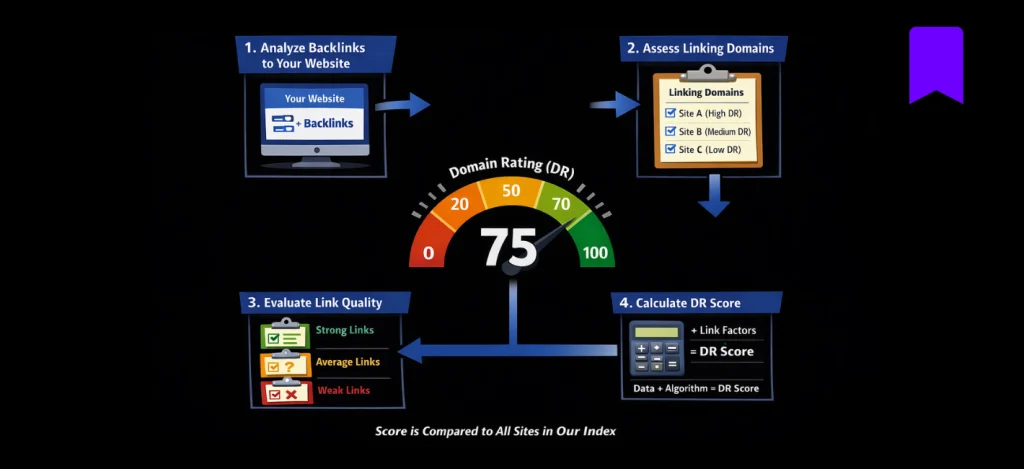
Domain Rating (DR) is a proprietary metric developed by Ahrefs that shows the strength of a website’s backlink profile. DR provides you with an overview of how authoritative your website seems to search engines, depending on who is linking to it. When comparing URL rating vs domain rating, it’s important to note that DR measures the overall domain authority, while URL rating focuses on individual page strength.
How DR is calculated
The calculation is logarithmic and runs on a scale from 0 to 100. Because it’s logarithmic, growing your DR from 20 to 30 is much easier than growing it from 70 to 80. The score is primarily influenced by:
- Referring Domains: The number of unique websites linking to you.
- Backlink Quality: The DR of the sites that link to you. Compared to a link from a DR 10 site, a link from a DR 90 site has significantly more weight.
- Dofollow vs. Nofollow: DR mostly ignores “nofollow” links and only looks at “dofollow” links that pass authority.
Domain Rating vs URL Rating: Interpreting the score
What defines a “good” DR depends on your niche. However, here is a general breakdown:
- DR 0-20: New sites or local businesses with few links.
- DR 21-50: Established small-to-medium businesses or blogs.
- DR 51-75: Popular brands and successful niche websites.
- DR 76-100: Big internet companies like Google, Facebook, and The New York Times (DR 95).
The fact that DR (Domain Rating) is a comparison metric must be kept in mind. Don’t worry about getting to DR 90 if you have a new blog with a DR of 12. Simply said, you want your DR to be higher than that of your direct competitors. Keep in mind the difference between domain rating vs URL rating, as each serves a distinct purpose in assessing overall site authority versus individual page performance.
What is URL Rating (UR)?
While domain authority looks at the big picture, URL Rating (UR) gets granular. UR is a metric that measures the strength of an individual page’s backlink profile.
URL Rating vs Domain Rating: How UR differs from DR
A website might have huge overall authority, but a specific deep page with zero internal or external links could still have a low UR. Conversely, a specific viral blog post on a smaller site could have a very high UR.
How UR is calculated
Like DR, UR uses a 0-100 logarithmic scale. But the factors that affect it are only true for that unique URL:
- Direct Backlinks: External sites linking specifically to that page.
- Internal Links: This is a major differentiator. A URL’s UR is increased by “link juice” from other authoritative sites on your own website.
- “Dofollow” Links: UR respects the “dofollow” attribute because these are the links that give ranking strength.
Domain Rating vs URL Rating: Key Differences
1. Scope of measurement
The most fundamental difference is scope. A site-wide aggregate is called a domain rating. Changes to a single page don’t affect it until that page gets enough high-authority links to raise the average for the entire domain. Rating of URLs is separate. If one page on your DR 40 site has gone viral or gotten a lot of attention, you can have a UR 80 page on that site.
2. Practical use cases
When analyzing possible link partners, you use DR (Domain Rating). You want high DR sites to guest post on because they pass on more authority. However, understanding the difference between domain rating vs URL rating is essential, as the URL rating can show the specific strength of a single page, which could be more relevant depending on your link-building strategy.
UR is used to analyze the search engine rankings’ difficulty. Check the UR of the pages that are at the top of the search results if you want to rank for a term. Competitors will be difficult to beat, even if their domain authority is low, if their individual pages have a high UR (many backlinks).
3. Link juice flow
DR shows you how much “link juice” a site has to provide. UR indicates the amount of “link juice” that a particular page got. This is why internal linking is so important: it lets you share the high UR of your homepage with lower UR product pages to help them rank.
Myth-busting
A common misconception is that a high DR guarantees high rankings for every page. This is false. A DR 80 site can post a tiny, poorly optimized piece of content that doesn’t get any traffic. Google ranks pages, not websites. High DR can help you get ahead, but high UR (which is based on certain links and content quality) is often what gets a page to the top.

Domain Rating vs URL Rating: How Domain Rating Affects Your SEO
Domain Rating acts as a strong indicator of your site’s overall health, and how authoritative other webmasters (and search algorithms, indirectly) consider it to be.
Correlation with organic traffic
There is a very strong link between high DR and high organic traffic, despite Ahrefs’ express statement that domain authority is not a direct Google ranking criterion. Why? Because sites with high DR frequently have thousands of backlinks, which are one of the most important factors for ranking.
Role in competitive benchmarking
For “at-a-glance” competition analysis, DR (Domain Rating) is the greatest tool available. It helps you in setting reasonable expectations.
Understanding the difference between domain rating vs URL rating can further refine your analysis, allowing you to determine whether to focus on domain-level authority or specific page strength.
Actionable improvement strategies
Increasing your DR is a long game. It takes months, sometimes years.
- Digital PR: Produce content that is noteworthy enough to attract links from significant media (high DR sites).
- Link Reclamation: Look for mentions of your brand that don’t have links and urge the publisher to add one.
- Guest Posting: Offer outstanding content to reputable websites in your industry.
How URL Rating Affects Your SEO
URL Rating can be a more useful metric if you want to change the ranking of a certain keyword.
Impact on ranking potential
According to Ahrefs, UR has an even stronger correlation with rankings than DR. This makes sense because Google’s algorithm looks at how relevant and authoritative the page that answers the search query is. A high UR indicates to Google that the content on your page is useful and trustworthy.
Identifying your strongest assets
You may find your “power pages” by looking at your UR. In order to transfer that authority, you should link from the high-UR page to your other priority pages.

Domain Rating vs URL Rating: Which Should You Focus On?
So, is it better to chase a high Domain Rating or a high URL Rating? The answer depends entirely on your current growth stage and goals.
For new websites (Focus: URL Rating)
If you are just starting, your DR will be low (probably 0-10). It takes a long time to move that needle. Instead, focus on creating incredible content pieces and building links directly to them (increasing UR). A single high-UR page can rank for competitive keywords even if your overall domain is weak. This approach brings in early traffic and validation.
For established sites (Focus: Balance)
If you already have a decent DR (30+), you have “authority in the bank.” You should switch your focus to internal linking. Use your existing site authority to boost the URL rating of new pages you publish. Simultaneously, run broader brand-awareness campaigns to keep that DR climbing slowly.
Understanding URL rating vs domain rating will help you prioritize internal strategies effectively, using both metrics for targeted growth.
The content marketing perspective
From a content strategy view, UR tells you which topics are resonating. If you publish a guide that naturally attracts links and gains a high UR, you should double down on that topic cluster. DR tells you how “loud” your microphone is – the higher your domain authority, the easier it is to get your new content heard (indexed and ranked) quickly.
Common Mistakes to Avoid
- Obsessing over metrics over money
- Comparing metrics across tools
- Expecting overnight results
- Ignoring internal linking
Conclusion
Understanding the difference between Domain Rating vs URL Rating is the first step toward a more mature SEO strategy. While DR helps you benchmark your overall authority against competitors, UR provides the surgical precision needed to rank specific pages. Both are vital, but they serve different roles in your growth.
Ultimately, you shouldn’t just chase numbers. Focus on creating high-quality content that users love and other sites want to link to. When you do that, both your DR and UR will rise naturally.
Need help developing a comprehensive SEO strategy that balances DR and UR optimization? Webugol Agency specializes in data-driven SEO approaches that deliver real results. Contact us to audit your site’s authority metrics and create an actionable improvement plan.