



Ahrefs vs Majestic: Which Backlink Tool Is Right for You?
Ahrefs vs Majestic is the most searched seo software comparison among professionals weighing an all-in-one SEO platform against a specialist link intelligence tool. Ahrefs covers keyword research, technical site audits, rank tracking, and backlink analysis from one interface. Majestic is a pure backlink analysis tool built entirely around Trust Flow and Citation Flow, with no keyword or audit features.
For teams running a full SEO workflow, Ahrefs is the more complete platform. For link specialists who need historical link data, topical trust filtering, and developer-friendly API access, Majestic earns its seat.
At Webugol, we use both platforms on live client campaigns. This guide focuses on the decisions that actually matter: which tool handles specific tasks better, where each shows its limits, and how to build a workflow that does not duplicate effort or inflate costs.
What is the difference between Ahrefs and Majestic?
Ahrefs is a full SEO platform; Majestic is a pure link intelligence tool. Ahrefs handles keyword research, technical site audits, rank tracking, content gap analysis, and backlink monitoring from a single dashboard. Majestic maps the web's link structure with more contextual depth than any competing platform, and stops there.
The metrics each tool uses reflect that focus. Ahrefs measures link authority through Domain Rating (DR) and URL Rating (UR), both on a 0-to-100 logarithmic scale. DR correlates well with ranking potential, is fast to interpret, and is easy to communicate to clients. Majestic uses Trust Flow and Citation Flow. These metrics reveal the nature of a site's authority rather than just its scale. DR tells you how much authority a domain has. Trust Flow and Citation Flow tell you where that authority comes from.
Both approaches are valid. Neither tool is redundant. The strongest SEO workflows often run both, and the choice between them depends on the specific task at hand.
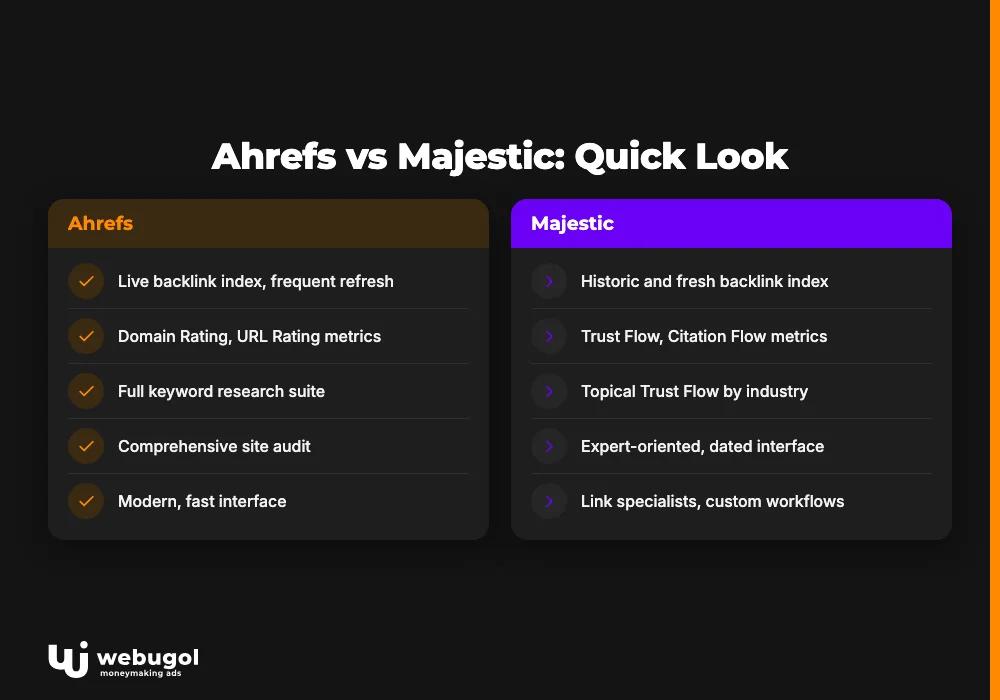
Quick comparison: Ahrefs vs Majestic at a glance
| Feature | Ahrefs | Majestic |
|---|---|---|
| Backlink database | Live index, refreshed every 15-30 min | Historic (5+ years) + Fresh Index |
| Link quality metric | Domain Rating (DR) / URL Rating (UR) | Trust Flow (TF) / Citation Flow (CF) |
| Topical authority mapping | Not available | Topical Trust Flow by industry |
| Keyword research | Full suite: Google, YouTube, Amazon, Bing | None |
| Site audit | Full technical crawler | Not available |
| Competitor analysis | Link Intersect, Content Explorer | Clique Hunter, Neighborhood Checker |
| PBN / network detection | Not available | Neighborhood Checker |
| API access | Enterprise plans only | Standard plans |
| Interface | Modern, fast | Dated, expert-oriented |
| Best fit | All-in-one SEO teams | Link specialists, custom workflows |
If you need one platform for the complete SEO cycle, this table answers the question. If you are evaluating Majestic as a supplement to an existing stack, the sections below cover where it earns its place.
Which SEO tool has a larger backlink database?
Ahrefs has the faster, fresher live index; Majestic has the deeper historical record. For active link-building campaigns, Ahrefs is the better choice. For auditing the full link history of an aged domain, Majestic's Historic Index has no direct equivalent.
Ahrefs runs AhrefsBot, which the company describes as one of the most active non-Google crawlers by URL crawl rate. Its Live Index refreshes every 15 to 30 minutes. Place a new link today, and you can confirm it is indexed within hours. That speed is critical when monitoring a live outreach campaign where new links need to be verified quickly.
Majestic operates two separate indexes. The Fresh Index covers current link data and updates regularly. The Historic Index is the more distinctive product. It spans more than five years of crawl history and is widely regarded as one of the most complete records of the web's historical link structure. For a domain that has been active for a decade, this index surfaces high-authority referring domains that Ahrefs removed from its live index as crawl priorities shifted over time.
The ahrefs vs majestic database difference has practical consequences. At Webugol, we have run link audits where a client domain showed a meaningfully different authority profile in Majestic's Historic Index than in Ahrefs' current data. Redirected or expired links from years earlier still shaped how that domain accumulated authority. Ahrefs showed the current picture. Majestic showed why it looked that way.
The question is not which database is larger in absolute terms. Both are enormous and adequate for most tasks. The real question is whether you need current data or historical data.
How does Trust Flow compare to Domain Rating?
Trust Flow measures proximity to trusted seed sites; Domain Rating measures overall link authority based on volume and quality of linking domains. Both metrics run from 0 to 100, but they answer different questions about the same backlink profile.
Domain Rating is a composite number on a logarithmic scale. The gap between DR 80 and DR 90 represents a much larger real-world difference than the gap between DR 20 and DR 30. DR correlates reasonably well with ranking potential. When sorting a large list of link prospects by a fast threshold, DR is practical and reliable.
Majestic Trust Flow works differently. It measures how close a site's link profile is to a curated set of seed sites that Majestic considers trusted. Sites earning links from sources that are themselves close to those seeds accumulate high Trust Flow. Majestic Citation Flow counts inbound links separately, measuring volume regardless of quality.
The ratio between the two is where domain rating explained as a single number shows its limits. A site with Citation Flow 48 and Trust Flow 9 has a large volume of low-quality or manipulative links.
That same site might still carry a respectable DR in Ahrefs, because DR weighs volume and quality together in a way that softens an obvious quality gap. Trust Flow and Citation Flow make that gap explicit and measurable.
This is one of the clearest points where the ahrefs vs majestic philosophies diverge. Majestic extends this further with Topical Trust Flow, which categorizes each site's link authority by industry. A domain with strong authority in "Health/Medicine" is a fundamentally different prospect than one whose authority comes from "Recreation/Gambling," even if both show similar Citation Flow scores.
Ahrefs tells you a high-DR site links to you. Topical Trust Flow tells you whether that authority is contextually relevant to your niche.
For a health site evaluating guest post opportunities, discovering that a prospect's Trust Flow comes primarily from unrelated industries changes prioritization entirely. Running prospects through this filter before outreach reduces wasted effort on links that will not move the needle for topically sensitive queries. No single seo software comparison can declare a clear winner here. DR is faster to use. Trust Flow and Citation Flow are more precise about quality.
Is Majestic better than Ahrefs for backlink analysis?
For contextual link quality analysis, yes. Trust Flow, Citation Flow, and Topical Trust Flow together provide more nuance than Domain Rating alone. For speed, freshness, and daily campaign use, Ahrefs is the stronger backlink analysis tool.
The ahrefs vs majestic distinction in backlink analysis is really speed versus precision. Ahrefs works better when you need to act quickly: monitoring new links from an outreach campaign, filtering referring domains by anchor text, spotting patterns in a competitor's profile, or packaging data for a client report. The interface is clean and the data is immediately usable.
Majestic works better when careful quality judgment matters. Filtering prospects by topical relevance, comparing Trust Flow to Citation Flow ratios to flag suspicious profiles, and validating a domain's multi-year link acquisition history all benefit from Majestic's approach. The extra context is worth the slower, expert-oriented interface.
Two Majestic tools deserve particular attention. Clique Hunter, similar to Ahrefs' Link Intersect, identifies domains that simultaneously link to multiple competitors. The key difference is that Clique Hunter ranks shared linkers by Trust Flow. Ahrefs shows the opportunity. Majestic shows which portion of that opportunity is worth pursuing.
The Neighborhood Checker has no Ahrefs equivalent. It examines IP addresses and subnets associated with linking domains. A cluster of links from the same narrow IP range is a common fingerprint of a private blog network. When auditing a domain before acquisition, checking a competitor for penalty risk, or validating the integrity of a link profile, this tool surfaces manipulation that neither DR nor Trust Flow alone would catch.

Keyword research: Ahrefs leads by a wide margin
Ahrefs' Keywords Explorer is one of the most complete keyword research tools available. It covers Google, YouTube, Amazon, and Bing from a single interface. The platform uses clickstream data to estimate actual click-through rates rather than raw query volume alone, which produces more realistic traffic projections. From a single seed keyword, it generates thousands of related ideas sorted by parent topic, keyword difficulty, and estimated click volume.
Majestic has no keyword research functionality. This reflects a deliberate product focus, not an oversight. But for any team that needs to handle content planning, topic clustering, PPC research, or editorial prioritization, Majestic cannot function as a standalone platform.
This is where the seo software comparison becomes a total cost question. Running Majestic alongside a separate keyword platform adds a second subscription. For larger agencies where the specialized link depth justifies the expense, that is a reasonable setup. For smaller teams, adding a second tool changes the budget calculation significantly. The complete absence of keyword features in Majestic is the clearest argument for making Ahrefs the primary platform.
Ahrefs site audit and technical SEO
The Ahrefs site audit crawls your website and returns broken links, missing or duplicate meta tags, redirect chains, orphaned pages, slow-loading URLs, and internal link structure gaps. It checks for Core Web Vitals issues and JavaScript rendering failures. For most sites, it covers the full technical baseline without requiring a separate crawler.
Majestic can crawl pages, but its crawl focuses on link context rather than page health. It does not flag duplicate title tags, missing H1s, server errors, or canonicalization problems. A complete technical audit using only Majestic means adding Screaming Frog, Lumar, or a comparable dedicated crawler to the workflow.
A structured review of your site's technical and content setup is the foundation of any serious SEO engagement. Ahrefs handles both the technical and backlink layers in one platform. Majestic handles only the latter.
When should I use Majestic instead of Ahrefs?
The ahrefs vs majestic choice becomes clearest in four specific scenarios. Outside these, Ahrefs handles the workflow more efficiently.
Historical link auditing on aged domains. Majestic's Historic Index spans more than five years. For a domain active before 2020, this index often reveals referring domains that no longer appear in Ahrefs' live index. Understanding the complete history of a domain's link acquisition matters when auditing a potential acquisition, investigating unexplained ranking drops, or checking whether authority was built organically over time or through short-term manipulation.
Topical trust filtering for link prospecting. Majestic Citation Flow combined with Topical Trust Flow lets you filter prospects by industry category, not just overall authority score. A candidate that looks strong in Ahrefs based on DR may reveal in Majestic that its Trust Flow is concentrated in verticals unrelated to your niche. Running prospects through this filter before outreach reduces wasted effort and improves the topical quality of acquired links.
PBN and link network detection. The Neighborhood Checker identifies clusters of linking domains sharing IP addresses or subnets. This pattern is a reliable indicator of private blog networks. When evaluating a domain for acquisition, assessing competitor penalty exposure, or reviewing an existing profile for algorithmic risk, this tool surfaces systematic manipulation that neither DR nor Trust Flow would detect on its own.
Cost-effective API integration for custom scoring. Majestic makes its API available on standard plans. Ahrefs restricts API access to Enterprise-level plans, which cost significantly more per month. For agencies building internal domain qualification pipelines that grade prospects at scale, Majestic's standard-plan API is a practical cost advantage.
Outside these four scenarios, Ahrefs is the more efficient and practical daily choice for SEO work.

Competitor analysis: different questions, different tools
Both tools support competitor backlink analysis. The ahrefs vs majestic difference here is about what question each tool helps you answer.
Ahrefs' Link Intersect takes multiple competitor domains and returns sites that link to all of them but not to you. That list becomes a direct outreach queue. Content Explorer shows which competitor pages attract the most backlinks and social shares, informing the content angle for any new piece targeting the same SERP.
Majestic's Clique Hunter performs the same multi-competitor analysis but ranks shared linkers by Trust Flow. The output shows not just who links to your competitors but which of those sites carry genuine authority worth pursuing. The Neighborhood Checker adds another layer, flagging whether any competitor link clusters originate from networks rather than independent editorial decisions.
Majestic also lets you examine a competitor's full Topical Trust Flow distribution. If a competitor carries strong DR but their Trust Flow concentrates in unrelated verticals, that finding explains why their link profile may not produce the ranking power the raw number suggests. These are questions Ahrefs cannot help you answer.
Ahrefs identifies the opportunity. Majestic validates whether it is worth taking.
API access: Ahrefs vs Majestic for developers
For teams building custom workflows or domain scoring tools, API access is a real factor in the ahrefs vs majestic evaluation.
Ahrefs restricts API access to Enterprise-level plans, which carry a significantly higher monthly cost than standard subscriptions. The Google Looker Studio connector is available for client reporting, but each query consumes API credits. Teams reporting inside Ahrefs' native interface will not notice this constraint. Teams building automated data pipelines will.
Majestic offers API access on standard plans. The API is well-documented and pulls Trust Flow, Citation Flow, and full link data into internal dashboards or custom scoring tools. The Open Apps ecosystem allows third-party developers to build directly on top of Majestic's data. For agencies grading hundreds of domains per week through a custom pipeline, this structure reduces tooling costs without sacrificing the link data quality needed for the job.
The rule is straightforward. Teams working inside a standard Ahrefs interface will never need API access. Teams building proprietary scoring tools will find Majestic's standard-plan API a meaningful cost advantage over Ahrefs' enterprise-only gating.
Which tool belongs in your SEO stack?
The ahrefs vs majestic decision is really about workflow fit, not about which tool wins on a feature checklist.
Ahrefs is the right primary platform for any team running the full SEO cycle: keyword research, technical auditing via the Ahrefs site audit, content strategy, rank tracking, and backlink monitoring. It consolidates multiple tools into one subscription, is faster to onboard, and is easier for stakeholders to follow. If you had to work from one tool only, Ahrefs is the one.
Majestic is the right supplementary tool for teams that treat link building as a core discipline. Its Trust Flow metrics, Historic Index, Topical Trust Flow segmentation, and Neighborhood Checker provide a quality layer that Ahrefs' DR-based approach does not replicate. Running both gives the most complete picture of any domain's link profile, current and historical.
How paid and organic search channels compare for your acquisition goals also shapes which tool priorities make sense for your team. Teams investing in content-driven link acquisition extract more from Majestic's prospecting tools. Teams running blended organic and paid strategies extract more from Ahrefs' keyword and content capabilities.
Ready to build the right SEO stack?
Choosing the right backlink analysis tool is one step in building a competitive SEO workflow. The platform matters, but the strategy behind it matters more.
At Webugol, our SEO team runs both Ahrefs and Majestic as part of a structured client process. If you want a clear picture of your site's current link profile, a technical audit, or a plan for building domain authority in a competitive niche, contact us to start the conversation.
FAQ
What is the main difference between Ahrefs and Majestic?
Ahrefs is a full SEO platform covering keywords, site audits, rank tracking, and backlinks from one interface. Majestic is a dedicated link intelligence tool focused on Trust Flow, Citation Flow, and backlink structure, with no keyword or audit capability. Ahrefs replaces multiple tools; Majestic specializes in one discipline.
Is Majestic better than Ahrefs for backlink analysis?
Majestic provides more contextual link quality data through Trust Flow, Citation Flow, and Topical Trust Flow, giving a more precise picture of link relevance and reliability than Domain Rating alone. Ahrefs is faster and more practical for daily campaign monitoring. Which is better depends on whether the task requires depth or speed.
How does Trust Flow compare to Domain Rating?
Domain Rating measures overall link authority on a 0-to-100 logarithmic scale based on the quantity and quality of linking domains. Trust Flow measures proximity to trusted seed sites, reflecting link reliability rather than raw volume. DR is faster for filtering large prospect lists; Trust Flow is more precise about quality.
When should I use Majestic instead of Ahrefs?
Use Majestic for historical link audits on aged domains, topical trust filtering during prospecting, PBN detection through the Neighborhood Checker, and cost-effective API integration into custom domain scoring tools. For keyword research, technical site audits, and daily campaign management, Ahrefs is the more complete solution.
Which tool is better for keyword research?
Ahrefs has a full keyword research suite covering Google, YouTube, Amazon, and Bing with clickstream-based traffic estimates and keyword difficulty scoring. Majestic has no keyword research capability at all. Between these two tools, Ahrefs is the only relevant option for keyword research.