



Telehealth website development: features, costs, and compliance in 2026
Telehealth website development is the process of designing and building a secure, patient-facing platform that moves clinical care online without sacrificing safety or regulatory compliance. A complete telehealth website combines encrypted video consultations, appointment scheduling, a patient portal, and HIPAA-compliant data handling into one unified system. Healthcare providers who invest in a purpose-built platform, rather than adding a video link to a generic business site, report stronger patient retention and fewer compliance problems. This guide covers what that build process actually involves, which features matter most, and what to look for in a development partner.
Why telehealth has become a clinical standard
Remote care has moved from a convenience feature to a core delivery model across medicine. The structural reasons are straightforward. Patients in rural or underserved areas no longer need to drive hours for a follow-up. Those managing chronic conditions benefit from more frequent check-ins without the friction of an in-person visit. Providers see lower no-show rates because the barrier to attendance drops when an appointment is a phone or laptop away.
The operational case for practices is equally concrete. A well-configured HIPAA compliant medical website that handles scheduling, intake forms, and post-visit messaging removes entire categories of administrative work from clinic staff. That transforms the daily experience of running a virtual practice. Specialties like mental health, dermatology, and primary care have found high-volume virtual care sustainable when the underlying platform is built for the purpose.
Both sides of the clinical relationship benefit from telehealth website development.
For healthcare providers:
- Practices expand geographic reach without opening additional physical locations.
- Appointment efficiency increases and schedule gaps decrease across the day.
- Patient data management connects directly to existing records and reduces manual entry.
- Flexible scheduling gives providers more control over their work-life balance.
- Virtual appointments see lower no-show rates than traditional in-person visits.
For patients:
- Patients access care immediately, regardless of location or transportation options.
- Specialists become reachable without taking time off work or arranging childcare.
- Chronic condition management improves through regular virtual follow-ups.
- Waiting-room exposure drops for immunocompromised patients.
- Patients gain access to specialists who are not available in their local area.
What is the difference between telehealth and telemedicine websites?
The terms are used interchangeably, but they describe different scopes.
Telemedicine refers specifically to the remote delivery of clinical services: physician-to-patient consultations, diagnosis, and treatment via video or phone. A telemedicine website is purpose-built for that transaction. A provider logs in, a patient books and attends a video appointment, and the clinical record updates.
Telehealth is broader. It covers remote patient monitoring, patient education, administrative workflows, mental health sessions, chronic disease management programs, and provider training delivered at a distance. A full telehealth platform layers these capabilities alongside the core video consultation feature.
In practice, when a practice hires a telemedicine web development company or a healthcare web development firm, the conversation covers both. A virtual clinic website built only for video consultations has a fundamentally different architecture from one that integrates remote monitoring devices, insurance billing, and asynchronous messaging. Knowing which model your practice actually needs before telehealth website development begins determines almost every downstream decision: the technology stack, the third-party integrations, the compliance surface, and the timeline.

What features should a telehealth website have?
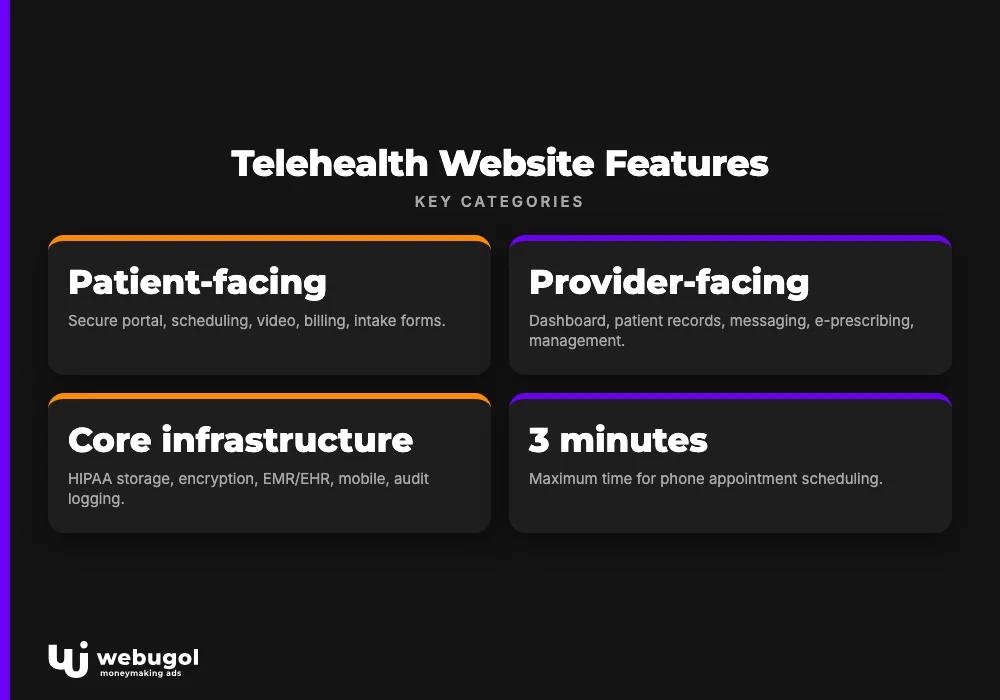
Getting the feature scope right is the central challenge of telehealth website development. The platform must work as a full clinical system, not a website with a video call attached. The features that matter fall into three categories.
| Category | Essential features |
|---|---|
| Patient-facing | Secure patient portal, appointment scheduling, video consultation, online billing and payment, customizable intake forms |
| Provider-facing | Provider dashboard, patient record access, secure messaging, e-prescribing integration, appointment management |
| Core infrastructure | HIPAA-compliant data storage, end-to-end encryption, EMR/EHR integration, mobile compatibility, audit logging |
Patient-facing features
Secure patient portal. Patients need a private login giving them access to appointment history, test results, invoices, and messages with their care team. Without it, patient data fragments across channels, creating compliance exposure and care continuity problems that erode trust over time.
Intuitive appointment scheduling. The booking flow must be completable on a phone in under three minutes. Friction converts a scheduling problem into a lost appointment. Simple, fast booking is not a nice-to-have.
High-quality video consultation. The video layer must handle variable internet conditions without dropping the connection mid-consultation. Providers need session controls: recording with patient consent, screen sharing for reviewing images or lab results, and the ability to add a third party such as an interpreter.
Online billing and payment. Integrated billing reduces administrative friction on both sides. Patients pay at session end without waiting weeks for a paper invoice. Practices see faster payment cycles and smaller accounts receivable backlogs.
Customizable intake forms. Digital intake collected before the appointment means the provider starts the session already informed. These forms must be editable by administrators without requiring a code change, since clinical workflows evolve constantly.
Provider-facing features
Secure messaging. HIPAA-compliant asynchronous messaging allows providers to answer patient questions between appointments, share lab results, and coordinate with colleagues. This is a clinical communications channel, distinct from ordinary email.
E-prescribing integration. Connecting the platform to a prescribing system lets providers issue prescriptions directly from the consultation interface. It eliminates fax-based workflows that persist in many practices.
Patient record management. Providers need a single view of the patient record during the consultation. Genuine EMR/EHR integration means data flows into the existing record in real time, not through a separate portal open in another browser tab.
Core infrastructure
Mobile compatibility. A significant portion of patients access telehealth services from a smartphone. The interface must function fully on iOS and Android without requiring a separate app download. Practices that want a dedicated native experience will need telehealth app development added to the project scope from the start.
Audit logging. Every access to protected health information must be logged with a timestamp and a user identity. This is a required HIPAA technical safeguard, and it is also what makes any breach investigation possible.
EMR/EHR integration is frequently the most technically complex part of any healthcare web development project. Different EHR vendors use different APIs, and legacy systems sometimes require custom middleware to bridge the gap. A team with prior telehealth website development experience will have solved this before. A team encountering it for the first time will learn on your project.
What is HIPAA compliance for telehealth platforms?
HIPAA compliance means the platform meets the Privacy Rule, Security Rule, and Breach Notification Rule requirements governing protected health information (PHI) in the United States. For a telehealth platform, these requirements translate into technical decisions embedded throughout the architecture. A policy document alone does not constitute compliance.
The Privacy Rule governs how patient information is collected, used, and disclosed. The platform must ensure patient data is accessible only to authorized users, and only for authorized purposes. This includes limiting what third-party analytics scripts and session tracking tools can observe during patient interactions.
The Security Rule mandates specific technical safeguards for electronic PHI. Required measures include end-to-end encryption for data in transit, encryption for data at rest, unique user identifiers, automatic session timeouts, and audit controls across every system that touches a patient record. Every API endpoint handling PHI requires authentication.
Business Associate Agreements (BAAs). Every third-party vendor handling PHI on behalf of the practice, including the hosting provider, video platform, and messaging service, must sign a BAA. A HIPAA compliant medical website is not only code. It is also a set of signed legal contracts with every vendor in the stack.
Breach notification. If PHI is accessed or disclosed improperly, the practice has mandatory notification obligations to affected patients and to HHS. A well-built platform includes monitoring and alerting so the team learns about potential issues quickly, not weeks after the fact.
Telehealth website development that starts with HIPAA requirements built into the architecture costs far less to maintain and audit than a platform that retrofits compliance later. Working with a telemedicine web development company that has navigated this before is the difference between compliance as a design constraint and compliance as an emergency retrofit.
For a closer look at how regulatory requirements shape technical decisions in healthcare, the healthcare web design and development guide covers the design and compliance layer in practical detail.
How to choose a telehealth website development company
Selecting a development partner for a clinical platform requires different evaluation criteria than hiring an agency for a marketing site. The consequences of a poor choice are also different.
Healthcare industry experience. A team that has never built a HIPAA-compliant system will learn the requirements on your project. The compliance surface of a telehealth platform is large, and mistakes carry regulatory consequences. Look for a portfolio of healthcare-specific builds, not a stated willingness to learn the domain.
Portfolio and case studies. Concrete examples of previous telehealth website development or telemedicine website design projects tell you whether the team can handle EMR integration, video infrastructure, and the security layer. Claims of healthcare experience without supporting examples are a warning sign.
Customization capability. Every practice has different clinical workflows. A vendor offering only a pre-built template with minimal configuration will likely fail to accommodate the intake forms, billing codes, or specialty-specific features your practice needs. Ask specifically what is configurable without a code change.
Security testing practices. Ask what vulnerability testing the team runs. A competent team treats penetration testing, dependency scanning, and OWASP checks as standard practice. These should not be optional add-ons at extra cost.
Scalability. A virtual clinic website handling 200 patients per month may fail under 2,000. Architecture decisions made early in development determine how easily the platform scales. Cloud-native infrastructure with horizontal scaling is the right answer for most growth-oriented practices.
Communication and transparency. A telehealth website development engagement takes months. The team needs to surface problems early, communicate decisions clearly, and involve the practice in choices that affect clinical workflows. An agency that goes quiet for weeks between updates is a project risk.
Post-launch support. HIPAA requirements, browser APIs, and video platform dependencies change over time. Understand what post-launch maintenance looks like and what it costs before signing anything.
When our team at Webugol takes on a healthcare web development project, the work begins with a discovery phase that maps clinical workflows before a line of code is written. That is not standard at every agency. It is the difference between a platform that fits the practice and one that forces the practice to adapt to the software.
The development process, step by step
Understanding what happens during a professional telehealth website development engagement sets accurate expectations. It also helps practices make better decisions throughout the project.
Initial consultation and discovery. The team conducts structured intake covering which clinical workflows the platform must support, who the patient populations are, what existing systems need to integrate, and what regulatory context applies. This phase produces a scope document both parties agree to before design or code begins. No surprises later means fewer costly changes mid-project.
Strategy and planning. Based on discovery, the team creates a detailed project plan with user personas, patient journey maps, and a defined technical architecture. Technology stack, hosting environment, and EMR integration approach are locked in at this stage.
UI/UX design. Designers produce wireframes and high-fidelity mockups. Healthcare interfaces must serve patients across a wide range of technical fluency. That is a different design challenge from a consumer app aimed at a narrow demographic. Clean, professional, and usable without instruction: those are the targets.
Development and integration. Engineering builds the front-end and back-end in parallel. The video consultation layer, payment gateway, messaging system, and EMR integration are all connected here. This is the longest phase of most telehealth website development projects.
Rigorous testing. Before launch, the platform goes through security testing, HIPAA compliance verification, load testing, and cross-device compatibility checks. For a clinical platform, quality assurance is not optional.
Deployment and launch. The team manages production deployment, runs final verification, and monitors for errors in the first hours after go-live. A clean launch is a managed process, not a single button press.
Training and ongoing support. Staff need role-specific training on the features they use daily. The practice also needs a defined support channel for post-launch issues. Ongoing maintenance keeps the platform secure as dependencies and regulations evolve.
How long does it take to build a telehealth website?
Timeline in telehealth website development depends on platform scope, integration complexity, and how quickly the practice reviews and approves deliverables. No two projects are identical.
A core-feature platform covering video consultation, scheduling, a patient portal, and HIPAA-compliant infrastructure typically takes three to five months from discovery to launch, based on our team's project experience. That window assumes the practice is responsive during design reviews and no major scope changes occur mid-project.
More complex builds take longer. Legacy EHR integration, custom billing logic tied to specific insurance workflows, and multi-provider clinic management all add months. Six to nine months is realistic for platforms in that category.
Discovery is where timeline compression is most dangerous. Practices that rush through discovery to start development faster frequently encounter costly rework cycles when a requirement not surfaced early turns out to require a fundamental architectural change.
A phased approach helps many practices. Launching with a production-ready core feature set and adding secondary capabilities in subsequent releases lets the practice start generating value from the platform earlier. Webugol's MVP development services are structured for teams that want a working first release without waiting for a fully feature-complete build.
How much does telehealth website development cost?
Cost in telehealth website development depends on scope, team location, and integration complexity. No honest universal figure exists because a five-screen scheduling prototype and a multi-practice platform connected to three EHR systems have almost nothing in common.
The factors that consistently drive cost higher are:
Custom EHR and EMR integration. Most EHR vendors do not publish clean, well-documented APIs. Building middleware to connect a telehealth platform to a legacy system requires significant engineering time and carries ongoing maintenance costs.
Video infrastructure. Building a compliant video layer from scratch is expensive. Most teams use licensed third-party video APIs, which carry their own cost structure and impose constraints on the interface.
Regulatory surface area. A platform meeting HIPAA requirements alongside state-level telehealth licensing rules and insurance credentialing requirements has compliance work embedded in every phase of development.
Post-launch maintenance. A platform receiving regular security patches, dependency updates, and feature releases costs more annually than one left unmaintained. An unmaintained clinical platform is a liability, not a cost saving.
Any quote without a detailed scope document behind it deserves scrutiny. The scope is what the price attaches to, and scope changes after contract signing are where project costs grow unpredictably.

What is coming next in telehealth platform development
The technology behind telehealth continues advancing in ways that will expand what these platforms can do over the next several years.
Artificial intelligence integration. AI-powered tools are being added to pre-consultation triage flows, helping patients describe symptoms and routing them to the right provider or care level. On the provider side, AI-assisted documentation reduces the time spent on post-visit notes.
Remote patient monitoring. Connected consumer devices like smartwatches and blood pressure monitors create a continuous data stream that telehealth platforms can ingest. For patients managing chronic conditions, this shifts care from episodic consultations to continuous monitoring with alerts when values move outside normal range.
Virtual and augmented reality. Mental health applications are exploring VR environments for exposure therapy. Surgical training platforms use AR for procedural simulation. These remain specialized today, but the underlying hardware is becoming more accessible.
Advanced data analytics. Practices generating large volumes of virtual visit data are applying predictive analytics to identify at-risk patients, optimize provider scheduling, and catch deteriorating cases before they require emergency intervention.
Practices that invest in telehealth website development also benefit from building the organic search presence that brings patients to the platform. Attracting patients through organic search compounds the return on a well-built platform by making the practice discoverable before a patient ever reaches the booking page.
Build a telehealth platform that earns patient trust
A well-designed telehealth website development project is an investment in the long-term viability of a practice. The right platform reduces administrative friction, expands the patient panel beyond local geography, and signals to patients that remote care receives the same level of attention as in-person care.
Webugol is a digital marketing agency with deep experience in healthcare web development. Our team combines technical infrastructure expertise with practical knowledge of clinical workflows, so the platforms we build work for the providers using them and the patients depending on them. We design, develop, and support telehealth platforms built for compliance, scalability, and real clinical use.
Ready to discuss your telehealth website development project? Contact us today to walk through your requirements and understand what a realistic scope and timeline look like for your practice.
FAQ
What features should a telehealth website have?
A telehealth website needs a secure patient portal, encrypted video consultation, HIPAA-compliant messaging, appointment scheduling, online billing, and EMR/EHR integration. Together these features create a platform that replaces the in-person visit without introducing new administrative or compliance problems. Mobile compatibility is essential because a significant portion of patients access healthcare services from a smartphone.
How much does telehealth website development cost?
Cost varies significantly based on platform scope, EHR integration complexity, and team location, so no accurate universal figure exists. The factors that drive cost highest are custom legacy system integrations, proprietary video infrastructure, and multi-jurisdiction compliance requirements. Any quote without a detailed scope document behind it should be treated with caution.
How long does it take to build a telehealth website?
A core-feature telehealth platform typically takes three to five months from discovery to launch when requirements are clear and the practice reviews deliverables promptly. Complex builds with legacy EHR integration or multi-provider workflows take six to nine months. A phased MVP approach lets practices go live with core features faster while secondary functionality is developed in subsequent releases.
What is HIPAA compliance for telehealth platforms?
HIPAA compliance for a telehealth platform means meeting the Privacy Rule, Security Rule, and Breach Notification Rule requirements governing protected health information in the United States. In technical terms this requires end-to-end encryption, audit logging, unique user authentication, automatic session timeouts, and signed Business Associate Agreements with every vendor handling patient data. Compliance must be built into the platform architecture from day one, not added after launch.
What is the difference between telehealth and telemedicine websites?
Telemedicine refers specifically to remote clinical consultations between a provider and patient, typically via video or phone. Telehealth is a broader category covering remote patient monitoring, chronic disease management, patient education, and administrative workflows delivered at a distance. Most platforms built today are telehealth platforms because practices need more than video calls to run a sustainable virtual care operation.