



How much does it cost to market a concierge medicine practice? [2026 benchmarks]
When a vendor proposal lands on your desk claiming to fill your panel for a fixed monthly retainer, there is no published industry benchmark to tell you whether the number is reasonable. The marketing cost for concierge medicine practices cannot be calibrated against standard primary care because the membership model converts a one-time acquisition cost into multi-year recurring revenue, which fundamentally changes what a defensible spend ceiling looks like. Most practices actively filling a panel invest 8–15% of gross membership revenue in marketing, with solo practices in growth mode sitting toward the higher end. This article provides stage-based budget benchmarks, per-channel cost comparisons, and a framework to evaluate whether any agency proposal is built on your actual numbers. Marketing cost concierge medicine benchmarks only hold when measurement is in place first, which is why the framework below starts with attribution before it addresses spend levels.
Why concierge medicine marketing costs differ from standard healthcare
Every agency proposal that arrives in your inbox is benchmarked against something. That something is usually not a concierge practice. The mistake is using fee-for-service norms to evaluate concierge marketing cost. A concierge practice is not selling an appointment; it is selling a relationship that generates predictable annual revenue from a fixed number of members, and that structural difference rewrites every cost calculation from CPL to cost-per-enrolled-member.
The membership model changes your acquisition math
A member generating $3,000–$15,000 per year in recurring revenue justifies a substantially higher cost-per-acquisition than a single-visit patient in a traditional practice. The rational ceiling for per-member acquisition spend is a function of annual membership fee, expected member tenure, and churn rate. These three variables together determine your maximum defensible acquisition cost. Standard healthcare marketing benchmarks ignore that structure and systematically undersell the case for growth investment in a concierge practice.
What "cost per member" actually means vs. cost per lead
Cost per member equals total channel spend divided by net new members enrolled over the measurement period, not leads generated. That distinction matters. Cost per lead misses the downstream funnel entirely: it ignores consultation no-shows, consultation-to-enrollment conversion, and any leads who book but never commit to the annual fee. Two practices can run identical CPL numbers from the same channel and produce entirely different cost-per-enrolled-member outcomes based on their consultation process.
Five cost drivers specific to concierge medicine marketing set it apart from standard healthcare:
- The membership sales cycle adds funnel stages absent in fee-for-service: inquiry, consultation, and a deliberate enrollment decision each require separate tracking and optimization.
- Affluent-audience targeting carries a CPL premium on Google and Meta because that audience is targeted by every high-ticket category, not just healthcare.
- HIPAA compliance tooling adds a fixed overhead layer regardless of channel mix, with platform and configuration costs that scale with the number of channels and tracking systems in use.
- Low panel capacity limits volume targets and raises per-member breakeven: a practice filling its last 50 member slots cannot absorb the volume-discount efficiencies available to larger patient acquisition funnels.
- Coastal and metro geography premiums affect all paid channels through higher keyword competition and audience costs.
Marketing cost concierge medicine: how much should your practice budget?
Established concierge practices typically invest 8–15% of gross membership revenue in marketing, with practices actively filling a panel investing toward the higher end of that range. Marketing cost for concierge medicine varies more by growth stage than by channel mix.
Budget benchmarks by practice stage: solo, growing, and group
Three distinct budget bands apply depending on where a practice sits in its growth lifecycle:
| Stage | % of gross membership revenue | Primary channel mix |
|---|---|---|
| Solo practice, filling panel (under 300 members) | 10–15% | Google Search + physician referral program |
| Growing practice (300–600 members) | 8–12% | Google Search + SEO + selective Meta |
| Group or multi-location (600+ members) | 6–10% | Full channel mix with SEO as long-term base |
The dollar amounts behind these percentages vary with panel size and annual membership fee. A practice charging $6,000 per year with 200 current members has a very different absolute budget from one charging $12,000 per year at 400 members, even if both sit in the same 10–12% band. Any agency proposal quoting a fixed monthly retainer without referencing your revenue target is not a defensible number.
The percentage-of-revenue rule, and when to ignore it
The standard 5–10% healthcare marketing guideline assumes volume-based revenue from a large patient panel. For a concierge practice with a fixed panel ceiling, percent of target revenue at full enrollment is the more accurate denominator than percent of current revenue. A practice 40% below its target panel fill should invest at the upper end of the range. Using current revenue as the base systematically underinvests during exactly the stage when marketing matters most.
What does each marketing channel cost, and what should you expect?
No single number defines the marketing cost concierge medicine practices face by channel. CPL ranges and what moves them up or down matter more than any headline average. The benchmarks below draw from patient acquisition data across concierge and membership medicine practices, including realistic timelines.
Google Search Ads: CPL range and what drives it up
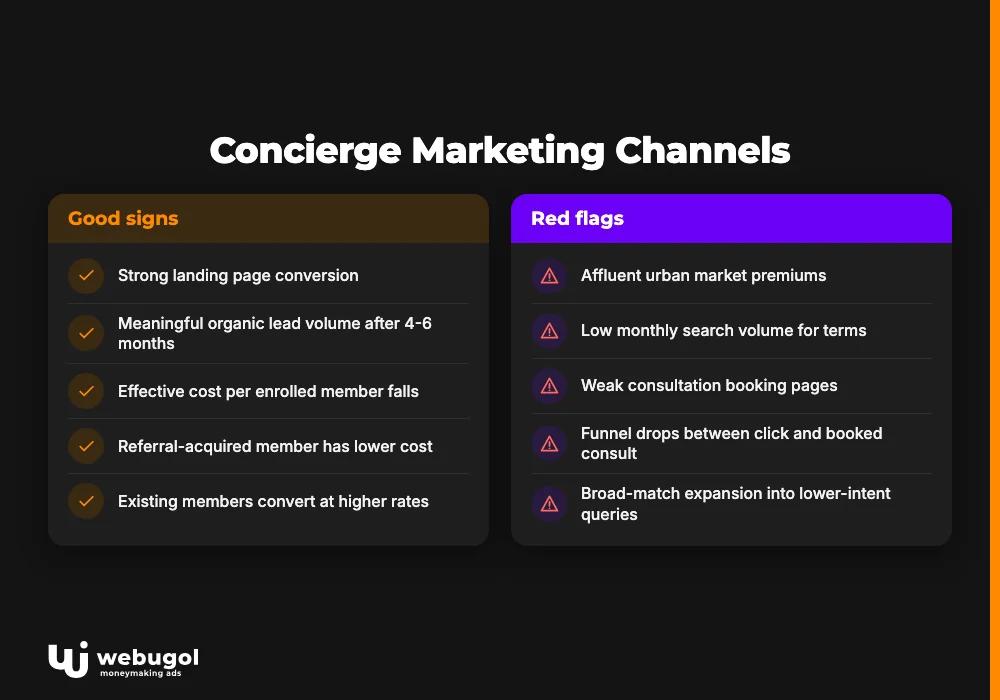
Google Search delivers the highest purchase intent for concierge medicine terms. CPL varies significantly based on three factors: affluent urban market premiums, low monthly search volume for concierge-specific terms that forces broad-match expansion into lower-intent queries, and weak consultation booking pages that waste paid traffic after the click. Practices in competitive metro markets with strong landing page conversion see meaningfully lower cost-per-member than those where the funnel drops between click and booked consultation.
SEO: monthly investment and realistic timeline
Monthly SEO investment depends on the competitive density of the target geography and the starting state of the practice's website. Meaningful organic lead volume generally begins at the 4–6 month mark. The case for SEO is a cost-per-member calculation at the 12-month horizon: once organic traffic scales, the effective cost per enrolled member typically falls well below the equivalent from paid search. That makes SEO the most capital-efficient channel for a panel filling gradually over 12–24 months.
Referral and retention programs: the cheapest member you will acquire
A referral-acquired member carries materially lower acquisition cost than any paid channel, making retention-driven acquisition the highest-ROI channel at steady-state panel size. Existing members convert at higher rates, need less education about the membership model, and churn less often than members acquired through cold paid channels. For the full member lifecycle economics behind that math, patient retention strategies covers how retention rate directly reduces the acquisition spend required to maintain a full panel.
Meta Ads: compliance constraints that add cost
Meta's health advertising policies prohibit condition-based targeting, limit retargeting audiences to general behavioral signals, and require consent-mode implementation. Each restriction raises effective CPL above what direct-to-consumer advertisers experience on the same platform. A HIPAA-compliant Meta campaign structure also requires server-side pixel configuration and ongoing ad copy review, both of which add operational cost whether you run the account in-house or through an agency.
A channel-by-channel cost summary:
| Channel | CPL direction | Primary driver |
|---|---|---|
| Google Search | High intent, variable CPL | Geography + landing page conversion rate |
| Meta Ads | Lower intent, compliance overhead | Policy restrictions + broad targeting constraints |
| Organic SEO | Lowest effective CPL at 12-month horizon | Content investment + competition + ramp time |
| Referral program | Lowest per-member cost of any channel | Incentive structure + member satisfaction |
| Physician referral network | No direct ad spend | Relationship-building time + geographic density |

Does HIPAA compliance affect my concierge medicine marketing budget?
Yes, and by more than most agency proposals itemize. The marketing cost concierge medicine practices carry on the compliance side adds meaningful tooling and configuration overhead regardless of channel mix, often more than the agency proposal explicitly itemizes.
Tools and consent management that cost real money
A HIPAA-compliant marketing stack requires four layers, each carrying a real cost:
- A consent management platform captures and logs patient consent signals before any tracking pixel fires, typically billed per domain on a recurring basis.
- PHI-safe analytics replace standard Google Analytics configurations that may expose health-related page visits as protected health information.
- Server-side pixel configuration prevents third-party tracking scripts from capturing identifiers tied to medical context, implemented once and maintained as platform APIs evolve.
- Periodic compliance review of running ad copy and landing pages catches claims that drift into policy violations as platform rules tighten, often months after a campaign launches.
Skipping any of these layers does not reduce the cost. It transfers the risk to the practice. When comparing proposals, ask which layers are included in the retainer and which are billed separately or absent.
DIY vs. agency: the real marketing cost concierge medicine practices pay
The marketing cost concierge medicine practices absorb when running campaigns in-house extends well beyond tool licensing. It includes skilled labor, coordination overhead, and the performance gap from managing campaigns without specialization. The comparison is rarely as favorable to DIY as a surface budget calculation suggests.
What a full DIY marketing stack actually costs
Running Google Ads, Meta, SEO, email, and CRM in-house requires platform licensing across a minimum of five to seven tools plus a substantial weekly skilled-labor commitment to manage campaigns at a competitive level. Owner time spent coordinating between tools, reviewing creative, and troubleshooting tracking gaps is typically not counted in the DIY cost estimate. That coordination load, priced at a market rate for the role required, often exceeds a full-service agency retainer before you account for the performance gap from non-specialist campaign management.
What you stop paying when one team owns the full funnel
An agency retainer consolidates tool costs, removes cross-vendor coordination overhead, and centralizes attribution accountability in one contract. For practices where conversion drops between click and booked consultation, that scope includes the landing page and website layer, owned by the same team managing campaigns. The more important gain is measurement quality. When spend, attribution, and member count are managed by one accountable team, the cac payback period calculation is defensible; when distributed across vendors, it reflects whatever each vendor chose to report. In Webugol's work with Valhalla Vitality, the 45% reduction in CAC came specifically from closing the diagnostic gap between what campaigns reported and what members actually enrolled, not from any single channel tactic. That diagnostic access is structurally unavailable in a distributed-vendor model.

How do you know if your concierge marketing spend is working?
You cannot know without end-to-end attribution from ad click to enrolled member. Without that chain, any benchmark comparison is guesswork. Most concierge practices have partial measurement: they know how many leads a channel generated, but not how many of those leads became paying members.
The tracking setup that ties spend to new members
A functional concierge marketing measurement system connects click source and campaign to consultation booking, show rate, enrollment decision, and first membership payment in one auditable chain. This requires instrumentation across the ad platform, booking system, and CRM, with offline conversion data flowing back to both platforms. Without that chain, the CPL your agency reports is a partial number. It may look efficient while cost-per-enrolled-member runs well above your actual benchmark.
If you cannot trace a new member back to the originating campaign, measurement is the first problem to fix before scaling spend. The Healthcare Growth System starts week one with a full tracking and funnel audit because scaling an unmeasured funnel accelerates cost without improving outcome. Book a strategy call to see where your current attribution chain breaks.
Ready to benchmark your concierge marketing budget?
If you are evaluating a vendor proposal, planning next year's budget, or defending a CAC number to a board, the benchmarks above give you a reference framework, but the numbers only hold with proper measurement in place. Webugol builds tracking-first patient acquisition systems for concierge and membership medicine practices. The system spans campaign management, tracking, and the landing page and website layer in one accountable engagement. The Healthcare Growth System starts with a full tracking and funnel audit in week one and targets a predictable cost-per-member within 90 days. Book a strategy call.
FAQ
What is a good cost per lead for concierge medicine?
A useful CPL benchmark for concierge medicine depends on geography, channel, and your enrollment conversion rate. The more meaningful metric is cost per enrolled member: divide total channel spend by net new members enrolled and compare that against your annual membership fee. A CPL that looks high may still represent an efficient acquisition if your consultation show rate and enrollment conversion are strong.
Is Google Ads worth it for concierge medicine marketing?
Google Search is worth running when your landing page converts consultations at a defensible rate and your geography has sufficient monthly search volume for concierge terms. In metro markets with intent-matched campaigns, it is typically the fastest channel to generate qualified consultation requests. The risk is that low search volume forces broad-match expansion, which raises CPL without improving lead quality.
How does HIPAA compliance affect my marketing budget?
HIPAA compliance adds a fixed cost layer across consent management, PHI-safe analytics, and server-side pixel configuration, regardless of which channels you run. The actual number depends on your stack and configuration state; audit each layer against your current setup to get the real figure. This applies in-house and through an agency; the difference is whether it is itemized in the proposal or absorbed into overhead. Skipping compliance layers does not reduce this cost; it converts it into remediation and regulatory risk.
How do I calculate ROI on my concierge marketing spend?
Divide total marketing spend over a period by net new members enrolled in that period to get cost per enrolled member. Compare that number against annual membership revenue multiplied by average member tenure to see the payback multiple. The marketing cost concierge medicine ROI calculation differs from standard healthcare because recurring membership revenue extends the payback window well beyond a single visit.

