



Creative Digital Marketing: Build Engagement, Drive Results
Creative digital marketing is the practice of combining original ideas, audience data, and channel-specific tactics to produce campaigns that cut through noise and deliver measurable outcomes. It goes beyond running ads or posting content; it uses storytelling, personalization, and channel-native formats to earn attention and convert it into revenue. For marketing directors and business owners competing in crowded digital markets, the gap between a forgettable campaign and one that drives growth almost always comes down to creative strategy.
This guide covers what separates effective creative strategies from generic ones, how visual storytelling brands build lasting brand equity, and which metrics confirm a campaign actually worked.
What is creative digital marketing?
Creative digital marketing is a strategy-first approach that merges original content, design, and data-driven execution across digital channels to generate meaningful brand engagement and business results. It treats the audience as the starting point, not an afterthought. Where standard digital marketing copies templates and relies on volume, creative digital marketing invests in messages that resonate specifically with the people most likely to convert.
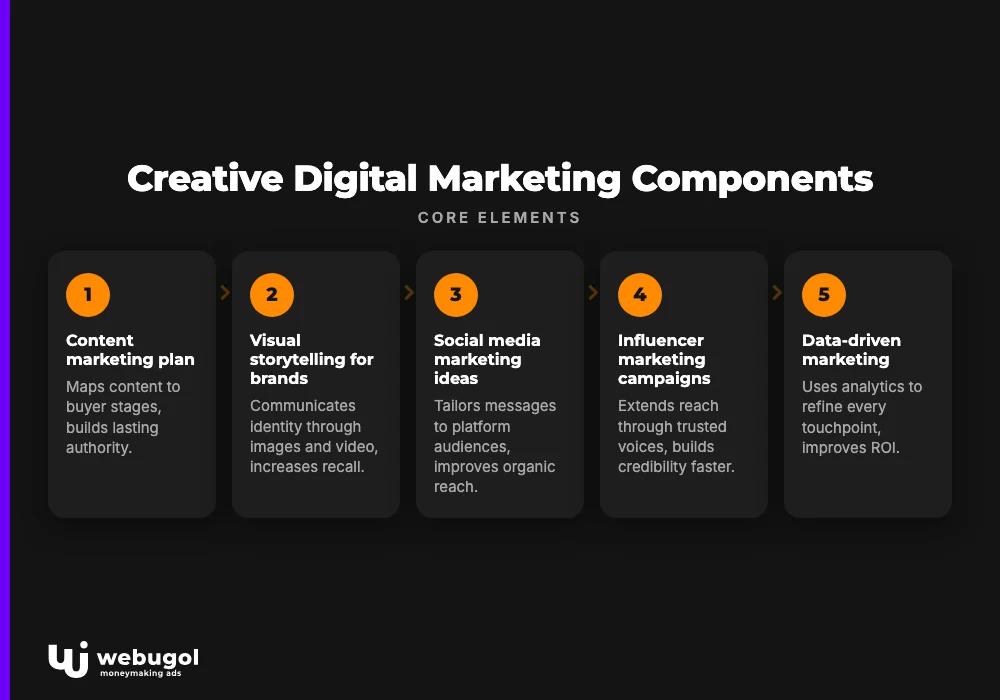
The core components span content marketing plans, social media marketing ideas, visual storytelling, influencer marketing campaigns, and performance analytics. Used as a system, they build compounding returns rather than a series of unconnected executions.
| Component | What it does | Why it matters |
|---|---|---|
| Content marketing plan | Maps content to buyer stages | Prevents random posting; builds lasting authority |
| Visual storytelling for brands | Communicates identity through images and video | Increases recall and emotional connection |
| Social media marketing ideas | Tailors messages to platform-specific audiences | Improves organic reach and paid efficiency |
| Influencer marketing campaigns | Extends reach through trusted voices | Builds credibility faster than branded content alone |
| Data-driven marketing | Uses analytics to refine every touchpoint | Reduces waste and improves ROI over time |
What makes a digital marketing strategy stand out?
Most digital marketing strategies fail to stand out because they copy competitors rather than finding the angle their specific audience responds to. The strategies that break through share three qualities.
They start with a sharp audience definition. Generic messaging aimed at everyone produces weak results. High-performing campaigns begin with a clear picture of who is buying, what problem they are solving, and where they spend time online. That picture drives every creative decision that follows.
They maintain a consistent brand voice across channels. Brand engagement tactics produce results only when the audience recognizes the brand across email, social, search, and paid formats. Inconsistency breaks the trust that drives repeat engagement and referrals.
They measure and adjust continuously. Data-driven marketing means checking which content formats, subject lines, and creative executions produce the strongest click-through and conversion rates, then reallocating toward what works. Static campaigns decay. Adaptive ones grow.
How does visual storytelling help brands grow online?
Visual storytelling communicates a brand's value through images, video, and interactive media rather than text alone. Audiences process and retain visuals faster than written content. In crowded feeds, that speed matters.
For brands, the effect is direct. A video showing a real customer outcome generates more trust than a paragraph describing the same result. An infographic that explains a complex process in three steps gets shared; a dense article covering the same material rarely does. Brands that build a recognizable visual language and apply it consistently across channels grow their audiences faster because every touchpoint reinforces the same impression.
Sephora's AR "Virtual Artist" tool is a well-documented example: by letting customers try products virtually before buying, the brand converted curiosity and convenience into purchase intent within a standard product page. The creative execution turned browsing into an interactive brand engagement experience.
Strong visual storytelling for brands also supports search performance. Descriptive image filenames, meaningful alt text, and video transcripts give search engines additional signals that reinforce written content, compounding the return from a solid content marketing plan.

How do you make a digital marketing campaign more engaging?
Engagement drops when campaigns talk at an audience rather than with one. High-engagement approaches share a common structure: they invite participation.
Social media marketing ideas that consistently drive engagement include interactive formats such as polls, quizzes, and short-form video challenges. Platforms reward content that generates comments and shares, so formats that prompt a response outperform broadcast-style posts on every major channel.
User-generated content outperforms branded content on a simple principle: people trust peers more than advertisers. When real customers document their experience with a product, the result reads as authentic in a way that polished ad creative cannot replicate. Brands that make it easy for buyers to share and get featured create a self-reinforcing loop of organic reach.
Influencer marketing campaigns extend this logic to creators with existing audiences. The key variable is alignment, not audience size. A micro-influencer whose community trusts their recommendations in a specific category will convert at a higher rate than a celebrity endorsement with no contextual relevance. A forced or inauthentic partnership erodes the brand credibility it was meant to build.
Personalization adds another layer. Email campaigns that customize subject lines and content based on past behavior consistently outperform generic blasts on open and click-through rates. Dynamic content on landing pages, adjusted by location or prior browsing, keeps messaging relevant rather than generic. Starbucks uses loyalty gamification, rewarding purchases with status tiers and exclusive offers, to keep customers returning on a cycle driven by progress rather than price.

What metrics show whether a digital marketing campaign worked?
Likes are not results. The metrics that actually indicate creative digital marketing performance are tied to behavior: click-through rates, conversion rates, cost per acquisition, and return on ad spend. These numbers tell you whether campaigns are producing revenue, not just impressions.
Engagement metrics, including shares, comments, time on page, and scroll depth, reveal whether content is resonating. They matter as leading indicators, but should always be read alongside conversion data. High engagement with no downstream conversion usually signals a message-to-audience mismatch.
A/B testing turns data into decisions. Testing headlines, calls to action, images, and email subject lines produces directional evidence for iterative improvement. Understanding how paid campaigns complement your organic strategy helps allocate budget more precisely as you scale a creative digital marketing program.
Sentiment analysis extends measurement beyond numbers, capturing how people feel about a brand after a campaign. Comments, reviews, and brand mention tone provide qualitative confirmation that the creative execution landed as intended, or that it needs adjustment.
Turn creative strategy into a growth system
The approach is only as useful as the platform supporting it. A campaign that sends traffic to a slow, poorly structured site loses most of its value at the final step. At Webugol, we build the technical foundation and the marketing system together, so the results your campaigns generate compound rather than leak through the cracks.
The flexible content infrastructure we implement gives content teams the ability to publish, update, and personalize at speed, so your creative campaigns are always supported by a site that can keep up. If you are ready to stop running campaigns that disappear without trace and start building a system that grows, get in touch.
FAQ
What separates creative digital marketing from standard digital advertising?
Standard digital advertising focuses on paid placements and volume; creative digital marketing builds a broader system that includes content, storytelling, social engagement, and measurement working together. The goal is not just impressions but a consistent brand identity that compounds across channels. Creative campaigns earn attention in ways that paid-only approaches do not.
How do I build a content marketing plan that supports brand engagement?
Start by mapping content types to each stage of the buyer journey, then assign formats based on where your audience spends time. Video and visual content perform best at the top of funnel; case studies and comparison content convert better in the middle and lower stages. Review and adjust the plan quarterly using performance data rather than assumptions.
How do influencer marketing campaigns fit into a broader creative strategy?
Influencer marketing campaigns work best when integrated with other digital marketing strategies rather than run in isolation. Influencer content can seed social proof that strengthens paid performance, improve organic reach on social platforms, and generate user-created material that feeds your content marketing plan across multiple channels.
What is the role of data-driven marketing in creative campaigns?
Data-driven marketing provides the evidence that separates creative ideas that work from those that do not. Analytics reveal which content formats generate clicks, which audience segments respond to specific messages, and where budget is producing the strongest return. Creativity sets the direction; data confirms whether to continue or redirect.

