



What makes a HIPAA-compliant marketing agency and how to find the right one
A HIPAA-compliant marketing agency has replaced standard pixel-based tracking with PHI-safe alternatives, signed a Business Associate Agreement that covers its sub-processors, and configured its ad accounts to avoid condition-specific audience data. Most agencies using compliance language have done none of these things. If you are re-evaluating your agency after a suspension, a compliance concern, or a year of green dashboards while revenue stayed flat, the problem is accountability across the full stack. This guide gives you the specific criteria, questions, and red flags to verify compliance before you sign anything.
What "HIPAA-compliant marketing" actually means
Healthcare marketing compliance under HHS guidance on tracking technologies is not a document or a policy position. It is a set of technical configurations that either exist in your stack or do not. Most agencies use compliance language to describe intent; the ones actually compliant describe the architecture.
The rules that eliminate most standard agency tactics
Standard digital marketing runs on behavioral data collected directly from the browser. Healthcare compliance removes most of that by default. These tactics create PHI exposure and cannot be used in a compliant healthcare setup:
- Standard pixel-based retargeting fires on users who visited condition-specific pages, appending that visit data to their advertising profile across platforms, which the HHS Office for Civil Rights has treated as a potential PHI disclosure.
- Third-party form-fill tracking sends lead data to ad platforms before it passes through any consent or de-identification layer, creating PHI exposure at the moment of capture.
- Behavioral ad audiences built from site-visit data tied to health conditions or treatment pages expose patient intent to advertising platforms that have not signed a BAA and cannot process PHI.
- Condition-specific ad copy that implies the user has a diagnosed health condition creates regulatory exposure under both HIPAA and platform policies simultaneously.
A genuinely compliant setup routes data differently from the ground up. It is not a standard stack with a few settings adjusted.
Does a BAA alone make a marketing agency HIPAA compliant?
No. A BAA is a legal document that assigns liability after a breach occurs; it does not reduce the technical likelihood of one. Many healthcare operators sign a BAA with their agency, verify nothing else, and carry full exposure through every pixel, ad platform connection, and CRM sync the agency runs on their behalf.
A BAA with your marketing agency should cover these specific items:
- The agency's obligations regarding PHI it accesses or processes during campaign setup and ongoing management.
- The specific sub-processors the agency uses, including ad platforms, analytics tools, and CRM connectors, and whether each has executed its own BAA or qualifies under a narrow exemption.
- The agency's obligation to notify you within a defined window if a breach or suspected breach occurs.
- What the agency is prohibited from doing with PHI, including using patient data for purposes unrelated to your contracted services.
- Termination and data return or destruction provisions if the engagement ends.
A BAA that does not address sub-processors is functionally incomplete. If your agency routes tag data through a third-party server-side container, that vendor needs its own BAA coverage.
What should a HIPAA-compliant marketing agency actually deliver?
The best HIPAA-compliant marketing agency answers that with documentation before the contract is signed, not after. The question to ask is not "are you compliant" but "show me the configuration." Compliance is a technical setup, and capable agencies walk you through it before you commit.
Conversion tracking without PHI: how it works in practice
Server-side tagging replaces the client-side pixel. Instead of a JavaScript snippet loading in the visitor's browser and firing data directly to ad platforms, a server-side container intercepts the data first, strips PHI, and passes only compliant signals forward. This is the foundational technical difference between a compliant and non-compliant tracking setup.
A compliant conversion tracking setup routes events through server-side Google Tag Manager, imports offline conversion data into ad platforms after de-identification, and uses clean room attribution where possible. The goal is an accurate picture of cost per booking without the PHI exposure a standard pixel creates. When configured correctly, you gain measurable CPA data without the regulatory exposure that stops most healthcare operators from trusting their own numbers.
How do HIPAA-compliant agencies run Google Ads and Meta campaigns?
Both platforms layer their own healthcare advertising policies on top of HIPAA requirements, and a capable agency navigates both simultaneously. That means compliant audience targeting, restricted copy in condition-sensitive verticals, and an ad account structure that does not create PHI exposure at the audience or creative level.
Compliant targeting uses demographic signals (age, location, household income) and in-market categories that do not imply a specific medical condition. It avoids custom audiences built from health-condition page visitors without documented de-identification. First-party list uploads are permissible with a clean consent chain, and look-alike models on de-identified seed lists extend reach within compliance limits.
Ad copy in condition-sensitive verticals cannot imply the reader has the condition being treated. Copy focuses on outcomes people actively seek: convenience, access, speed, privacy. The compliance approver on your side reviews creative before it runs. A capable agency treats that approver as a collaborator, not a bottleneck.
Email, CRM, and lifecycle inside HIPAA boundaries
A HIPAA-compliant email and lifecycle setup starts with the platform itself. HubSpot, ActiveCampaign, and GoHighLevel can each operate in HIPAA-compliant mode, but only with specific data configurations active, a BAA in place with the platform vendor, and behavioral triggers that do not use medical condition data as the event source.
The accountability gap here extends beyond the agency. Any external specialist who accesses your CRM or email platform, including a healthcare marketing consultant brought in for a specific project, carries the same BAA and data-handling requirements as the primary agency. That gap is usually invisible until something goes wrong.
Lifecycle flows built within HIPAA limits drive meaningful patient engagement: appointment reminders, educational sequences, renewal flows, and re-engagement campaigns all function without touching condition-specific behavioral data. Good patient journey mapping defines those touchpoints before any automation is built, reducing both rework and compliance drift over time. The constraint shapes the architecture, not the ambition.
What questions should you ask a HIPAA-compliant marketing agency?
Ask for documentation, not assurances. The agency that answers "we are HIPAA compliant" without offering to show tracking configuration, a BAA template, or a sub-processor list is describing a posture, not a setup.
5 questions to ask before signing a healthcare marketing contract
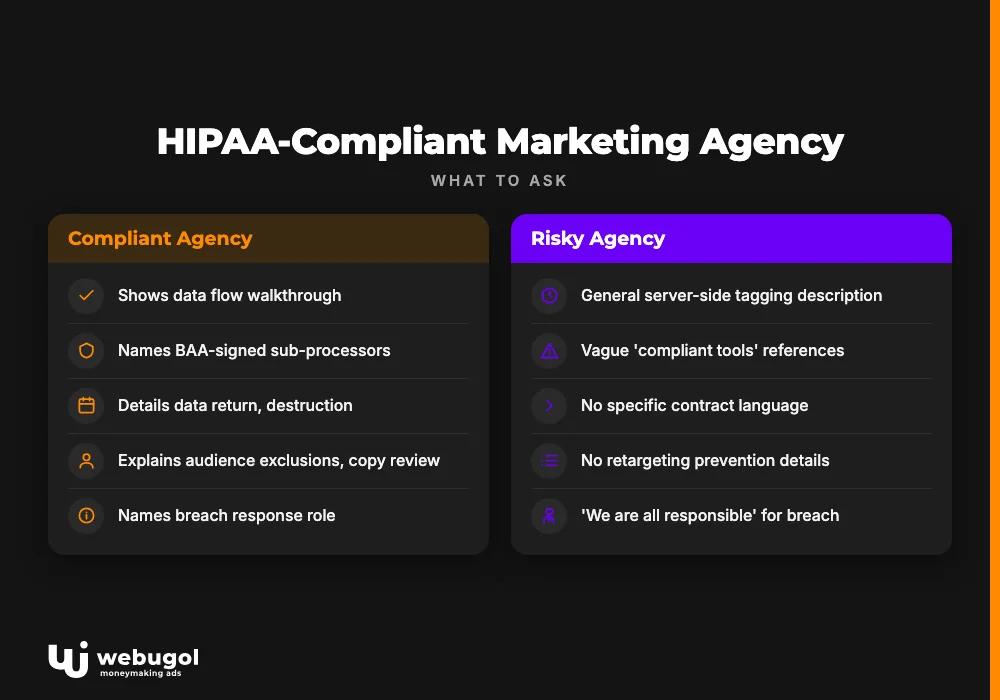
These five questions separate a genuinely compliant agency from one using compliance language as positioning:
- Can you show me your current tracking architecture for a healthcare client, including how conversion data moves between the ad platform and your server-side container? A satisfactory answer includes an actual data flow walkthrough, not a general description of what server-side tagging is.
- Which of your sub-processors have signed a BAA, and how do you handle sub-processors that do not offer one? A satisfactory answer names specific vendors and explains whether each has a signed agreement or qualifies for an exemption. Vague references to "working with compliant tools" do not cover sub-processor liability.
- What happens to our patient data if we end the engagement? A satisfactory answer references specific contract language about data return, destruction timelines, and what happens to ad platform audiences built from your first-party data.
- How do you configure ad accounts for condition-sensitive verticals? A satisfactory answer explains audience exclusions, copy review processes, and how the account structure prevents retargeting on health condition signals.
- Who at your agency is responsible if a tracking configuration creates a PHI breach? A satisfactory answer names a role or individual and describes the incident response process. "We are all responsible" means no one is.
Red flags that signal your agency is putting you at risk
These patterns in an agency conversation or in your existing setup indicate structural compliance exposure:
- The agency describes compliance as a policy or document rather than a technical configuration.
- Standard Google Analytics 4 with no server-side layer is in place and the agency has not flagged it as a problem.
- The BAA template does not list sub-processors or contain a provision for notification if sub-processors change.
- Ad platform custom audiences are built from health-condition page visitors without documented evidence that the data was de-identified before upload.
- The compliance conversation is led entirely by the agency's sales team rather than the person who manages technical implementation.
- Retargeting campaigns target users who visited specific condition or treatment pages on your site.
- The agency has not asked about your internal compliance approver or how creative and copy review works in your organization.
The highest-risk version of this situation is an agency that has run your campaigns for over a year with a standard pixel setup. The exposure accrues quietly for every day the configuration runs.
Before signing with any new agency, audit your current stack to understand exactly what you are inheriting. The Healthcare Growth System starts week one with a full compliance and tracking audit so a new engagement does not carry forward existing liability.

HIPAA-compliant strategies that still scale patient acquisition
Compliance constraints do not eliminate patient acquisition. They change the architecture of it. Healthcare operators who scale past seven figures in monthly ad spend do so within these constraints, not around them. The question is whether your agency knows how to build that architecture and optimize it for cost per booking.
First-party data and demographic targeting: compliant scale
Demographic targeting, first-party list uploads with a documented consent chain, and look-alike modeling on de-identified seed lists are the three mechanisms for compliant scale. Each requires discipline at the agency level to configure correctly. When this architecture works, it drives patient acquisition at a measurable CPA without the PHI exposure that makes standard retargeting off-limits.
The accountability gap for configuring compliant targeting correctly exists whether campaigns run internally or through an external partner. The comparison between in house marketing vs agency in healthcare often comes down to this: an internal team has easier access to consent records and CRM data needed to build clean first-party lists, but rarely has the platform expertise to configure server-side tracking and compliant audience management. An external agency brings the technical depth but needs clear data governance from your team to use it effectively.
First-party data strategy requires documented patient consent before any data enters an ad platform, clean separation between clinical and marketing data systems, and regular audits of list membership to remove patients who have exercised opt-out rights.
Telehealth and weight loss programs: additional compliance layers
Telehealth and GLP-1 or weight loss programs carry higher PHI sensitivity than general healthcare marketing because condition intent is implied by the ad click itself. A user who clicks an ad for a GLP-1 program has signaled a health condition. That signal, combined with any identifying information from the click, creates PHI exposure before a form is ever completed.
Compliant scaling tactics for these verticals include:
- Landing page URLs should omit the condition name so that server-side tagging fires on a neutral event rather than a condition-identified page view.
- Ad campaign structure should ensure condition-specific creative does not drive traffic to pages where standard pixel tracking could associate the click with a diagnosis.
- Meta campaigns should rely on demographic and geographic signals instead of health-related interest targeting to avoid implied condition data at the audience level.
- Offline conversion imports should report appointment completions back to ad platforms without transmitting individual-level health data.
- Consent mode configurations should prevent tracking triggers from firing before explicit patient consent is recorded.
What happens when you switch to a HIPAA-compliant agency?
Switching agencies does not reset your compliance exposure. The tracking infrastructure, ad platform configurations, and CRM data flows your previous agency built continue to operate under your business's liability until you audit and change them. This is the scenario most agency onboarding processes do not address.
Auditing your current martech stack before you sign anything
A stack audit before onboarding a new agency gives you an accurate picture of what you are inheriting and prevents the new agency from building on a compromised foundation. The audit covers four areas.
Pixel and tracking configuration: which pixels are live on which pages, whether any fire on health-condition-identified URLs, and whether server-side tagging is in place and what it covers.
BAA coverage: which vendors in your current stack have signed a BAA with you, which have not, and whether your previous agency's BAA covered their sub-processors.
Ad platform audiences: what custom and look-alike audiences currently exist in your ad accounts, how they were built, and whether the source data was compliant.
CRM and form data flows: whether your CRM vendor has a BAA in place, how form submissions route from your website to your CRM, and whether any third-party form tools in the chain have BAA coverage.
An agency that starts week one with this audit before launching any new activity treats your compliance exposure as shared liability, not your problem alone. That distinction separates an accountable partner from a vendor who owns only their slice.

Ready to build a patient acquisition system that owns compliance end to end?
If you are re-evaluating your agency after a suspension, a compliance concern, or a year of green dashboards while revenue stayed flat, the structural problem is accountability across the full stack, not a single bad channel. Webugol built the Healthcare Growth System as a 90-day sprint that starts with a full compliance and tracking audit and ends with a measurable, PHI-safe acquisition system. Book a strategy call.
FAQ
What makes a marketing agency HIPAA compliant?
A HIPAA-compliant marketing agency has replaced standard pixel-based tracking with server-side or PHI-safe alternatives, signed a Business Associate Agreement that covers both the agency and its sub-processors, and configured its ad accounts to avoid audience targeting that creates condition-specific PHI exposure. Compliance is a technical configuration, not a policy position. An agency that claims compliance should be able to show you their tracking architecture and BAA documentation before you sign.
Does my agency need to sign a BAA, and what should it cover?
Yes, your marketing agency must sign a BAA if it accesses, processes, or transmits protected health information as part of its work. The BAA should cover the agency's specific sub-processors, include a breach notification timeline, and specify what the agency cannot do with your patient data. A BAA that does not name sub-processors leaves significant liability uncovered.
What happens if my marketing agency causes a HIPAA violation?
Your organization remains liable for HIPAA violations caused by your business associate, including your marketing agency, unless the agency's BAA clearly assigns responsibility and the agency acted outside the scope of that agreement. The BAA transfers some risk contractually, but regulators look at the covered entity first. This is why auditing your agency's technical setup matters as much as the legal document.
How do I know if my current agency's tracking setup puts me at risk?
If your agency has standard Google Analytics 4 or Meta Pixel running on condition-specific pages without a server-side tagging layer, you have PHI exposure. Ask your agency to walk you through the data flow from a form submission to the ad platform conversion event. If they cannot describe the path clearly, that is a material gap in your compliance posture.
Is HIPAA compliance handled differently for telehealth and weight loss programs?
Yes. In telehealth and weight loss programs, including GLP-1 offerings, the ad click itself implies a health condition, which creates PHI exposure before any form is submitted. These verticals require landing page URL structures, ad account configurations, and consent mode setups that go beyond the standard HIPAA marketing checklist. Any HIPAA-compliant marketing agency working in these verticals should have a documented protocol for this additional layer.