



Marketing agency contract: 8 clauses and the accountability gap most templates miss
A marketing agency contract is a binding agreement that defines deliverables, timelines, costs, and exit terms. For a healthcare operator running $20,000 or more per month in ad spend, the problem is not what standard contracts include. It is what they structurally omit: named accountability for the revenue path from ad click to booked patient, and the HIPAA compliance obligations that no generic digital agency contract template addresses.
What should a marketing agency contract include?
A complete marketing agency contract requires eight clause categories: scope of work with named handoff ownership, deliverables and reporting cadence, pricing and fee triggers, performance benchmarks in writing, data access and account ownership terms, IP ownership for creative and custom audiences, HIPAA-compliant data handling responsibilities, and a termination and transition protocol.
Here is the checklist:
- Scope of work with explicit handoff ownership between channels and systems, not just a channel list
- Deliverables, timelines, and reporting cadence tied to actionable metrics, not platform vanity data
- Pricing, payment terms, and scope-change billing rules that prevent surprise invoices
- Performance benchmarks and KPI definitions written into the contract text, not only the kickoff deck
- Data access, account ownership, and exit rights covering GA4, Meta Ads, tracking pixels, and CRM
- IP ownership clause covering ad creative, landing page copy, email sequences, and custom audiences
- HIPAA-compliant data handling and health ad compliance responsibilities named by party
- Termination, notice period, and transition protocol with a data export and campaign handover checklist
The clauses most generic templates omit are handoff ownership between systems, performance benchmarks with defined consequences, and every healthcare-specific compliance requirement. The following sections cover each in detail.
Agency scope of work clause: what it should actually say
The scope section of most contracts names channels: paid search, social ads, SEO, email. That is not enough. It does not assign responsibility for what happens when those channels interact.
Tracking fires from the website. The pixel was set up by the agency. Conversions pass into the CRM, configured by a third party. Leads route to intake, which belongs to operations.
When the handoff between those systems breaks, each vendor correctly says the problem is outside their scope. The contract made that outcome inevitable.
An agency scope of work clause that protects you names the handoff explicitly: the agency is responsible for confirming that conversion events pass from the landing page into the CRM pipeline correctly, and that any tracking break is flagged within 48 hours with a root cause report. That is a different sentence than "agency will manage paid campaigns." For a clinic where a broken tracking integration can mean two weeks of unmeasured lead volume, that difference is not trivial.
Deliverables, timelines, and reporting cadence
A contract marketing agency should commit to specific outputs. Weekly performance reports in a format you own, not a platform-native dashboard that disappears when the relationship ends. Monthly strategic reviews with variance explanations. Documented change logs for any material shift in campaign structure or targeting.
Vanity metrics tell you the ad ran. Actionable data tells you what a new consult booking cost this week versus last week, why it changed, and what the next adjustment will be. The contract should specify which metrics appear in reporting and, more importantly, which ones trigger a required agency response.
Pricing, payment terms, and fee triggers
Fixed retainers, percentage-of-spend models, and performance-based fees each carry different risk profiles. The structure matters less than the rules around changes to it.
Scope creep billing is where most contracts fail clinic owners. A new landing page variant, a compliance rewrite of ad copy, an additional tracking integration: each can arrive as an invoice rather than an agreed change order. Understanding what a full agency engagement actually costs requires knowing what triggers additional fees and whether those triggers require your written approval before work begins. The contract must say so explicitly.
Agency performance benchmarks in writing
An agency performance benchmark in a kickoff presentation is not a contractual commitment. It is a projection. That distinction matters when CPA is running 60 percent above target at month four and the agency's only obligation is to "optimize campaigns."
Healthcare operators should embed specific targets into the contract text: target cost per booked consult, minimum ROAS threshold, speed-to-lead response window with the agency confirming the CRM integration is functioning, and acceptable show rate range. Each benchmark should carry a stated consequence: a required remediation plan within two weeks if the metric misses by more than a defined percentage for two consecutive reporting periods.
This structure gives both sides a shared definition of success.
What is cross-scope accountability in an agency agreement?
Cross-scope accountability in an agency agreement means naming which party is responsible for the handoffs between systems, not just deliverables within each channel. In a typical multi-vendor arrangement, the agency owns paid campaigns, the developer owns the website, and a CRM specialist owns the pipeline. None owns what happens between them. A cross-scope accountability clause assigns those gaps to a specific party in writing.
For a telehealth operator running campaigns across Google and Meta, those gaps are where revenue disappears. The campaign drives a click. The landing page loads slowly because the developer sprint is a week out. The lead converts but the webhook to the CRM misfires. The intake coordinator calls three hours later because speed-to-lead routing was never built into the workflow.
Each vendor performed correctly within their scope. Nobody owned the path end to end.
The clause that closes this gap names accountability explicitly: which party confirms that conversion events reach the CRM pipeline, which party is notified first when a discrepancy appears between ad platform data and CRM entries, and what the response SLA is when a tracking break is detected. Without this clause, the clinic owner becomes the integration layer between vendors by default. That is the most expensive coordination role in the business.
How do you protect data access rights in a marketing contract?
Data access rights in a marketing contract are protected by requiring client-held owner-level access to all advertising accounts, analytics properties, and tracking tools from the start of the engagement, with the agency operating under delegated manager-level access only.
Who owns the GA4 property? Who has admin access to the Meta Ads account? Who controls the tracking pixels installed on the site? In most digital agency contract templates, these questions are not addressed at all.
At contract end, data access disputes are common. An agency that built the account structure often retains admin access as leverage during fee disputes or because access was never formally transferred. The contract must state that the client holds owner-level access from day one.
The exit protocol should specify exact steps: the agency removes itself from account admin within five business days of contract termination, provides a full export of audience lists and campaign structures, and delivers a transition briefing document to the incoming vendor.
Agency data ownership rights extend beyond account access. Ad creative, landing page copy, email sequences, and custom audiences built on client data during the engagement default to agency ownership in most jurisdictions when the contract is silent. For a clinic with a retargeting audience of several thousand past website visitors, that audience has measurable acquisition value. Losing it at contract end is a real cost.
The contract should state that all creative assets, copy, and custom audience lists built using client data are client property, transferred in full within 10 business days of contract termination.
Your GA4 setup and pixel configuration carry their own HIPAA compliance exposure, which is a prerequisite to drafting the data access clause correctly in a healthcare context.
What HIPAA obligations belong in a healthcare marketing contract?
A healthcare marketing contract must name which party is responsible for ensuring that retargeting audiences exclude protected health information, that consent mode is configured correctly on the client's website, that ad copy complies with Google and Meta health advertising policies, and that any platform policy rejection is handled within a defined timeframe with client notification.
This is the agency accountability clause absent from every generic digital agency contract template ranking in the top 10 right now. It is the clause healthcare operators most need.
Healthcare advertising operates under Google's healthcare and medicine advertising policy, Meta's health and wellness advertising guidelines, and HIPAA's restrictions on using protected health information in targeting and retargeting. The contract must name which party owns each obligation.
Assigning HIPAA compliance to the client with no defined protocol is a red flag. Assigning it to the agency without written acknowledgment of specific obligations is equally dangerous.
Any agency operating in a regulated vertical should be able to name each compliance requirement and state which party owns it. If an agency cannot produce this language when asked, that is diagnostic information about how the engagement will go.
The data flows inside your CRM pipeline carry the same compliance exposure as your tracking setup. Both obligations belong in the contract.

What are the red flags in an agency contract?
The five red flags in a marketing agency contract are vague scope language with no handoff ownership, performance benchmarks that exist only in presentations and not in the signed contract, liability caps that exclude revenue impact, no explicit guarantee of client-held owner access to all accounts, and HIPAA compliance assigned to the client without a named protocol.
Here is what each looks like in practice.
Vague scope language with no handoff ownership. The contract says "manage paid campaigns." It does not name who confirms the tracking integration is firing correctly, or who is accountable when a campaign sends traffic to a broken landing page. Demand scope language that names specific touchpoints between systems and assigns responsibility for each.
No performance benchmarks in the contract. The kickoff deck shows projected CPA and ROAS. The contract commits to "best efforts optimization." Those are two different things. Demand that specific KPI targets and remediation triggers appear in the signed document.
Liability caps that exclude revenue impact. Most agency contracts cap liability at fees paid in the prior month. For a clinic running significant ad spend, that cap means an agency can be responsible for a campaign that drives zero bookings for 30 days and owe you one month of retainer. Read the liability language and understand what it actually covers.
No explicit data access guarantee on exit. If the contract does not state that you hold owner-level access to all accounts from day one, you may not. Demand written confirmation before signing.
HIPAA compliance assigned to the client with no protocol. A clause stating "client is responsible for HIPAA compliance" is incomplete. You need a written protocol naming what the agency will and will not do with patient data, how retargeting audiences are built and excluded, and who reviews ad copy for protected health information.
Several of these red flags point to the same structural question. The question is whether a single in-house structure makes more sense than a multi-vendor model at your stage, because some red flags are symptoms of a vendor arrangement that is structurally unlikely to produce accountable revenue outcomes regardless of the contract language.
Month-to-month vs. annual marketing agency contract
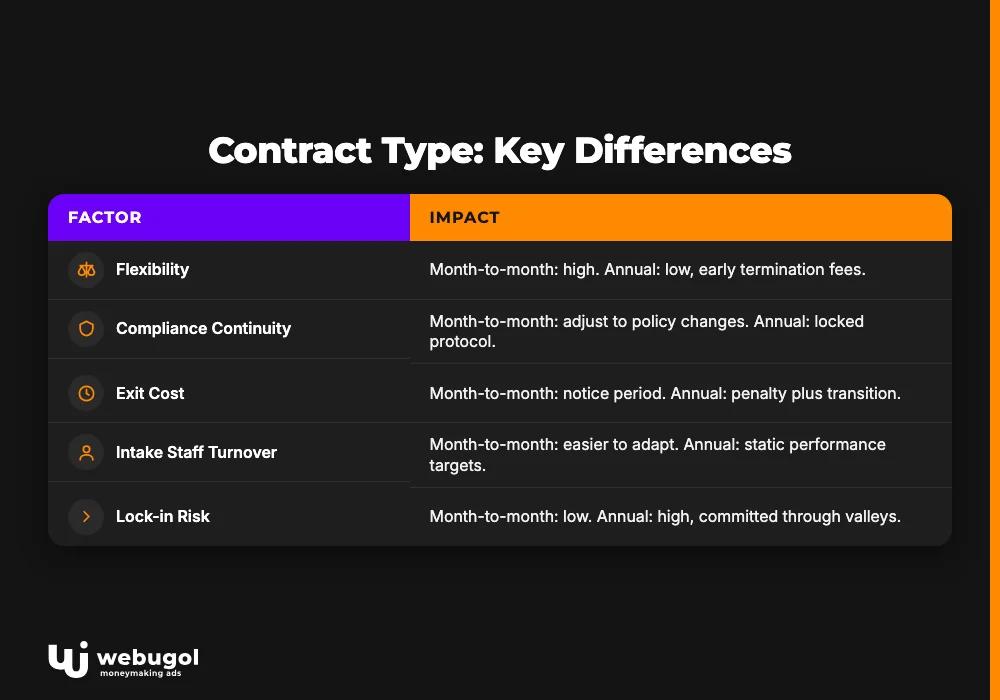
For most healthcare operators, a month-to-month marketing agency contract provides more protection than an annual one. It preserves exit optionality without sacrificing campaign continuity when structured with a clear notice and transition protocol. The right answer depends on your compliance cycle, your platform policy exposure, and your current intake stability.
| Factor | Month-to-month | Annual |
|---|---|---|
| Flexibility | High: exit with 30-day notice | Low: early termination fees or forfeiture |
| Lock-in risk | Low | High: committed through performance valleys |
| Exit cost | Notice period only | Early termination penalty plus transition cost |
| Commitment signal | Lower to agency | Higher: more leverage for negotiated rates |
| Compliance continuity | Review at each renewal | Locked into existing protocol for contract term |
| Platform policy exposure | Easier to adjust if account flagged | May require renegotiation to change approach |
The healthcare-specific factor is compliance continuity. Google and Meta update health advertising policies on their own timelines. An annual contract that fixes your compliance protocol for 12 months may lock you into an approach that platforms have since restricted.
Staff turnover in intake also affects this calculation. A new intake coordinator changes show rate and speed-to-lead performance even when campaigns are unchanged. An annual contract that benchmarks agency performance against a static target does not account for that operational variable.
Month-to-month contracts work best when the transition protocol is well-defined. Without that protocol, a short-notice exit causes the same performance gap as a bad annual contract.

What happens when these clauses are missing
These are not hypothetical scenarios. They are patterns that repeat across healthcare operator relationships with multiple agency types.
Ad account suspension with no transition protocol. A Google health policy flag suspends the account. The agency's contract defines a response SLA for campaign optimization, not for account reinstatement or traffic continuity. Zero new patient volume accumulates during the suspension. The contract provides no remedy because the scenario was not named.
Tracking pixel ownership disputed at agency exit. The agency installed the Meta pixel, Google Tag Manager container, and offline conversion configuration. At contract end, the agency retains admin access pending resolution of a disputed invoice. A new vendor cannot establish a clean baseline without that access. Six weeks of performance data is lost before the dispute resolves.
CPA spike with no benchmark requiring agency response. Cost per booked consult increases materially over two months. The contract commits to campaign management and monthly reporting. Because no benchmark threshold triggers a required remediation plan, the agency documents the trend and continues optimizing. The contract gives information. It gives no lever.
Data lockout because account admin was never transferred. The agency contact who held admin credentials is no longer with the agency. The account was never set up with client-held owner access. Recovering owner access requires platform support queues measured in weeks.
Each failure pattern maps to a missing clause from the sections above. None required bad intent from the agency. Each required a contract that assumed everything would go smoothly.
This is the structural problem. When no agreement assigns revenue path ownership, the clinic owner becomes the default integration layer between vendors. Every failure mode requires a founder-level intervention to resolve.
Agency exit clause: what the transition protocol must include
An agency exit clause is not just a notice period. It is an operational protocol that determines whether you receive a working system or inherit a cleanup project.
The notice period should include a defined handover checklist: the agency continues campaign optimization at the agreed service level, provides a full account audit document, exports all audience lists and creative assets, and participates in at least one transition call with the incoming vendor. Without this language, the notice period becomes a negotiation rather than a protocol.
For healthcare operators, one additional item belongs in the transition protocol: a compliance review of all active ad creative and landing pages, confirming that no running ads contain claims that require re-approval under the new vendor's compliance workflow.
At exit, you should receive owner-level access to every account and analytics property, exported audience lists and campaign structures, a documented change log of all material changes made during the engagement, and a compliance summary of all active ad copy. Getting any one of these after the fact costs weeks.
Run the audit before you sign the next marketing agency contract
The missing accountability clause is not a drafting problem. It is a structural one.
When four vendors each own a slice of the revenue path and none owns the handoffs between slices, no contract revision makes the model accountable. Each vendor correctly performs inside their scope. Each correctly points elsewhere when something breaks between scopes. The CEO fills that gap personally. That is the most expensive coordination role in the organization.
As a digital marketing agency built for healthcare operators, Webugol owns the full revenue path as one system. One team. One accountability point: cost per booked patient, measured end to end. What you stop losing is the coordination tax, the diagnostic uncertainty, and the founder hours spent translating between vendors.
If you are about to sign a new marketing agency contract or reviewing a relationship that has not produced the revenue clarity you expected, run the audit first. Read every active vendor contract and mark where handoff ownership is explicitly assigned. Most maps show the same thing: the handoffs belong to no one.
Book a Strategy Call to walk through what that map looks like for your current structure and what a single-accountability model changes about your cost per booking.
FAQ
What should a marketing agency contract include?
A complete marketing agency contract must include scope of work with named handoff ownership between systems, deliverables and reporting cadence, pricing and fee trigger rules, performance benchmarks written into the contract text, data access and account ownership terms, IP ownership for creative and custom audiences, HIPAA-compliant data handling responsibilities, and a termination and transition protocol. The clauses most generic templates omit are handoff ownership between systems, performance benchmarks with defined consequences, and healthcare-specific compliance responsibilities.
What are the red flags in an agency contract?
The five red flags to watch for are vague scope language with no handoff ownership between systems, performance benchmarks that appear only in presentations and not in the signed contract, liability caps written to exclude revenue impact, no explicit guarantee of client-held owner access to all accounts, and HIPAA compliance assigned to the client without a named protocol. Any contract that cannot answer "who is accountable when a lead enters the CRM and never reaches intake" before you sign it is missing the clause that matters most.
What is cross-scope accountability in an agency agreement?
Cross-scope accountability means the contract names which party is responsible for the handoffs between systems, not just deliverables within each channel. In a multi-vendor arrangement, campaigns, website, and CRM each have an owner, but the connections between them belong to no one. A cross-scope accountability clause assigns ownership of those gaps explicitly, including who confirms that tracking fires correctly and who responds when data between systems disagrees.
How do you protect data access rights in a marketing contract?
Protect data access rights by requiring client-held owner-level access to all advertising accounts, analytics properties, and tracking pixels from the first day of the engagement, with the agency operating under delegated manager-level access only. The contract should also state that all creative assets, copy, and custom audience lists built on client data are client property, transferred in full within 10 business days of contract termination.
What HIPAA obligations belong in a healthcare marketing contract?
A healthcare marketing contract must name which party ensures that retargeting audiences exclude protected health information, that consent mode is configured correctly on the client's website, that ad copy complies with Google and Meta health advertising policies, and that any platform policy rejection is handled within a defined timeframe. Assigning HIPAA compliance to the client with no named protocol is insufficient; the contract must identify specific obligations and assign ownership of each one.

