



Marketing for cosmetic dentists: how to attract high-value patients
Marketing for cosmetic dentists means building a system where your online presence, local search visibility, and social proof all work toward the same goal: converting researchers into booked consultations. Unlike general dental marketing, cosmetic procedures carry higher price points and longer patient decision cycles. Practices that treat their marketing as a coordinated system consistently outperform those running disconnected tactics.
Procedures like teeth whitening, veneers, and Invisalign are more popular than ever. Demand is real. Competition for those patients is equally real.
What makes marketing for cosmetic dentists different from general dental advertising
A patient with a toothache books the nearest available dentist. A patient considering veneers researches for weeks, comparing before-and-after galleries, reading reviews, and weighing financing options. That difference in patient behavior means cosmetic dentistry advertising must do two things simultaneously: reach patients early in their research phase and remain visible until they are ready to act.
Generic dental marketing built around availability or emergency appointments fails at both. Effective marketing for cosmetic dentists positions the practice around visible outcomes, smile transformations patients can see in case photos, backed by credible social proof at every stage of the funnel.
Cosmetic dentistry online presence is not a single asset. It is a layered system: your website, search rankings, review profile, and social media all reinforcing each other.
How to market a cosmetic dental practice?
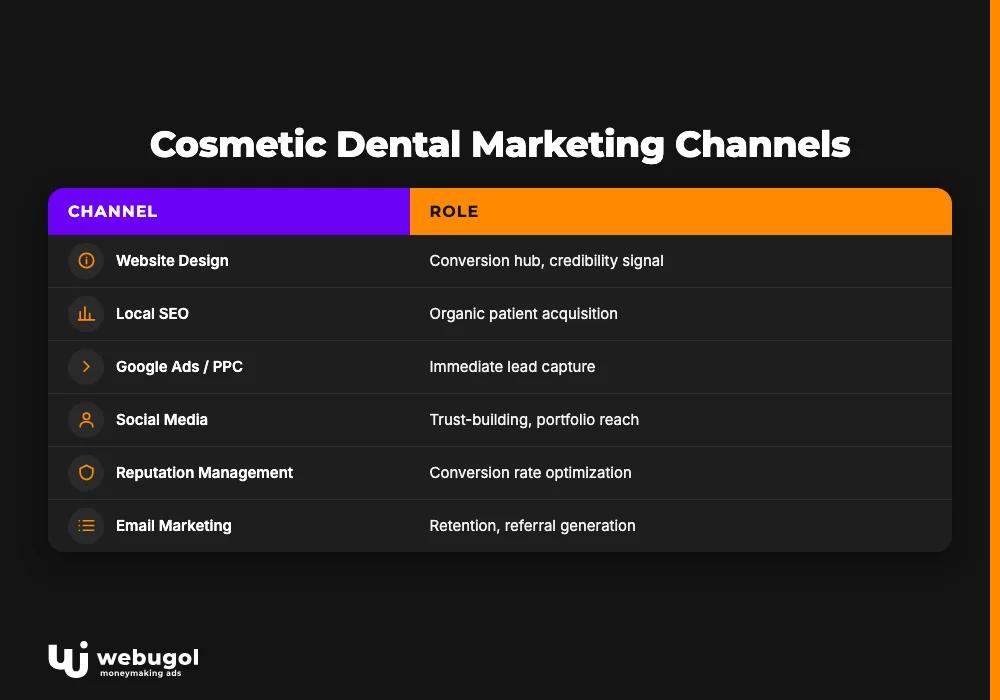
Marketing a cosmetic dental practice works when its core channels are aligned and sequenced correctly. The six components below form a complete system.
| Channel | Primary role | Typical timeline |
|---|---|---|
| Cosmetic dentist website design | Conversion hub and credibility signal | Ongoing |
| Local SEO for dentists | Organic patient acquisition | Several months |
| Google Ads / PPC | Immediate lead capture | Days to weeks |
| Dental practice social media | Trust-building and portfolio reach | Ongoing |
| Reputation management | Conversion rate optimization | Ongoing |
| Email marketing | Retention and referral generation | Ongoing |
The channel you prioritize most depends on where your practice currently has the biggest gap. New practices should build the website and local SEO foundation first, then layer paid ads to accelerate lead flow while organic rankings develop. Established practices with existing patient bases often see faster returns from reputation programs and email campaigns that convert satisfied patients into referral sources.
What is the best way to get more cosmetic dentistry patients?
The most reliable path to steady dental patient acquisition combines a high-converting website with consistent local search visibility and verifiable social proof. Paid advertising amplifies that foundation. Without the foundational elements in place, ad spend rarely converts at acceptable rates for high-ticket cosmetic procedures.
Cosmetic dentist website design and conversion signals
Your website is the core of your cosmetic dentistry online presence. It must communicate credibility within the first few seconds and make it simple to take the next step.
Key website elements for dental patient acquisition:
- Before-and-after case galleries organized by procedure, so visitors can find examples relevant to their own situation quickly.
- Procedure pages written for patients rather than clinicians, covering what each treatment involves, who it suits, and what recovery looks like.
- Patient testimonials with names and photos positioned close to calls to action.
- Online consultation booking that requires as few steps as possible to complete.
- Fast mobile loading. Slow pages lose the visit before a single word is read.
Responsive design and clear navigation are baseline requirements. A visitor who cannot find services or contact information quickly will leave for a practice whose website makes it easier.
Local SEO for dentists: ranking where patients search
Most patients searching for a cosmetic dentist add a location to their query, "cosmetic dentist near me" or "veneers in [city]." Local SEO for dentists is the process of making your practice appear prominently in those results. It starts with your Google Business Profile and extends to on-page optimization across your site.
Claim and complete your Google Business Profile. Add accurate address, phone number, and hours. Upload procedure-specific photos. Collect reviews consistently and respond to every one promptly. The healthcare local SEO complete guide covers the technical steps and content work required to rank in competitive local markets.
On your site, create location-specific procedure pages. A page targeting "dental veneers in [city]" with patient-focused content and appropriate local schema will outrank a generic veneers page in local results.
Does SEO help cosmetic dentists get more clients?
Yes. Organic search is among the highest-return channels in marketing for cosmetic dentists because it captures patients at the exact moment they express intent. A patient searching "cosmetic dentist [city]" is already in evaluation mode, not browsing passively.
The challenge is time. Local SEO typically takes several months to produce meaningful ranking movement. Practices that stop early miss the compounding effect that makes organic search valuable at scale. Running paid ads alongside SEO during the build phase bridges that gap.
For the broader case on why organic search compounds where paid resets each month, building lasting search visibility for health businesses lays out the long-term logic.
Backlinks from local partners, dental associations, and healthcare directories strengthen domain authority over time. Combined with a well-maintained Google Business Profile and steady review generation, this builds a local search presence that compounds patient acquisition month over month.

What social media platforms work best for cosmetic dentists?
Instagram and Facebook lead for dental practice social media in the cosmetic segment. Instagram's visual format suits before-and-after content and educational posts about specific procedures. Facebook supports community engagement and paid targeting of local demographics with aesthetic interest signals.
TikTok has grown into a genuine discovery channel for cosmetic procedures, particularly among younger patients. Short videos explaining what veneers involve or demystifying Invisalign reach people who are curious but not yet searching actively. Partnering with local influencers extends reach without requiring large ad budgets.
Consistency outperforms production quality on every platform. A practice posting several times a week with real patient content, staff introductions, and procedure education builds more trust over time than one posting polished content sporadically. Use a content calendar. Respond to every comment and message. For context on how social platforms influence patient engagement in healthcare, the behavioral patterns by channel are worth reviewing before committing to your content mix.
Reputation management and reviews as conversion tools
Online reviews are a primary conversion signal in any cosmetic dentistry advertising strategy. Patients evaluating a high-ticket procedure read reviews carefully, and review volume matters as much as average rating. A practice with a large number of reviews signals a consistent track record rather than a curated selection of best-case outcomes.
Proactive reputation management means requesting reviews from satisfied patients immediately after a positive appointment, while the experience is fresh. A direct link to your Google Business Profile sent via text or email is the most effective prompt. Monitor all review platforms and respond to every review, including critical ones, professionally and without defensiveness.
An unaddressed negative review damages trust. A measured, empathetic response to that same review often repairs it.

Content marketing and paid advertising
Content marketing builds authority that paid ads cannot create on their own. A practice blog answering questions patients actually ask, "What is the difference between veneers and bonding?" or "How long does Invisalign take?", positions the practice as a credible resource before a patient has made first contact. This content also captures long-tail organic traffic and strengthens SEO across the site.
Paid advertising, specifically Google Ads targeting high-intent cosmetic dentistry keywords and local service ads, complements organic efforts by delivering visibility immediately. Retargeting campaigns keep your practice present for site visitors still in the consideration phase. Facebook and Instagram ads allow precise demographic targeting for cosmetic procedures, reaching local audiences with specific aesthetic interests.
Organic and paid channels reinforce each other rather than competing. Email marketing rounds out the system by converting single-visit patients into repeat bookings and referral sources. For practices building a patient retention program, patient retention email programs for cosmetic practices offer a practical framework.
Grow your practice with a complete marketing strategy
Marketing for cosmetic dentists works when the channels are coordinated rather than running in isolation. Investing in ads without a strong website, or in SEO without a review strategy, creates predictable leaks in the patient journey.
Webugol builds integrated digital marketing programs for cosmetic dental practices, covering website design, local SEO, paid campaigns, and content strategy. If you want a clear picture of where your current marketing underperforms and what would move the needle fastest, reach out for an assessment.
FAQ
How to market a cosmetic dental practice?
Marketing for cosmetic dentists works best as a coordinated system: a high-converting website, strong local SEO, consistent review generation, and targeted paid ads all aligned to the same patient journey. Build the foundation before layering on ad spend, or budgets will consistently underperform.
What social media platforms work best for cosmetic dentists?
Instagram and Facebook are the most effective platforms for dental practice social media in the cosmetic segment, given their support for visual content and precise local ad targeting. TikTok is growing as a discovery channel for younger patients curious about procedures like veneers and Invisalign.
How much should cosmetic dentists spend on marketing?
There is no universal figure, as ideal spend depends on market size, competition level, and practice growth targets. The most useful starting point is calculating your current patient acquisition cost and setting a budget against realistic patient lifetime value for cosmetic procedures.
Does SEO help cosmetic dentists get more clients?
Yes, local SEO is one of the most cost-effective acquisition channels for cosmetic dental practices because it captures high-intent patients at the moment they are actively searching. Results build over several months and compound over time, making early investment worthwhile.
What is the best way to get more cosmetic dentistry patients?
The most effective approach combines a fast, credible website with consistent review generation, strong local SEO, and targeted paid advertising. Practices that align all four channels around a clear patient journey see the most sustained dental patient acquisition growth.

