



Pet industry marketing: strategies that scale your pet brand
Pet industry marketing works when brand identity, digital channels, and customer retention connect into a single growth system. For pet brand owners and marketing directors, the challenge is rarely a shortage of tactics. The real problem is structure. Campaigns run in isolation instead of compounding into something durable. This guide covers what actually moves revenue in the pet category and how to build the system behind it.
The pet market and the growth plateau
Pet owners treat their animals as family members, and spending reflects it. Gourmet treats, premium supplements, and purpose-built accessories have moved from niche to mainstream. The emotional bond between owner and pet is the engine of this category, and brands that understand it hold a structural edge.
Growth stalls when the brand-to-customer journey has gaps. A strong product and active social presence will not scale if the website does not convert, email sequences are absent, or loyalty has no mechanism.
What you stop losing when these systems connect: the customer who bounced from a slow page, the lead who never got a follow-up, the repeat buyer with no reason to return.
A pet brand owner hitting that plateau faces the same structural challenge as any SMB at the same stage: channels operating in parallel rather than as one compounding system.
How to market a pet business?
Start with a clear unique value proposition. Pet parents choose brands that reflect their care. Before any channel investment, answer three questions directly:
- What makes your brand different? Name the one thing competitors do not do or cannot credibly claim.
- What problem do you solve for pet owners? Be specific: ingredient transparency, convenience, or a measurably better outcome for the animal.
- Why should they trust you? Real customer stories and visible ethics carry more weight than broad category claims in this space.
Pet parents have grown more aware of the ethical and environmental impact of their purchases. Building transparency and sustainability into your brand identity is not positioning strategy. It is what buyers in this category now expect. A clear marketing strategy for pet shop owners starts here, before deciding which channels to activate.
Marketing pet products without addressing these signals leaves a gap competitors will use. Brands in other lifestyle product categories face the same discipline: specificity wins over generic claims.
Building your pet industry marketing system
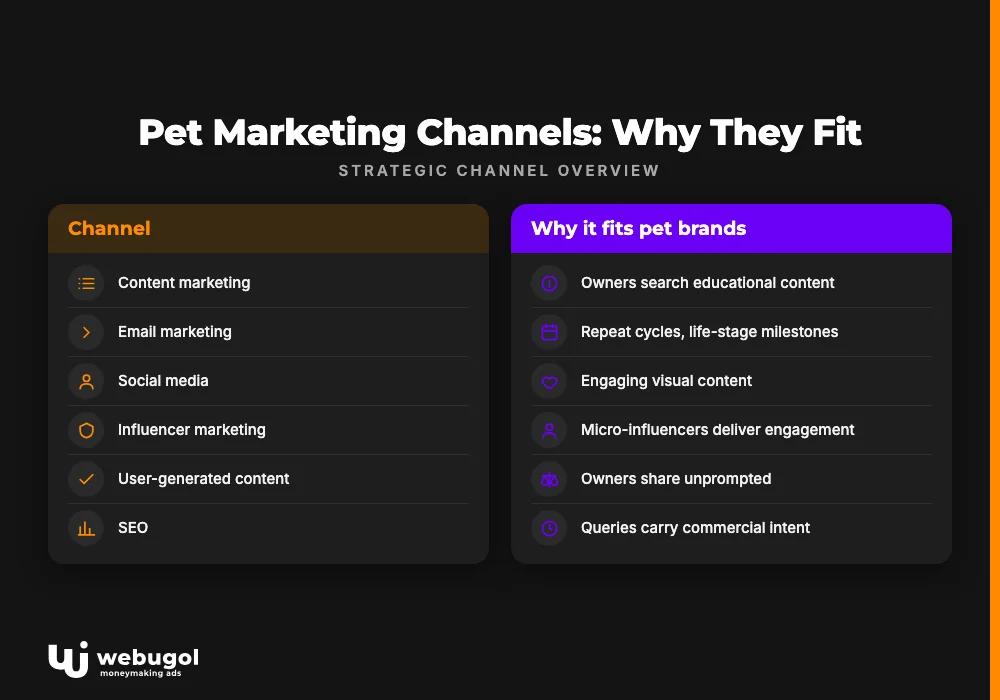
No single channel wins alone. Here is how the main options compare within a pet brand marketing plan:
| Channel | Primary function | Why it fits pet brands |
|---|---|---|
| Content marketing | Organic traffic, search authority | Pet owners search for educational content at every stage of ownership |
| Email marketing | Nurture, repeat purchase, retention | Repeat purchase cycles and life-stage milestones suit email automation well |
| Social media | Reach, community, visual storytelling | Pets generate engaging visual content with minimal production overhead |
| Influencer marketing | Trust transfer, new audience reach | Micro-influencers in pet niches deliver higher engagement than broad accounts |
| User-generated content | Authenticity, social proof | Pet owners share unprompted; UGC scales without incremental spend |
| SEO | Long-term organic acquisition | Pet product queries carry high commercial intent |
Each channel belongs in a mature pet industry marketing strategy. The order of investment depends on your current constraint: awareness, conversion, or retention.
What digital marketing channels work best for pet brands?
The best-performing stack for most pet brands combines content marketing, email, and social media, with influencer marketing added once the brand foundation is clear.
Content marketing
Content builds the search foundation every pet food marketing strategy requires. Publish guides, how-to articles, and educational videos that solve real problems for pet owners. Consistency separates compounding authority from isolated ranking wins. Use SEO best practices to optimize every piece from publication so search visibility accumulates over time rather than spikes and fades.
Email marketing
Email marketing delivers the highest return for pet brands with an existing customer base. Segment by pet type, purchase history, or product category. Automated flows handle what manual campaigns cannot: abandoned cart recovery, post-purchase sequences, birthday promotions tied to the pet, and reactivation for lapsed buyers. Test subject lines and call-to-action formats regularly to find what resonates with your audience.
Social media and influencer marketing
Social media is where pet brand digital marketing becomes most visible. Three platforms carry the most weight: Instagram, TikTok, and Facebook. All three support the visual and emotional formats the category demands. Aim for a 3:1 ratio of educational and entertaining content to product promotion. Respond to comments directly in the early months.
Influencer partnerships accelerate trust transfer. Partner with influencers whose values align with your brand, not just their follower count. Micro-influencers in focused pet niches consistently outperform large accounts on engagement. Build long-term relationships rather than one-off posts: trust accumulates over repeated exposure.

How to attract pet owners as customers?
The most cost-efficient acquisition channel at scale is user-generated content. Real customers sharing their pets and your products carry credibility that paid creative cannot match. UGC gives potential buyers proof of real-world performance and reduces first-purchase hesitation. Encourage it through loyalty incentives, hashtag campaigns, and consistent resharing of strong customer submissions.
Marketing to pet owners follows the same trust-first logic as other health-conscious product categories. The approach to launching a consumer product brand applies directly to positioning a new pet food or supplement line: category-specific credibility signals, third-party validation, and transparent ingredient sourcing each lower the barrier to first purchase.
Pet brands that combine UGC, micro-influencer content, and community engagement outperform competitors relying on paid acquisition alone. The community becomes the channel.
How to build customer loyalty in the pet industry?
Loyalty programs are the most direct mechanism for converting one-time buyers into repeat customers. The components that produce results:
- Use a points system that rewards purchases with discounts, free products, or exclusive access.
- Create membership tiers that increase benefits as customers reach higher spend thresholds.
- Personalized offers reflect each customer's purchase history and the specific pets in the household.
- Top-tier members receive early access to new products and limited editions.
- Referral bonuses reward customers for recommending the brand to their networks.
Programs that tie rewards to the emotional relationship perform best in this category. Points connected to the pet's birthday, breed-specific recommendations, and life-stage transitions build affinity that generic discount programs do not.
Data drives the optimization layer. Track which rewards get redeemed, which segments churn despite membership, and which product categories show the highest repeat purchase rate.
Customer reviews and post-purchase surveys feed directly into both product and messaging decisions. If reviews consistently praise a product's durability, lead with that in your next campaign. If a recurring complaint surfaces, address it before a competitor does. This feedback loop is where pet industry marketing compounds over time: retention insights from existing customers sharpen the campaigns that bring in new ones.

Scale your pet brand with an integrated growth system
Effective pet industry marketing requires more than running good individual channels. It requires a connected system. Website, content, email, and retention need to reinforce each other. Brands that treat these as separate functions hit a plateau that campaign-level improvements cannot solve.
Webugol builds the website and the growth system together, so the site itself becomes the acquisition, conversion, and retention engine, not just the container for it. Reach out to discuss what a full-growth approach looks like for your category.
FAQ
How to market a pet business?
Effective marketing for a pet business combines a differentiated value proposition, a content strategy that builds organic search authority, and an email system that drives repeat purchases. The most common failure is treating these as separate campaigns rather than a connected system. Start with the channels closest to existing customers before investing in broad acquisition.
What is the best marketing strategy for a pet shop?
The best marketing strategy for a pet shop combines local SEO to capture nearby intent, email marketing for repeat purchases, and social media content that builds community around the shop. Loyalty programs reduce churn significantly in pet retail. Prioritize retention and local visibility before scaling paid acquisition.
How to attract pet owners as customers?
Attracting pet owners requires trust-first messaging that addresses product quality, safety, and the care behind what you sell. Micro-influencer partnerships and user-generated content campaigns build that trust efficiently without large paid-media budgets. Pet owners make purchase decisions emotionally and validate them logically, so messaging needs to satisfy both.
What digital marketing channels work best for pet brands?
Email marketing and content marketing deliver the highest long-term return for established pet brands. Social media drives awareness and community engagement. Influencer partnerships accelerate trust transfer with new audiences. For local pet shops, Google Business Profile optimization and local SEO are the highest-priority channels before any paid media investment.
How to build customer loyalty in the pet industry?
Build a tiered loyalty program with points rewards, personalized offers tied to the customer's specific pets, and referral bonuses. Combine this with automated post-purchase email sequences and active social community engagement. Pet owners who feel a brand understands their specific animal convert to long-term advocates at higher rates than those engaged through generic discount programs.

