



The Medical Weight Loss Clinic Business Model: Program Design, Retention Economics, and Marketing That Doesn't Leak
A medical weight loss clinic is a physician-supervised facility that treats excess weight as a medical condition using prescription medications, structured nutrition protocols, and clinical monitoring. For clinic owners, the business model is continuity-adjacent: acquisition costs recover only when patients stay through the full program cycle. Most patients do not stay.
What a medical weight loss clinic actually sells
The product is not weight loss. It is ongoing physician-supervised management. Patients who understand this upfront show materially higher continuation rates than those who arrive expecting a fixed endpoint and a final result.
The revenue model depends on continuation. Program design determines whether that continuation happens at a margin that justifies the acquisition spend that brought each patient in.
How is a medical weight loss clinic different from a commercial diet program?
It requires physician supervision, uses FDA-approved medications and medical-grade protocols, and carries clinical liability. For operators, the distinction also means higher per-patient margins, stricter compliance requirements, and a patient relationship structurally built for continuation rather than a one-time transaction. Commercial programs sell a product. A medical clinic for weight loss manages an ongoing health condition, which is a fundamentally different revenue model.
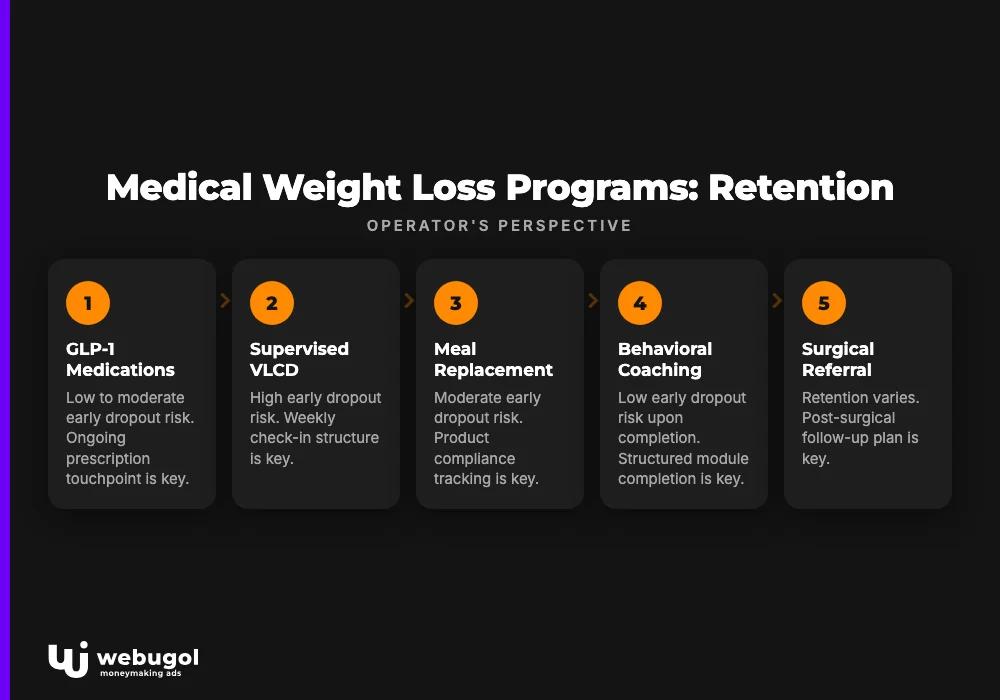
Medical weight loss programs: what exists and how each performs on retention
Evaluating a medical clinic weight loss program requires understanding both the clinical fit and the retention economics. Each program type carries a different dropout risk, a different margin structure, and a different set of retention levers. The comparison below maps these differences from an operator's perspective.
| Program Type | Avg Duration | Early Dropout Risk | Margin Profile | Key Retention Variable |
|---|---|---|---|---|
| GLP-1 Medications | 24+ weeks | Low to moderate | High per-visit; medication cost variable | Ongoing prescription touchpoint |
| Supervised VLCD | 12–16 weeks | High | Moderate; labor-intensive at scale | Weekly check-in structure |
| Meal Replacement | 8–16 weeks | Moderate | Moderate | Product compliance tracking |
| Behavioral Coaching | 12–24 weeks | Low upon completion | High margin; requires credentialed staff | Structured module completion |
| Surgical Referral | Varies | Varies | Referral-only | Post-surgical follow-up plan |
GLP-1 medications: semaglutide, tirzepatide, and why they change your retention math
GLP-1 medications are the highest-demand service line in the current market. Semaglutide candidates typically require a BMI of 30 or higher, or 27 or higher with a weight-related comorbidity. Tirzepatide eligibility follows similar clinical criteria with somewhat different insurance authorization patterns across payers.
The retention advantage is structural. Ongoing prescriptions require ongoing clinic contact. Most practices fail to convert that mandatory touchpoint into a systematized retention interaction. The patient shows up for the prescription. Nothing captures the engagement signal. That is a retention system gap, not a clinical failure.
Supervised low-calorie and meal-replacement plans
Supervised VLCD protocols carry the highest early-dropout risk in the program mix. They also carry the most natural retention structure: weekly check-ins create mandatory touchpoints that GLP-1 programs have to engineer in through separate outreach. Operators who design each check-in around explicit expectation-setting, not just clinical measurement, see lower week-4 attrition than those who default to measurement-only touchpoints.
Behavioral counseling and lifestyle coaching
Behavioral programming is the most continuity-ready program type in medical weight loss and the most undermonetized. Patients who complete structured behavioral tracks show higher re-enrollment rates than any other program cohort. Most clinics treat behavioral modules as an optional add-on. Repositioning them as a retention floor rather than an upsell changes the unit economics of the entire program.

What happens at your first appointment at a medical weight loss clinic?
The first appointment typically includes a health history intake, baseline lab work, a physician consultation, and a program recommendation. Most clinics complete all of this in a single visit of one to two hours. For the operator, this is both the highest-cost patient interaction and the moment that sets every retention expectation that follows.
Patient journey mapping of the first visit reveals where expectation gaps drive downstream attrition. Each step carries a specific retention signal:
- Health history intake: documents prior diet program history, a direct predictor of dropout pattern and week-4 return likelihood
- Baseline lab work: creates a measurable starting point; patients who see their initial numbers return to see change
- Physician consultation: expectation-setting on rate of loss here directly predicts whether a patient returns at week 4
- Program recommendation: patients presented with one clear path show higher follow-through than those given multiple options without guidance
- Prescription or plan activation: same-visit activation closes the dropout window that opens between consultation and first step
- Follow-up scheduling: clinics that book the next appointment before the patient leaves retain that slot at higher rates than those that send a "schedule when ready" message

The retention leak: why your medical weight loss CAC keeps climbing
Rising acquisition costs are almost always a retention signal, not a media buy problem. When patients leave before the program cost is recovered, no amount of paid traffic fixes the math. The acquisition budget simply refills the same hole each cycle.
The measurement framework is the same for any continuity-adjacent program. Patient retention strategies covers how to track churn as a marketing metric rather than a clinical outcome.
How churn before week 8 destroys your payback window
Most programs recover their acquisition cost somewhere between weeks 6 and 12, depending on program type and pricing. When program design follows clinical milestones instead of engagement milestones, dropout clustering happens at different points than when engagement is designed in. The CAC payback period calculation changes materially based on which week patients exit.
Clinics that price on competitor benchmarks without knowing their own break-even visit are structurally unable to make defensible retention investment decisions. The number is not hard to calculate. Most owners have not done it.
Reactivation requires a system, not a one-off campaign
Dormant patients who completed at least six weeks represent the highest-propensity re-enrollment segment in the entire patient database. Patient reactivation must be a standing program, not an occasional email blast. A systematic reactivation sequence for a continuity-model clinic tracks weeks-since-last-visit, not campaign calendar.

How much does a medical weight loss clinic cost in 2025?
Cost is among the highest-volume search topics in this category. Unanswered cost questions at the consultation stage are a primary pre-enrollment dropout trigger. Operators who build a clear cost narrative into patient communication convert at higher rates than those who direct all cost questions to a consult call.
Out-of-pocket cost varies by program type, location, and insurance coverage:
- Initial consultations range from low to mid three figures depending on market and program tier
- Per-visit fees differ significantly between labor-intensive VLCD programs and GLP-1 check-in protocols
- GLP-1 medications without coverage are the largest monthly expense variable and the most common cost barrier patients raise at enrollment
- Behavioral and coaching programs typically carry a flat program fee rather than per-visit billing
- Patients searching for a weight loss medical clinic near me compare these line items across providers before they book
Whether you operate in Texas, Tampa, Baltimore, Virginia Beach, New Jersey, Kennesaw, Alpharetta, or Charleston, the cost conversation structure is the same. Patients want a number before they commit to a consult.
Does insurance cover medical weight loss programs?
Coverage varies by payer and state. GLP-1 medications are increasingly included in Medicare Advantage and many commercial plans, but prior authorization is standard and denial rates remain high. Operators without a defined insurance workflow lose patients at this decision point before the clinical relationship has any retention value.
What it costs operators to deliver each program type
Delivery cost per program week varies significantly across program types. GLP-1 programs carry lower touchpoint labor cost but high medication cost variability. VLCD programs are labor-intensive at scale; every weekly check-in is a staffed interaction. Behavioral programs carry the highest margin potential but require credentialed staff to deliver.
Webugol works with 50+ healthcare practices and builds acquisition and retention systems around this cost structure rather than around competitor pricing pages, connecting marketing spend to the program economics that actually determine whether CAC pays back.
6 retention signals that predict whether a patient stays past week 8
Converting a standard intake into a retention-risk screening tool requires mapping each intake signal to a downstream attrition pattern. These six signals are present at intake or the first visit:
- Insurance coverage confirmed before program start: unresolved insurance questions are the most common pre-enrollment dropout trigger; confirm coverage before the first appointment
- Realistic rate-of-loss expectation set explicitly: patients who expect faster progress than the program delivers drop before clinical results become visible
- Prior diet program failure pattern documented: repeated short-cycle dropout history is the strongest single predictor of week-4 attrition
- Support system disclosed: patients without household-level support show higher dropout at behavioral and lifestyle stages
- Program-fit assessment completed: patients placed in the wrong program type for their history show higher early exit
- Behavioral commitment marker at week 1: patients who complete a structured week-1 action show materially higher week-8 retention than those whose first active milestone falls at week 4 or later
Ready to stop refilling the same acquisition budget?
Most practices have strong clinical programs and no retention system connected to marketing metrics. When churn is managed as a clinical outcome rather than a revenue metric, every growth target requires proportionally more acquisition spend.
The Healthcare Growth System builds the acquisition-to-renewal path as one connected system. Book a strategy call to see where your current program leaks.
FAQ
What is a medical weight loss clinic?
It is a physician-supervised facility that treats excess weight as a medical condition using prescription medications, structured nutrition plans, and clinical monitoring. All treatment decisions are made by licensed medical providers, distinguishing these programs from commercial diet products or fitness plans.
How much does a medical weight loss clinic cost out of pocket?
Out-of-pocket costs vary by program type, location, and insurance coverage. GLP-1 medication costs without coverage represent the largest variable expense for most patients, while consultation and per-visit fees vary by market and program structure. Clinics with transparent cost guidance at the pre-enrollment stage convert and retain patients at higher rates than those that defer the conversation.
Is GLP-1 medication available at medical weight loss clinics?
Most medical weight loss clinics now offer GLP-1 medications including semaglutide and tirzepatide for patients who meet eligibility criteria. Eligibility typically requires a BMI of 30 or higher, or 27 or higher with a weight-related comorbidity, subject to physician evaluation and insurance authorization.
How long does a typical medical weight loss program last?
Program length depends on the treatment type and the patient's goals. Structured GLP-1 and VLCD programs typically run 12 to 24 weeks for the initial phase, with many patients continuing on a maintenance or renewal basis afterward.
How do I choose the right medical weight loss clinic?
Look for a physician on staff rather than contracted remotely, clear written protocols for the treatment type you need, transparent pricing and an insurance guidance process, and a defined plan for what happens after the initial program phase ends. Clinics that cannot explain the continuation path rarely have one.