



MVP development cost in 2026: what you actually pay by app type, stack, and team location
MVP development cost in 2026 ranges from $3,500 for AI-accelerated builds to $100,000 or more for complex multi-role SaaS or AI-powered products. Three variables set your budget: scope, tech stack, and team location. AI tooling has pushed the entry point down significantly, making production-quality MVPs accessible at price points traditional agencies could not reach. For most founder-stage products, the realistic range sits between $8,000 and $35,000.
What drives MVP development cost?
Three variables determine your budget before any design or development begins. Scope is the biggest driver. Stack and team location together decide how efficiently your budget converts into working product.
Scope and core feature set
The number of user roles, core workflows, and third-party integrations is the single largest cost variable in any MVP. A product with one user type, three core flows, and no external API dependencies can be built for a fraction of the cost of a multi-role platform with payment processing, calendar sync, and a notification layer.
Before requesting quotes, separate must-have from nice-to-have features. These items belong in MVP scope:
- Core user flows that test your primary business hypothesis
- Authentication and basic account management
- One integration the product cannot function without (payment, booking, etc.)
- A simple admin view to monitor early user activity
These can wait until after validation:
- Advanced reporting and analytics dashboards
- Multi-tier permission structures beyond two roles
- Native mobile apps when a responsive web app will do
- Automated onboarding sequences and in-app messaging
Keeping scope lean is the highest-leverage cost decision a founder makes before development begins.
Tech stack: custom vs. AI-accelerated vs. no-code
No-code and AI-first tools like Lovable create a genuine entry point around $3,500 for simple validation builds. These work well for two or three core flows with minimal custom logic.
AI-accelerated custom development sits in the middle range. A team using AI code generation and automated QA can deliver production-quality web apps faster than traditional development without trading away reliability or security. This is how Webugol prices AI-accelerated builds starting at $3,500, delivering scope that traditional agencies quote $15,000 or more for.
Fully custom stacks carry the highest cost floor. They are the right choice when your product requires unique architecture, complex security rules, or integrations that no low-code tool can support.
Team location and engagement model
Hourly rates vary significantly by region, and the choice of fixed-scope versus time-and-materials contracts shifts both total cost and risk.
Fixed-scope contracts give you cost certainty but require well-defined requirements upfront. Time-and-materials contracts offer more flexibility but put the cost ceiling risk on your side. For founder-stage MVPs with evolving requirements, a phased fixed-scope approach typically delivers the best balance.
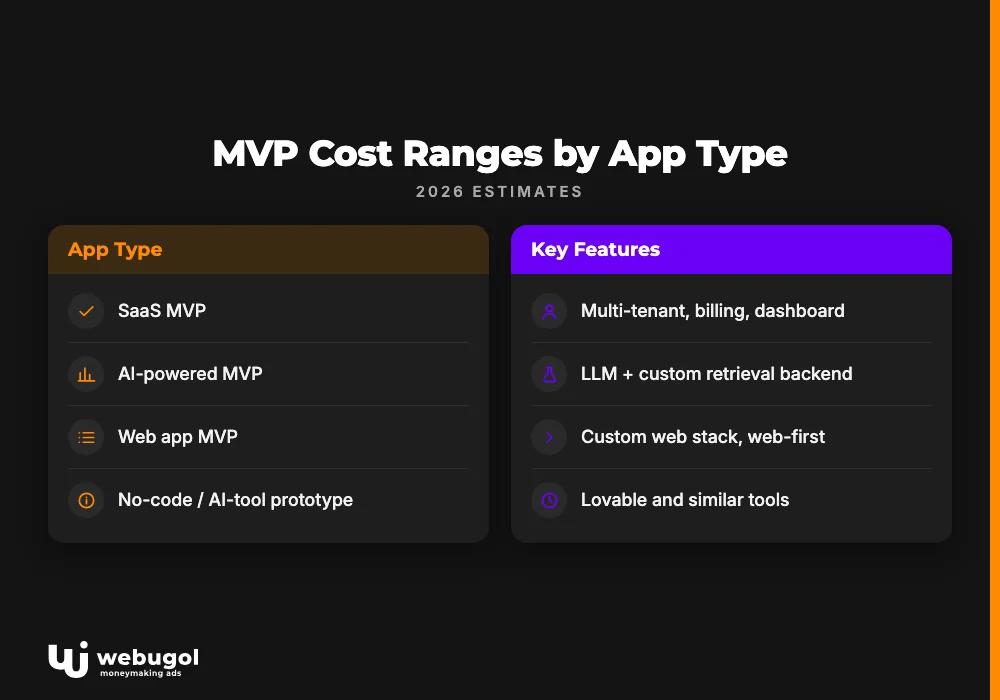
MVP cost ranges by app type
The following table covers the three product categories most relevant to founders in 2026 and shows what actual mvp app development cost looks like across product types.
| App type | Cost range | Typical timeline | Notes |
|---|---|---|---|
| SaaS MVP | $8,000–$35,000 | 6–12 weeks | Multi-tenant, billing, dashboard |
| AI-powered MVP (RAG, agents, chatbots) | $5,000–$40,000 | 6–14 weeks | LLM + custom retrieval backend |
| Web app MVP (dashboard, marketplace, portal) | $8,000–$50,000 | 6–14 weeks | Custom web stack, web-first |
| No-code / AI-tool prototype | $0–$3,500 (tool fees) | 1–4 weeks | Lovable and similar tools |
How much does a SaaS MVP cost?
A SaaS MVP in 2026 typically costs $8,000–$35,000, depending on multi-tenant architecture, billing integration, and dashboard complexity. Generic MVP quotes miss three SaaS-specific cost drivers that push budgets higher than expected.
The first is multi-tenancy. Building true multi-tenant architecture from day one costs more upfront but avoids a painful and expensive refactor once you have ten paying clients.
The second is billing. Integrating a payments layer with subscription logic, failed payment handling, and plan upgrades adds meaningful development time.
The third is dashboard complexity. It is one of the most common reasons saas mvp development cost overruns initial estimates, because the pressure to scope in too many metrics early is hard to resist.
AI-powered MVP cost (RAG, chatbot, agents)
LLM-based MVPs, including RAG pipelines, AI agents, and chatbots, range from $5,000 to $40,000 depending on model selection, retrieval architecture, and data pipeline complexity. The range is wide because underlying complexity varies more than in a standard web app.
A simple chatbot with a fixed knowledge base sits at the low end. A multi-agent system with a custom retrieval pipeline, evaluation layer, and integrations into external data sources sits at the high end. Model costs are operational, not build costs, but choosing a high-latency or high-cost model at the architecture stage compounds every user interaction.
Webugol builds AI products as part of a growth system. That means the product is instrumented for conversion data from launch, not retrofitted for it after the first growth wall.
Web app MVP cost
Standard web-first MVPs covering dashboards, marketplaces, and portals typically range from $8,000 to $50,000. The wide range reflects how much architecture complexity scales with the number of integrations and user roles.
Webugol's focus is web-first development. Mobile-only scope is outside this team's stack, but most founder-stage products do not need a native mobile app to validate their core hypothesis. A responsive web app covers the first paying users effectively.

MVP cost by team location
Location is a major cost lever. A team in Eastern Europe bills at $40–$70 per hour compared to $120–$180 per hour for US-based developers, which reduces total mvp development cost by 40–60% for equivalent scope.
| Region | Hourly rate | MVP cost at mid-scope |
|---|---|---|
| United States | $120–$180/hr | Full-rate baseline |
| Poland | $40–$70/hr | 40–60% below US baseline |
| Ukraine | $40–$70/hr | 40–60% below US baseline |
| India | Lower rate range | Largest rate discount; higher coordination overhead |
This table illustrates the rate differential; your actual total depends on scope, timeline, and engagement model. The mvp development cost poland and Ukraine figures reflect typical market rates for senior developers, not entry-level capacity.
Eastern European teams overlap US business hours closely, which keeps async coordination overhead low. That overlap advantage does not hold for Southeast Asian teams, where time-zone gaps often add project management friction that partially erodes the rate advantage.

What do you actually get for $5k, $15k, or $40k?
At $5,000 you get a no-code or AI-scaffolded prototype covering two or three core user flows. It validates an idea but is not production-hardened. At $15,000 you get a production-ready custom web MVP with authentication and one core integration, stable enough to onboard real users. At $40,000 you get a complex multi-role SaaS or AI-powered product ready for early paying users at scale.
Each budget tier maps to a different kind of stakeholder conversation. A $5k prototype is a tool for founder-market fit testing. A $40k product is a tool for growth.
One point founders consistently underestimate: once real users are on the product, the cost of data you cannot see is high. Setting up Google Analytics permissions correctly from launch, with the right access structure for your team and future growth partners, prevents the data gaps that slow every subsequent decision.

How long does an MVP take? Timeline and cost breakdown
Most MVPs take 4–12 weeks. Lean AI-accelerated builds run 4–6 weeks; complex SaaS or AI-powered products with multiple integrations run 10–14 weeks. That mvp development startup cost timeline varies by phase as follows:
| Phase | Duration | What determines cost |
|---|---|---|
| Discovery and scoping | 1–2 weeks | Requirements clarity, stakeholder count |
| Core development | 3–8 weeks | Feature scope, integrations, AI components |
| QA and launch prep | 1–2 weeks | Test coverage, infrastructure setup |
Decision speed on the client side is an underestimated variable. Every round of scope revision after development begins adds cost directly. Locking requirements before development starts is budget protection, not bureaucratic overhead.
Parallel work compresses timelines. Teams that run design and backend development simultaneously rather than sequentially can shorten a 10-week timeline to 7 weeks. That matters when runway is fixed.
Not sure which budget tier fits your product idea? We scope AI-accelerated MVP development for US startups, starting at $3,500. Book a free 30-minute scoping call.
How to lower MVP development costs without cutting what matters
Reducing mvp development cost is about sequencing and tooling, not feature deletion. Cutting the features that test your core hypothesis defeats the purpose of building an MVP.
AI-accelerated development cuts time, not quality
AI tooling, specifically code generation, automated QA, and scaffolding, reduces engineering hours by 30–50% on standard CRUD features. Speed increases because the mechanical parts are automated. Quality does not drop. Human review is built into every push.
That structural reduction is why Webugol's starting price sits at $3,500 where traditional agencies quote $15,000 or more for equivalent scope. The scope is the same. The hours are fewer.
Can I build an MVP with no-code tools like Lovable?
Yes, and for pure idea validation it is often the right first step, costing $0–$3,000 in tool fees. No-code tools are genuinely capable for simple flows.
The ceiling appears at custom integrations, security requirements, and scale. When your product needs a custom auth flow, webhook-heavy integrations, or any kind of compliance layer, no-code tools become a bottleneck rather than an accelerator. The right sequence: build in Lovable to validate core flows with real users, then migrate to a custom stack when you hit the ceiling. Migration cost is lower than building custom before you have validated user feedback.
Ready to scope your MVP? Let's talk numbers.
AI-accelerated MVP development starts at $3,500 in 2026. The same scope from a traditional agency starts at $15,000 or more. That gap is structural: AI tooling cuts engineering time per feature, not architecture quality or security.
Webugol builds MVPs as part of a full growth path: development and marketing infrastructure come together as one accountable system, not separate handoffs to separate vendors. The result for founders is a lower cost per first paying user and no gap between the product and the growth layer. If you are a startup founder or marketing lead evaluating your first build, start with a scoping conversation. We will put real numbers on your specific scope.
FAQ
How much does MVP development cost in 2026?
MVP development cost in 2026 starts at roughly $3,500 for AI-accelerated or no-code builds and reaches $80,000–$100,000 or more for complex multi-role SaaS or AI-powered products. Most founder-stage MVPs land in the $8,000–$35,000 range depending on scope and team location.
What is the difference between a $5,000 and a $40,000 MVP?
A $5,000 MVP is a no-code or AI-scaffolded prototype covering two or three core user flows; it validates an idea but is not production-hardened. A $40,000 MVP includes custom architecture, authentication, integrations, and enough stability to onboard real paying users at scale.
How long does MVP development take?
A lean MVP with an AI-accelerated team typically takes 4–6 weeks. Complex SaaS or AI-powered products with multiple integrations run 10–14 weeks. Timeline depends on feature count, third-party integrations, and decision speed on the client side.
Is it cheaper to hire a dev team in Poland or Ukraine for MVP development?
Yes. Senior developers in Poland and Ukraine bill at $40–$70 per hour compared to $120–$180 per hour in the US, reducing total MVP cost by 40–60% for equivalent scope. Both regions overlap US business hours, which keeps coordination overhead low.
Can I start with no-code and upgrade to a custom MVP later?
Yes, and it is often the right sequence. Build in Lovable or a similar tool to validate core flows with real users, then migrate to a custom stack when you hit integration, security, or scale limits. The migration cost is lower than building custom before you have validated user feedback.

