



Why clinics lose the second purchase (and how to measure what is leaking)
Repeat purchase rate (RPR) measures the share of patients who transact more than once within a defined period: divide the count of patients who purchased again by total unique patients, then multiply by 100. For clinics, RPR spans program restarts, membership renewals, and follow-up lab kit orders, not just a single product reorder as in standard ecommerce RPR models. The diagnostic reality most owners overlook is that marketing, intake, and billing each control a slice of the second purchase while nobody is accountable for the combined outcome. That structural gap is where most of the revenue loss lives.
What is repeat purchase rate? (Definition + formula)
RPR = (patients with 2+ purchases in the period ÷ total unique patients in the period) × 100.
For a clinic, a "repeat purchase" covers any of the following:
- A patient who restarts a weight-loss or GLP-1 program after completing an initial round.
- A member whose subscription renews for another billing cycle.
- A patient who orders a follow-up lab kit or bloodwork package after an initial assessment.
RPR and retention rate are related but distinct. RPR counts whether a transaction occurred again; retention rate measures whether a patient remained active across two consecutive periods. A subscription clinic needs both, but they diagnose different failure modes.
How do you calculate repeat purchase rate?
Divide the number of patients who made more than one purchase in a defined period by the total number of patients in that same period, then multiply by 100. The five-step RPR calculation for a clinic:
- Define the time window. A 90-day rolling window aligns with the typical payback horizon for clinic programs; 180-day windows capture slower-cycling program restarts.
- Pull total unique patients. Count distinct patient records from your CRM or billing system for the period, not order rows.
- Identify patients with two or more purchases. Filter the same patient list for anyone with more than one closed transaction in the window.
- Apply the formula. Illustrative example: 180 patients seen in Q1, 38 returned for a second program, RPR = (38 ÷ 180) × 100 = 21.1%.
- Sanity-check against your billing system. CRM contact counts and billing invoice counts rarely match; reconcile before reporting.
What is a good repeat purchase rate for a healthcare clinic?
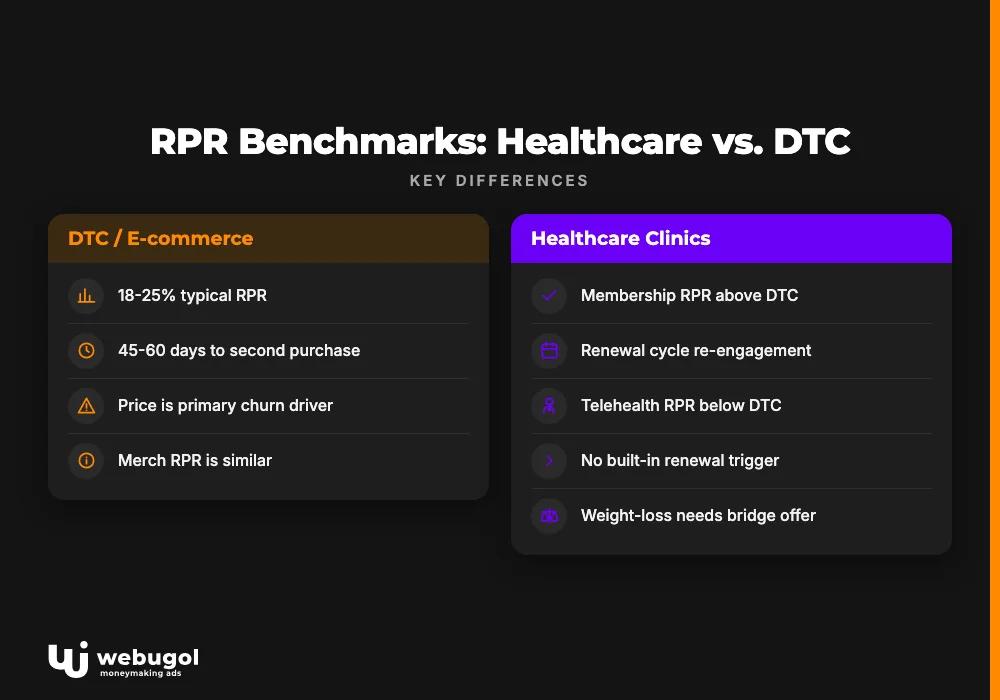
For most membership or subscription clinics, a healthy RPR sits substantially above general e-commerce norms because the billing cycle creates a built-in re-engagement moment; for telehealth episodic models, the realistic range is lower because re-engagement depends on proactive outreach rather than a renewal trigger. General DTC benchmarks of 18-25% understate what a continuity-model clinic can realistically reach, so calibrate against your own cohort data before deciding whether your number represents a problem.
Healthcare and telehealth RPR benchmarks
Healthcare-specific RPR benchmarks are not published in a consolidated public source; the patterns below reflect diagnostic observations across clinic and telehealth operator types. Note that merch RPR benchmarks from standard DTC retailers sit in the same 18-25% band as general e-commerce and do not transfer to subscription health models.
| Vertical | Typical RPR signal | Typical time to second purchase | Primary churn driver |
|---|---|---|---|
| General e-commerce / DTC | 18-25% | 45-60 days | Price / competitive alternatives |
| Membership clinic | Typically above DTC baseline; renewal cycle creates a structural re-engagement moment | Renewal billing cycle | Billing friction / perceived value drop |
| Telehealth episodic | Typically below DTC baseline; episodic structure lacks a built-in renewal trigger | Longer gap typical; no renewal anchor | No re-engagement after first consult |
| Weight-loss / GLP-1 program | Bridge offer to next phase is the key variable; calculate against your own program cohort | Shorter when a bridge offer is present; longer when the program ends without one | Program completion with no bridge to next phase |
| Med spa | Seasonal pattern; typically mid-range relative to DTC norms | Moderate; seasonal variation common | Offer mismatch / seasonal drop |
Healthcare membership models outperform the DTC benchmark because the billing cycle creates a structural re-engagement moment. The question is whether your post-purchase flow arrives before that moment closes.
Understanding how these RPR figures compound into long-run revenue requires a separate calculation. See how second-purchase frequency compounds into total patient revenue for the mechanics connecting second-purchase timing and total patient value.
RPR benchmarks by business stage
Stage matters as much as vertical. Early-stage clinics (typically under $500k/month revenue) post RPRs at the low end of their vertical range because post-purchase automation is underdeveloped and the patient base is too small to generate reliable signal. Growth-stage operators often see RPR plateau during rapid acquisition phases when large new-patient cohorts dilute the repeat signal. Scale-stage practices either outperform their vertical range because renewal systems have been built deliberately, or they are running acquisition spend to mask a retention leak.

Repeat purchase rate vs. retention rate vs. reorder rate vs. cross-sell rate
Clinics routinely conflate these four metrics across billing, CRM, and marketing. Each one lives in a different part of the stack, and confusing them produces the wrong diagnosis and the wrong fix.
| Metric | Definition | Formula | When to use | Typical healthcare range |
|---|---|---|---|---|
| RPR | Share of patients who transacted again in a period | (Repeat buyers ÷ total buyers) × 100 | Measuring re-transaction behavior across all clinic models | Wide spread by clinic model; benchmark against your own cohorts, not a cross-vertical average |
| Retention rate | Share of patients who remained active across two consecutive periods | (End active − new) ÷ start active × 100 | Subscription and membership churn tracking | Substantially higher than episodic models; calculate against your own renewal cohort |
| Reorder rate | Share of patients who ordered the same product or program again | (Same-product repeat orders ÷ total orders) × 100 | Replenishment and continuity product performance | Highest where a refill or retest cadence is built in (lab kit and continuity programs); track against your own refill cycle |
| Cross-sell rate | Share of patients who purchased a second, different service line | (Cross-product buyers ÷ total buyers) × 100 | Offer-expansion and upsell effectiveness | Depends on whether a second service line is offered at a natural decision point; measure per offer, not clinic-wide |
Declining RPR usually points to a post-purchase timing or engagement problem. Declining retention rate in a membership clinic usually points to a billing or perceived-value problem. Mixing them produces the wrong fix.
For a wider view of how these metrics interact with the patient retention funnel in healthcare and where measurement gaps tend to accumulate, the patterns are consistent across clinic models.
When do repeat purchases actually happen in a clinic?
The pattern across clinic models shows most second programs tend to close by day 45 or not until after day 120, with the sharpest dropout typically occurring between days 7 and 30. That gap is the active window where your post-purchase flow needs to be running.
The 60-to-90-day window is financially consequential. The payback window that makes second-purchase timing financially critical determines whether your first acquisition investment is recovered before the patient lapses. A second program closing at day 50 changes the unit economics of a campaign; one closing at day 150 may not recover first-visit acquisition cost within your planning horizon.
The dropout curve follows a consistent pattern across clinic models:
- Days 0-7: highest intent window; the patient is still in context from the first experience
- Days 7-30: sharpest dropout; most lapse decisions are made here without active re-engagement
- Days 30-90: moderate conversion still possible with a structured follow-up sequence
- Days 90+: reactivation economics apply; cost to re-engage approaches new acquisition cost

Why is your clinic's RPR lower than it should be?
The problem is almost never a weak CRM or a missing loyalty program. It is the handoff structure between marketing, intake, and billing. Each team reports correctly inside its own scope: marketing shows a strong new-patient flow, intake reports a clean show rate, billing reports on-time renewals. Nobody is paid to look at what happens in the gaps between those scopes. That is where the second purchase leaks.
The post-purchase timing gap
Post-purchase automation in most clinics is configured to start on day 14. The pattern we observe across clinic models is that the highest-intent window for the second-purchase decision closes considerably earlier than that trigger. Those two timelines do not overlap.
Compounding the timing problem is a suppression pattern that most marketing teams do not recognize. Recent buyers are actively excluded from outbound campaigns because suppressing them from active ad audiences reduces CPC and improves ROAS optics. The patients most likely to convert to a second program are the ones being held out of every outreach sequence. For episodic telehealth operators, this pattern consistently suppresses RPR below what the product economics would otherwise support. It is often the most impactful fix available.
Membership vs. one-time purchase RPR
In a membership clinic, RPR is a renewal rate in disguise. The metric looks healthy in marketing's dashboard because the billing system auto-renews a large share of members each cycle. What goes unmeasured is the gap between billing's definition of "active" (a paid invoice) and the CRM's definition (an engaged contact).
A patient can be billing-active and engagement-dead, with no outbound touchpoint for three renewal cycles, until a cancellation request surfaces the lapse. Reactivation economics for a membership clinic are fundamentally different from episodic RPR recovery: a lapsed member who cancels costs considerably more to reacquire than an engaged member costs to retain through a proactive renewal flow. The owner who treats this as a billing metric rather than a marketing metric funds the acquisition budget to cover a retention leak.
If intake and billing report to separate owners in your clinic, the second purchase is leaking at a handoff. A structured clinic revenue diagnostic maps exactly where across all three systems.
How to increase repeat purchase rate in a clinic
Each tactic below names the specific failure mode it fixes, rather than a generic channel recommendation.
- Move your post-purchase flow trigger to day 3. Fixes: timing gap. The pattern across clinic models shows the re-purchase decision typically falls in days 3-7, when the patient is still engaged with the outcome; most clinic flows start on day 14 because that is when the product is used.
- Remove recent buyers from suppression lists for re-engagement campaigns. Fixes: buyer suppression. Create a distinct segment for 30-to-60-day post-purchase patients and run it as a separate outbound sequence outside standard suppression logic.
- Reconcile CRM active status with billing active status weekly. Fixes: billing-CRM misalignment. When the two systems disagree about who is active, the patient most at risk of lapse often appears healthy in both until cancellation arrives.
- Sequence your second offer to match the program completion moment. Fixes: offer mismatch. A weight-loss patient completing month 3 is most receptive to a maintenance or next-phase offer in that specific window; a generic membership upsell converts poorly.
- Extend post-purchase sequences to cover the full 90-day window. Fixes: flow coverage gap. Most clinic flows run 21-30 days and stop; the 60-to-90-day segment is the second-highest conversion window for patients who missed the early one.
- Assign one person to own RPR as a KPI across marketing, intake, and billing. Fixes: accountability gap. If the metric belongs to nobody, the handoff problem never gets a budget, a timeline, or a fix.

How do you track repeat purchase rate when revenue lives in three systems?
Designate your CRM as the single source of truth for patient counts, then reconcile billing and GA4 against it before calculating. Most healthcare clinics run Shopify or a billing platform for transactions, GoHighLevel or HubSpot as CRM, and GA4 for behavioral tracking. Three systems, three different customer IDs for the same patient. That divergence means the Shopify definition of RPR and your CRM-based RPR will produce different numbers unless you deliberately reconcile them.
A five-step tracking setup for clinics:
- Define "customer" across systems. A patient who books through an intake portal and pays through a billing platform has two IDs; designate one as canonical (typically the CRM contact ID).
- Designate CRM as the source of truth for patient counts. Billing counts invoices; CRM counts people; GA4 counts sessions. RPR is a people metric.
- Export and deduplicate the order table by patient ID. Pull transaction records from billing, then match against CRM records to collapse duplicate IDs before calculating.
- Automate via Shopify report or GoHighLevel pipeline. In Shopify Analytics, go to Reports, then Customers, then Returning Customers, and set a rolling 90-day window.
- Confirm GA4 is not used for patient-level behavioral attribution. GA4 behavioral data tied to individual patient identifiers creates HIPAA exposure; aggregate behavioral reporting is acceptable, patient-linked records are not.
The same reconciliation logic applies when answering how to track RPR on Shopify accurately: the Shopify returning-customers report is a starting point, not a final number, because it cannot see patients who entered through a separate intake portal.
Find out where your clinic's second purchase is leaking
Your RPR number is already inside your data. The question is whether anyone in your organization is looking across all three systems at once: marketing's outreach timing, intake's CRM status, and billing's renewal records.
Webugol is a digital marketing agency that owns the full revenue path from ad click to recognized revenue and runs a structured diagnostic that traces exactly where the second purchase breaks down across clinic handoff structures. The Healthcare Growth System includes that diagnostic in month one alongside the tracking infrastructure and funnel build. If your board or investor targets require a step-change in retention revenue, the current handoff structure is worth examining before the next acquisition budget increase.
FAQ
What is a good repeat purchase rate for healthcare clinics?
For episodic telehealth, a healthy RPR sits below the general e-commerce norm because the model lacks a built-in renewal trigger; for membership or subscription clinics, the target is substantially higher, driven by renewal economics rather than reacquisition. General e-commerce benchmarks of 18-25% understate what a continuity-model clinic can realistically achieve because the billing cycle creates a structural re-engagement moment that merchandise models lack.
How do you calculate repeat purchase rate?
Divide the number of patients who made more than one purchase in a defined period by the total number of patients in that same period, then multiply by 100. Example: 40 returning patients out of 200 total in a 90-day window gives an RPR of 20%.
What is the difference between repeat purchase rate and retention rate?
RPR counts whether a patient transacted again within a period; retention rate counts whether a patient remained active across two consecutive periods. For subscription clinics, both matter, but they flag different failure modes: transaction lapse versus subscription churn.
How soon after a first visit should a clinic try to re-engage a patient?
The pattern across clinic models suggests the highest-yield window is days 3-7 post-purchase, while the patient is still in context from the first experience. Most clinic post-purchase flows are triggered on day 14 or later, after the majority of lapse decisions have already been made.
How do I track repeat purchase rate on Shopify?
In Shopify Analytics, go to Reports, then Customers, then Returning Customers, and set a rolling 90-day window. For cross-system accuracy in a clinic, export the raw orders table by customer ID and reconcile against your CRM contact records to capture patients who booked through a separate intake portal.

