



Software Development Services: Types, Costs, and How to Choose
Software development services are professional engagements where a vendor designs, builds, and maintains software tailored to a specific business. The category spans early-stage MVP builds, AI integrations, cloud infrastructure, and enterprise platform modernization. The right partner does more than ship working code. They deliver a system that generates revenue from day one, with growth infrastructure already in place.
What is included in software development services?
Custom software development services differ from buying packaged software in one fundamental way: the system fits how your business actually operates, rather than requiring your team to adapt to a generic tool. Scope ranges from a focused MVP testing a single value proposition to enterprise platforms managing compliance, multi-system integration, and thousands of concurrent users.
A development engagement is also distinct from a consulting engagement. Consulting produces a diagnosis. Development produces a working system. That distinction matters when evaluating whether a vendor can actually deliver, not just advise.
Six service categories fall under the software development services umbrella: custom application builds, web and mobile applications, AI-powered development, cloud and DevOps infrastructure, legacy system modernization, and post-launch maintenance. Each carries different cost ranges, timelines, and vendor selection criteria.
Types of software development services
Knowing the taxonomy before talking to vendors helps you scope the right engagement, ask sharper questions, and compare quotes on equal terms. The table below maps each service type to the business situation that most commonly drives it.
| Service type | Best for | Typical timeframe |
|---|---|---|
| Custom software development | Workflows no existing product can match | 3 to 12 months |
| Web and mobile applications | Products delivered through browsers or app stores | 6 weeks to 6 months |
| AI and automation development | Replacing manual workflows or embedding LLMs | 4 to 16 weeks per feature |
| Cloud and DevOps infrastructure | Any product that must scale reliably | Ongoing; foundations in weeks 1 to 3 |
| Legacy system modernization | Stacks blocking integrations or security patches | 3 to 18 months |
| Maintenance and support | Post-launch systems needing monitoring and iteration | Monthly retainer |
Custom software development
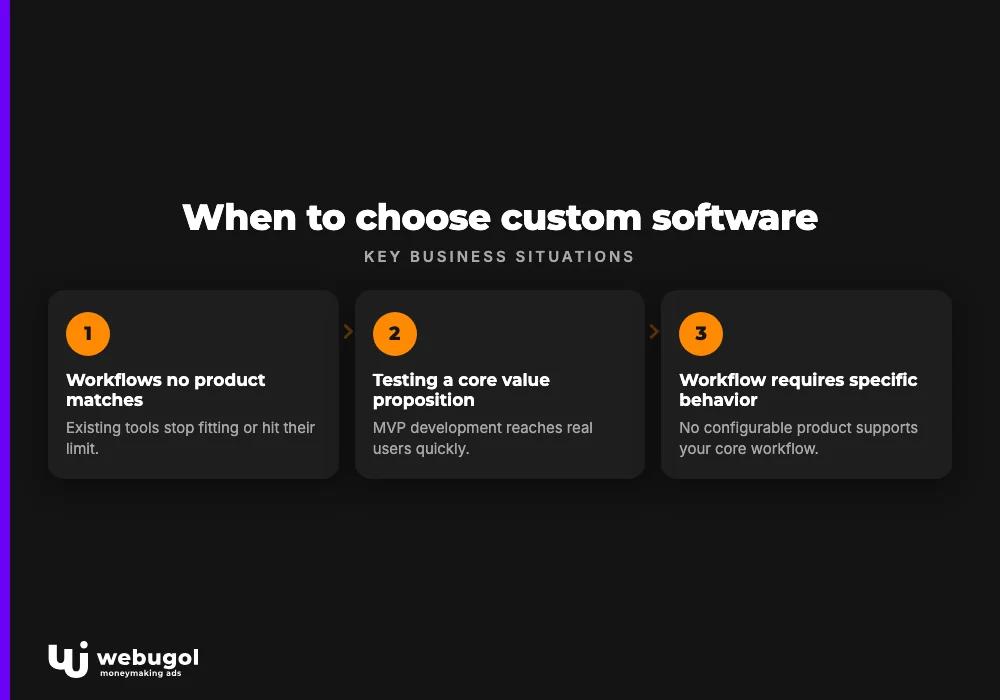
Custom software development covers net-new applications built entirely around a specific business's workflows, rather than configured from an existing product. The decision to go custom almost always follows a ceiling hit. Off-the-shelf tools stop fitting. No-code platforms hit their limit.
For businesses testing a core value proposition before committing to a full platform investment, the most practical entry point is MVP development, where a focused build reaches real users quickly. AI-accelerated tooling has brought that entry point down to $3,000 to $5,000 for many focused builds. That shift rewrites the build-versus-buy calculation for most SMBs.
Custom software development services make sense when at least one of these conditions holds:
- Your core workflow requires behavior no configurable product supports.
- A compliance requirement (HIPAA, SOC 2, PCI-DSS) excludes your current platform.
- Per-seat or per-transaction pricing on existing tools will exceed a custom build's cost within 18 months.
- You are building a product to sell, not just a tool for internal use.
- Integration failures between current tools create recurring operational costs with no vendor-side fix.
Web and mobile application development
Web applications are the dominant product surface for most software businesses. Dashboards, booking flows, customer portals, and data-driven tools all live here. A web application differs from a marketing site in that it handles state, user authentication, and user-specific data rather than delivering static content.
Teams building recurring-revenue products typically pursue SaaS product development, where the architecture is designed for multi-tenant use from day one. The choices made in the first sprint around data isolation, billing integration, and access control determine how expensive the product is to operate at scale. Vendor experience with this architecture is a real selection criterion.
Choosing a web app development company means verifying the vendor has built the type of application you actually need. A booking flow for a two-sided marketplace carries different architecture requirements than a single-tenant reporting dashboard. That distinction shows up in discovery questions, not portfolio screenshots.
AI-powered development and automation
AI software development services cover two distinct things buyers often conflate. The first is using AI tools to accelerate the build itself: code generation, automated testing, and scaffolding that compresses timelines on repetitive tasks. The second is embedding AI as a product feature layer: LLM integrations, RAG pipelines, agent workflows, and process automation that replace manual steps in the user's workflow.
Both matter when comparing vendors. AI-assisted development is the mechanism behind the $3,000 to $5,000 entry point for focused MVPs, work that previously required far larger teams. AI feature-layer builds require LLM framework experience and data pipeline architecture knowledge, not just general backend skill. That capability gap is worth verifying directly in any vendor evaluation.
Cloud, DevOps, and infrastructure
Cloud-native architecture, CI/CD pipelines, containerization, and infrastructure-as-code are the operational foundation underneath every modern software product. Buyers frequently treat this as a backend detail rather than a business decision. That attitude leads to scaling problems, unpredictable infrastructure costs, and expensive migrations later.
What to expect from a serious vendor: cloud infrastructure built alongside the application from the first sprint, not retrofitted post-launch. Automated deployments, environment parity between development and production, and containerized services are baseline expectations for any professional software development engagement.
Legacy system modernization
Legacy system modernization covers migrating brittle monoliths and outdated codebases to modern stacks without disrupting running operations. The business triggers are predictable: security patches can no longer be applied, new integrations are impossible or fragile, performance degrades under growing load, and the original developers who understood the system are no longer available.
The common mistake is treating legacy system modernization as a technology project rather than a business continuity project. Phased migration, where new functionality is built on the modern stack while legacy components are progressively retired, reduces risk and keeps the business running through the transition.
Maintenance and support
Maintenance and support is the category buyers most consistently underbudget. Post-launch monitoring, dependency updates, bug resolution, and iterative feature work are ongoing costs for any production system. The real question is whether a vendor explicitly scopes this as a deliverable with defined terms.
A well-defined support retainer covers response time SLAs, a process for triaging and prioritizing bugs, a schedule for dependency updates, and capacity for small feature work. Vendors who treat maintenance as an afterthought create handoff problems that cost more to fix than a structured retainer would have prevented.
When should a small business hire a software development agency?
The threshold arrives when the tool becomes the bottleneck rather than the business. Once your team spends more time working around a platform than using it, or a compliance requirement or integration need exceeds what the platform supports, you have likely already crossed the line.
The cost of staying on a tool that is almost right compounds quietly. Developer workarounds, friction in core workflows, and delayed growth initiatives that never launch all accumulate in ways that rarely appear on a budget line. That invisible cost is why businesses stay on the wrong platform far longer than makes economic sense.
This dynamic is the same whether you are a startup founder who has hit the ceiling of a no-code prototype or a marketing director at a growing SMB whose platform can no longer support the integrations your stack requires. The structural problem is identical: the platform is capping growth. Figuring out whether a custom build or a migration is the right fix is the first decision worth scoping carefully.
Signs you have outgrown your current tools
These signals indicate the platform has become the constraint:
- Integration failures: the tool cannot connect reliably to other systems your business depends on, or the connections require expensive middleware that breaks when either platform updates.
- Compliance requirements the platform cannot meet: HIPAA, SOC 2, PCI-DSS, or data residency requirements the vendor cannot certify for your use case.
- Scaling costs that exceed custom ownership: platform pricing grows faster than business value as user count or data volume increases.
- Customization dead-ends: the core workflow your business depends on requires behavior the platform explicitly does not support and is not on the vendor roadmap.
- Performance degradation under real load: features that worked at 50 users break or slow unacceptably at 500.
Once you hit these limits, the decision is about which path reduces risk and total cost of ownership over the next 24 months. The table below maps the key trade-offs.
| Path | Upfront cost | Scalability ceiling | Customization | Best for |
|---|---|---|---|---|
| Off-the-shelf SaaS | Low | Defined by vendor | Low | Standard workflows with minimal integration needs |
| No-code / low-code | Low to medium | Moderate | Medium | Prototyping and simple internal tools |
| Custom development | Medium to high | Near-unlimited | Full | Unique workflows, compliance needs, or scale targets |
Industry requirements that shape custom software development
Vertical software development differs from a standard web application build in three areas: the compliance layer, the integration requirements, and the data architecture decisions that every feature depends on. Getting those decisions right from the start costs significantly less than retrofitting them after the first user-facing launch.
Healthcare software development operates under HIPAA at a minimum, with EHR interoperability (HL7 FHIR), patient portal architecture, and audit trail requirements shaping every data decision. The compliance layer is not a feature added at the end. It affects database schema, API design, access controls, and vendor agreements from day one. Webugol's work with Valhalla Vitality, Ways2Well, and Humanaut Health reflects this: each product required HIPAA-compliant data flows and patient-facing interfaces designed around how the care team actually operates.
Financial software development operates under SOC 2, PCI-DSS, and in some cases banking-specific regulatory requirements that change the architecture. Latency requirements, fraud prevention layers, and audit trail expectations for financial transactions differ from standard SaaS in ways that affect infrastructure choices from the architecture phase.
Enterprise software development is defined by integration complexity. The core challenge is connecting new software to existing ERP systems, WMS platforms, and legacy databases while maintaining the operational reliability the business depends on. Role-based access controls, procurement-side approval workflows, and audit requirements are standard regardless of vertical. In every case, the compliance scope must be defined before the architecture, not after the first sprint.
How much does custom software development cost?
AI-assisted MVPs typically start at $3,000 to $5,000. Full web applications and SaaS products run $25,000 to $100,000 or more depending on scope. Enterprise platforms with compliance requirements and legacy system migrations vary widely and are best scoped through a structured discovery engagement rather than an upfront quote.
That range is wide for a real reason. The variables that drive cost in any software development services engagement are not always visible from a project description. Vendors who quote without a discovery phase are pricing on assumptions that often shift after the first week of actual work.
What drives MVP development cost
These are the variables buyers control and the ones dictated by the project:
- Scope complexity: the number of distinct user workflows, data models, and system states the software must manage. A booking system with two user roles costs less than a multi-tenant platform with five.
- Compliance requirements: HIPAA, SOC 2, and PCI-DSS add engineering time for audit logging, access controls, encryption layers, and vendor review processes that standard builds do not require.
- Third-party integrations: each integration adds specification, implementation, and ongoing maintenance cost. The more integrations, the less predictable the total.
- Team size and seniority: a larger or more specialized team compresses timelines at higher cost. The right balance depends on deadline tolerance and risk appetite.
- Post-launch support tier: a structured maintenance retainer changes the total cost of ownership calculation over a 12-to-24-month horizon in ways most buyers overlook when comparing initial quotes.
The most common mistake is treating quotes as comparable when one includes discovery and the other does not. A fixed-price quote without a discovery phase is a budget commitment based on incomplete information. Either scope gets cut or cost overruns follow.
How AI-accelerated development changes the budget
AI-assisted development compresses timelines on repetitive coding tasks: boilerplate, test scaffolding, documentation, and standard data operations that used to require senior developer hours. This is the mechanism behind the $3,000 to $5,000 entry point for focused MVPs.
For business owners, this produces two concrete effects. Faster feedback loops: a working product can reach real users in six to eight weeks rather than four to six months. More budget for product-specific logic: integration decisions and architecture choices that require genuine expertise receive more of the total budget, because less goes to code a well-prompted model generates reliably. The result is proportionally better output for the same investment compared to traditional development.

How do I choose a software development company?
A structured evaluation produces better vendor decisions than portfolio browsing alone. The criteria below map to behavioral signals that predict a successful engagement, not just impressive case study pages.
What to look for beyond the portfolio
The portfolio shows past work. The discovery process reveals how a vendor thinks about future work. A vendor who leads with a structured discovery engagement, defines deliverables clearly, and asks hard questions about your constraints before proposing a scope demonstrates the process quality that determines whether a project runs on schedule and on budget.
Communication cadence and escalation paths matter equally. A vendor who disappears between sprint reviews or routes every question through account management creates information gaps that compound into scope and budget problems. The right pattern is direct communication with the people doing the build.
When businesses hire a software development team or decide to outsource development SMB-side, the most common gap is a defined post-launch arrangement. Vendors who hand off working code with no accountability for what happens next create a transition problem that typically costs more to resolve than a structured retainer would have. A partner who pairs software development services with growth marketing ships products with measurement and distribution already built in, rather than treated as an afterthought.
Webugol, as a development and growth marketing agency, treats these as a single engagement. The product ships with its growth channel already in place.
Red flags in vendor evaluation
These behavioral patterns predict a poor-fit engagement before a contract is signed:
- No structured discovery phase: the vendor prices from a description alone, without a defined process for validating scope and requirements before work begins.
- Fixed-price-only proposals on first-time builds: appropriate for well-defined, low-uncertainty work. A red flag when applied to new products with unresolved architecture decisions.
- Generic stack for every project: a vendor who proposes the same technology regardless of compliance, scale, or integration requirements is optimizing for their own workflow, not yours.
- No post-launch support plan: no defined SLA, no maintenance scope, no transition process if the engagement ends.
- Vague intellectual property terms: ambiguous ownership of code, documentation, or third-party integrations creates legal and operational risk after the project closes.
- Inability to reference past clients at a relevant scale: a pattern that signals either a short track record or engagements clients would not recommend.
Questions to ask before signing the contract
Running this scorecard on every vendor shortlist reveals more about process quality than any portfolio.
| Criterion | Why it matters | Question to ask |
|---|---|---|
| Discovery scope and deliverables | Defines what is actually being built | What does your discovery phase produce, and what decisions does it require from me? |
| Code ownership and handoff | Determines what you control post-launch | Who owns the intellectual property and what does the handoff process include? |
| Communication cadence | Predicts information flow during the build | Who do I communicate with directly, and how often? |
| Post-launch maintenance terms | Sets realistic total cost of ownership | What is included in maintenance, and what is the SLA for production issues? |
| References from comparable projects | Verifies track record on similar-scale work | Can you share references from projects at a similar scale and compliance level? |
How long does it take to build custom software?
A focused MVP with a defined scope takes 6 to 12 weeks with an experienced team. A full web application or SaaS product typically takes 3 to 6 months depending on feature complexity and third-party integrations. Enterprise platforms with compliance review and legacy system migrations run 6 to 18 months.
These are medians, not guarantees. Scope clarity at kickoff is the single biggest determinant. A vague brief adds weeks of discovery before development can start.
The variables that compress or extend timelines:
- Number of third-party integrations: each depends on the external vendor's documentation quality and response times, adding schedule uncertainty.
- Compliance review requirements: HIPAA, SOC 2, and PCI-DSS audits add structured work that cannot be compressed without increasing risk.
- Client feedback turnaround speed: the build team is blocked when decisions are waiting. Slow feedback effectively halves sprint capacity.
- Team size and experience: a larger team parallelizes more work at higher coordination cost. The right size depends on deadline pressure and project complexity.
Software project scoping: what it produces and why it matters
Software project scoping is the process of defining what gets built before development starts. It is not a preliminary formality. A well-run scoping phase is the single most effective cost-control mechanism in any custom software development services engagement.
A complete scoping output includes a specification document, a phased project plan, a list of confirmed third-party integrations and their dependencies, a definition of the compliance requirements and their architecture implications, and a post-launch support arrangement. Each of these has budget and timeline implications. Vendors who skip to a quote without producing these documents are estimating, not scoping.
Scoping also defines what does not get built. First-time buyers consistently overestimate what needs to be in version one. A good discovery process strips the scope to the minimum viable feature set that tests the core value proposition with real users. That is what makes the AI-assisted $3,000 to $5,000 MVP entry point realistic: the scope has been designed for it, not just the technology. Without that discipline, the same team builds a much larger product at significantly higher cost.

What the development process looks like from the client side
Knowing what the engagement looks like from your side matters more than memorizing phase names. What decisions do you own, when, and what does good look like at each stage are the questions that predict whether a project runs smoothly.
Weeks 1 to 2 (Discovery and specification): Structured sessions to define scope, constraints, and success criteria. The output is a specification document and project plan. Your responsibility is honest input on requirements, timeline constraints, and post-launch support budget. Discovery quality is the single biggest predictor of whether the rest of the project runs on schedule.
Weeks 2 to 3 (Design and architecture review): Wireframes, user flows, and architecture decisions are locked in before code is written. This is where compliance requirements, integration patterns, and data architecture are confirmed. Changes here are inexpensive. Changes in week 10 are not.
Weeks 4 through completion (Build sprints with regular demos): Two-week sprint cycles with working demos at each cycle end. Your responsibility is timely feedback and decisions when the team is blocked. Slow client feedback is one of the most reliable predictors of a delayed launch.
Final 2 weeks (QA and staging): Comprehensive testing in a production-equivalent environment, user acceptance testing, and launch preparation. This phase surfaces integration edge cases and load-testing gaps that sprint demos miss.
Go-live and post-launch: Deployment, monitoring setup, and transition to the support retainer. The first two weeks post-launch surface issues that only appear under real usage patterns.
For content-heavy products, a headless CMS architecture separates the content management layer from the application logic. Marketing teams can publish and update content independently without engineering involvement on every change. That separation matters as the product scales.
Ready to scope your project?
When you hire a software development team that also owns your growth channel, the product ships with distribution already in place. That is the difference between a working system and a working business. Book a free scoping call with Webugol to map your project against a realistic timeline and budget before committing to a vendor.
FAQ
What is included in software development services?
Software development services cover the full build lifecycle: requirements definition, architecture, design, development, testing, deployment, and post-launch support. Depending on the engagement, the scope can include custom application development, third-party integrations, cloud infrastructure, compliance implementation, and ongoing maintenance. The exact deliverables should be defined in a discovery phase before any code is written.
How much does custom software development cost?
AI-assisted MVPs typically start at $3,000 to $5,000, while full web applications and SaaS products run $25,000 to $100,000 or more depending on scope. Enterprise platforms with compliance requirements and legacy system migrations vary widely and are best scoped through a structured discovery engagement. The main cost drivers are project complexity, compliance requirements, team size, third-party integrations, and the level of ongoing maintenance required.
How do I choose a software development company?
Start with the discovery process, not the portfolio. A vendor who runs a structured discovery phase, defines deliverables before pricing, and communicates directly with the people doing the build demonstrates the process quality that determines whether a project delivers on time. Ask for references from projects at a comparable scale and compliance level before signing anything.
How long does it take to build custom software?
A focused MVP with a defined scope takes 6 to 12 weeks with an experienced team. A full web application or SaaS product typically takes 3 to 6 months depending on feature complexity and third-party integrations. Enterprise platforms with compliance review and legacy system migrations run 6 to 18 months.
When should a small business hire a software development agency?
Hire a development agency when the tool you are using has become the bottleneck: integrations are failing, performance is degrading under real load, or compliance requirements exceed what the platform supports. If per-seat or per-transaction platform costs will exceed a custom build's cost within 18 months, custom development is typically the better long-term investment. A no-code prototype that has validated real demand is another clear trigger for bringing in a development team.

