



How to Build a Marketing Team Structure That Doesn't Depend on You
A marketing team structure is the operating model that defines who owns decisions, handoffs, and outcomes. It is not the same as an org chart, which only shows reporting lines. If the CEO is the single connector between paid media, CRM, and vendors, the structure is broken regardless of what the org chart shows.
What a Marketing Team Structure Actually Is (and What an Org Chart Misses)
Your org chart shows five people and three vendors. Your message thread history tells a different story. Every time paid and content need to coordinate, the thread includes the CEO. Every time there is a discrepancy between the CRM and the ad platform, someone pings the owner to translate.
That pattern is a hub-and-spoke with the CEO at the center. It does not change by hiring another specialist. It changes when ownership is assigned at the seams.
Apply the thread test: how many message threads from the last 30 days had you as the only connector between two parties? If that number exceeds five, structure is the constraint, not the budget.
What Is the Ideal Marketing Team Structure for a Small Business?
The right marketing team structure depends on revenue stage, not headcount. At $0 to $500K, the acquisition channel is still unproven, and hiring an in-house generalist before the model is validated is a common and expensive mistake. A startup marketing team structure at this stage works best with founder-led acquisition and fractional strategy.
At $500K to $2M, a small marketing team structure needs one in-house demand-gen owner, fractional strategy leadership, and execution support from an agency or contractor. Above $2M, a modern marketing team structure requires a dedicated marketing operations function to keep the data layer intact as channel complexity grows.
Role assignments by revenue stage:
- $0 to $500K: Founder-led or one generalist. Keep strategy fractional. Do not hire a coordinator before a strategist is in place.
- $500K to $2M: One in-house demand-gen owner. Fractional CMO or strategy lead. Agency or contractor for execution. Marketing ops named even if fractional.
- $2M and above: In-house demand gen plus in-house marketing ops. Fractional or full-time CMO. Dedicated analytics owner. Compliance approver named in the org structure.
Core Roles a Growing Marketing Team Actually Needs
Demand generation owns pipeline creation and paid channels. Content owns organic acquisition and conversion assets. Analytics owns the reporting layer that connects spend to revenue. These three appear in most guides. Marketing operations does not.
Marketing ops is the function that makes data flow correctly between the ad platform, the CRM, and the dashboard. It is not a tool admin role. The person here is accountable for whether the CRM and ad platform agree on what a conversion is, whether lead routing fires correctly, and whether reporting answers causal questions.
In a growth marketing team structure, this function often gets distributed across whoever is most technical. A clear marketing operations team structure names one person accountable for what flows between systems, not just what happens within each one. That is exactly how the CEO ends up translating between vendors when this role is missing.
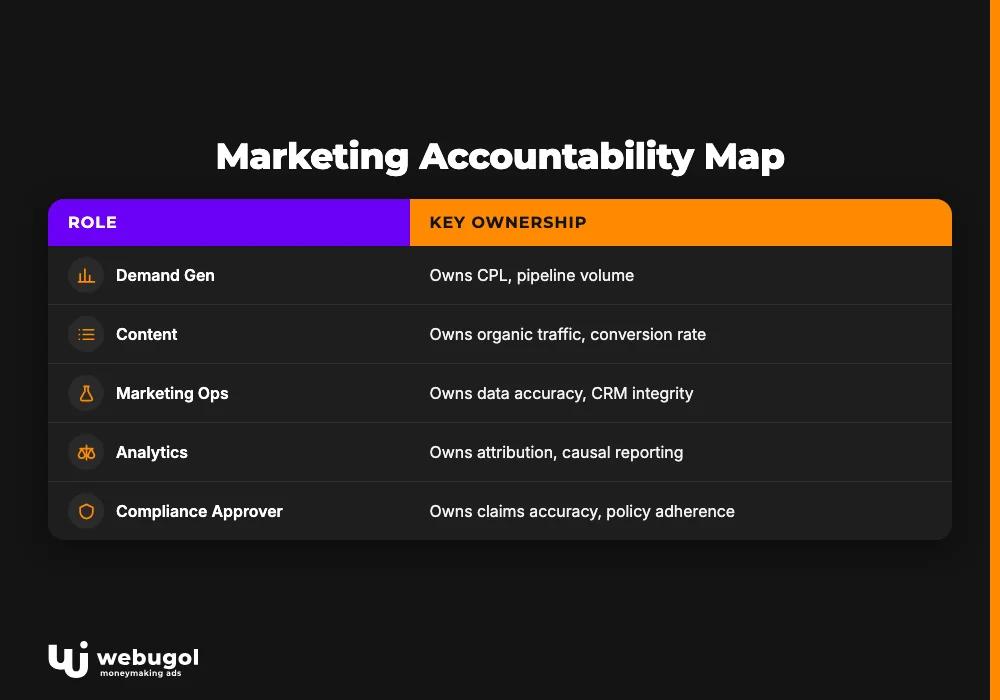
Who Owns What? A Simple Accountability Map
"Everyone is responsible for growth" means no one is accountable for a specific failure. When a campaign underperforms, paid blames creative, creative blames the brief, and the brief came from the CEO. An org chart with five names does not solve this. An accountability map does.
| Function | Owns outcome | Executes work | Reports results |
|---|---|---|---|
| Demand gen | CPL, pipeline volume | Campaigns, ad creative | Weekly pacing report |
| Content | Organic traffic, conversion rate | Assets, copy | Monthly performance |
| Marketing ops | Data accuracy, CRM integrity | Platform configs, integrations | Reconciliation report |
| Analytics | Attribution, causal reporting | Dashboard, tracking | Board-level summary |
| Compliance approver | Claims accuracy, policy adherence | Review workflow | Audit log |
Every analysis of an in-house marketing team structure describes these roles. None assigns the handoffs between them. That is where the coordination load defaults to the CEO.
Who Should Own Marketing Operations in a Growing Company?
The person accountable for data flow between ad platforms, CRM, and reporting owns marketing ops. This role must be distinct from channel execution.
When a channel specialist doubles as the tool admin, they prioritize their own channel's data over the integrity of the whole funnel. That is where the ad platform and CRM end up disagreeing, and where nobody can explain the discrepancy without routing the question to the owner.

When Should You Hire In-House vs. Use a Marketing Agency?
The decision depends on which bottleneck you are solving, not on company size. Strong channel execution with weak strategy points to fractional leadership, not another specialist. Speed-to-market needs with limited internal capacity point to a structured agency relationship. The full cost-and-control comparison covers what each model costs in ownership risk and coordination load.
Three models and when each fits:
- Full in-house: Fits when volume is high enough to keep specialists productive and there is a CMO setting strategy. Breaks when headcount grows faster than strategy clarity, or when marketing ops has no named owner.
- Fractional leadership plus execution support: Fits for teams at $500K to $3M that need strategic direction without a full-time CMO cost. Breaks when execution is split across too many unconnected vendors with no one accountable for the full acquisition path.
- Full-service agency: Fits when one party is accountable for the end-to-end revenue path. Breaks when the agency optimizes for its own deliverables rather than downstream revenue, or when no accountability clause exists in the contract.
If your board has a revenue target your current structure cannot reach, the constraint is almost never the budget. The growth sprint built around a structural diagnostic starts with an ownership review before any campaign work begins. Schedule a call to see exactly where your structure is leaking revenue.

Why Marketing Teams Break at the Handoffs
No specialist is paid to look between their scope and the next person's scope. Paid optimizes to cost per click. Creative optimizes to engagement. CRM optimizes to open rates.
Nobody checks whether those three systems agree on what a conversion is. Revenue leaks at the seam between each function, and none of it appears in any single vendor's report.
Webugol is a digital marketing agency that owns the full revenue path from ad click to recognized revenue. The value is not in any one channel. The value is in closing the layer where specialists stop and handoffs begin.
Five symptoms of a broken handoff structure:
- Metrics look fine, but revenue and spend are moving in different directions.
- The ad platform and CRM report different conversion counts and nobody reconciles them.
- Speed-to-lead is measured in hours because lead routing crosses two systems with no owner.
- Show rate is tracked by intake but owned by nobody in marketing.
- Every cross-functional change routes to the CEO because nobody else holds the complete picture.

Marketing Team Structure for Healthcare and Regulated Industries
Healthcare operators face a structural challenge that standard B2B teams do not. The compliance approver is not a one-time sign-off at campaign launch. It is a standing function in the org chart with a named person, a defined scope, and a review cadence. Without that structure, ad copy drifts out of compliance and the first warning is a platform policy rejection.
Speed-to-lead and show rate are marketing metrics, but most healthcare org charts place them in operations or intake. When a patient does not show for a booked consult, marketing cannot diagnose why if they do not own that data. Assigning these metrics to a named marketing function closes that blind spot.
This ownership clarity also extends to patient retention outcomes. When nobody in marketing owns reactivation or the second-purchase path, that revenue defaults to ad hoc effort rather than a measurable program.
For teams building this accountability layer without a full-time marketing hire, the fractional leadership model for regulated-industry operators covers how to assign compliance, strategy, and marketing ops ownership in a part-time structure. Most of these teams start by naming the compliance approver and marketing ops function before the next campaign launches.
Compliance structure checklist:
- Name who approves ad creative before launch and document the expected turnaround time.
- Name who reviews copy for clinical accuracy and platform compliance at the campaign level.
- Name who owns HIPAA-aligned tracking and audits it when the stack changes.
- Name who reviews ads that have been live for more than 90 days.
What to Get Right Before Your Next Hire
The self-diagnosis test: count the message threads from the last 30 days where you were the only connector between two parties. More than five means adding a specialist increases coordination load before it increases output. The problem is structural, not a capacity gap.
Knowing how to structure a marketing team before the next hire prevents repeating the hub-and-spoke pattern. Each unchecked item below is a coordination cost that defaults to whoever is most senior when nobody else owns it.
Pre-hire checklist:
- Handoff map is documented: every function knows what it receives, what it delivers, and to whom.
- KPI ownership is assigned per function: every metric has exactly one named owner.
- CRM and ad platform data are reconciled: the discrepancy is explained and accepted, not ignored.
- Compliance approver role is named with a written scope, not just a verbal understanding.
- Reporting answers causal questions: the dashboard explains why a metric moved, not only by how much.
Whether the team is structured for ABM, ecommerce, or an agile sprint model, this foundation stays the same. The model matters less than whether ownership is assigned before the hire is made.
Is Your Marketing Structure Holding Back Your Next Growth Target?
For healthcare operators facing a board or investor target the current structure cannot reach, the first step is an honest structural diagnostic. The Healthcare Growth System is a 90-day sprint that starts with that diagnostic before any campaign budget is committed. Schedule a Strategy Call to see what your current structure is costing in booked appointments and recognized revenue.
FAQ
How many people do you need in a marketing team?
The number depends on which functions have named owners and which gaps create coordination costs. A team of three with clear ownership of demand gen, content, and marketing ops often outperforms a team of eight where everyone is responsible for everything. Start with ownership assignments, then identify which roles have no clear owner.
What does a marketing operations person actually do?
Marketing ops owns data flow between the ad platform, CRM, and reporting. This includes lead routing, conversion tracking integrity, platform integrations, and making sure the dashboard answers causal questions rather than just displaying volume. When this function is missing, those responsibilities distribute randomly across the team and usually land on the CEO.
How do I know if my marketing team structure is broken?
Count the message threads from the last 30 days where you were the only connector between two parties. If that number exceeds five, or if the ad platform and CRM regularly disagree on conversion counts with no one assigned to reconcile them, the structure is the constraint. A broken structure does not show up in any single vendor's report.
What is the difference between in-house marketing and a fractional CMO?
In-house marketing means building a team of employees who execute against strategy set internally. A fractional CMO provides strategic leadership and accountability part-time, typically directing in-house staff or external vendors without a full-time cost. The right choice depends on whether the primary gap is execution capacity or strategic ownership.
Does a healthcare company need a different marketing team structure than a standard B2B business?
Yes, primarily because of the compliance layer. A standard B2B team structures around demand gen, content, and analytics. A healthcare team requires a named compliance approver as a standing function, plus explicit ownership of HIPAA-aligned tracking and claims review. Speed-to-lead and show rate must be assigned to a marketing function rather than left in operations, or they become unmeasured gaps in the revenue path.

