



B2B healthcare digital marketing: strategies that drive growth
B2B healthcare digital marketing is the structured process of connecting healthcare solution providers with institutional buyers through digital channels, building a measurable pipeline from first contact to signed contract. For clinic owners and CMOs already running paid acquisition, the same structural gaps that stall enterprise B2B campaigns apply at the practice level: broken tracking between channels, slow lead follow-up, and handoffs that no single vendor owns. The channel is almost never the problem. The system connecting each channel to revenue is where growth stops. This guide covers what closes that gap.
What is B2B digital marketing in healthcare?
B2B digital marketing in healthcare describes structured efforts to attract, nurture, and convert organizational buyers, including health systems, group practices, procurement teams, and clinical decision-makers, through digital touchpoints rather than field sales alone. The buying structure differs fundamentally from direct-to-patient marketing: every decision involves multiple stakeholders, compliance review chains, and evaluation cycles that span weeks to months.
The COVID-19 pandemic pushed healthcare's shift to digital channels forward by years. Virtual conferences, webinars, and remote-access content replaced in-person sales processes, and those behaviors held. B2b marketing for medical companies that center their pipeline on conferences and field reps without a digital backbone are competing at a disadvantage that compounds each year.
That same structural gap applies to patient acquisition at scale. If your clinic generates leads but does not close them efficiently, or if CPA climbs without a clear cause, the problem is almost never the ad or the platform. It is the absence of a system that tracks each lead from first click through intake to revenue, flags where the chain breaks, and routes follow-up before the window closes.
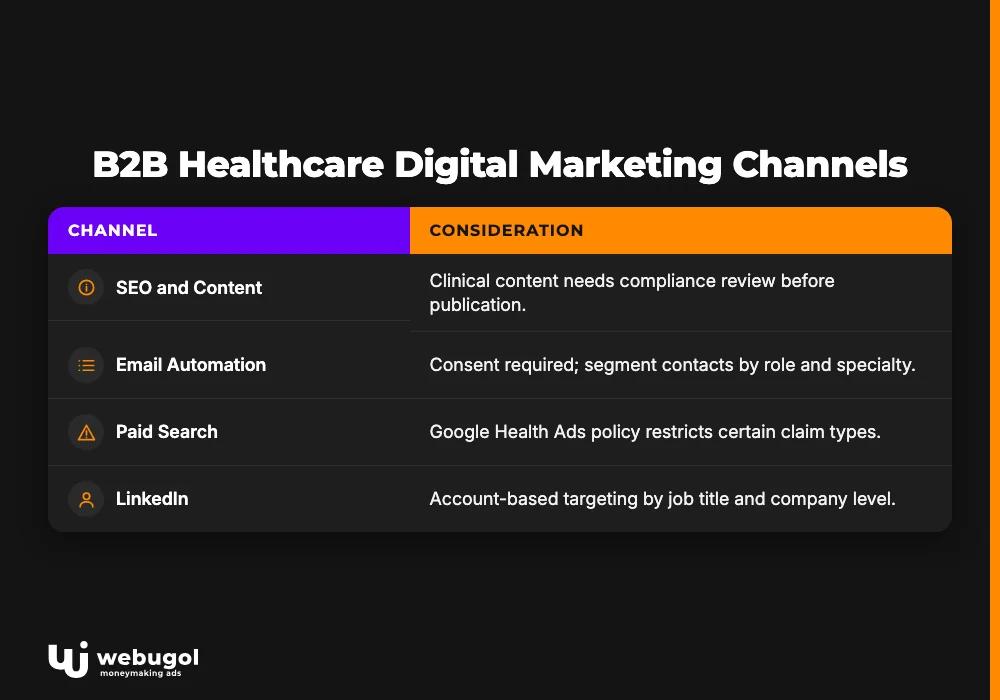
Core channels in B2B healthcare digital marketing:
| Channel | Primary role | Key healthcare consideration |
|---|---|---|
| SEO and content | Long-term organic pipeline | Clinical content requires compliance review before publication |
| Email automation | Lead nurture and re-engagement | Consent requirements; segment contacts by role and specialty |
| Paid search | Intent capture at evaluation stage | Google Health Ads policy restricts certain claim types |
| Account-based targeting | Job-title and company-level reach for procurement contacts | |
| Webinars | Mid-funnel trust and conversion | High-credibility format; CME credit opportunities for clinical audiences |
| Video | Process and product demonstration | Simplifies complex clinical workflows for non-clinical buyers |
How do you market to healthcare decision makers?
Map content to the decision stage the buyer is actually navigating, not to the funnel stage your CRM shows. Healthcare decision-makers route approvals through procurement, legal, and clinical leadership before any contract moves. Effective medical b2b marketing strategies address that full chain: credibility content for initial category evaluation, specificity content for vendor shortlisting, and objection-handling content for compliance and procurement gates.
Account-based marketing (ABM) concentrates budget where the probability of closing is highest. The pool of high-value healthcare accounts is finite. Select accounts that match your ideal customer profile, identify the two to four stakeholders involved in the decision, and coordinate every channel, paid search, LinkedIn, personalized email, and direct outreach, around those accounts and their stated priorities. Broad awareness campaigns produce click volume with low close rates; ABM produces fewer contacts with significantly higher qualification rates.
Institutional buyers increasingly expect communications tailored to their specialty, organization type, and current regulatory environment. Generic outreach is filtered before it is read.
Key B2B healthcare digital marketing strategies
The medical b2b marketing strategies that consistently outperform treat the path from ad click to signed contract as one system rather than a set of independent tactics. Broken tracking between the ad platform and the CRM, landing pages that contradict ad messaging, and follow-up measured in hours rather than minutes each erode campaign results regardless of channel spend. The highest-leverage improvements in b2b healthcare digital marketing come from fixing those handoffs first.
Healthcare content marketing that compounds over time
Healthcare content marketing earns its investment through compounding authority. Whitepapers on integration requirements, case studies with measurable ROI, and compliance-aware comparison guides reduce evaluation time for institutional buyers and build the credibility that shortens sales cycles. Updating high-performing pages consistently with current data outperforms creating new thin content. Clinical buyers reward specificity: sourced claims, named data, and defined scope outperform hedged generalist content in both search rankings and conversion rates.
Healthcare marketing automation: closing the speed-to-lead gap
Healthcare marketing automation addresses one of the highest-cost leaks in B2B pipelines. Speed-to-lead in healthcare sales is measured in minutes, not hours. Automation platforms common in this space, including HubSpot, ActiveCampaign, and GoHighLevel, trigger personalized follow-up sequences at the moment of intent, route leads to the correct rep, and flag high-priority contacts for immediate human review.
The compliance layer does not disappear under automation. HIPAA-compatible data handling, explicit consent capture, and platform restrictions on retargeting for medical conditions apply to every automated workflow. Build those guardrails into the architecture before scaling, not after an incident forces a rebuild.
Telemedicine marketing strategies for competitive vendor markets
Telemedicine marketing strategies in a B2B context target buyers who have already decided virtual care is viable. The remaining question is vendor selection. Content addressing integration requirements, security certifications, and clinical outcome data outperforms awareness-level content in competitive searches and converts at a higher rate in direct outreach campaigns.
How does content marketing help healthcare companies?
Healthcare content marketing creates three compounding outcomes: search visibility that generates inbound inquiries, evaluation assets that procurement and clinical stakeholders rely on during the decision process, and institutional credibility that distinguishes vendors when competing on feature parity.
The compliance constraint is real and manageable. Content that survives the medical approver's review and still answers specific buyer questions ranks for evaluation-stage queries and draws qualified traffic. Broad, hedged content ranks for low-intent queries and converts poorly. Build the compliance review into the production cycle rather than treating it as a final gate that delays everything.
Challenges every B2B healthcare digital marketing program faces
Regulatory compliance heads every practitioner's list. HIPAA governs data handling across the US healthcare stack. Google and Meta apply platform-specific policies that restrict certain targeting parameters and claim types. GDPR applies to any European contact in the CRM. These constraints are not negotiable, and a violation carries costs no marketing budget absorbs.
Tracking accuracy fails quietly and expensively. Ad platform data, analytics, and CRM systems regularly disagree on lead and conversion counts by wide margins. When leadership stops trusting the numbers, budget decisions shift to instinct. An end-to-end tracking audit before scaling any b2b healthcare digital marketing program is a prerequisite, not a nice-to-have.
Market saturation at the channel level is real. Healthcare content and paid search are competitive enough that generic positioning does not break through. Clear differentiation built around a specific buyer pain and a measurable outcome is the entry requirement.
Budget constraints require sequencing. Running SEO, content, paid search, ABM, and email simultaneously at full scale requires significant coordinated investment. Phased rollout, with tracking infrastructure established first and channel expansion following proof, produces better outcomes than spreading spend thin across every available channel at once.
Build the system, not just the campaign
Healthcare organizations that consistently grow their B2B pipelines do not simply add channels. They close the gaps between them. B2B social targeting for healthcare organizations, structured email nurture for healthcare decision-makers, and search visibility that compounds over time for healthcare companies each deliver stronger results as integrated components than as parallel standalone programs.
Webugol builds tracking-first, conversion-led acquisition systems for US healthcare providers: end-to-end ownership of the revenue path from ad click to recognized revenue, including tracking, funnel, website, CRM, and lifecycle automation managed as one accountable system. If your current setup generates leads without consistent conversion, or if spend is climbing without a proportional lift in appointments or contracts, request a Strategy Call through the Healthcare Growth System to identify exactly where the system is breaking.
FAQ
What is B2B digital marketing in healthcare?
B2B digital marketing in healthcare is the use of digital channels to attract, nurture, and convert organizational buyers such as health systems, group practices, and clinical procurement teams. It differs from direct-to-patient marketing in its multi-stakeholder approval processes, longer evaluation cycles, and the compliance requirements that govern every touchpoint.
How do you market to healthcare decision makers?
Map content to each stage of the approval chain, from clinical evaluation through procurement and legal review, and concentrate budget on high-value accounts using account-based marketing. Healthcare decision-makers respond to specific, sourced content that addresses institutional risk and measurable ROI, not generic awareness campaigns.
What are the best B2B healthcare marketing strategies?
Account-based marketing, healthcare content marketing anchored to evaluation-stage queries, and automation connected to CRM intent signals consistently produce the highest lead quality. The common trait is system integration: each channel is measured against trackable revenue outcomes rather than in isolation.
What digital channels work best for B2B healthcare?
Search engine optimization and LinkedIn-based account targeting deliver the strongest lead quality for B2B healthcare consistently. SEO captures in-market intent at the evaluation stage; LinkedIn reaches specific decision-maker titles at target organizations. Email automation sustains engagement between intent signals and conversion.
How does content marketing help healthcare companies?
Healthcare content marketing builds compounding search visibility, provides evaluation materials for procurement and clinical stakeholders, and establishes credibility with buyers who must justify vendor selection to compliance and senior leadership. Content that addresses specific clinical or operational problems with named sources converts at a higher rate than broad educational content.

