



Dental email marketing: a practice owner's guide to retention and growth
Dental email marketing is one of the highest-ROI channels a practice can run, reaching existing patients directly in their inbox with reminders, educational content, and timely offers that keep them returning. Campaign Monitor reports a 4,400% average ROI for email marketing across industries, and healthcare consistently ranks among the strongest-performing sectors. For a dental office with an established patient base, email compounds retention revenue without raising ad spend. This guide covers the system behind that result: list building, the right campaign types, sending cadence, compliance requirements, and how to measure what actually matters.
Does email marketing work for dental offices?
Yes. The numbers are hard to argue with. The 4,400% ROI figure Campaign Monitor published is an industry-wide average, and healthcare outperforms that baseline in most analyses. For dental practices specifically, the channel works because the relationship is inherently recurring: patients have already chosen your office, already trust your clinical team, and already have a reason to hear from you. Email campaigns for dentists maintain that relationship actively, rather than passively hoping patients remember to rebook.
The alternative is silence. A patient who receives no communication after their last cleaning is functionally identical to a patient who has forgotten you exist. Email reaches hundreds or thousands of patients simultaneously at almost zero marginal cost per send.
What makes dental email marketing different from general broadcast channels is specificity. You know who your patients are, when they last visited, what treatments they have received, and roughly when they are due for a recall. That data, used correctly, turns a generic outreach approach into a systematic retention program.
The retention math most dental practices miss
Acquiring a new dental patient costs significantly more than retaining an existing one. Most practice owners know this in principle. Fewer have mapped the actual revenue impact.
A patient who skips a six-month recall appointment and drifts to a competitor represents lost revenue on every future visit, every treatment plan, and every referral that patient would have generated. Multiply that across dozens of lapsed patients each year and the number gets uncomfortable quickly.
Patient retention emails are the most direct lever for closing that gap. They do not replace a great patient experience or a well-run front desk. What they do is systematically address the most common reason patients lapse: they simply forgot, or nothing reminded them to rebook.
Here is how the main email types map to the specific problems they close:
| Email type | Primary problem solved | Key metric |
|---|---|---|
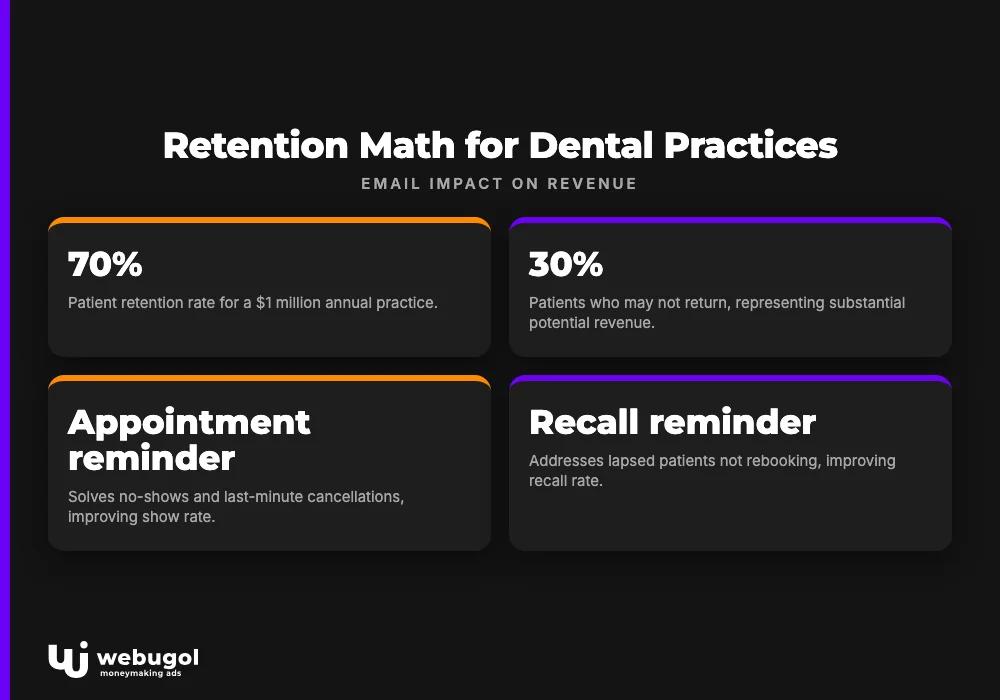
| Appointment reminder | No-shows and last-minute cancellations | Show rate |
| Recall reminder | Lapsed patients not rebooking | Recall rate |
| Welcome series | New patients who never complete intake | 90-day retention |
| Dental practice newsletter | Patients disengaging between visits | Open and engagement rate |
| Post-treatment follow-up | Low satisfaction scores, missed referrals | NPS, referral rate |
| Promotional offer | Idle schedule capacity during slow periods | Bookings from list |
Consider a practice generating $1 million annually with a 70% patient retention rate. The 30% of patients who may not return represent substantial potential revenue, multiplied across every future visit and referral they will not send. Even recovering a fraction of that through consistent email outreach shifts the revenue math without touching the ad budget.
For practice owners managing growth beyond a single location, the same logic applies at every site. A dental practice newsletter running across two or three locations compounds those retention gains without tripling the marketing workload. Email is one of the few channels that scales horizontally without a proportional increase in cost.
How to build a patient email list for a dental practice?
Start at intake. Every patient who walks through the door is a list candidate if your intake form collects an email address with a clear opt-in. Practices that treat list-building as an afterthought end up with an email database covering a fraction of their actual patient file.
Three high-yield approaches that work in practices with active email programs:
Digital intake and check-in forms. A digital intake form that collects email with an explicit consent checkbox is the highest-volume source of opted-in contacts. Keep the opt-in language specific: "Receive appointment reminders, oral health updates, and practice news." Patients who understand what they are opting into unsubscribe less and engage more than those added without clear context.
Post-visit follow-up emails. A brief satisfaction survey or care summary sent within 24 hours of an appointment confirms the address is live and starts the communication relationship positively. This is also a natural moment to collect any email addresses missed at intake, without the front desk having to make a separate call.
Website newsletter sign-up forms. A sign-up form on new patient pages or treatment-specific pages captures contacts outside the existing patient file. This requires a dental practice newsletter that consistently delivers something worth reading; otherwise the form converts but the list churns quickly.
One compliance point that cannot be skipped: dental email marketing lists fall under CAN-SPAM Act requirements, and any list involving protected health information also falls under HIPAA. Use a compliant email platform, store patient data appropriately, include a working unsubscribe mechanism in every email, and never share patient contact data with third parties without explicit authorization. The compliance infrastructure is not a legal formality; it is the foundation the entire program rests on.
For practices that want to understand how the broader regulatory and strategic framework applies across healthcare communication channels, the guide on how healthcare operators structure patient email programs covers the compliance layer in depth.
What should a dental newsletter include?
A dental practice newsletter earns its inbox placement by being useful. The practices with the highest open rates structure each issue around one genuinely helpful piece of content, with everything else secondary.
Content that works consistently:
- Oral health email tips readers can apply immediately. Seasonal oral hygiene advice, explanations of what a particular symptom might indicate, or simple prevention guidance. These build trust without selling anything.
- Practice updates that actually affect patients: extended hours, a new piece of equipment, a new provider. Brief and specific, not a press release.
- Treatment explanations that answer questions patients are too embarrassed to ask in the chair. How long does whitening last. What to expect during a root canal. Whether Invisalign is covered by most insurance plans. These reduce anxiety and increase case acceptance for treatment conversations that follow.
- Appointment prompts for patients approaching their six-month mark. The nudge does not need to be a separate campaign; embedding it in a newsletter is often sufficient.
Subject lines make or break newsletter performance. A specific subject line, "3 things your toothbrush isn't catching," typically outperforms a generic one like "News from [Practice Name]" by a wide margin. Testing two subject line variations on a subset of your list before the main send is a low-effort way to improve opens over time.
Mobile optimization is non-negotiable. The majority of email opens now happen on mobile devices, and a newsletter that looks clean on desktop but renders badly on a phone will see higher unsubscribe rates regardless of content quality. Clear fonts, single-column layouts, and short link labels are baseline requirements.

Appointment reminder emails: cutting no-shows without calling everyone
No-shows are one of the most controllable revenue problems in a dental practice. Appointment reminder emails, once automated, run without ongoing manual effort and consistently deliver among the clearest, most attributable ROI of any email campaign type.
An effective reminder sequence runs in layers: a confirmation at booking, a reminder seven days before the appointment, and a final reminder 24 to 48 hours out. Including a one-click reschedule link in each reminder reduces friction in both directions. The patient can move the appointment without a phone call, and the front desk gets advance notice of the gap rather than a last-minute surprise in the schedule.
Once set up, this sequence runs automatically for every new appointment in the system. The return on the initial setup time compounds indefinitely.
The same automation infrastructure handles recall reminders for patients who have not been in for six months or more. This is where the retention math becomes concrete: a practice with 2,000 active patients and a 15% annual lapse rate has 300 people to reach with a single automated recall campaign. Many of those patients have received no communication from the practice since their last visit. A recall email that acknowledges the time gap and makes rebooking simple recovers a meaningful percentage of that group.
Personalization in these emails does not need to be complex. Using the patient's first name, referencing their last visit date, and linking to online booking is usually sufficient to lift open and click rates above baseline for healthcare email.
How often should dentists send marketing emails?
One to two emails per month is the right cadence for most dental practices. Enough to stay present in the inbox, not so frequent that patients start filtering you out.
The exception is event-driven emails, which should send when the trigger happens, independent of the monthly schedule. Appointment confirmations, recall notices, post-treatment follow-ups, and welcome sequences are triggered by patient behavior, not a calendar. A patient who books an appointment should receive a confirmation the same day. A patient who hits the six-month threshold should receive a recall reminder when that threshold is crossed.
Where practices get into trouble is treating email campaigns for dentists like a broadcast channel, sending the same message to everyone at the same frequency. A new patient who joined last week does not need a re-engagement offer. A patient who last visited three years ago is a very different conversation than a patient who is simply two weeks overdue for a recall reminder. Segmenting the list by recency, treatment history, and engagement status makes every send more relevant, and relevance is what drives open rates over time.
Seasonality is worth building into the cadence too. Dental practices often see softer booking periods in certain months. A targeted promotional campaign sent to low-activity patients during a known slow period can recover idle schedule capacity without discounting publicly or running paid ads.

What is the ROI of email marketing in dentistry?
The Campaign Monitor benchmark of 4,400% across industries is a reasonable reference point. Practice-specific ROI is harder to anchor to a single number because it depends on list size, cadence, offer quality, and how well the practice tracks bookings back to email source.
A practical framework: estimate the revenue value of one reactivated patient (average treatment value multiplied by expected annual visits over their time with the practice). Multiply that by the number of lapsed patients a recall campaign can realistically reactivate from your list. Even conservative estimates show the cost of an email platform and program setup is recovered within the first month of consistent sending.
What practices commonly find after running a dentist marketing strategy through email for six months: the acquisition cost for a reactivated patient is a fraction of the cost for a new patient sourced through paid search or direct mail. That is not a reason to stop new patient acquisition. It is a reason to treat the existing patient list as a primary revenue asset, not a secondary list to send newsletters to occasionally.
Compliance directly affects the ROI calculation. Missing unsubscribe links, violating CAN-SPAM, or mishandling patient health information can result in legal exposure that eliminates any campaign return. Practices embedding dental email marketing inside a broader local search visibility strategy for dental practices will find the same documentation-first approach applies across every digital channel.
Tracking matters as much as the emails themselves. If your practice management software and email platform are not connected, your dental email marketing data exists in a black box. Setting up UTM parameters on booking links, tracking appointment conversions back to email source, and reviewing list engagement monthly gives you the data to improve the program rather than just maintain it. That closed-loop measurement is what separates a dental email program that grows from one that just runs.
Ready to build a dental email marketing program that actually runs?
Your patient list is probably the most underused asset in your practice. A systematic dental email marketing program, built on compliant list collection, smart segmentation, and automated sequences, recovers lapsed patients, reduces no-shows, and builds the kind of consistent communication that earns referrals over time.
Webugol works with healthcare operators to remove the blind spots between ad spend and practice revenue, starting with the channel most practices underuse. Email sits inside a connected system: tracking, website, CRM, and paid media managed as one accountable stack, not a collection of siloed tools. Explore our dental email marketing services to see the full scope, or reach out to our digital marketing agency to start with a strategy conversation about your practice.
FAQ
Does email marketing work for dental offices?
Yes. Email marketing keeps existing patients engaged between appointments and drives recall bookings at a fraction of the cost of new patient acquisition. Healthcare consistently ranks among the top-performing sectors for email ROI, with Campaign Monitor reporting a 4,400% industry-wide average that the healthcare sector regularly matches or exceeds.
How often should dentists send marketing emails?
One to two scheduled emails per month is the standard baseline for most practices. Event-driven emails, including appointment reminders, recall notices, and post-treatment follow-ups, are triggered by patient behavior and send as needed, independent of the monthly broadcast schedule.
What should a dental newsletter include?
A dental newsletter performs best when it leads with one specific, actionable piece of content: an oral health tip, a treatment explanation, or a seasonal reminder. Keep promotional content secondary, and always include a clear call to action linking to online booking or a recall prompt.
How to build a patient email list for a dental practice?
Collect email addresses at intake with an explicit opt-in consent checkbox, and confirm addresses with a post-visit follow-up email. Website newsletter sign-up forms add contacts outside the existing patient file. All collection and storage must comply with CAN-SPAM requirements and HIPAA where patient health information is involved.
What is the ROI of email marketing in dentistry?
Exact ROI varies by practice, but the clearest measure is revenue recovered from lapsed patients. A practice that reactivates even a fraction of its dormant patient file through a structured recall email program typically earns back its platform cost many times over in the first quarter of consistent sending.

