



Marketing for nursing homes: a complete guide to filling beds and building trust
Marketing for nursing homes means converting family trust into admissions decisions, and those decisions rarely happen quickly. Families researching care options spend weeks comparing facilities, reading reviews, and looking for proof of genuine care before making contact. A nursing home digital strategy that covers search, reputation, content, and local visibility builds the pipeline that sustains occupancy over time.
Whether you are running the first campaign for a single facility or trying to break through a growth plateau at a multi-location operation, the structural problem is the same: no clear line of sight between marketing activity and admitted residents. Fixing that requires a system, not a list of tactics.
Why marketing for nursing homes requires a different approach
Elder care facility promotion operates under constraints that most marketing channels were not built for. Families are not buying a product. They are transferring custody of a parent, often under time pressure, with high emotional stakes and limited information.
This shapes every channel choice. The primary decision-maker is typically an adult child in their 40s or 50s, not the future resident. Search queries for care options tend to arrive at moments of crisis, not during casual research. A slow follow-up response after an inquiry is enough to lose a qualified prospect to a competing facility.
Senior care branding also faces a trust deficit. Negative press coverage of elder care in general creates baseline skepticism that individual facilities must actively overcome. Transparency and community proof are not optional. They are the minimum threshold before most families consider a first visit.
How to market a nursing home effectively?
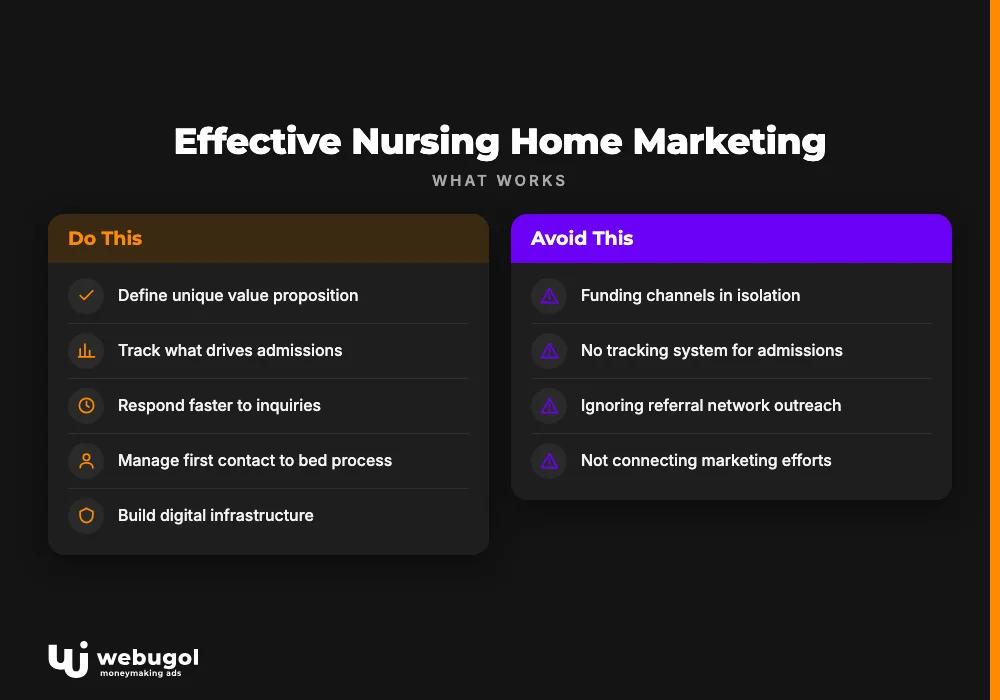
Effective marketing for nursing homes starts with a defined unique value proposition, then builds digital infrastructure around it: an SEO-optimized website, an active local profile, and a reputation management system that converts satisfied families into visible social proof.
The facilities that consistently outperform competitors on occupancy do not necessarily spend more. They track what actually drives admissions, respond faster to inquiries, and treat the gap between first contact and confirmed bed as a system to manage.
Core nursing home marketing strategies at a glance
| Strategy | Primary goal | Strongest channel |
|---|---|---|
| Local SEO | Capture in-market search demand | Google Search + GBP |
| Reputation management | Convert reviews into trust signals | Google, Yelp, A Place for Mom |
| Content marketing | Build authority for elder care queries | Blog + YouTube |
| Paid search | Capture crisis-stage inquiries | Google Ads |
| Nursing home social media | Community building, family engagement | Facebook, YouTube |
| Family nurture, referral partner outreach | Email platform | |
| Virtual tours | Reduce barriers to the first visit | Website + YouTube |
Each of these works. None of them works in isolation. The common failure pattern in elder care facility promotion is funding one or two channels without connecting them to a tracking system that shows what actually produces admissions.
A secondary audience matters equally: hospital discharge planners, social workers, and elder care consultants make regular referrals. Skilled nursing facility outreach to this referral network, maintained consistently through visits, materials, and direct communication, often drives a material share of admissions that never touches a search engine.
The absence of end-to-end tracking from marketing activity to an occupied bed is not specific to elder care. It is the same structural problem that blocks scaling in any healthcare operation, whether that is a telehealth clinic, a multi-location medical practice, or a skilled nursing facility network. Measuring the acquisition path precisely enough to know what produces revenue, and what does not, is the shared discipline that separates growing healthcare operators from ones stuck at the same occupancy or revenue plateau.
What digital marketing strategies work best for nursing homes?
The digital strategies with the highest return for nursing homes are local SEO, review management, and paid search. These three directly address the moment when a family has a need and is actively searching for a solution.
Local SEO and elder care online visibility
A nursing home that does not appear in the top three local search results for queries like "nursing home near [city]" or "skilled nursing facility [neighborhood]" is invisible to the majority of in-market families. Local search visibility for nursing homes depends on a complete and accurate Google Business Profile, consistent name, address, and phone number across directories, and a website built for geographic keyword relevance.
For local SEO performance for elder care facilities, the priority pages are the homepage, the services page, and individual location pages for multi-site operators. Each page should target the facility's city and surrounding service area. Schema markup that surfaces ratings and review counts directly in search results gives elder care facilities an edge over competitors who optimize only for ranking position.
A proper SEO audit examines site structure, page speed, mobile responsiveness, and content gaps against the actual questions families search for. These are technical improvements with direct impact on how often the facility appears when a family needs it.
Content marketing and healthcare facility content ideas
Content builds trust before a family is ready to call. A blog with articles covering topics like "what to look for in a skilled nursing facility," "how to talk to a parent about moving to assisted living," or "what Medicare covers in long-term care" attracts families in early research stages and positions the facility as a credible resource.
Healthcare facility content ideas that consistently perform well include:
- Resident and staff spotlight interviews that show real people and genuine care relationships, not brochure language.
- Guides that explain care levels, including independent living, assisted living, and skilled nursing, so families understand when each is appropriate.
- Answers to the specific compliance and cost questions families search for most, including payment options and inspection records.
- Seasonal newsletters that keep current families engaged and demonstrate active community life throughout the year.
- Educational webinars and recorded Q&A sessions on topics like memory care planning and fall prevention that answer families' most specific questions.
This content does not need to be produced at high volume. A facility that publishes two or three substantive articles per month, consistently, compounds authority faster than one that publishes in bursts and then goes quiet.
Email campaigns for elder care facilities
Email remains one of the highest-ROI channels in nursing home marketing because the sales cycle is long and families need multiple touchpoints before making a decision. The right email engagement for nursing home families segments contacts by stage: initial inquiry, tour scheduled, tour completed, and referral partner.
For initial inquiries, the email sequence should deliver useful information: a checklist for evaluating facilities, a summary of what families should ask during tours, and timely updates about the facility's programs and community. For referral partners like hospital discharge planners, the content is different: clinical capability summaries, available bed updates, and streamlined referral workflows.
Personalization matters. An email to a family asking about memory care should not look identical to one about short-term rehabilitation. This level of segmentation is straightforward with modern email platforms and directly improves both open rates and inquiry quality. Done consistently, email is one of the most cost-efficient components of marketing for nursing homes because it compounds over the full length of a family's decision cycle.
Which social media platforms should nursing homes use?
Nursing homes get the best return from Facebook and YouTube. Facebook reaches adult children in the demographic most likely to be researching care options for a parent. YouTube hosts video content that answers visual questions about facility life that text cannot.
For nursing home social media, Facebook works best for community updates, event announcements, resident milestone posts (with appropriate consent and privacy protections in place), and paid advertising targeted at adults 45 and older within a specific geographic radius. Research on how social media works in senior care marketing consistently shows that consistency in posting schedule outperforms production quality; a weekly update on a regular schedule outperforms a polished video campaign run once a quarter.
YouTube earns its place through virtual tour content and staff introduction videos. A ten-minute facility walkthrough on YouTube, embedded on the website, reduces the barrier to booking a first visit. It answers the visual questions families have before committing to a physical tour.
Instagram and LinkedIn are secondary channels. Instagram works for brand storytelling aimed at younger family members. LinkedIn is useful for recruiting and referral partner outreach. Neither should be the first investment for a facility building elder care online visibility from scratch.
Paid social and compliant targeting
Paid social campaigns for elder care operate under platform compliance requirements. Meta's health and wellness advertising policies restrict targeting by sensitive health conditions, which affects how nursing home audiences are built. Broad geographic and demographic targeting, supplemented by lookalike audiences built from inquiry lists, is the compliant and effective approach.
Claims in ad creative need to reflect realistic outcomes without making guarantees that cross healthcare advertising lines. A compliance review of ad copy every 60 to 90 days reduces the risk of account-level policy violations that can pause all campaigns without warning. Paid social is one component of marketing for nursing homes that requires the most ongoing compliance attention, given how frequently platform policies on health and wellness advertising change.
How can nursing homes increase occupancy through marketing?
Nursing homes increase occupancy by shortening the gap between inquiry and admission decision. Marketing generates the inquiry. The conversion depends on how fast the facility responds and whether the follow-up system stays engaged through the full decision cycle.
The most common occupancy gap is not a marketing gap. Facilities that struggle to convert inquiries into admissions often have adequate inbound volume but slow first-response times. A family that fills out a contact form and waits 48 hours for a response has usually contacted two or three other facilities in the same window. Speed-to-lead directly affects close rate, and that belongs to admissions operations, not the marketing budget.
Referral partnerships with hospital discharge planners, social workers, and home health agencies create a parallel admission pipeline that is not dependent on digital marketing at all. Maintaining these relationships consistently, through regular visits, updated materials, and direct communication, often drives a substantial share of admissions.
Online reputation management
Online reputations directly influence family decisions. Facilities with a 4.0 or higher rating on Google and consistent recent reviews rank higher in local search and convert more profile visits into calls.
The practical system: designate a staff member responsible for monitoring reviews on Google, Yelp, and senior care directories like A Place for Mom and Caring.com. Respond to every review. For positive reviews, a brief personalized thank-you acknowledges the family and signals to future readers that the facility is attentive. For negative reviews, a calm, factual response that invites further conversation offline demonstrates accountability without admission of fault.
Encouraging reviews requires a low-friction request. A short message to families after a positive milestone, with a direct link to the Google review form, generates a steady stream of genuine reviews without the compliance risks of incentivized review programs. Including testimonials on the facility website reinforces the same trust signals for visitors who do not check third-party directories first.
Measuring what drives admissions
The measurement gap is where most nursing home marketing falls apart. Tracking inquiry volume, tour bookings, and admission conversions separately is not enough. The goal is to trace which marketing activities actually produce admissions.
A basic measurement framework covers: source of each inquiry (search, referral, social, direct), time from inquiry to first contact, tour conversion rate, and inquiry-to-admission rate by source. This data exists in most CRM and phone systems. The problem is that it is rarely connected to marketing reporting. Closing that gap is what turns marketing for nursing homes from an expense into a managed acquisition system.
How to build family trust in marketing for nursing homes?
Building family trust in nursing home marketing requires three things: visible evidence of care quality, responsive communication, and transparency about operations. All three need to be present before most families will schedule a first visit.
Visible evidence comes from consistent review volume, resident and staff video content, and third-party recognition like state inspection records or accreditation status. Families do their own research before contacting a facility. What they find in that independent research either advances or ends the conversation.
Responsive communication starts at first contact. A prompt call-back after an inquiry, a staff member who can answer specific clinical questions, and a tour experience that matches what the website promised are more persuasive than any campaign.
Transparency works because families expect nursing home marketing to oversell. A facility that acknowledges its limitations alongside its strengths, publishes inspection results, and discusses staffing ratios openly earns credibility that marketing copy alone cannot create.
Virtual tours and video storytelling
Virtual tours remove one of the highest barriers to inquiry: the discomfort of visiting a facility before committing to it emotionally. A video walking through the dining room, resident rooms, therapy spaces, and outdoor areas answers visual questions that photos cannot and allows families to present options to other decision-makers without coordinating a group visit.
Resident and staff spotlights go a step further. A short video of a staff member explaining their care philosophy, or a resident describing their daily routine, adds the human element that facility photography and copy cannot replicate. These videos do not require production budgets. They require consent, honesty, and consistency.
The most effective video strategy pairs a comprehensive virtual tour (hosted on YouTube and embedded on the website) with a rotating series of shorter spotlight clips. The tour answers logistical questions. The spotlights build emotional connection. Together they address the two primary concerns families arrive with: whether the place is safe and whether their parent will be happy there.

Technology that strengthens marketing for nursing homes
Three technology areas consistently improve both resident experience and marketing outcomes in elder care facilities: family communication platforms, in-room engagement technology, and AI-assisted care personalization.
Family communication platforms, often mobile apps, give family members real-time visibility into their loved one's daily schedule, activity participation, and health updates. This transparency reduces the anxiety that leads ambivalent families toward intensive home care instead of long-term placement. Facilities that offer family portal access typically see higher family satisfaction scores, which feed directly back into review quality and referral behavior.
In-room engagement technology, including virtual reality systems for residents with limited mobility, extends the experiential range available to residents who cannot leave the facility. VR implementations require staff training on both operation and customization for individual resident preferences and physical limitations. The care value comes first; the marketing value follows when families observe the technology working during tours.
AI-assisted care personalization, through systems that analyze activity participation, health metrics, and stated preferences to adjust care plans, positions a facility as a technology-forward operator in a category where most competitors are not. The marketing application is straightforward: document the technology in content and tours, let families observe it, and let that evidence carry the positioning argument.
Ready to build a nursing home marketing system that tracks from inquiry to admission?
Most elder care facilities have some marketing running. Few have a system that connects every activity back to occupancy data and identifies precisely where the conversion breaks down. That gap, between marketing activity and admitted residents, is where budget disappears without producing results.
Webugol closes that gap as the accountable owner of the full acquisition path, turning disconnected marketing activities into a system where every dollar spent is traceable to an occupied bed. We work with healthcare operators to build that system and scale what already works. Book a strategy call to see where your current pipeline breaks down and what a full-funnel system looks like for your facility.
FAQ
How much should a nursing home spend on marketing?
Marketing budgets for nursing homes vary by facility size, market competition, and growth goals. Most facilities allocate the largest share to digital channels (search, social, and email), followed by community events and referral outreach, video production, and content development, with the balance varying by competitive market and growth stage. Total spend depends on target occupancy and cost-per-admission targets specific to each facility.
What is the most effective marketing strategy for nursing homes?
Local SEO combined with proactive reputation management delivers the highest sustained return for most nursing home marketing programs. These two strategies address the exact moment when a family has a need and is actively searching, and they compound over time rather than stopping when budget runs out.
How long does it take for nursing home marketing to show results?
Search and reputation improvements typically show measurable impact on inquiry volume within 60 to 90 days of consistent implementation. Paid search can generate inquiries faster, often within the first week, but requires budget and ongoing optimization. Full admission pipeline improvements, including conversion from inquiry to bed, take three to six months to stabilize.
Which social media platforms work best for nursing home marketing?
Facebook and YouTube deliver the highest return for most elder care facilities. Facebook reaches the adult children most often making care decisions, while YouTube hosts virtual tours and staff spotlights that answer visual and emotional questions families have before committing to a visit. Instagram and LinkedIn play secondary roles for most facilities.
How can nursing homes get more positive online reviews?
The most reliable way is to ask satisfied families at a natural moment, such as after a positive health milestone or a successful family event, with a direct link to the Google review form. Keeping the request simple, timely, and personal produces a steady stream of genuine reviews without compliance risks.

