



Google Analytics discrepancy: why GA4, Ads, and your CRM all show different numbers
When GA4, Google Ads, and your CRM all report different conversion numbers, none of them is lying. Each platform records a different event at a different moment under different attribution rules, and comparing them without understanding those differences produces the wrong diagnosis every time. A google analytics discrepancy of 30-40% is almost always a measurement architecture problem, not a tracking bug. The fix starts with understanding which source owns which decision.
For a clinic or telehealth operator spending $20k to $100k per month on paid media, an unexplained gap between dashboards carries a direct operational cost: leadership stops acting on any of the numbers. The gap rarely reflects a misconfiguration. It reflects a measurement stack assembled in pieces, with no single team accountable for what breaks at the handoffs between platforms.
That accountability gap is the real problem, not the variance itself.
How much discrepancy between GA4 and Google Ads is normal?
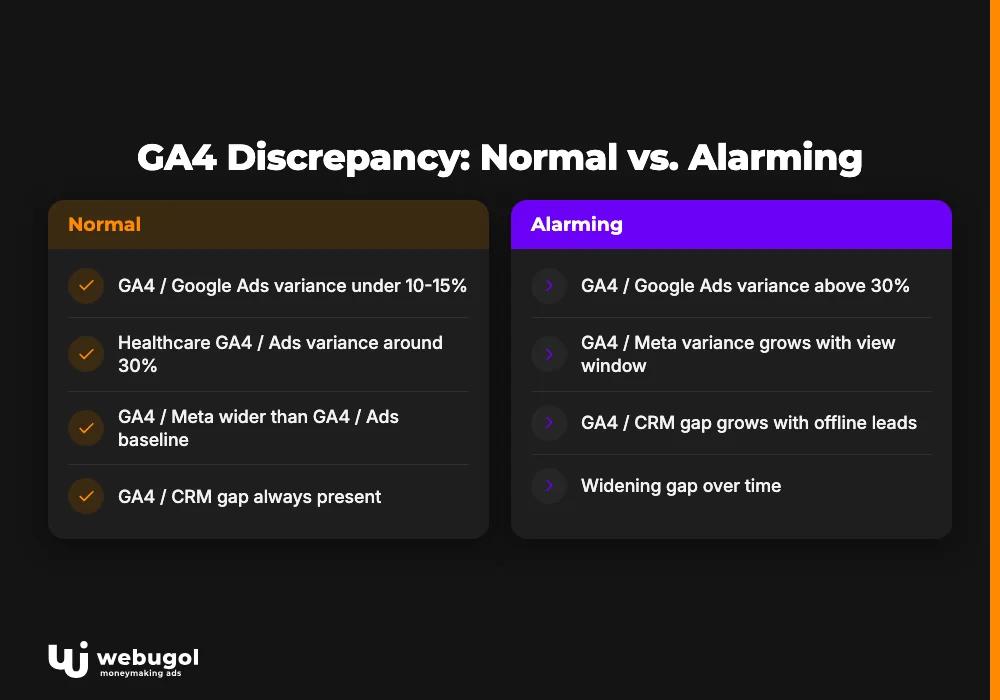
A variance under 10-15% between GA4 and Google Ads is typical and largely unavoidable. Minor time-zone offsets, cross-device deduplication gaps, and small attribution window differences all contribute. A gap above 30% almost always signals a structural cause: misaligned attribution windows, Consent Mode data suppression, or a double-counting configuration error.
For healthcare practices running HIPAA-compliant consent banners, 30% is not a red flag. It is often the baseline. Consent Mode suppression alone accounts for a substantial share of the google analytics discrepancy in healthcare accounts. Knowing that specific driver lets a marketing director bring a coherent explanation to leadership instead of an uncomfortable shrug.
Acceptable vs. alarming thresholds by platform pair
| Platform pair | Expected variance | Red-flag threshold | Most common structural cause |
|---|---|---|---|
| GA4 / Google Ads | 10-15% | 30%+ | Attribution window mismatch, Consent Mode suppression |
| GA4 / Meta (Facebook) | Wider than GA4/Ads baseline | Grows significantly with view window length | View-through credit included by default; iOS ATT signal gaps |
| GA4 / CRM | A gap is always present | Grows with offline and phone lead volume | Different event types: web session vs. post-web confirmation |
These thresholds are a starting point for diagnosis. Your actual variance depends on ad spend, consent decline rate, and how much of your lead flow bypasses the web funnel entirely.
A widening gap over time is more diagnostic than a large gap at a single point. If the GA4-to-Ads variance grew from 15% to 40% over three months without a configuration change, something in Consent Mode behavior or attribution settings shifted. Watch the trend, not just the number.
Why do Google Ads and GA4 show different conversion numbers?
Google Ads and GA4 share the same parent company. They still disagree by 20-40% in most linked accounts. The source is not misconfiguration in the majority of cases. It is five structural differences in how each system was designed to count the same user journey. Each one maps directly to a symptom a healthcare marketer sees in the account.
Attribution window mismatch
Google Ads defaults to a 30-day click attribution window. GA4 also defaults to 30-day click, but many accounts inherited a 7-day window from legacy Universal Analytics settings that carried over during the UA-to-GA4 migration. That single attribution window mismatch can account for a large share of the google analytics discrepancy on its own, inflating Google Ads conversion counts relative to what GA4 records for the same period.
Checking your window in both platforms is the first diagnostic step, not the last. Many accounts spend weeks investigating code errors when the answer is a settings mismatch resolvable in an afternoon.
Cross-device deduplication gaps
Google Ads deduplicates clicks across devices when a user is signed into their Google account. GA4 uses a client-ID cookie that breaks at every device and browser boundary. When a patient searches for your clinic on mobile and books a consultation on desktop, Google Ads may count one continuous user journey while GA4 counts two separate sessions from two separate users.
This is a fundamental difference in identity resolution, not a bug in either system. For healthcare services where the research-to-booking cycle spans days and multiple devices, this gap is structural and expected. Enabling Google Signals narrows the google analytics discrepancy caused by cross-device journeys but requires a minimum user threshold before cross-device reports populate.
Consent Mode suppression in healthcare accounts
Consent Mode v2 restricts GA4 from firing standard tags when a user declines consent. Google Ads can still receive a modeled conversion signal through its own pixel path. The result: Google Ads records a conversion, GA4 records nothing for that session.
For practices running HIPAA-compliant consent banners, this consent mode data loss is the single largest driver of the google analytics discrepancy between the two platforms. It cannot be resolved without changing the consent setup. Understanding what HIPAA-compliant tracking actually suppresses in your GA4 property clarifies which portion of your gap is structural and which is fixable.
Why does Facebook report more conversions than Google Analytics?
Facebook reports more conversions because it counts view-through conversions by default. If a patient saw your ad on Monday but searched for your clinic on Thursday and booked directly, Facebook claims that conversion while GA4 does not. This facebook conversion discrepancy is not a sign that one platform is wrong. They are measuring different events in the same user journey.
View-through vs. click-through accounting
Meta's default attribution window is a 7-day click plus a 1-day view, with an optional 7-day view extension. GA4 counts only interactions on your own domain, with no view-through credit of any kind. For high-intent healthcare services, view-through credit reflects genuine brand influence, but comparing the Meta conversion count directly to GA4's click-only count produces a misleading picture of cost per acquisition.
Align before comparing. Set both platforms to a 7-day click window before running any cost-per-lead analysis. The numbers will still differ due to attribution model differences, but the gap will reflect signal methodology rather than incomparable window definitions.
iOS ATT signal loss and modeled conversions
Post-ATT (App Tracking Transparency), Meta fills missing user-level signals with aggregated modeling. GA4 receives no modeled data at all. The result is two platforms with fundamentally different signal completeness: Meta's conversion count reflects a mix of observed and estimated conversions, while GA4's count reflects only what its tag could directly observe on your site.
Trend comparison is the more reliable metric here. If Meta's trend line and GA4's trend line move in opposite directions week over week, investigate. If they move together at different magnitudes, the gap is structural. That distinction is what turns a confusing google analytics discrepancy into a manageable reporting difference with a clear methodological explanation.

Why does GA4 revenue differ from CRM data?
GA4 records revenue when the confirmation page loads. Your CRM records revenue when the transaction is confirmed, refunded, a subscription renews, or an operator manually reconciles. These are different events, so the ga4 revenue gap crm exists even when both systems are configured correctly. Two systems counting different moments in the same transaction lifecycle will never match exactly.
Refunds, taxes, and subscription reconciliation
GA4 typically receives the pre-tax, pre-shipping subtotal passed by the data layer at the moment the thank-you page fires. Your CRM records recognized revenue after refunds, cancellations, and subscription adjustments. For healthcare practices using membership models, monthly reconciliation differences compound quickly across multiple subscription cycles.
The practical response is not to reconcile the absolute numbers. It is to understand the delta and monitor whether it changes. A stable, predictable delta means both systems are working as designed. A widening delta means something in your data layer, refund handling, or CRM intake changed.
When CRM shows more conversions than GA4
The CRM counts a lead when a form is submitted and routed. GA4 counts a conversion when its tag fires on the confirmation page. Close in time, but not identical. Several lead sources bypass the GA4-tagged web funnel entirely: phone calls, referrals, intake form submissions that go directly to the CRM via API, and patients who convert from a nurture email sequence without returning to the site.
The CRM will always show more conversions than GA4 when any of those channels are active. This crm conversion data mismatch has no floor unless every entry point has a designated measurement method. For practices where phone and referral leads are significant, structuring your CRM data to map leads back to recognized revenue events is a prerequisite for reconciliation, not an optional audit step.

How do I fix a tracking discrepancy in a healthcare marketing account?
Most advice on closing a google analytics discrepancy assumes a standard e-commerce setup. Healthcare practices operate under HIPAA constraints that make server-side tagging and enhanced conversions non-trivial to implement. Zero discrepancy is not the goal. A stable, explainable gap with a clear owner for each data source and a threshold that triggers a review when the gap unexpectedly widens is the realistic target for healthcare attribution tracking.
Enhanced conversions and server-side tagging
Enhanced conversions pass hashed first-party data, specifically email and phone, to Google Ads from your server. This recovers signal lost to Consent Mode without transmitting health-condition identifiers.
The implementation requires a consent banner that captures hashed data before any PHI field is involved, explicit PHI exclusion mapping to prevent diagnostic or treatment data from reaching the ad platform, and a CRM hashing layer that processes data server-side before forwarding it to Google.
Server-side tagging via Google Tag Manager Server moves the GA4 measurement point off the browser. This reduces the impact of ad blockers and ITP (Intelligent Tracking Prevention) on GA4 event counts. The practical effect is a smaller portion of the google analytics discrepancy driven by browser-side signal loss, though the consent and attribution gap remains unchanged.
Implementation checklist for healthcare accounts
Work through these in order before escalating to custom development:
- Configure your consent banner to capture hashed email and phone before any PHI field is involved.
- Exclude PHI fields explicitly from all tag manager rules and data layer pushes.
- Deploy a server-side GTM container with a first-party subdomain.
- Enable and test Google Ads enhanced conversions against a PHI-safe test conversion event.
- Run a weekly variance check against established reconciliation thresholds to catch unexplained shifts early.
Which number to use for which decision
Assigning each data source to the decisions it is authoritative for removes the pressure to find one universal source of truth.
Google Ads conversion data governs bid optimization and campaign budget allocation. The platform's algorithm bids against this number regardless of what GA4 reports, so evaluating ad performance against GA4 conversion counts while the algorithm runs on Ads data creates a systematic decision error.
GA4 governs on-site behavior analysis, funnel drop-off investigation, and channel-level traffic quality. Use it to understand what happens between the ad click and the conversion event on your site.
Your CRM governs lead quality scoring, speed-to-lead measurement, appointment show rate, pipeline revenue, and any decision that crosses from marketing operations into sales operations.
None of these sources answers the same question. Treating them as competing versions of the same answer is the root of the leadership trust problem.
When all three show different numbers and no one can explain why, budget decisions stall. The CEO re-enters as the integrator between vendors who each insist their number is correct. That scenario has an operational cost extending well beyond the marketing department.
For healthcare marketing teams with $20k to $100k per month in paid media, the reconciliation layer is a prerequisite. A minimal stack has three components: a weekly cross-platform view that maps each source to its designated decision type, a designated primary source per decision, and a clear escalation threshold that triggers an audit when unexplained variance exceeds 15%.
Ready to know which number to trust in your account?
When Google Ads, GA4, and your CRM all show different numbers, the fix is not a new dashboard. It is a tracking foundation built to separate platform-level signal from business-level outcomes, with one team accountable for the full path from ad click to recognized revenue.
Webugol, a growth partner for US healthcare providers, builds this foundation before any campaign optimization begins. The tracking diagnostic and cross-platform reconciliation layer run in the first weeks of an engagement. Every downstream decision depends on whether the measurement layer underneath it can be trusted.
The Healthcare Growth System includes this reconciliation layer as part of the tracking foundation built in Month 2. If you want a diagnostic read on where your healthcare attribution tracking is breaking and which number your team should actually be using, the next step is a strategy call.
FAQ
What is a normal discrepancy between GA4 and Google Ads?
A variance of 10-15% is typical and caused by time-zone differences, minor attribution window offsets, and cross-device deduplication gaps. A gap above 30% usually has a structural cause: mismatched attribution windows, Consent Mode suppression, or a misconfigured conversion action. Healthcare accounts with HIPAA-required consent banners commonly see 30% or higher as an expected baseline due to Consent Mode suppression alone.
Why does Facebook report more conversions than Google Analytics?
Facebook's default attribution window includes view-through conversions, so it claims credit for users who saw an ad but converted through a different channel later. GA4 only records conversions that happen through its own tag on your site. The Facebook number is not inflated; it is measuring a wider event set, which is why comparing it directly to GA4 without aligning attribution windows first produces a misleading cost-per-acquisition figure.
Which data source should I trust, GA4 or my CRM?
Trust your CRM for decisions about lead quality, appointment show rate, or revenue, because the CRM captures events that happen after the web session ends. Trust GA4 for on-site behavior and channel-level traffic analysis. For campaign budget decisions, use the conversion data inside the ad platform, since its algorithm bids against that number regardless of what GA4 reports.
Does Consent Mode cause data discrepancy in GA4?
Yes. When a user declines consent, GA4 cannot fire its standard tag and receives no event data for that session. Google Ads can still receive a modeled conversion signal through its own pixel path. For healthcare practices with HIPAA-compliant consent banners, GA4 will consistently undercount conversions relative to Google Ads, and the resulting google analytics discrepancy grows with the consent decline rate in that account.
Why does GA4 revenue differ from my CRM revenue?
GA4 captures the revenue value passed by the data layer at the moment the confirmation page loads, typically a pre-tax, pre-shipping subtotal. Your CRM records recognized revenue after refunds, cancellations, and manual adjustments. For subscription-based healthcare services, the two numbers will never match exactly, and the goal is to understand and monitor the reconciliation delta, not eliminate it.

