



Product Development Consulting: What It Is, When You Need It, and How to Choose Right
What is product development consulting?
Product development consulting is an external engagement where a specialist guides a company from idea validation through launch, covering strategy, technical scope, and delivery oversight. It is not staff augmentation. It is not a full-service agency that owns the build entirely. A consultant defines what to build and how, reduces the risk of wrong early decisions, and exits with a documented handoff. The best engagements pair the build with a growth infrastructure, so the product reaches users from day one rather than competing for attention after the fact.
When do you need a product development consultant?
You need a product development consultant when the cost of a wrong technical decision exceeds the cost of the engagement. For most founders, that threshold arrives earlier than expected.
Founders typically engage too late, after a wrong architecture decision has already compounded into rework. These triggers signal the right moment:
- Your no-code or AI-assisted build has hit a wall. The prototype works, but the next feature requires real infrastructure the tooling cannot support.
- You have no technical co-founder. Without an independent technical voice, you cannot evaluate vendor proposals or recognize scope creep until money is already spent.
- You have missed launch targets repeatedly. Not because the team is slow, but because the spec kept shifting and no one owned the decision.
- Your roadmap is a wish list. Features without priorities, dependencies unmapped, no clear definition of what ships first.
- An investor demo is approaching. You need a working product, not a slide deck, and the clock is real.
- You are about to commit real budget on a verbal agreement. A handshake description of a build is not a spec, and a spec is not optional once money moves.
- You are still [deciding between an MVP, prototype, or proof of concept](/blog/mvp-vs-prototype-vs-poc). Engaging a consultant while that question is open prevents weeks of rebuilding.
Any one of these is enough. Three or more, and consulting is not optional.
What does a product development consultant actually do?
A product development consultant runs a defined engagement, not an open-ended retainer. The deliverables are concrete at each phase, and both sides agree on what "done" looks like before work begins.
- Discovery. Structured stakeholder interviews, a review of any existing code or no-code assets, and a competitive scan. Output: a written product brief that both sides sign off on.
- Scope definition. The brief becomes a prioritized feature list, a tech stack recommendation, and a ranged estimate with stated assumptions. Vague "it depends" answers get replaced with real numbers and real risks.
- Architecture review. If code already exists, the consultant identifies structural risks before a new line is written. This step alone prevents expensive rebuilds.
- Sprint oversight. The consultant reviews deliverables against the spec, flags drift early, and keeps the build accountable without creating a bottleneck.
- Handoff. Documentation, access transfer, and a transition brief. You own the product when this phase closes.
New product development consulting services typically bundle all five phases. The time ratio between them varies by complexity and by how much foundational work existed before the engagement started. A good consulting firm also tells you when you are ready to replace it with a full-time hire.
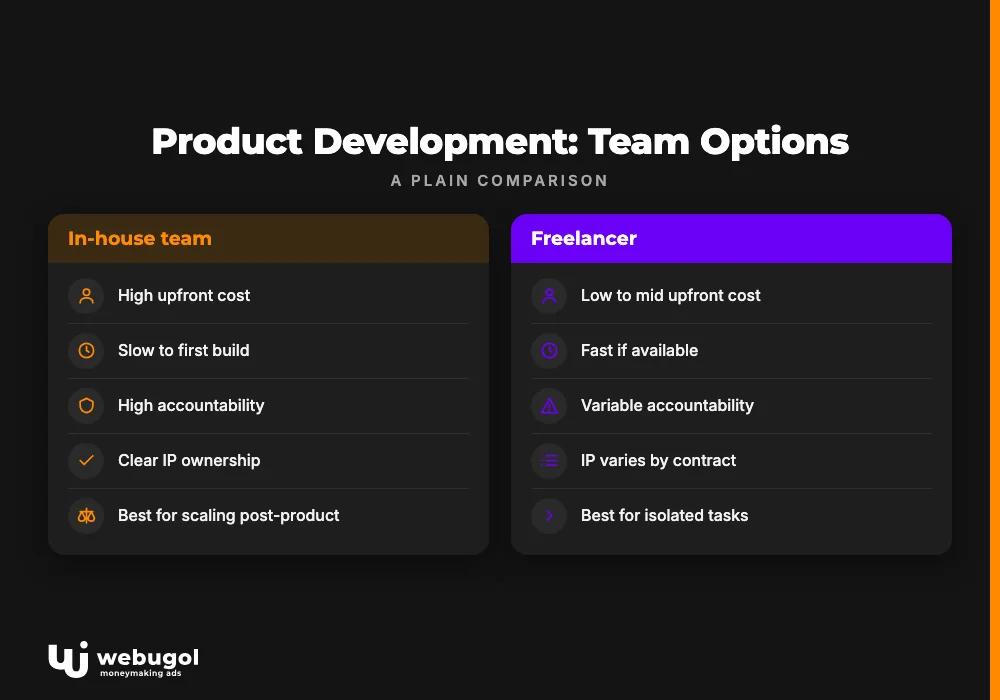
In-house team vs. consulting firm vs. freelancer: a plain comparison
No competitor in this SERP provides this comparison. It is the first question most founders ask before committing to any engagement.
| Criterion | In-house hire | Freelancer | Consulting firm |
|---|---|---|---|
| Upfront cost | High (salary, equity, recruiting) | Low to mid | Mid (scoped engagement fee) |
| Speed to first build | Slow (3-6 months to hire and onboard) | Fast if available | Fast (days from scoping to start) |
| Accountability | High but slow to course-correct | Variable; exits when contract ends | High; tied to defined deliverables |
| IP ownership | Clear (employment agreement) | Varies by contract | Clear (work-for-hire standard) |
| Long-term fit | Best for scaling post-product | Best for isolated, well-defined tasks | Best for 0-to-1 and architecture decisions |
The decision often comes down to accountability and speed. An in-house hire takes months to onboard; a freelancer exits when the contract ends; a consulting firm owns a defined outcome from day one.
Product development consulting firms operate on a project basis: fixed scope, defined end date, no ongoing payroll risk. That model fits a founder who needs to validate before scaling. Software product development and consulting can also include an ongoing advisory layer, but the standard engagement is time-bounded. The distinction matters at contract time.

How AI-accelerated development changes the equation
A meaningful consulting engagement on software development once started at $20k or more. Discovery took weeks. Design was a separate phase. Development teams billed hourly with no fixed ceiling.
AI-assisted workflows have changed the floor. Scoping and early builds now start at $3-5k.
That matters for founders who assumed consulting was enterprise-only. At this price point, a pre-revenue founder validates architecture decisions before writing a check to any dev shop. The consulting cost is a fraction of the cost of rebuilding a wrong architecture.
For domain-specific work, timelines remain longer. Aerospace, edge computing, and telecoms projects carry complexity that AI tooling does not compress. Life science and medical device engagements add regulatory requirements that extend every phase. But for software products, the minimum viable budget for a consulting engagement is at its lowest historical point. A lean approach to the engagement emphasizes speed to validation over comprehensive specification upfront, and current tooling makes that realistic.
Product development consulting for startups: from MVP to launch
MVP product development consulting addresses a structural problem specific to early-stage founders: the most expensive architecture decisions get made at the beginning, when the team knows least about what the product actually needs to do.
A consulting engagement at this stage runs in four steps:
- Validate demand before touching code. The consultant defines what "demand" means for your specific idea and sets measurable criteria before any build begins.
- Define the MVP. Not the smallest possible product, but the smallest product that surfaces information you cannot get any other way.
- Choose the right build path. Some products start on no-code tools; others cannot. A consultant without a stake in the technology choice gives an honest answer. The hands-on build phase is where a quality MVP development service bridges the gap between consulting output and a working product.
- Set up for launch. The build is not the end. Analytics, an acquisition channel, and a feedback loop need to be in place before the first real user arrives. The step-by-step guide to building an MVP covers the tactical depth of each phase.
The structural failure mode is hiring a dev shop after step 2 and skipping the consulting layer entirely. The shop builds what was described in a casual conversation, not a proper brief. The founder gets a product that functions, but not one the market was ready to adopt.
Book a free scoping call to map your build path before committing to a full development budget.
How do you choose a product development consulting firm?
The right consulting partner brings three things: domain-relevant experience for your product category, a documented process you can review before signing, and verifiable references from founders who were at your stage when they engaged. Those three criteria eliminate most candidates before the sales call.
What remains is a shorter list where the conversation can focus on fit. Watch for these red flags:
- The firm cannot price the engagement upfront. A ranged estimate with stated assumptions is achievable in the first conversation; if it is not offered, that is a sales tactic, not a process limitation.
- No handoff process is defined before the engagement starts. What happens after it ends should be specified in writing before it begins.
- Post-launch support is unaddressed. Architecture decisions have downstream consequences; a firm that disappears at launch leaves you holding problems they introduced.
- The kick-off call is all promise. A good consulting firm states what it cannot do as clearly as what it can.
- The portfolio describes builds, not outcomes. Case studies with no mention of what happened after launch tell you nothing about whether the product succeeded.
- The process deck could apply to any client in any sector. If it describes no engagement specifically, it describes no actual process.
In regulated sectors, domain experience is the baseline, not the differentiator. Life science consulting, medical device consulting, and similar regulated-product engagements each carry compliance requirements that generalist firms cannot navigate without prior experience.

Why development without a growth plan stalls
Most consulting firms deliver a product. Few deliver a product that grows.
The pattern is consistent. A founder engages a software product development and consulting partner, receives a well-built product, launches to the immediate network, generates early traction, then stalls. The product is technically sound. The acquisition channel is not.
No SEO foundation was built during the development phase. No analytics tied to revenue conversion were wired in from the start. Growth was treated as a phase to address later. Later always arrives with no infrastructure in place.
Webugol, a digital marketing agency, owns the full growth path from build to acquisition as a single engagement. By the time the build is done, the SEO foundation and the conversion funnel are already in place. What founders stop losing is the cost of a cold start: months reworking page structure for search, rebuilding analytics from scratch, or paying for traffic that could have been earned from day one.
Engaging a pure dev firm and then a separate growth agency introduces a handoff between two vendors who optimized for different goals. Every founder who has done it once structures the next engagement differently.
Ready to build a product that actually grows? Let's talk.
Pairing a consulting engagement with a built-in growth strategy means you launch to an audience, not a void. Engagements start at $3-5k for AI-assisted MVP scoping and early builds, scaling to $20k and beyond for full-cycle strategy and development.
Connect with the Webugol team at webugol.com/contact to map your build scope and growth path.
FAQ
What is the difference between a product development consultant and a product manager?
A product development consultant is hired externally for a defined scope and typically owns strategy, scoping, and delivery oversight for a specific engagement. A product manager is a full-time internal role responsible for the ongoing roadmap and cross-functional team coordination. The consultant exits with a handoff; the product manager stays indefinitely.
How much does product development consulting cost?
Engagements start at $3-5k for AI-assisted MVP scoping and early builds, scaling to $20k or more for full-cycle strategy and development. The final cost depends on scope, complexity, and whether the firm handles development alongside consulting.
How long does a product development consulting engagement take?
A scoped MVP build typically runs 4-10 weeks from kick-off to a working version. Broader engagements covering strategy, design, development, and launch support usually span 3-6 months.
When should a startup hire a product development consultant?
The right moment is before committing significant budget to development, after validating demand but before any production code is written. Bringing in a consultant too late means paying to fix architecture decisions that a proper scoping process would have prevented.
What do product development consulting firms typically deliver?
Most firms deliver a combination of strategy artifacts (product brief, roadmap, technical spec) and hands-on execution (design, development, testing). The best ones include a go-to-market component so the product launches to an audience, not a void.

