



SEO blog writing services for businesses that want to grow
SEO blog writing services are professional content programs that combine keyword research, on-page optimization, and audience-focused copywriting to produce posts that rank in search results and drive qualified traffic to your site. A well-run blog turns your website into a lead-generation asset that compounds over months and years, without ongoing ad spend. Whether you are building your first content program or trying to break through a growth plateau, the structural gap looks the same: topics chosen without keyword research, posts published without on-page structure, and no performance tracking in place.
For business owners and marketing teams, that gap has a direct cost. It is search real estate given to competitors who publish consistently and optimize properly.
What are SEO blog writing services?
SEO blog writing services go beyond putting words on a page. They include keyword research, competitive analysis, structured on-page optimization (title tags, meta descriptions, header hierarchy, and internal linking), along with performance tracking to show what is actually working. The goal is to make each article visible to people actively searching for what you offer.
Generic blog posts inform. SEO blog writing services make content rank, attract the right audience, and move readers toward a decision.
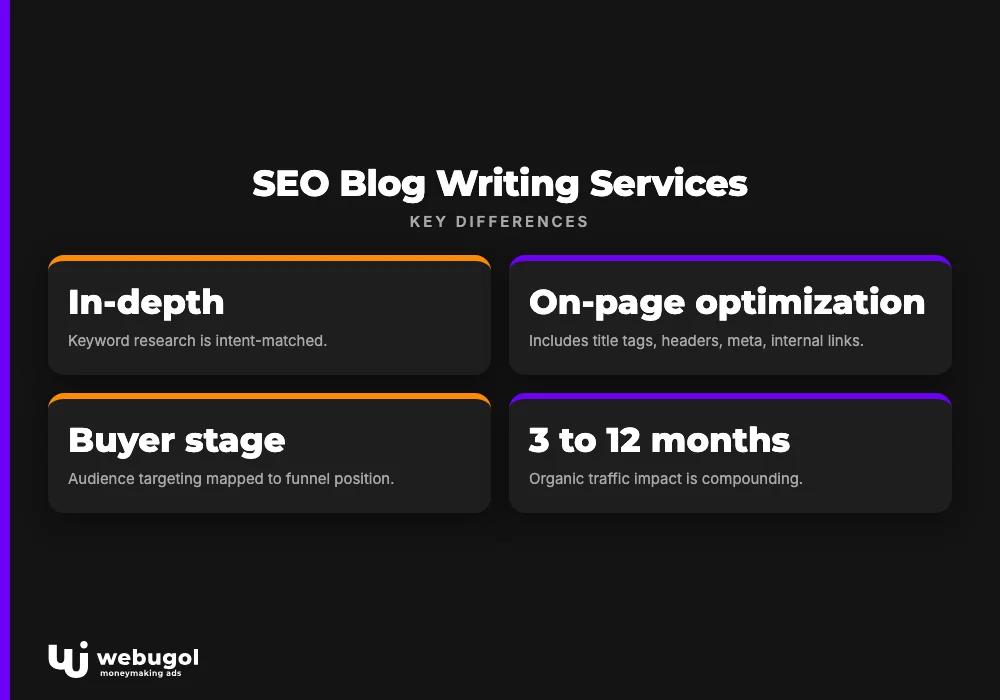
| Element | Generic blog writing | SEO blog writing services |
|---|---|---|
| Keyword research | Absent or surface-level | In-depth, intent-matched |
| On-page optimization | Rarely included | Title tags, headers, meta, internal links |
| Audience targeting | Broad | Mapped to buyer stage and funnel position |
| Performance tracking | Usually absent | Built into delivery |
| Organic traffic impact | Minimal and unpredictable | Compounding over 3 to 12 months |
A complete content marketing strategy maps topics to buyer questions at each stage of the funnel: awareness articles attract cold traffic, consideration pieces compare options, and decision-stage posts address objections before the sales call. That mapping is what turns a blog from a news feed into a growth channel.
Not all content creation agencies handle the full cycle. Some write; others just optimize. The difference matters because an article written without keyword research at the start requires either a rewrite or an underperforming piece. The most effective agencies build strategy, writing, and optimization into a single workflow, with performance data feeding back into future topic selection.
What makes a blog post SEO-friendly?
An SEO-friendly post does five things well: it targets a keyword phrase with real search demand, uses structured headers the crawler can parse, links internally to related content, loads fast on mobile, and answers the reader's question more thoroughly than the current top results. That last point is the hardest to systematize. Keyword placement and header structure have checklists. Answering a question better than the existing top results requires real expertise.
Good blog structure for seo covers the primary keyword in the title, H1, and first paragraph; a meta description under 160 characters; headers in logical H2/H3 order; image alt text; and a word count long enough to cover the topic without padding. These are checkable. Consistency is what most businesses miss.
Copywriting for business in a blog context also means writing for a human, not a crawler. Posts that rank but fail to engage are expensive bounce-rate generators. The difference between a post that holds a top-three position for years and one that ranks briefly is usually whether the content genuinely answers the full query or just hits surface-level keywords. The better posts demonstrate knowledge depth and give readers a clear next step.
How often should a business publish blog posts?
Frequency matters less than consistency and quality. For most small and mid-size businesses, two to four well-optimized posts per month is a sustainable baseline. That schedule gives search engines regular new content to index and gives readers a reason to return.
Publishing ten thin articles in one week and then going quiet for two months does not build a channel. It creates an erratic crawl pattern and trains your audience not to expect anything. Consistent publishing also supports branded traffic: the more often your brand appears alongside relevant topics in search results, the stronger the recall effect when a buyer reaches decision stage.
For marketing directors and business owners already managing full plates, the right answer is usually to outsource production while keeping editorial oversight in-house. That split preserves brand voice and frees internal bandwidth for decisions that require judgment rather than execution.
Should I hire a blog writing service or write content in-house?
The decision usually comes down to one variable: does your team consistently publish on a predictable schedule? If the answer is yes, in-house works. If drafts pile up, a service fills the gap.
Writing in-house keeps complete control over voice and subject matter expertise. The cost is time, typically ten to twenty hours per published post when research, drafting, revision, and optimization are included. For most businesses, that is expensive time redirected from revenue-generating work.
A blog writing service trades some editorial proximity for speed and consistency. The right content creation agency brings its own keyword research infrastructure, SEO tooling, and editing workflow. You review and approve; it handles execution.
The stronger case for a service is not speed, though. It is the SEO infrastructure: the keyword tools, the on-page optimization workflow, the ability to track what is driving organic traffic growth and iterate. Most small businesses do not have that infrastructure built, and building it in-house is a separate investment on top of the writing itself.
For businesses pairing a new or rebuilt website with an organic growth plan, the same analysis holds across every vertical. Health and wellness seo shows how industry-specific keyword clusters, built through consistent blog publishing, create durable search visibility even in competitive niches. The structural mechanics are the same regardless of sector.
How Webugol's SEO blog writing services work
Webugol builds websites that grow. For clients who need both a performant web presence and the content system that feeds it, we run blog writing as part of the same growth engagement, not as a separate vendor relationship.
Every project starts with a keyword research session mapped to the buyer's search journey. We identify the terms your audience uses at each stage of the funnel, then match topics to where they do the most work: awareness content that attracts cold traffic, consideration pieces that compare options, and decision-stage posts that address objections. The result is a full content marketing strategy, not a list of topics to fill a calendar.
Each post goes through a structured optimization pass before delivery. Title tag, meta description, header hierarchy, image alt text, and internal linking are set against a consistent checklist. We track rankings, organic sessions, and conversion events so you see what is working, and so we can adjust what is not.
Webugol's work spans e-commerce, health and wellness, home services, and technology sectors. A representative example: Partington Plastic Surgery's digital presence was rebuilt around targeted, keyword-optimized content that raised search visibility and patient engagement.
The consistent thread across clients is the same: businesses that publish consistently and optimize properly gain compounding returns. Those that treat blog content as optional fill-in work give ground to competitors who do not.
Getting started is straightforward. We begin with a strategy session covering your business goals and competitive landscape, then build a topic map and publishing calendar. Once writing begins, every post is delivered with full on-page optimization and tracked from day one.
For marketers who have invested in website content writing before and seen it fail to move rankings, the culprit is almost always the same: topics chosen by gut rather than keyword demand, posts published without on-page structure, no internal linking plan, and no performance tracking. The investment was real. The strategy was absent.
Ready to build a blog that earns organic traffic?
If your site's organic traffic is flat despite having strong products or services, the gap is likely keyword-optimized content, not product quality. Webugol handles the research, writing, and blog post optimization so your team can focus on what it does best.
Contact Webugol today and we will map the keyword gaps your competitors are winning right now.
FAQ
What are SEO blog writing services?
They are professionally produced blog posts that combine audience-focused writing with on-page optimization (keyword research, structured headers, meta descriptions, and internal linking) so the content ranks in search results and attracts qualified readers. They differ from generic writing services in that every piece is built to perform in search, not just to inform.
How much do blog writing services cost?
Pricing varies by scope, agency, and volume. Most professional content creation agencies charge per post or on a monthly retainer, with per-post rates depending on research depth, word count, and optimization requirements. The right benchmark is cost per qualified organic lead, not cost per word.
How often should a business publish blog posts?
Two to four well-optimized posts per month is a sustainable baseline for most small and mid-size businesses. Consistency matters more than raw volume: a predictable publication schedule signals content freshness to search engines and builds audience expectations over time.
What makes a blog post SEO-friendly?
An SEO-friendly post targets a specific keyword with real search demand, uses structured H2 and H3 headers, includes a meta description, links internally to related content, and covers the topic fully without padding. Mobile load speed also factors into rankings, though that is typically a site-level concern rather than a per-post issue.
Should I hire a blog writing service or write content in-house?
Hiring a service makes sense when in-house drafts consistently fall behind schedule or when your team lacks the SEO infrastructure to optimize and track performance. Writing in-house works best when subject matter expertise is genuinely difficult to transfer and the team has reliable, consistent bandwidth to publish on a predictable schedule.