



Home services web design: features that generate leads
A strong home services web design turns your site into your top-performing salesperson. It answers the right questions, moves visitors toward booking, and stops you losing jobs to competitors whose sites simply work better. This guide covers what your site must do, what most contractor sites get wrong, and how to close the gap.
The same structural weaknesses that cost a new plumber their first ten leads keep an established HVAC company stuck at a revenue plateau. Whether you're launching or scaling, the site problems are identical.
Why do home services companies need a professional website?
Potential customers form an opinion within seconds of landing on your site. A slow, confusing, or outdated page signals the same thing to them as a rusted-out work van parked in your driveway. Your website is your first quote, and it either earns the call or loses it.
Home service companies operating without a credible site rely entirely on word-of-mouth at the exact moment competitors are capturing search demand. Local search intent is high and purchase timelines are short. Someone searching for an emergency plumber or same-day HVAC repair is ready to call. If your site can't be found, loads slowly, or makes it hard to request a quote, that job goes elsewhere.
A professional site also does something less obvious: it qualifies leads before they call. Clear service pages, transparent scope, and visible reviews filter out poor-fit inquiries and attract customers who are already pre-sold.
What home services web design features drive results?
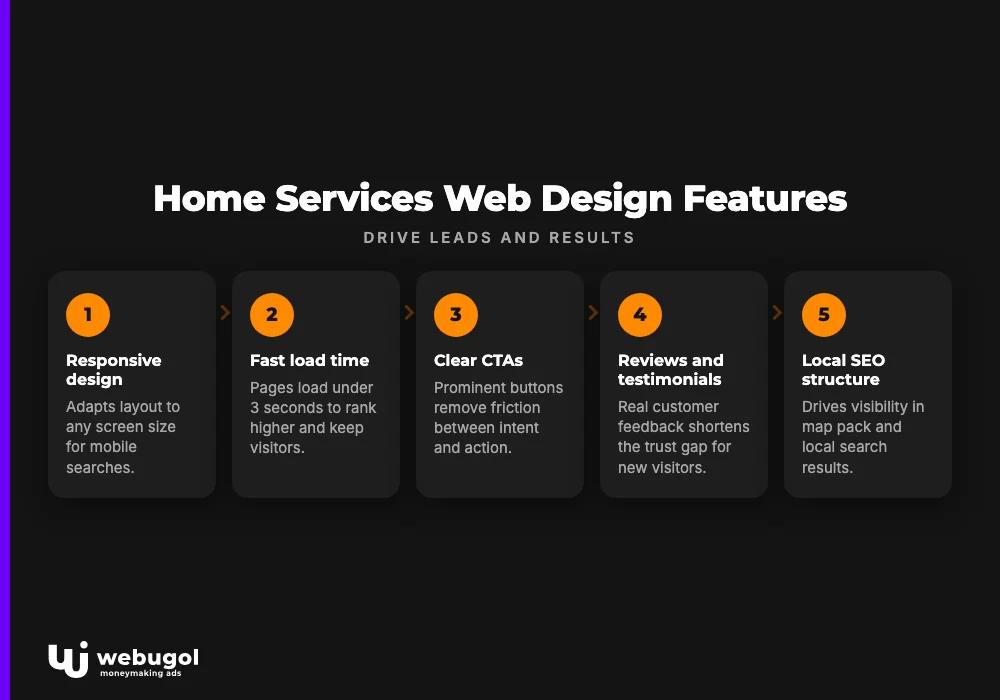
The contractor website features that drive results fall into four categories: performance, trust, conversion, and local visibility. Weakness in any one category costs you leads.
| Feature | What it does | Why it matters |
|---|---|---|
| Responsive design | Adapts layout to any screen size | Most local service searches happen on mobile |
| Fast load time | Pages load under 3 seconds | Slow sites rank lower and lose visitors before they read a word |
| Clear CTAs | Prominent call, quote, and booking buttons | Removes friction between intent and action |
| Contact forms | Simple name/phone/service fields | Captures leads who prefer not to call |
| Online scheduling | Self-serve appointment booking | Reduces no-shows and fills the calendar passively |
| Reviews and testimonials | Real customer feedback on key pages | Shortens the trust gap for new visitors |
| Local SEO structure | Location pages, schema, GMB alignment | Drives visibility in map pack and local results |
| Live chat | Real-time visitor support | Converts visitors mid-consideration |
Responsive design for plumber and contractor websites
A website's layout and content must adapt cleanly across desktop, tablet, and phone. Responsive design uses flexible grids, fluid images, and media queries to maintain a consistent experience regardless of device. Search engines rank mobile-friendly websites higher, and most home service searches happen on a phone.
Practical checklist for a responsive home services site:
- Compress images to maintain quality without slowing load times.
- Reduce HTTP requests by consolidating scripts and stylesheets.
- Design for mobile first, then scale up to larger screens.
- Make buttons and tap targets large enough for thumb use.
- Choose font sizes that remain legible at small sizes without zooming.
- Use a content delivery network to serve assets quickly to users in different locations.
- Test on real devices, not just browser emulators.
Reaching more clients starts with a site that works on the device they're already holding.
Speed and Core Web Vitals
Page speed is not a checkbox. It directly affects both search rankings and the probability that a visitor stays long enough to convert. Every additional second of load time increases the chance they leave before the page finishes rendering.
To improve speed: compress and serve next-gen image formats, minimize render-blocking JavaScript, reduce server response time, and implement lazy loading for below-the-fold content. For electrician website tips and HVAC company website builds, speed optimization is non-negotiable, because local searchers have a low tolerance for waiting when they need service today. When an existing site fails these checks, Core Web Vitals optimization fixes speed on the pages you already have, without waiting for a full rebuild.
What makes a good contractor website?
A good contractor website removes doubt at every step. Doubt about whether you service their area. Doubt about whether you're licensed. Doubt about what they'll pay. The best contractor sites answer those questions before the visitor has to ask. This is the core principle of effective home services web design: every element either confirms you're the right choice or creates friction that pushes visitors toward a competitor.
The contractor website features that separate high-converting sites from average ones:
Clear service scope. Each service gets its own page with enough detail to answer "do you do this?" without requiring a call. A plumber website design that lists only "plumbing services" with no breakdown leaves visitors guessing.
Trust signals above the fold. Licenses, insurance badges, years in business, and review counts should appear near the top of the homepage and service pages. These are what a first-time customer looks for in the first three seconds.
A dominant phone number. The phone number should be in the header, sticky on mobile, and visible on every service page without scrolling. This seems obvious. Most contractor sites bury it.
Visual proof of work. Photos of real jobs, real teams, and real equipment build more credibility than stock photography. A local service business site that shows your actual trucks, uniforms, and completed work closes the gap between "can they do this?" and "yes, they can."
Review integration. Google reviews displayed on the site, particularly near CTAs, shorten the decision timeline. Positive reviews also contribute to local search rankings. Encouraging satisfied customers to leave reviews builds a compounding asset over time.
Signs your current site is costing you jobs
Poor UX design for a home services website shows up in your analytics before it shows up in your revenue, but the revenue impact follows. Watch for:
- High bounce rate: Visitors leave quickly because they can't find what they need or the site loads too slowly.
- Low time on page: Content isn't engaging or the layout is confusing.
- Low conversion rate: Traffic exists but visitors don't call, book, or fill out a form.
- Negative reviews about the booking process: Customers mention difficulty scheduling or contacting you.
- Inconsistent design: Mismatched fonts, colors, and layouts signal a lack of professionalism.
These signals are diagnostic, not abstract. Each one points to a specific problem you can fix.
How to get more leads from a home services website?
More leads come from two directions: more qualified visitors arriving at the site, and a higher percentage of those visitors converting. Home services landing page optimization works on both. Home services web design that connects organic reach with on-page conversion is what compounds growth over time.
SEO for home service businesses starts with keyword research. Find what your customers actually search, then build pages around those terms. For local service business sites, this means location-specific pages, structured data for local search, and content that answers real questions rather than vague brand copy.
Organic rankings compound over time. Complementing your organic rankings with paid campaigns can accelerate results during the months it takes SEO to build. Our playbook for Google Ads home services campaigns covers how to structure paid search for home service companies specifically, including what keywords convert and how to build landing pages for lower cost per lead.
Lead generation features that consistently move the needle:
- Online quoting tools let visitors get a ballpark estimate by entering project details. This increases the probability of a follow-up call because the customer has already committed time to your site.
- Customer referral programs reward existing clients for recommending your services. Word-of-mouth is already your highest-converting channel. A structured referral program makes it systematic.
- Email newsletter signups keep potential customers engaged between service calls. Maintenance reminders and seasonal tips keep your brand top of mind when they need service next time.
- Special promotions on the homepage or service pages create urgency. Seasonal offers and first-time customer discounts reduce the friction of trying a new provider.
- Live chat allows visitors to ask questions in real time. Many potential customers prefer this to picking up the phone, especially for initial inquiries.
The combination of organic search visibility and conversion-optimized pages is what separates home service companies that grow consistently from those that depend entirely on referrals.

How much does web design cost for a home services company?
Web design costs for home service businesses vary based on scope, complexity, and whether you're working with a freelancer, a template platform, or a full-service agency. For home services companies working with Webugol, entry-level builds with AI-accelerated development start from $3,000 to $5,000 and cover the core site with lead generation features built in.
The more relevant question isn't what the site costs. It's what a site that doesn't convert costs you in missed jobs. A residential HVAC company in a mid-sized market receiving 200 monthly site visitors at a 2% conversion rate and a $500 average job value leaves significant revenue on the table with every percentage point of conversion rate they don't capture.
Ongoing maintenance, SEO updates, and design refreshes are separate considerations. A site built well reduces ongoing maintenance load. A site built on a fragile theme or outdated platform will require constant intervention.
Home services web design: SEO and site structure
Search engine optimization for a home services website isn't separate from design. It's embedded in every structural decision: URL structure, heading hierarchy, image alt attributes, page speed, and internal linking.
Practical SEO decisions for an HVAC company website or electrician website:
- Use short, descriptive URLs with the target keyword included.
- Write meta titles and descriptions that include location and service type, not just the brand name.
- Add structured data markup so search engines can display rich results (business hours, review stars, service areas).
- Include location-specific content on service area pages, not just the homepage.
- Build internal links between service pages and blog content to distribute authority and help visitors navigate.
- Update content when services, service areas, or pricing change. Search engines prefer current information.
Quality content that answers real questions also extends time on site and reduces bounce rate. Both are signals that correlate with better rankings, though the content quality is the cause, not the correlation.
How testimonials and reviews build trust
Customer reviews are the fastest trust signal available to a home services company. A visitor who lands on your site for the first time knows nothing about you. Reviews from real customers provide the social proof that closes that gap.
Google reviews in particular influence both rankings and customer decisions. Search algorithms factor review quantity and recency into local rankings. Displaying a live feed of recent reviews on your site, near service page CTAs, reinforces credibility at the moment a visitor is deciding whether to call.
Encouraging satisfied customers to leave reviews requires only a simple post-service follow-up. The compounding effect over time, in both rankings and conversion rate, makes this one of the highest-ROI activities a home services business can maintain.

What a full-stack approach to growth looks like
Most home services companies treat their website as a brochure. The companies growing fastest treat it as the first step in a system: site captures the lead, CRM tracks the follow-up, reviews feed back into rankings, and the whole loop tightens over time.
This is the distinction between building a site and building a growth system. A plumber website design that integrates booking, review collection, and local SEO from the start doesn't require three separate vendors and four different logins to manage.
Webugol builds home services web design as part of that full system. AI-accelerated development brings the entry cost down to a range that works for growing companies, and the site ships with the structure that supports lead generation from day one.
Ready to stop losing jobs to a competitor's website?
If your site isn't converting visitors into calls and bookings, the gap is fixable. Webugol, a results-focused web design team, builds home services websites that generate leads, rank locally, and grow with your business. Get in touch to review what your current site is leaving on the table.
FAQ
What features should a home services website have?
A home services website needs responsive design, fast load times, prominent contact options, online booking, trust signals like reviews and licenses, and location-specific SEO. These features work together to convert visitors into booked jobs rather than losing them to a competitor.
How much does web design cost for a home services company?
Costs vary based on scope and who builds the site. AI-accelerated builds for home service companies start in the $3,000 to $5,000 range and include core lead generation features. The more relevant number is the revenue cost of a site that doesn't convert.
What makes a good contractor website?
A good contractor website removes doubt fast: it shows what you do, where you work, what customers say about you, and how to reach you, all without making a visitor scroll or search. Clear CTAs, real photos, visible reviews, and a dominant phone number are the fundamentals.
How to get more leads from a home services website?
Combine local SEO to bring qualified visitors to the site with conversion features like online quoting, booking forms, and live chat to convert them. Each percentage point improvement in conversion rate multiplies the value of every visitor your site already receives.
Why do home services companies need a professional website?
Local search demand for home services is high and decision timelines are short. Customers searching for a plumber or HVAC tech are ready to call. A professional site captures that intent; a poor one sends it to a competitor.

