



Closed loop marketing pharma: how CLM drives HCP results
Closed loop marketing pharma connects every HCP touchpoint into a self-improving feedback system. Each interaction generates data. Whether a rep visit, email, or webinar, that data sharpens the next campaign. Traditional broadcast marketing sends messages outward and waits weeks for aggregate results; CLM measures and corrects in real time.
What is closed-loop marketing in pharma?
CLM in pharma is a strategy where each HCP interaction produces data that refines the next one. Healthcare closed loop marketing treats every email open, rep call, and webinar registration as both a delivery channel and a measurement point. That dual function is what closes the loop.
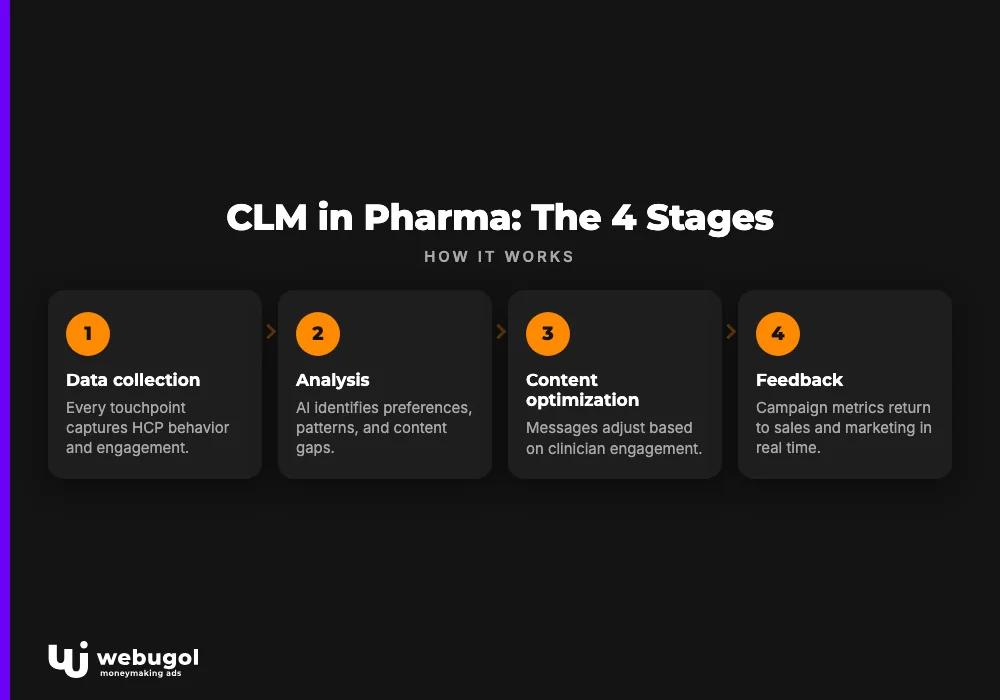
The process runs in four linked stages:
| Stage | What happens |
|---|---|
| Data collection | Every touchpoint captures HCP behavior: email opens, click-throughs, webinar attendance, and rep call notes. |
| Analysis | AI-driven analytics identify preferences, engagement patterns, and content gaps across HCP segments. |
| Content optimization | Messages are adjusted based on what each clinician engaged with, not demographic proxies. |
| Feedback | Campaign metrics, including prescription upticks and email click-through rates, return to sales and marketing in real time. |
These four stages compound over time. A pharma company promoting a new cardiac therapy, for instance, collects HCP email interaction data, identifies physicians interested in trial efficacy results, and sends them targeted white papers. Follow-up rep conversations then reflect exactly what each HCP already read.
How does CLM work in pharmaceutical sales?
Pharma CLM starts where traditional selling ends: at the data. A sales rep logs an HCP call in the CRM. That record combines with email engagement and digital content interaction data in an analytics layer, which scores the HCP's current interests. The next outreach, automated or human-led, reflects that score.
Three conditions determine whether the loop actually closes:
- The CRM captures structured data from every channel, not just call reports.
- Marketing and sales teams share the same dataset and define joint engagement goals.
- The analytics system updates outputs continuously, not in end-of-quarter batches.
Without all three, organizations produce data silos. The loop opens.
What tools are used in pharma closed-loop marketing?
Pharma marketing automation platforms do the analytical work. The most widely deployed are Veeva, Salesforce, and HubSpot. Each centralizes interaction data, automates follow-up sequences, and generates the performance dashboards that power pharmaceutical marketing analytics.
Beyond the CRM layer, CLM implementations typically include:
- Presentation tracking tools that log which slides an HCP viewed during a rep visit, delivering real engagement signals beyond call duration.
- Email systems that track opens and clicks at the individual HCP level and trigger follow-on content based on behavior. A structured email approach for healthcare providers improves open rates and downstream click-through performance.
- AI analytics engines that process behavioral data and surface next-best-action recommendations for reps.
- Compliance layers enforcing GDPR and HIPAA requirements across all data collection and storage.
Platform selection should follow compliance requirements first. Healthcare data carries regulatory obligations that many consumer marketing tools cannot meet without heavy customization.
How is CLM different from traditional pharma marketing?
Traditional pharma marketing fires messages outward and waits for aggregate results. CLM measures, corrects, and adapts on a continuous cycle. The distinction is not digital versus analog. It is reactive versus adaptive.
In a traditional model, a rep carries printed brochures to a physician visit. Feedback arrives through prescription data weeks later, stripped of context. With pharma CLM, the rep's tablet logs which content the physician actually engaged with, and that behavioral signal updates the HCP's profile before the rep leaves the building.
That immediacy reshapes the HCP engagement strategy in two concrete ways. First, reps enter follow-up conversations with evidence of what already resonated, not generic talking points. Second, marketing can retire underperforming content in real time rather than waiting for quarterly reviews. The result is consistent multi-channel engagement across HCP touchpoints that traditional campaigns struggle to maintain.

What are the benefits of CLM for HCP engagement?
The core benefit is relevance at scale. Pharma marketing automation lets a company deliver the right content to thousands of HCPs without manually managing each profile. Engagement improves because content reflects individual behavior, not population averages.
Additional benefits documented in CLM implementation practice include:
- Reduced content waste. Underperforming materials are identified and pulled rather than distributed until budget runs out.
- Sales and marketing alignment. Shared dashboards break the information barrier between reps and campaign teams, and both sides work from the same HCP interaction history.
- Compliance confidence. Centralized data capture makes audit trails manageable under GDPR and HIPAA.
- Faster iteration. Click-through rates and email open rates return actionable signals within days, not quarters.
The pharmaceutical marketing analytics layer is what makes these benefits concrete. Without it, CLM is a CRM with good intentions and no feedback.
Challenges in closed loop marketing pharma
CLM is not a plug-in. Three obstacles appear consistently across implementations.
Legacy system integration. Many pharma organizations run CRM and data infrastructure built before modern CLM requirements. Bridging those systems requires middleware or API layers, and that integration work delays any marketing benefit.
Team adoption. A CLM platform only closes the loop if reps log structured call data and marketing teams act on analytics outputs. Poor onboarding produces expensive software used as a basic contact list. User-friendly interfaces and hands-on training reduce this risk, but both require sustained investment beyond the initial rollout.
Data privacy. Patient and HCP data sits under GDPR and HIPAA. Any CLM implementation must build compliance in from the start. Non-compliance carries financial penalties and reputational consequences that outweigh any efficiency gain.
These obstacles are manageable with strategy, proper training, and a technology partner who understands pharma regulatory requirements, not just software deployment.

Build your CLM strategy with expert support
Pharma companies that treat closed loop marketing pharma as a technology purchase rather than a strategic capability typically stall at integration. The organizations that succeed align marketing, sales, and compliance functions before selecting a platform.
If your team is evaluating CLM options or wants to close gaps in your current HCP engagement strategy, Webugol, a digital marketing agency with healthcare sector experience, can help structure an approach that fits your regulatory environment and commercial goals.
FAQ
What is closed-loop marketing in pharma?
Closed loop marketing pharma is a strategy where every HCP interaction, across email, rep visits, and digital channels, generates data that refines the next campaign. The feedback loop replaces guesswork with behavioral signals from actual engagements.
How does CLM work in pharmaceutical sales?
Sales reps log structured call data into a CRM, which combines with email and digital interaction data in an analytics layer. That layer produces next-best-action recommendations so each follow-up reflects what the HCP already engaged with.
What tools are used in pharma closed-loop marketing?
Common platforms include Veeva, Salesforce, and HubSpot, combined with presentation tracking tools, email systems, and AI analytics engines. All tools must meet GDPR and HIPAA compliance requirements for pharmaceutical use.
How is CLM different from traditional pharma marketing?
Traditional pharma marketing sends messages outward and waits weeks for aggregate prescription data. CLM measures HCP engagement at every touchpoint in real time and updates content strategy continuously rather than in quarterly review cycles.
What are the benefits of CLM for HCP engagement?
CLM delivers personalized content at scale, aligns sales and marketing on shared HCP interaction data, and produces faster campaign iteration through real-time performance metrics. Centralized data capture also simplifies GDPR and HIPAA compliance auditing.

