


What is Parasite SEO and Why Your Health Business Needs It by Webugol
Picture starting a new health facility in a busy city. You have the best equipment and staff, but your business is in a quiet alley where no one walks by. Meanwhile, the well-known hospital across the street has dominated the local foot traffic and skyline for decades. You know your services are superior, but patients can’t get to you because they can’t locate you.
This is the exact reality for thousands of health businesses online. What if, instead of trying to build a skyscraper from scratch, you could rent a penthouse in an already existing building?
This strategy is known as parasite SEO. While the name sounds aggressive, the practice – when done ethically – is a legitimate and powerful way for health businesses to bypass the long waiting period of traditional SEO.
At Webugol Agency, we specialize in helping health professionals leverage high-authority platforms to gain immediate visibility. In this guide, we will explore exactly what this SEO strategy entails and why it is the missing piece in your patient acquisition puzzle.
What is Parasite SEO?
This SEO method is all about posting content to third-party websites with high search rankings to rank for competitive keywords.
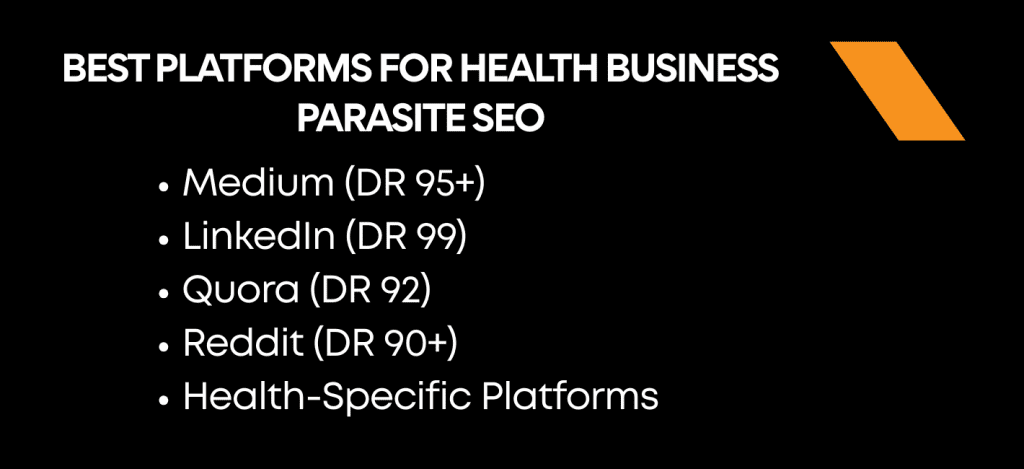
Think of parasite SEO as a “piggyback” strategy. Google assigns every website a level of trust and authority (often measured by metrics like Domain Rating or Domain Authority). A new private practice website might have a Domain Rating (DR) of 5 out of 100. A site like LinkedIn or Medium has a DR of 90+. When you publish an article on your own site, Google views it with skepticism because you lack history. When you publish that same article on LinkedIn, Google trusts it immediately because it trusts the host platform.
How Parasite SEO Works
The mechanics of this strategy are straightforward but require precision to execute correctly:
- You choose high-authority sites.
- You write a high-quality, SEO-rich article targeting a specific keyword.
- Because the host site already has millions of backlinks and years of trust, your article can jump to the top of search results in days or weeks.
Why Health Businesses Specifically Need Parasite SEO
Healthcare marketing is uniquely difficult. You aren’t just selling a product; you are dealing with people’s well-being. Because of this, health businesses face specific hurdles that parasite SEO is perfectly designed to overcome.
The Unique Challenges of Healthcare Marketing
A. YMYL Content Scrutiny
Google classifies health content as “Your Money or Your Life” (YMYL). Because bad medical advice can physically harm someone, Google holds health websites to an incredibly high standard. A new blog post on a new clinic’s website is guilty until proven innocent. It takes a massive amount of time to prove to Google that your own website is trustworthy enough to rank for medical advice.
B. Intense Competition
If you are a dermatologist, you aren’t just competing with other local skin clinics. You are battling Healthline, WebMD, and insurance directories.
C. Patient Acquisition Urgency
New practices have overheads to pay immediately. You cannot pay rent in October with the promise of SEO traffic arriving next July.
How Parasite SEO Addresses These Challenges
1. Rapid Visibility for Competitive Keywords
Let’s say you want to rank for “best dermatologist near me” or “chronic pain treatment options.” Your own website might be on page 10. However, a well-crafted article on LinkedIn titled ‘How to Choose the Best Dermatologist in [City]’ can quickly achieve top search rankings, as search engine algorithms highly value LinkedIn’s authority.
2. Cost-Effective Patient Acquisition
Building a website’s authority from scratch requires expensive technical SEO, massive content production, and costly link-building campaigns. Parasite SEO bypasses the need for technical infrastructure and link acquisition because the host platform already has it. You are simply publishing content.
3. Market Testing and Validation
Before you spend thousands building a dedicated webpage for a new service, you can write a Medium article about it. If the article ranks and drives inquiries, you have validated the demand.
4. Multi-Channel Presence
Why settle for one spot on Google? With parasite SEO, you can occupy multiple positions. Your website might rank #5, your LinkedIn article #2, and your YouTube video #8. This allows you to dominate the Search Engine Results Page (SERP) real estate.
5. Backlink Building
This is the hidden benefit. When you publish good content for high authority sites, you should link back to your primary practice website. These backlinks are very valuable and will assist your website’s authority to grow over time.

White-Hat vs. Black-Hat Parasite SEO in Healthcare
In healthcare, reputation is everything. There is a right way and a dangerous way to execute this SEO strategy. Understanding the difference is critical for protecting your medical license and brand.
White-Hat (Ethical) Parasite SEO
This is the only approach reputable health businesses should consider. Your information should be useful, medically correct, and interesting to the people who read it. It meets the rules of the host platform exactly and offers detailed information about the author.
Grey-Hat Approaches
This often involves paid sponsored posts on news outlets that look like news but are actually ads, or using AI to generate mass content that meets only minimum quality standards.
While not always penalized, these tactics carry a higher risk. If a news outlet gets flagged by Google for selling links, your investment evaporates overnight.
Black-Hat (Unethical) Parasite SEO
This includes low-quality content full of keywords that often pushes “miracle cures” or uses spammy affiliate links.
For a health business, this is a massive risk. Beyond Google de-indexing your content, you can face legal liability, medical board violations, and severe reputational damage.
Why White-Hat is Non-Negotiable
In healthcare, patient safety and trust are the foundation of your business. Parasite SEO should extend your expertise, not compromise your ethics.
Step-by-Step Implementation Guide for Health Businesses
Phase 1: Strategic Foundation (Week 1)
Step 1: Define Your Goals
This is the most important step, because your goal dictates your platform.
Step 2: Keyword Research for Healthcare
Find “long-tail” keywords. Use phrases that have minimal competition but strong intent.
Step 3: Competitive Analysis
Look at where your competitors are mentioned. If a rival clinic has a great article on Medium ranking for a keyword you want, you know that platform works for your niche.
Phase 2: Platform Setup and Profile Optimization (Week 1-2)
Step 4: Create Profiles on Relevant Directories and Social Media Platforms
Make sure you highlight your credentials clearly. Link to your practice website. Use a professional headshot – trust is visual.
Step 5: Build Initial Credibility
Don’t just sign up and post. Engage with other content. Clap for articles on Medium. Comment on LinkedIn posts. Show the platform you are a real user, not a bot.
Phase 3: Content Creation (Ongoing)
Step 6: Develop High-Quality Healthcare Content
This is where the magic happens. Your content must demonstrate experience, expertise, authoritativeness, and trustworthiness.
Step 7: Optimize for SEO
Include your target keyword in the headline and the first 100 words. Use H2 and H3 headers to break up text. If the platform allows, add “alt text” to your images.
Step 8: Strategic Link Building
This is a delicate part of parasite SEO. Include a link to your practice in your author bio. Within the text, only link to your site if it adds value.
Phase 4: Publication and Promotion (Ongoing)
Step 9: Publishing Strategy
Consistency matters. Aim for 2-4 Medium articles a month, or 3-5 Quora answers a week.
Ethical Considerations and Compliance
As a health business, you operate under stricter rules than an e-commerce store.
1. HIPAA Compliance
Never, ever share identifiable patient information. Even if you don’t use a name, describing a specific, unique scenario could be a violation. Always use composite scenarios or obtain written consent.
2. Professional Standards
Follow your medical board’s advertising guidelines. Avoid “guaranteed results” language. Be honest about limitations.
3. Truth in Advertising
Disclose any affiliations. If you are recommending a supplement you sell, you must state that clearly.
4. Informed Consent Language
Always include a disclaimer: “This information is for educational purposes only and does not constitute medical advice. Consult a qualified healthcare provider before making treatment decisions.”
Conclusion
The question isn’t whether health businesses should use parasite SEO – it’s whether you can afford not to. In a digital world dominated by medical giants, this SEO strategy offers a rare opportunity to level the playing field.
Parasite SEO is not a magic bullet or a way to cut corners on ethics. It is a strategic tool. It lets you use the trust you’ve built up to give your knowledge to the patients who need it most right now. It fills the time frame between starting your own business and getting long-term organic visibility.
You may gain prime search engine real estate, establish your reputation, and – above all – assist more patients in getting the therapy they require by using the best parasite SEO platforms 2026 has to give and following white-hat practices.
Your patients are out there searching for answers. Make sure they find you.
Ready to accelerate your practice’s growth? Get started with Webugol today and let us build a high-visibility strategy tailored to your medical niche.