



What Is Custom Coding and Do You Actually Need It?
Custom coding is purpose-built, hand-written code tailored to your business requirements, not adapted from a template or generated by a visual builder. It gives you full ownership of your product's logic, integrations, and performance. For founders building their first product or scaling a business that outgrew its stack, the structural question is the same: when does it pay off over the tool you already use?
What does "custom coding" actually mean?
This is software written from scratch to solve your exact problem. No platform limits which features you can build, no visual editor constrains your data model, and no vendor controls your roadmap. The result is code you own outright, built to do precisely what your business needs.
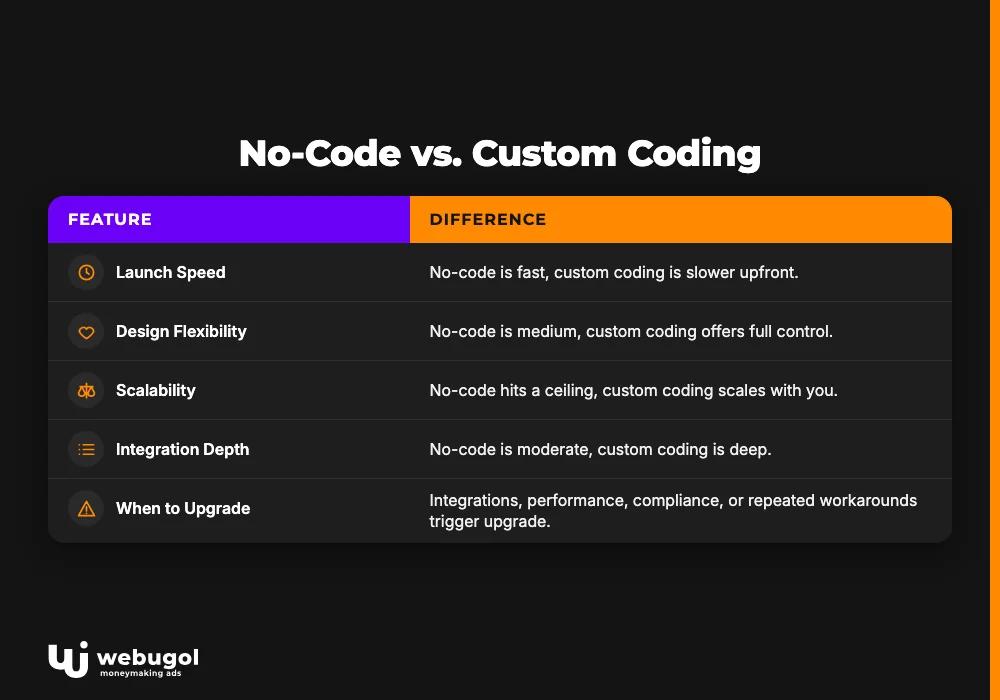
Custom coding vs. no-code tools: What's the real difference?
No-code platforms trade control for speed. This path trades speed for control. Knowing which matters more at your stage is the whole decision.
| No-code | Custom coding | |
|---|---|---|
| Speed to launch | Fast | Slower upfront |
| Design flexibility | Medium | Full |
| Scalability | Hits a ceiling | Scales with you |
| Integration depth | Moderate | Deep |
| Starting cost | Low | From $3k |
When no-code is the smarter choice
Lovable, Webflow, and similar platforms are the right call at the validation stage. If you want to build custom business apps without coding everything from scratch, these tools get you there fast. Custom coding is overkill when you are still testing whether the idea works.
When you've hit the no-code ceiling
Tools that promise custom software development without coding get you to proof of concept fast, and that is genuinely valuable. The ceiling appears when integrations are not supported, performance degrades under real traffic, a compliance requirement exceeds the builder's scope, or you are rebuilding the same workaround repeatedly. Two or more of these triggers means switching is cheaper than staying. Industries with strict compliance needs, including regulated sectors that depend on custom medical coding software solutions, hit this ceiling earlier than most.

What does custom development include?
A full custom build typically covers six areas:
- Custom frontend built to your brand and UX requirements
- Backend logic handling your specific business rules
- Database architecture designed for your actual data model
- Third-party integrations with your CRM, payments, or API stack
- Authentication and security layer for your compliance requirements
- Deployment pipeline for reliable, repeatable releases
For founders scoping their first product, build an MVP covers the full process from idea to working software.

How much does custom coding cost?
A custom build starts around $3,000 for AI-accelerated projects and can reach $15,000 or more for full-featured products. The main cost drivers are integration complexity, authentication requirements, and timeline. Understanding what is mvp in software development helps clarify which scope decisions push the budget up or keep it lean.
If your scope is clear, book a scoping call now. At Webugol, the growth marketing system is part of the build from day one, not handed off to a separate team after launch.

When should I choose custom development over no-code tools?
Choose custom development when your no-code tool can no longer deliver a required feature without a workaround. Five triggers to watch:
- A required integration the platform cannot support natively
- Performance issues hurting conversion
- A security or compliance requirement the builder cannot meet
- Business logic the visual editor cannot express without stacking patches
- You are rebuilding the same workaround repeatedly
Recognizing two or more of these means the gap between what your tool delivers and what your business needs is already costing you.
Ready to move beyond no-code?
You have proven demand. The question is whether your current tool can carry the product to the next stage. Webugol delivers AI-accelerated custom builds starting at $3k, bundled with a growth marketing system so you stop losing revenue to handoff gaps between build and growth. Explore mvp development services or book a scoping call to map your project.
FAQ
Is custom coding worth it for a small business?
It makes sense when demand is validated but your tool is blocking growth. Workarounds and broken integrations are real revenue costs, not abstract risks. If you are still testing the core idea, stay with no-code for now.
What's the difference between custom code and a website template?
A template is a pre-built design you customize within fixed limits. Custom code builds the system from scratch, with no built-in constraints. Templates are fast and cheap; custom code is flexible and built to scale.
Can AI tools replace custom development?
AI tools generate code fast and lower the entry price. Many founders want to build custom AI apps no coding required, or create custom AI agents without coding, platforms like Voiceflow handle those lightweight workflows. They do not replace the judgment needed to design a secure, scalable system. AI-accelerated development with an engineer owning the architecture gives you the best of both approaches.
How long does a custom project typically take?
A focused build with a clear scope takes between two and eight weeks depending on complexity. AI-accelerated development compresses that timeline compared to traditional agencies. Architecture and security stay in scope regardless.
How to create a custom video app without coding?
For simple streaming or playback needs, platforms like Vimeo, Uscreen, or Dacast let you build a video app with no code. If you need custom monetization, offline sync, or compliance controls, those requirements exceed what builders support. That is when development takes over.