



Healthcare Marketing Trends for Patient Acquisition in 2026
Healthcare marketing trends in 2026 center on AI-driven targeting, compliance-first telehealth marketing, and patient-centric funnel design. These shifts are reshaping how US clinics and telehealth operators move patients from first search to booked appointment. The channel landscape has changed; the structural problems underneath it largely have not.
For US clinic owners and telehealth operators spending $20k or more per month on acquisition, these trends matter less as a checklist and more as a diagnostic framework for identifying where their current system is leaking.
Whether you are building your first patient acquisition channel or optimizing a seven-figure healthcare marketing budget, the structural fragility is the same: no clean attribution path, no owned follow-up system, and no single accountable owner for the revenue path from click to appointment. Scale amplifies that fragility.
What are the biggest healthcare marketing trends right now?
The six trends with the clearest impact on patient acquisition for US healthcare providers in 2026:
| Trend | What it changes for your acquisition system |
|---|---|
| AI in targeting and copy | Reduces wasted spend; requires clean conversion data to work |
| Telehealth marketing strategies | Extends geographic reach; adds compliance and speed-to-lead demands |
| Patient-centric digital marketing | Improves consult-to-booking conversion when messaging matches how patients search |
| Voice search medical SEO | Captures intent-rich conversational queries; needs FAQ and structured data foundation |
| Healthcare social media marketing | Builds trust before the search intent exists; compliance shapes what you can say |
| Digital health content strategy | Drives organic demand at lower long-term CAC than paid |
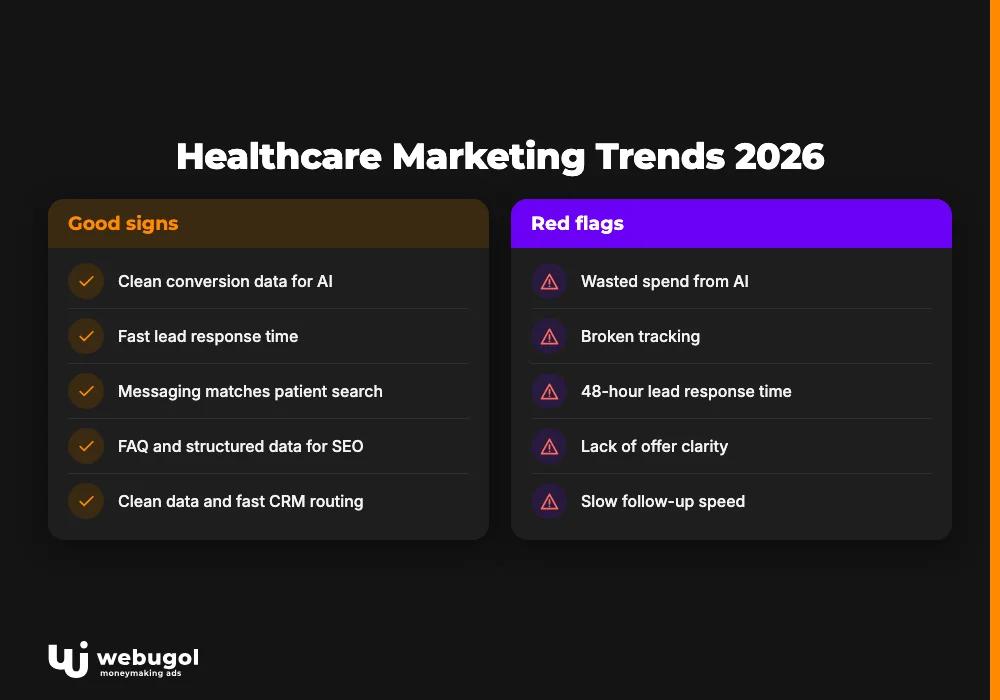
The pattern across all six: the channel is not the bottleneck. Attribution, follow-up speed, and offer clarity are. A practice that adopts all six channels with broken tracking and a 48-hour lead response time will spend more and grow less than one running two channels with clean data and fast CRM routing.
How is AI changing healthcare marketing?
Among current healthcare marketing trends, AI-driven campaign management has the most immediate impact on day-to-day acquisition costs. AI in healthcare advertising changes two things directly: how campaigns target and bid, and how copy is generated and tested at scale. These are operational shifts, not theoretical ones.
On the targeting side, platform AI (Google Performance Max, Meta Advantage+) now handles audience selection and bid optimization in real time. The critical input is conversion data quality.
Feed the algorithm clean conversion events tied to actual appointments or memberships, and it optimizes toward patients who book. Feed it incomplete or duplicated event data, and it optimizes toward whoever clicks. That distinction costs practices significant ad spend before anyone identifies the root cause.
On the content side, AI tools produce draft ad copy, landing page variants, and email sequences faster than any in-house team. The constraint remains compliance review. Healthcare claims still require human approval for HIPAA compatibility and platform policy adherence. Teams that use AI to draft and trained reviewers to approve move faster than those building from scratch each cycle. The bottleneck moves from production to review, which is a solvable ops problem.
The diagnostic pattern across telehealth and clinic accounts: when practices say AI is not working, the issue is almost always a tracking problem, not a targeting problem. The algorithm is as good as the signal you give it.
What is patient-centric marketing in healthcare?
Patient-centric digital marketing means designing your acquisition funnel around how patients actually search and decide, not around how providers categorize their services. The practical effect is better conversion rates and lower no-show rates, two metrics that rarely move together without intentional funnel design.
This shows up in three places.
First, messaging. Patients search for symptoms, outcomes, and reassurance, not procedure names. A weight loss clinic that leads with "GLP-1 program" speaks to a small, already-informed audience. The same clinic leading with messaging tied to the patient outcome reaches a broader population and then qualifies. Offer framing changes the audience before the ad algorithm does anything.
Second, the booking flow. Patients expect digital-native experiences: online scheduling, SMS reminders, and clear next steps after the first contact. Friction in the booking flow shows up as a CPA problem across every campaign simultaneously. Removing one unnecessary form step or reducing booking stages can produce a measurable improvement in cost per acquisition without touching bid strategy.
Third, feedback loops. Patient satisfaction data, review volume, and no-show rates are marketing data, not just operational data. A high no-show rate is frequently a messaging problem: the wrong patient expectation was set during acquisition. Connecting intake data and show rate to campaign reporting closes the loop that most media agencies do not look at.
What is telehealth marketing and how does it work?
Telehealth marketing strategies promote virtual care services by reaching patients before they make a provider decision, not just after they search for one. As a segment, telehealth sits at the leading edge of healthcare marketing trends because geographic reach, compliance constraints, and speed-to-lead all create dynamics that clinic marketing did not face. The mechanics differ from traditional clinic marketing in four significant ways.
Geographic reach is national, not local. A telehealth operator can run Google and Meta campaigns across multiple states. This changes budget allocation, competitive benchmarking, and audience strategy entirely compared to a geo-restricted clinic.
Compliance constraints are tighter and more actively enforced. HIPAA-compatible tracking, platform consent mode, and the prohibition on retargeting based on medical conditions all apply. Meta and Google both run active enforcement programs for health-related ads. Any tracking setup that records medical condition data in a pixel or user segment creates policy risk alongside legal risk.
Speed-to-lead is a conversion lever. Virtual care patients frequently have multiple providers open in adjacent browser tabs. CRM routing and lead assignment setup matter as much as the ad creative. A fast, well-structured intake flow captures patients that a slow one loses to a competitor who responded first.
Offer clarity drives down CPA faster than bid optimization. For telehealth programs in weight loss, TRT, or advanced blood work, a specific credible offer outlining the visit-one experience, price, and expected outcome outperforms a generic "book a free consultation" at the top of the funnel. Generic offers bring in browsers. Specific offers bring in buyers.

How do healthcare providers use social media effectively?
Healthcare social media marketing works when it builds patient trust before the search intent exists. The channels where this happens most reliably for US providers are Instagram, Facebook, and YouTube, with TikTok gaining traction in younger demographics.
Effective healthcare social content shares one structural quality: it shows the patient experience, not the service menu. Provider Q&A formats, educational content tied to specific health conditions, and patient journey stories (where platform rules permit) all perform because they answer questions patients are already asking in their own language.
The healthcare social media marketing guide covers platform-specific tactics and compliance guardrails in depth.
The compliance layer matters as much in organic social as it does in paid. Posts that make outcome claims, use patient testimonials without written authorization, or reference specific medical conditions in ways that could feed retargeting audiences create policy risk that extends to the ad account. A compliance incident in organic social that restricts an ad account stops acquisition across every paid channel at once. That risk alone justifies a formal review step in the content approval process.
What moves the number on social: posting cadence matters less than content quality and CTA clarity. A post that answers a real patient question and ends with a clear next step consistently outperforms high-volume low-specificity content.
Voice search and digital health content strategy
Voice search medical SEO captures a category of queries that standard text search misses: conversational, intent-rich questions patients ask on mobile devices and smart speakers. "What is the best weight loss clinic near me" and "how does telehealth work for TRT" are typical examples. These queries signal decision-stage intent and rarely appear in standard keyword planner output.
Optimizing for voice search requires the same infrastructure as good local search: a complete and accurate Google Business Profile, FAQ pages with direct answers to patient questions, and structured data markup. Voice assistants pull from the same sources as local pack results. Build the healthcare local SEO foundation first, and voice visibility follows.
A digital health content strategy compounds these gains over time. Organic content that ranks for high-intent queries brings in patients who are already decision-ready, at a lower cost per acquisition than paid channels as it accumulates. The time horizon is six to twelve months. Practices that treat content as a long-term acquisition channel alongside paid see lower CAC over time and reduced dependency on a single platform.

The measurement gap: what healthcare marketing trends miss
Here is where healthcare marketing trends diverge from healthcare marketing results.
The top-performing SERP content covers all six trends above. What it does not address: the measurement layer that determines whether any trend produces attributable revenue.
For a clinic or telehealth operator spending significant monthly ad budgets, the common state is: Google Ads, Meta, GA4, and the CRM all report different numbers. Attribution disagreements between platforms are routine.
Nobody has audited end-to-end data flow in over a year. Lead quality appears to be declining, but it is not clear whether the problem sits in the ad targeting, the landing page, the offer, or the intake process.
This matters because the standard response to declining performance is to change the channel or increase the budget. If the actual problem is a broken UTM parameter, an intake form that disqualifies good leads, or a follow-up sequence that fires days too late, more spend accelerates the problem rather than solving it.
Healthcare email marketing is frequently one of the fastest leverage points in this diagnostic, particularly for reactivating dormant leads and improving show rates through better pre-visit sequences.
At Webugol, the diagnostic pattern across telehealth and clinic engagements consistently surfaces structural issues that ad platform reporting cannot see. Fixing those issues improves ROAS without touching bid strategy and creates a measurement foundation the team can actually use to make decisions week to week.
Ready to close the gap between ad spend and revenue?
The Healthcare Growth System is a 90-day direct-to-patient sprint built in three phases: tracking and funnel diagnostics in month one, conversion asset build and campaign launch in month two, and scale after the measurement foundation is confirmed in month three. Book a strategy call to find out where your acquisition system is leaking.
FAQ
What are the most important healthcare marketing trends for 2026?
The highest-impact trends for US healthcare providers are AI-driven campaign optimization, compliance-first telehealth marketing, patient-centric funnel design, and voice search SEO. The common thread is that channel adoption without clean tracking and fast follow-up rarely improves cost per acquisition.
How does AI improve healthcare advertising campaigns?
AI platform tools help healthcare marketers test more ad variations faster and optimize bids toward high-value conversions in real time. The improvement depends on the quality of conversion data fed to the algorithm: incomplete or inaccurate tracking causes the algorithm to optimize toward the wrong audience.
What makes telehealth marketing different from traditional clinic marketing?
Telehealth campaigns can target patients nationally rather than locally, which expands reach but adds compliance complexity and geographic competition. Speed-to-lead, offer specificity, and HIPAA-compatible tracking setup matter more in telehealth than in geo-restricted clinic campaigns.
Why is patient-centric marketing important for healthcare providers?
Patient-centric digital marketing improves conversion rates by matching messaging to how patients search and decide, rather than how providers categorize their services. It also reduces no-show rates when the expectation set during acquisition matches the actual care experience.
How do I know if my healthcare marketing strategy is working?
The clearest signal is whether your ad platform data, CRM, and intake numbers agree on conversion counts. If the numbers diverge significantly across sources, there is a tracking or routing problem that makes every optimization decision unreliable.