



CBD digital marketing: legal strategies that drive sales
CBD digital marketing is the work of growing a cannabidiol brand across channels that actually permit it, while navigating the ad policies that block most campaigns before they reach a customer. Major paid platforms ban ingestible CBD ads outright. The brands that scale past that wall do it through SEO, email, content, and compliant influencer partnerships. Those channels compound, and over a 12-month horizon they cost less per lead than any paid strategy available on the major platforms.
CBD brand owners who rely on rented ad space without a system underneath hit the same structural wall that stalls any growing business at scale. Single-channel dependence. When the channel shifts or rejects the ad, there is nothing left. The same weakness holds back any SMB owner at plateau: without owned channels, compound growth, and a site that works as a growth asset, every platform policy change is a business risk.
How to market CBD products legally?
The core rule is clear. The FDA prohibits marketing CBD as a dietary supplement or drug without regulatory approval, and health or therapeutic claims require clinical evidence. No unsubstantiated claim, no enforcement risk. Compliant CBD digital marketing stays in the wellness lane: product quality, sourcing transparency, and lifestyle positioning.
What compliance looks like across touchpoints:
- Product copy: leads with hemp origin, third-party lab testing, and quality sourcing, not treatment outcomes.
- Blog and video content: explains how CBD interacts with the endocannabinoid system without claiming to treat or cure specific conditions.
- Testimonials: focus on personal experience, not diagnosis or symptom resolution.
- Paid ads (where permitted): include the standard FDA disclaimer that claims have not been evaluated by the FDA.
CBD advertising restrictions do not eliminate growth. They redirect it toward channels where trust builds over time.
What social media platforms allow CBD advertising?
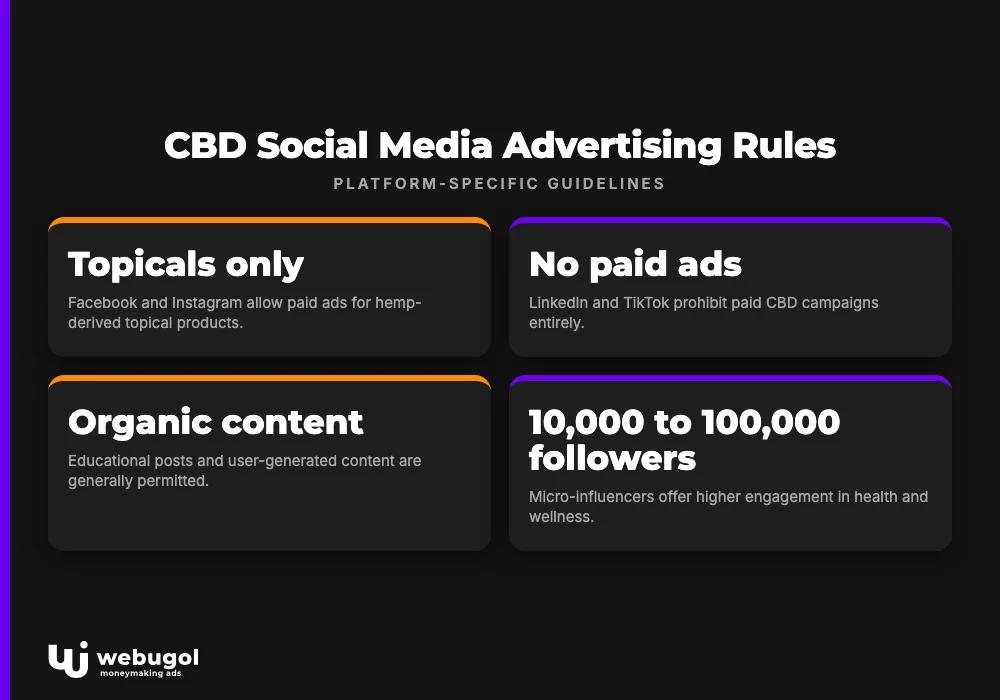
It depends on the platform. Facebook and Instagram allow topicals; Google bans most ingestible CBD advertising; TikTok prohibits paid CBD campaigns entirely. Each platform applies its own version of the restrictions.
| Platform | Paid Ads | Organic + Influencer | Key Restriction |
|---|---|---|---|
| Topicals only | Yes | Avoid "CBD"/"cannabidiol" in copy | |
| Topicals only | Yes | No therapeutic claims | |
| Twitter/X | Hemp-derived only | Yes | Educational content permitted |
| No | Yes | Informational posts only | |
| TikTok | No | Limited | Strict language rules, age-gating required |
CBD social media marketing on paid channels requires precise language. Facebook and Instagram allow hemp-derived topical products when copy avoids regulated terms. Using "hemp extract" or "hemp oil" instead of "CBD" keeps ads from triggering automatic rejection, and targeting must exclude audiences under 18.
Organic content has more room. Educational posts, production content, and user-generated posts rarely trigger platform policies. Influencer partnerships add reach without ad spend, as long as influencers disclose sponsored relationships under FTC guidelines and frame content as personal experience, not medical advice.
Micro-influencers (10,000 to 100,000 followers) outperform larger names on engagement per dollar in health and wellness categories.
Can CBD companies use Google Ads?
Not reliably, as of 2026. Google's standing policy bans advertising for ingestible CBD products. Google has piloted limited CBD campaign access in select markets under specific conditions, but those programs are inconsistent and approval outcomes are unpredictable. Standard campaigns for CBD tinctures, capsules, or gummies typically see disapprovals within days of launch.
What is possible: running search ads for hemp seed oil products with no CBD-specific claims, advertising compliant topicals in pilot-eligible markets, and using display for educational content that does not mention specific products. For most CBD brands, those workarounds do not justify the testing cost. Budget deploys more efficiently through CBD digital marketing channels like organic search and email, where there is no approval gate to clear.

What are the best CBD digital marketing channels?
Organic SEO, email, and influencer partnerships return the best results, because none of them are subject to platform ad bans. The highest-return approach stacks all three, each reinforcing the next.
Organic search and CBD content creation. Long-form guides, product comparisons, and educational articles build traffic without a paid budget behind them. The CBD SEO tips that move results: establish topical authority before targeting competitive transactional terms, build internal linking between related content, and earn backlinks from third-party sites that cite original research or data.
Email. Not subject to platform bans. Well-structured CBD email campaigns reach the full list without algorithm interference. Segmented sequences that match content to where subscribers are in their decision process consistently outperform broadcast blasts. Health and wellness email performs above average across open rate benchmarks, making it one of the highest-ROI channels in a compliant CBD digital marketing strategy.
Influencer partnerships. Health and wellness influencers with trust-based audiences introduce products to buyers more effectively than display ads. Prioritize micro-influencers: higher engagement per dollar, stronger credibility with specific audiences, and more manageable compliance review. Selection criteria: transparency about past brand partnerships, an audience skewed toward wellness-oriented adults, and willingness to follow FTC disclosure requirements.

How to build a CBD brand online?
Build a CBD brand online by establishing clear positioning, creating a content hub that earns organic traffic, and treating the website as a growth asset rather than a brochure. The differentiation that holds in saturated CBD categories comes from dimensions ad spend cannot fake: sourcing transparency, third-party certificates of analysis, and consistent messaging across every channel.
Position before you create content. An active-adult joint support brand talks differently than one targeting professionals seeking sleep support. Both may sell the same product. Positioning shapes every content and channel decision downstream, and changing direction after six months of content output is expensive.
Build a content hub. A resource library that answers real buyer questions, covering legality, dosing, testing standards, and how CBD differs from THC, earns organic traffic and backlinks. This is where CBD content creation returns the most compounding value. It builds the kind of authority that makes every other channel work better.
Use social proof carefully. Customer testimonials describing personal experience are permitted. Testimonials describing medical outcomes are not. Build a review collection process that encourages experiential language and audit it regularly for compliance.
Treat site performance as a channel multiplier. Site speed, structured data, and clean technical SEO amplify every channel above it. Many CBD brands invest heavily in content and lose half the value because the site itself does not convert. Build the technical foundation right the first time.
Stop losing budget to ads that reject you
CBD advertising restrictions are not going away next quarter. The brands winning in this category build on channels they own: search rankings, email lists, and audience trust. Those assets compound. They get harder for competitors to replicate the longer you build them.
If your CBD brand is spending on ads that keep getting rejected, or growing slowly without a repeatable system underneath the effort, Webugol builds the site and the growth system together: a compliant, compound CBD digital marketing strategy with technical infrastructure and owned channels in one engagement, not a marketing layer added on after the site is done.
FAQ
How to market CBD products legally?
CBD digital marketing stays compliant by focusing on product quality, sourcing, and education rather than treatment or cure claims. The FDA requires clinical evidence for therapeutic claims, so brand messaging should stay in the wellness lane. Use standard FDA disclaimers on any paid placements where required.
What social media platforms allow CBD advertising?
Facebook and Instagram allow paid ads for hemp-derived topical CBD products when copy avoids regulated terms like "CBD" and "cannabidiol." Organic content and influencer partnerships face fewer restrictions across all major platforms. TikTok prohibits paid CBD advertising and applies strict content rules to organic posts as well.
Can CBD companies use Google Ads?
Google bans ingestible CBD advertising under its current policy, with limited pilot exceptions in select markets. Most CBD brands see better returns from organic search and email than from testing Google Ads campaigns. Check Google's current advertising policies directly before allocating paid search budget.
What are the best CBD marketing channels?
Organic SEO, email, and influencer partnerships deliver the best returns for CBD brands because none of them are subject to platform ad bans. Segmented email drives repeat purchases, SEO builds compounding traffic, and micro-influencer partnerships add reach without the compliance risk of platform ads.
How does a hemp marketing agency help CBD brands grow?
A web growth partner that builds the site and the growth system together does more for a CBD brand than any channel-only agency. Connecting compliant SEO, email, and content to a site built to convert means traffic compounds and owned assets grow, without dependence on rented ad space that platform policy can shut down.