



Pharma B2B digital marketing: tactics, channels, and compliance
Pharma B2B digital marketing covers every online strategy pharmaceutical companies use to reach institutional buyers, from hospital procurement teams to government health agencies. It replaces reliance on in-person sales calls with data-driven channels built for long buying cycles. The results are measurable. Companies that execute it well generate qualified leads, build lasting credibility with clinical decision-makers, and create an advantage that competitors cannot replicate quickly.
What is B2B digital marketing in pharma?
B2B pharma digital marketing targets business customers rather than individual patients. Those buyers include hospital systems, pharmacy chains, medical distributors, and health administrators who evaluate products with far greater rigor than a typical consumer. They require peer-reviewed evidence, compliance documentation, and detailed cost-benefit analysis. Contracts run into the millions.
The audience also has multiple layers. A single purchase typically involves clinical staff, procurement managers, legal reviewers, and finance. Pharma B2B digital marketing must reach each stakeholder with the right information at the right stage of a process that can span months or years.
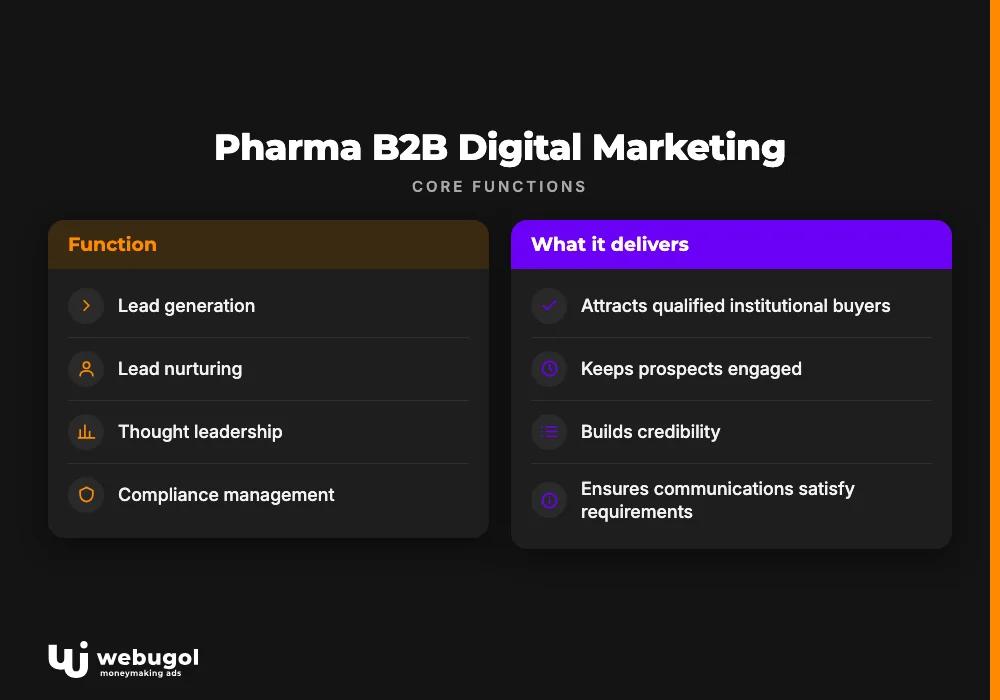
Core functions of pharma B2B digital marketing
| Function | What it delivers |
|---|---|
| Lead generation | Attracts qualified institutional buyers at the right stage |
| Lead nurturing | Keeps prospects engaged across long decision timelines |
| Thought leadership | Builds credibility with clinical and procurement audiences |
| Compliance management | Ensures all communications satisfy FDA and EMA requirements |
What digital channels work best for pharmaceutical B2B?
The highest-performing channels for b2b pharmaceutical marketing meet healthcare professionals where they already research: search engines, LinkedIn, and authoritative content hubs. No channel works in isolation. Sustainable results come from pharma omnichannel marketing that connects search, professional networks, email, and targeted advertising into a coherent buyer journey.
Content marketing and SEO
Premium content anchors any credible pharmaceutical marketing strategy. Original research white papers, clinical summaries, and therapeutic area guides establish authority with buyers who scrutinize every source. That credibility matters. Healthcare professionals routinely search for competitive analyses, clinical evidence, and product comparisons, making organic search one of the highest-intent channels available for pharma B2B.
Gated content produces leads efficiently. Healthcare buyers will exchange contact details for research they cannot find anywhere else, which makes this one of the lowest-friction mechanisms for healthcare b2b lead generation. Search-optimized editorial content compounds the effect over time.
Running organic search in regulated product categories imposes the same discipline as pharma SEO: claim restrictions, compliance language, and precise keyword targeting. The frameworks transfer directly.
LinkedIn and professional networking
LinkedIn gives pharma B2B marketers precise targeting. Campaigns reach specific job titles, institution types, and therapeutic specialties, which means budget converts rather than simply generating impressions. Thought leadership posts from clinical executives and researchers extend organic reach beyond paid placements and build brand recognition with decision-makers who are not yet in an active buying cycle.
Email marketing and automation
Email automation sustains engagement across multi-month sales cycles. It is not glamorous. But clinical decision-makers, procurement managers, and administrators each respond to different content at different frequencies, and automated sequences deliver the right material based on subscriber behavior. That precision reduces the manual overhead of managing complex multi-stakeholder pipelines at scale.
Account-based marketing
ABM fits pharma because the target buyer pool is concentrated. Major health systems, hospital networks, and government procurement bodies are identifiable accounts. Effective programs combine deep account research, tailored content production, and coordinated multi-channel outreach that reaches each stakeholder role with appropriate messaging at the right time. High contract values justify the investment.
AI and marketing technology
Artificial intelligence is reshaping pharma omnichannel marketing at the campaign level. Predictive lead scoring identifies accounts showing buying intent. Content personalization at scale ensures each stakeholder role receives relevant messaging without manual effort. Chatbots trained on product and compliance knowledge bases handle initial inquiries, qualify leads, and pass them to sales teams automatically, eliminating a significant layer of manual filtering.
How do pharmaceutical companies generate B2B leads online?
Effective healthcare b2b lead generation in pharma starts with delivering value that buyers cannot source elsewhere. Original clinical research, implementation case studies, and therapeutic webinars produce genuine contact exchanges rather than reluctant form fills. That distinction matters.
Paid search and LinkedIn campaigns accelerate lead flow when organic assets are still building authority. Targeting concentrates spend. Setting parameters by organization size, job function, and therapeutic focus means budget reaches accounts with the right profile, and combining inbound content with outbound ABM outreach shortens the path from first contact to a qualified sales conversation considerably.
Radical transparency works as a differentiator precisely because pharma buyers are equipped to evaluate disclosed data and reward companies that provide it. Shared clinical results, published pricing structures, and implementation outcomes build trust faster than polished marketing copy. Healthcare buyers reward it.
What regulations affect pharma digital marketing?
Pharma marketing compliance is the defining constraint in pharmaceutical digital transformation. The FDA and the EMA enforce standards that differ by therapeutic area, product type, and distribution channel. No exceptions apply. Every marketing communication must comply with applicable rules in each market: paid ads, email sequences, and social media content all fall within scope.
Core requirements include fair balance obligations (risk information must accompany benefit claims), substantiation of all clinical assertions, and clear separation between promotional and educational content. Privacy regulations add a parallel layer. Data-handling requirements in Europe and the US govern how companies collect and process information from healthcare professionals.
Compliance failures carry significant consequences: regulatory warning letters, fines, and reputational damage that takes years to reverse. Pharma B2B digital marketing that builds compliance review into the start of every campaign workflow avoids the expensive last-minute rewrites that come from treating it as a final approval step.
How to measure ROI in pharma B2B marketing?
Direct attribution is rarely possible when sales cycles span twelve months or longer. Causal analysis breaks down. But proxy metrics that map to pipeline stages are both measurable and defensible, making them a practical substitute for direct ROI tracking.
Define indicators that reflect actual pipeline progress: qualified lead volume, gated content downloads by named account, webinar attendance from target organizations, and sales-accepted lead rates. Track these over time. Correlate them with closed deals. The picture that emerges is defensible without waiting for contracts to close before assessing performance.
Advanced analytics platforms make the process tractable. When a procurement manager reads a white paper, attends a webinar three weeks later, and responds to an email sequence, that behavioral trail signals intent before a formal conversation begins. A review of healthcare digital marketing trends shows that pharma teams investing in measurement infrastructure recover the cost through sharper budget allocation.
Build a stronger pharma B2B digital marketing program
Webugol, a specialized digital marketing agency, works with pharmaceutical companies to design strategies that balance channel performance with regulatory compliance. From SEO and content programs to ABM, marketing automation, and custom SaaS tools for pharma teams, the team covers both strategic architecture and ongoing optimization. Contact us today for a free consultation.
FAQ
What is pharma B2B digital marketing?
This discipline covers every online strategy pharmaceutical companies use to reach institutional buyers: hospitals, health systems, distributors, and pharmacy chains. Unlike consumer campaigns, it addresses long sales cycles, multiple stakeholders, and strict regulatory requirements. The primary goals are qualified lead generation, pipeline nurturing, and credibility with clinical audiences.
How do pharmaceutical companies generate leads online?
The most consistent approaches combine gated research assets, LinkedIn campaigns targeting specific job titles and institution types, and ABM outreach to high-value named accounts. Clinical webinars produce strong results because they deliver verifiable expertise that healthcare buyers actively seek during their research process.
What regulations affect pharma digital marketing?
The FDA and EMA set the principal requirements, covering fair balance obligations, clinical claim substantiation, and channel-specific disclosure rules. Privacy regulations in Europe and the US add data handling constraints on top of content rules. Compliance review must be part of campaign development from the outset, not applied as a final check.
How do you measure ROI in pharma B2B marketing?
Because cycles often run a year or longer, direct attribution is rarely clean. Teams track intermediate metrics instead: qualified lead volume, content engagement by target account, and sales-accepted lead rates. Correlating those signals with closed revenue over time produces a defensible ROI picture.
Which digital channels work best for pharma B2B?
Content-driven SEO and LinkedIn consistently deliver the highest-quality leads because they reach healthcare professionals during active research. Email automation is necessary for sustaining engagement through long sales cycles. ABM adds precision when targeting major health systems or government buyers where individual contract values justify concentrated investment.

