


Marketing for security companies: a complete digital strategy guide
Marketing for security companies works when it builds credibility before a buyer ever places a call. Security clients research multiple providers, compare options carefully, and choose the firm they already trust. Trust is earned before the first conversation. A well-structured digital program combining SEO, paid advertising, and content converts that cautious buyer behavior into a predictable, scalable lead pipeline.
Who buys security services and what they need
Understanding your buyers is where effective marketing for security companies begins. The four segments that drive most security firms' revenue differ enough that a single generic campaign converts poorly across all of them.
Residential clients care about dependability, price transparency, and peace of mind. They respond to local search results, neighbor reviews, and clear comparisons between monitoring plans.
Commercial clients prioritize liability reduction, access control, and integration with existing building systems. They require case studies, compliance documentation, and decision-maker-level messaging before committing.
Industrial clients operate warehouses and manufacturing facilities requiring perimeter protection, intrusion detection, and fire alarm integration. Reliability and technical depth drive their evaluation more than price alone.
Public sector clients need emergency-ready, compliance-verified solutions and prefer vendors with documented track records on comparable contracts.
Each segment also moves on a different timeline. Residential buyers often decide within days. Commercial and industrial buyers run multi-stakeholder evaluations spanning weeks or months. Sending decision-stage messages to buyers still in the research phase burns budget and converts no one.
Matching messages to the buyer's journey
The buyer journey runs through three stages, each requiring different content and different channels.
At the awareness stage, buyers search general terms, ask peers, and scan trade publications looking for solutions to problems they have just identified. Content that answers common questions, accurate local search listings, and targeted social ads all intercept buyers here, before any competitor earns a spot on the shortlist.
At the consideration stage, buyers compare providers and study case studies to determine whether to trust you, not whether to buy security services at all. Your website, client testimonials, and structured comparison content carry the most weight at this point. You are one of several options; content and credibility determine whether you stay on the list.
At the decision stage, pricing clarity, credibility signals, and fast response times close the gap between interest and contract. Clear calls-to-action, case studies with specific named outcomes, and accessible contact paths all reduce friction at the final step.
How do security companies get clients online?
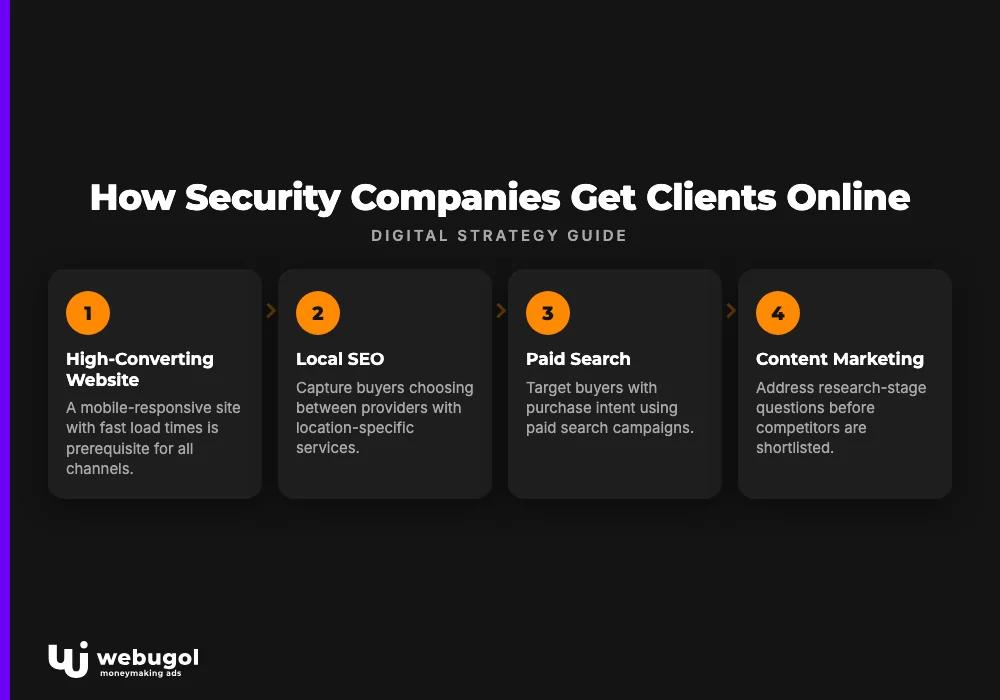
Security companies get clients online through local SEO that surfaces their listings when buyers search for nearby providers, paid search targeting buyers with purchase intent, and content that addresses research-stage questions before a competitor has been shortlisted. A website that converts that traffic is the prerequisite for every other channel.
Building online presence for security firms starts with the website. Most potential clients begin their search on a mobile device, and a slow or poorly structured site loses visitors before the page finishes loading. A high-converting security website requires:
- A mobile-responsive layout that adapts to any screen without breaking navigation or forms
- Fast load times, because pages taking more than three seconds see sharp increases in bounce rate
- Clear service descriptions that tell buyers whether you cover their property type and location
- Customer testimonials and case studies that demonstrate specific, verifiable outcomes
- Prominent calls-to-action guiding visitors toward requesting a quote or booking a consultation
Local SEO captures buyers who have already decided to hire and are choosing between providers. Ranking for terms like "commercial security services in Houston" or "home alarm monitoring near me" reaches buyers at peak purchase intent.
The same local SEO principles that apply to service businesses across industries govern security: location-specific service pages, a verified Google Business Profile, and consistent contact details across directories are the baseline every firm must establish.
SEO for security business extends authority beyond local search. Content targeting informational queries, such as how access control systems work or what to look for in a monitoring contract, attracts buyers at the research stage and creates compounding organic traffic. A well-optimized service page keeps earning visits for years with no ongoing spend.
What advertising works best for security firms?
Google Ads is the most efficient starting point for security company advertising. Buyers searching for security services are already in-market, so targeting high-intent phrases like "commercial surveillance installation" or "access control for office buildings" puts your ad in front of buyers at the moment they are actively comparing providers.
Budget discipline separates campaigns that generate leads from ones that burn money on irrelevant clicks. Setting up conversion tracking before any campaign launches is essential. Without it, there is no way to know which keywords produce qualified leads versus which ones simply cost clicks.
Understanding Google Ads campaign mechanics and measuring cost per qualified lead, rather than cost per click, determines whether a paid search investment scales or stalls.
Landing pages and ad copy must work as a matched pair. An ad promising 24/7 commercial monitoring should land on a dedicated monitoring page, not a generic homepage. Each page needs a single clear CTA, trust signals like certifications and client logos, and messaging that matches exactly what the ad said.
Mismatches between ad and landing page drive poor conversion rates. Buyers who click on a specific promise and land on a generic page rarely fill out a form. That gap costs real money across the life of a campaign.
For paid social, LinkedIn and Facebook serve different segments. LinkedIn reaches commercial and industrial buyers through job title and company size targeting, the most precise available for engaging property managers, facilities directors, and corporate operations leads. Facebook reaches residential and small-business clients through local demographic targeting, where video formats consistently outperform static images.
Retargeting campaigns are especially cost-efficient in security given how long consideration cycles run. Staying visible to buyers who visited your site but did not convert increases the probability of ending up on the final shortlist.
How to generate leads for a security company?
Security guard lead generation works best as a combined system: inbound content that attracts buyers, paid capture that converts traffic, and email nurture that moves leads toward a signed contract. No single channel produces consistent results in isolation. A complete marketing for security companies program runs all three as interconnected systems.
Inbound content builds the long-term pipeline. Publishing answers to questions buyers actually search, such as how to evaluate security vendors, what monitoring plans include, and how access control systems compare, ranks for informational queries and pulls buyers into your funnel before they have shortlisted anyone.
This is the compounding advantage of b2b security content strategy. Each published piece earns organic traffic indefinitely. The writing cost is fixed; the returns accumulate over years.
Lead magnets identify buyers who are actively researching. A downloadable security audit checklist, a vendor evaluation template, or a site assessment guide trades useful information for an email address. That exchange signals genuine intent. Buyers who self-identify this way convert at higher rates than anonymous website traffic.
Email sequences convert leads into consultations. A series of three to five emails introducing your firm's track record, sharing relevant case studies, and offering a no-obligation site assessment works well in security because trust is the primary buying criterion. Segmenting the list by buyer type means each message speaks directly to that segment's concerns rather than addressing everyone at once.
Measurement closes the loop. Tracking which content generates form fills, which sequences drive booked consultations, and which campaigns produce signed contracts makes reallocation toward high-performing channels systematic rather than guesswork.

What social media platforms work for security companies?
LinkedIn and Facebook consistently deliver results for the social media security industry. They serve fundamentally different buyer segments, and running a unified brand presence across both typically dilutes results. Treat them as separate campaigns with separate content strategies and separate objectives.
LinkedIn reaches commercial buyers. Decision-makers in facilities management, property ownership, and corporate operations are active there, and LinkedIn's targeting by job function, seniority, and company size is the most precise available for reaching the people who authorize security contracts at commercial accounts. Content addressing liability management, compliance requirements, and measurable security ROI outperforms generic brand posts on this platform.
Facebook reaches residential and small-business buyers. The platform's local demographic targeting, combined with video formats showing home monitoring walkthroughs and customer testimonial clips, performs consistently with homeowners. Retargeting pixels allow follow-up ads to visitors who viewed service pages but did not book, a high-value audience given the long consideration periods typical of security purchases.
Platform discipline matters as much as platform selection. Two channels with consistent, audience-specific content and regular measurement outperform five channels with scattered budget. Measure what generates actual leads, not just what earns engagement.
How much does digital marketing cost for security businesses?
There is no universal budget for marketing for security companies, but the allocation logic follows a consistent pattern. Firms competing in dense metro markets typically invest more in paid search early because organic rankings take six to twelve months to establish. Firms in lower-competition markets can lean on content and local SEO from the start.
Paid search requires a minimum spending threshold to produce actionable conversion data. Starting too small means there is no way to determine which keywords and ad variations actually convert, because the sample is too thin to be reliable. The right approach: set a controlled budget, measure cost per qualified lead against average contract value, and scale only the campaigns that clear that bar.
Content and SEO deliver the highest long-term return. A well-structured service page or informational post earns organic traffic for years with no ongoing spend. That compounding dynamic is what paid channels cannot replicate.
Email remains the most cost-efficient nurture channel. The primary cost is time, and conversion rates from segmented, relevant sequences consistently exceed those of cold paid outreach.

Take your marketing for security companies further
Marketing for security companies is not a one-channel problem. SEO captures buyers searching right now. Paid ads reach buyers who have not found you yet. Content earns the trust that moves browsers into clients across the full consideration cycle.
Getting these three systems working together, consistently measured and regularly optimized, is what separates security firms with predictable pipelines from those still depending on referrals.
Webugol is a digital marketing agency that builds integrated programs for service businesses, from search visibility through paid acquisition. Our Google Ads management and content programs operate as a single growth system, not disconnected tactics. Contact us for a free consultation to map out a realistic roadmap for your firm.
FAQ
How do security companies get new clients online?
Security companies attract new clients through local SEO that surfaces their listings when buyers search for nearby providers, Google Ads targeting purchase-intent keywords, and content that answers research-stage questions. A website that converts incoming traffic into consultation requests is the foundation that makes every other channel effective.
What is the most effective advertising channel for security firms?
Google Ads targeting high-intent search terms is typically the fastest route to qualified leads because it reaches buyers who are actively searching for security services. LinkedIn Ads work best for reaching commercial decision-makers; Facebook Ads perform well for residential and small-business audiences.
How long does security company digital marketing take to show results?
Paid search and social advertising can generate leads within days of a campaign launching. SEO and content marketing typically take six to twelve months to drive meaningful organic traffic, but they produce compounding returns that paid channels cannot match on their own.
What content performs best for attracting security clients?
Case studies showing specific security problems solved, vendor comparison guides, and explanatory posts on system types consistently attract buyers during the research phase. Content that directly answers real buyer questions earns search rankings while building credibility before any first contact.
Does email marketing work for security companies?
Email works well for nurturing leads through the long consideration cycles typical of commercial security buying. Segmented sequences addressing specific pain points by buyer type, paired with a clear consultation offer, consistently outperform generic newsletters in conversion to booked meetings.