



Digital marketing for doctors: the complete guide for family practices
Digital marketing for doctors is a system of connected online channels, including local SEO, content publishing, social media, and email, that links family practices to patients actively searching for care. A well-built program fills appointment slots, strengthens doctor-patient relationships, and keeps existing patients engaged between visits. Family practices that apply these strategies consistently see measurable gains in both new patient acquisition and retention. This guide covers each channel, how they interact, and what actually moves the needle.
Why digital marketing for doctors matters for family practices
Patients research healthcare providers online before calling. They check reviews, scan websites, and compare practices before picking up the phone. If your practice is hard to find or your website is outdated, a meaningful share of potential patients will book with a competitor before you ever know they were looking.
Family medicine marketing is not about chasing trends. It is about being findable and credible at the exact moment someone searches for a family doctor. Healthcare digital marketing gives smaller, independent practices the same visibility tools that large hospital networks use, without requiring a dedicated in-house team.
The underlying logic is simple. Patients who discover a practice through a useful, informative online experience arrive with higher intent. They have already read about your approach, your services, and your team. They cancel less often and convert from first visit to established patient at a higher rate.
Core digital marketing channels for family practices
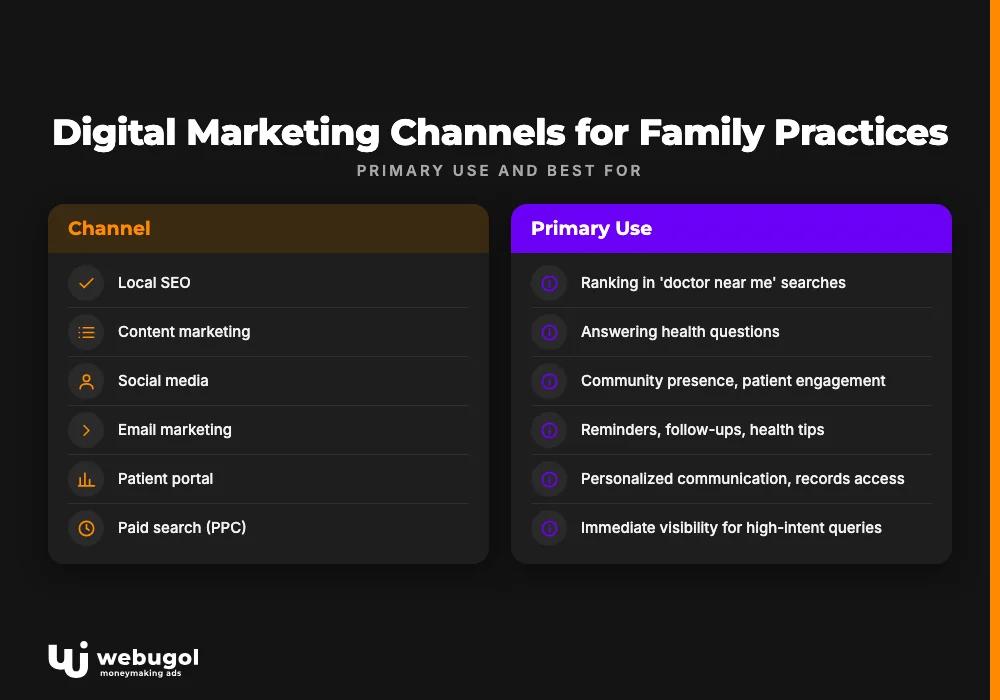
Before diving into tactics, the table below maps the primary online channels against their use cases. No single channel works in isolation; the most effective family practice marketing programs combine at least three and make them reinforce each other.
| Channel | Primary use | Best for |
|---|---|---|
| Local SEO | Ranking in "family doctor near me" searches | New patient acquisition |
| Content marketing | Answering health questions with articles and video | Trust-building, repeat visits |
| Social media | Community presence and patient engagement | Retention, word-of-mouth |
| Email marketing | Reminders, follow-ups, health tips | Retention, care adherence |
| Patient portal | Personalized communication, records access | Ongoing relationship quality |
| Paid search (PPC) | Immediate visibility for high-intent queries | Fast patient acquisition |
How can family physicians attract more patients online?
Family physicians attract more patients online by ranking prominently in local search, maintaining a conversion-focused website, and collecting consistent positive reviews. These three elements work together: medical practice SEO gets the practice in front of people who are actively searching, the website converts that traffic into booked appointments, and reviews provide the social proof that tips the final decision.
Local SEO and medical practice SEO
Medical practice SEO starts with your Google Business Profile. The listing must carry accurate hours, a current phone number, and the correct service categories. Practices appearing in the local pack (the map results at the top of Google search) consistently outperform those buried on page two, regardless of website quality.
A detailed walkthrough of local search visibility for family practices covers the specific steps from citation audits to geographic keyword optimization. The fundamentals are: consistent NAP (name, address, phone) across all directories, condition-specific landing pages, and a review-generation process built into the patient checkout workflow.
Keywords matter at every layer. Phrases like "family doctor [city name]" and "family medicine near me" target high-intent searches. These should appear naturally in page titles, headers, and service descriptions throughout the site.
Your website as the primary patient acquisition engine
A practice website that converts visitors into booked appointments shares a few qualities. It loads fast on mobile. The booking option is visible without scrolling. Each service has its own dedicated page with enough detail that a patient can self-assess before calling.
Responsive design is not optional. Most health searches happen on smartphones, and Google indexes the mobile version of each site first. A website that works well on desktop but breaks on a phone is actively losing patients.
Online appointment scheduling removes friction at the final step. Patients who can book a slot at 10 PM without waiting for office hours are far more likely to follow through.
What digital marketing strategies work best for medical practices?
The strategies that consistently produce results for medical practices are content marketing, structured email programs, targeted social media, and patient portal personalization. Each addresses a different stage of the patient relationship, from initial discovery through to long-term retention.
Content marketing builds authority advertising cannot replicate
Health content created by a practicing family physician carries credibility that generic articles cannot match. Blog posts answering common questions (medication interactions, when a symptom warrants a visit, preventive screening schedules) attract patients during the research phase, well before they book an appointment.
The key principle: write for your actual patient cohorts. Aging adults managing chronic conditions ask different questions than young parents dealing with childhood illness. Content tailored to each group demonstrates that your practice understands their specific situation. Over time, that kind of specificity builds the trust that turns first-visit patients into long-term ones.
Video content adds another dimension where production resources allow. A short clinic walkthrough or a two-minute explanation of a common procedure reduces the anxiety that often keeps people from booking a first appointment.
Email as part of digital marketing for doctors
Email is one of the highest-return channels in family medicine marketing, yet most practices underuse it. A structured program typically covers three areas: appointment reminders that reduce no-shows, condition-specific health tips sent at relevant intervals, and seasonal campaigns such as flu shot reminders and back-to-school checkups.
The strength of email is segmentation. A message about pediatric health sent to patients without children is noise. The same message sent to parents of young children is genuinely useful information. Segmented campaigns get opened, acted on, and remembered. A practical breakdown of patient retention through email programs covers segmentation logic and automation setup for practices without a dedicated marketing team.
Patient medical histories, when accurately recorded in your EHR, feed directly into this segmentation. A patient who presented for blood pressure management six months ago but has not scheduled a follow-up is a natural candidate for a check-in campaign. This is attentive care delivered digitally.
Patient portals and the personalized patient experience
Patient portals let patients access their records, exchange secure messages with the practice, and manage scheduling through a single online interface. Patients who use a portal show higher treatment plan adherence and book more consistently than those who interact with the practice only by phone. Ease of access is the differentiator.
Portals also enable data-driven communication. When a physician can see a patient's visit history, condition profile, and communication preferences in one place, every touchpoint can be tailored accordingly. That level of personalization is where most digital marketing guides for doctors fall short.

What social media platforms work best for family doctors?
Facebook remains the strongest platform for most family practices because its user base skews toward the 35-65 age group that drives the majority of primary care visits. Instagram works well for practices with a visual brand or wellness-oriented positioning. LinkedIn matters for physician-to-physician networking and referral relationship building. TikTok and YouTube are growing in health education but require consistent video production to be worth the ongoing investment.
The right platform depends on patient demographics. A practice serving primarily young families may find Instagram generates more engagement. An internist focused on geriatric care will find Facebook far more relevant.
Platform choice matters less than consistency. Sporadic posting followed by months of silence does more harm than good. A realistic content calendar, even two to three posts per week, outperforms bursts of daily activity followed by silence.
For a structured look at how social media channels influence patient trust and behavior, the analysis in building a social media presence in healthcare breaks down platform performance across practice types.
How to improve a family practice online presence?
Improving a family practice's online presence requires three simultaneous actions: auditing your current digital footprint, closing the most visible gaps, and establishing consistent publishing habits that compound over time.
Start with a basic audit. Search for your own practice name and specialty in your city. What appears? Are the details accurate? Do the reviews reflect the experience your patients actually have? This snapshot tells you exactly where you stand before you change anything.
The personalization layer most competitors skip
Most digital marketing content for doctors focuses on channels: SEO, social, email. What competitors largely overlook is the personalization layer inside those channels. This is where family practices can differentiate from both large hospital systems and other independent practices.
Personalized digital experiences in healthcare means using the data a family physician already holds, including patient history, age cohort, current conditions, and appointment frequency, to deliver communications that are genuinely relevant to each individual. No additional data collection required. The clinical data inside an EHR, used thoughtfully, is sufficient.
A patient who came in for blood pressure management six months ago and has not returned is a natural target for a check-in email. A patient managing a chronic condition benefits from a monthly communication covering strategies specific to that condition. These are not generic blasts. They are targeted follow-ups built from the practice's existing records.
Patient satisfaction surveys add another layer. Survey results reveal where the experience breaks down: slow response times, confusing intake forms, unclear billing. Each gap is an opportunity for a measurable digital improvement.
Data sources that power effective online marketing for physicians
Four sources of data consistently inform better patient engagement strategies in family practice:
- EHR records reveal patient needs, visit history, and follow-up timing. This feeds email segmentation and content planning without any additional data collection effort.
- Patient satisfaction surveys show where the experience breaks down. Low scores on communication become the target for portal improvements or response-time policy changes.
- Website analytics reveal which pages attract the most traffic and where users exit. A high-traffic services page with a low booking rate signals a conversion problem, not a visibility problem.
- Review sentiment across Google, Healthgrades, and Zocdoc surfaces recurring praise and recurring complaints. Both are direct inputs to the marketing strategy.
Together, these sources provide a far clearer picture of what is working than any single metric could.

How much does digital marketing for a doctor's practice cost?
Digital marketing for a doctor's practice ranges from a few hundred dollars per month for a managed-tools approach to several thousand for full-service agency work. The right investment level depends on practice size, local market competition, and how many channels you run simultaneously.
The most common mistake is treating digital marketing as a one-time purchase. A website build is a single investment. SEO maintenance, content publishing, email programs, and social media all require ongoing effort to maintain and grow. Practices that allocate a consistent monthly budget outperform those that spend in irregular bursts.
The right return benchmark for family medicine marketing is patient lifetime value. A patient who stays with the same practice for five to ten years generates substantial cumulative revenue. Acquisition cost looks fundamentally different against that baseline than against a single appointment fee.
Measuring patient engagement strategies that actually work
Tracking the right numbers is what separates systematic digital marketing for doctors from guesswork. For a family practice, these are the metrics that matter:
New patient acquisition: how many new patients booked from online channels each month, tracked by source (search, social, referral) to show what is generating volume.
Appointment show rate: a direct indicator of engagement quality. Patients who receive personalized reminders and use a portal show up more consistently.
Retention rate: how many patients return within 12 months. A rising retention rate means digital communication is working between visits.
Review velocity: new reviews per month on Google and Healthgrades. Both review count and recency affect local search ranking.
Email engagement: open and click rates by segment. Low open rates signal list hygiene or subject line issues. Low click rates signal a content relevance problem.
These metrics are not independent. A practice with strong new patient acquisition but poor retention points to an onboarding or experience problem, not a marketing problem. Measuring all five together shows where the system works and where it leaks.
Ready to build a digital marketing strategy for your practice?
Family practices that treat digital marketing for doctors as a coherent system, rather than a set of disconnected tactics, fill more appointment slots and retain patients more consistently. Whether the immediate priority is local search visibility, patient communication, or a complete online presence rebuild, a structured approach produces better results than scattered effort.
Webugol builds healthcare digital marketing systems for practices that want measurable, trackable growth. We combine technical SEO, content strategy, and patient engagement programs into a single program built around your specific patient population and local market. If you are ready to move beyond word-of-mouth referrals alone, reach out to our digital marketing agency team to start with a practice growth review.
FAQ
How long does it take to see results from digital marketing for doctors?
Most family practices see measurable results within three to six months of consistent SEO and content investment. Paid search delivers faster initial traffic but requires sustained budget to maintain. Organic channels typically outperform paid ones after the first 12 months.
Do family practices need a specialist agency for healthcare digital marketing?
Not necessarily, but healthcare digital marketing involves specific compliance considerations, patient communication norms, and local search dynamics that generalist agencies often miss. A specialist reaches effective campaigns faster and avoids common HIPAA-related pitfalls in paid advertising.
What is the most important first step for online marketing for physicians?
Claiming and fully optimizing your Google Business Profile is the single highest-leverage first step for most family practices. It controls what patients see in local search and directly determines whether you appear in map pack results for "family doctor near me" queries.
How does a patient portal support family practice marketing?
Patient portals give practices a direct, HIPAA-compliant communication channel that supports appointment scheduling, secure messaging, and records access. Patients who use a portal book more consistently and show higher treatment plan adherence than those who interact with the practice only by phone.
What content topics attract new patients through search?
The most effective content for family medicine marketing answers high-intent questions: what to do for a specific symptom, how often to schedule preventive screenings, and what to expect from a new patient appointment. These topics attract patients during the research phase and position your practice as the trusted resource before they call.

