



How to market a GLP-1 clinic: patient acquisition in a high-CPC, compliance-heavy market
A GLP-1 clinic with an empty calendar usually has a funnel problem, not a spend problem. When clicks on GLP-1 keywords are expensive, every gap between ad click and enrolled patient costs real money, and operators who respond by discounting accelerate their own margin erosion. The fix is not a higher budget. The variables that actually move the needle are program differentiation and funnel architecture.
Why GLP-1 clinics face a different paid media problem
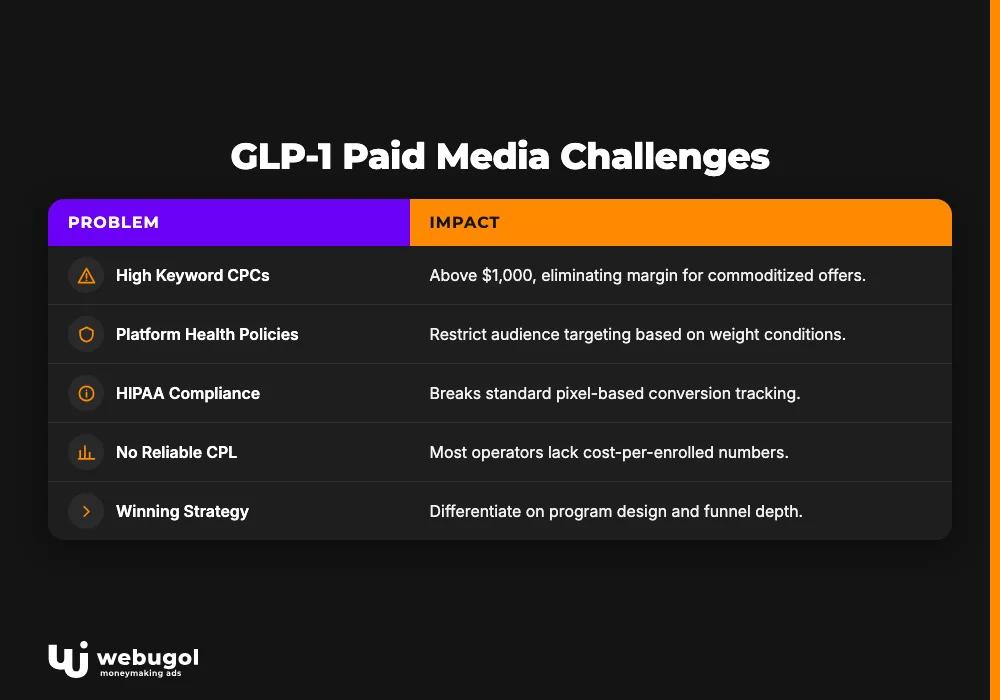
Three structural forces set GLP-1 paid media apart from other healthcare verticals. High keyword CPCs leave little margin for a commoditized offer: if your program looks identical to the telehealth brand bidding next to you, the auction extracts that margin directly. Platform health policies restrict audience targeting based on weight-related conditions, limiting the precision you can apply to a Meta campaign. HIPAA compliance requirements break standard pixel-based conversion tracking, leaving most operators without a reliable cost-per-enrolled number.
Operators who win in this environment do not win by outspending. They differentiate on program design and funnel depth, then measure acquisition economics with the precision that compliant tracking actually permits.
| Channel | CPL level | HIPAA complexity | Scalability | Best-fit use case |
|---|---|---|---|---|
| Google Search | Very high | High (offline conversion upload required) | High with strong offer | High-intent, bottom-funnel capture |
| Meta Ads | High | Very high (health category restrictions) | Moderate | Awareness and lead nurture |
| Local SEO | Lower long-term | Low | Moderate (geo-bound) | Near-me and geo-intent capture |
| Referral / partnerships | Lowest | Low | Limited | Trust-based, high-close-rate leads |
A structured patient acquisition system treats this channel comparison as a diagnostic input, not a media-buying menu. The goal is to allocate toward channels that fit your compliance setup and program margins, not to run all four simultaneously at half depth.
The GLP-1 patient acquisition funnel: from click to enrolled
Most GLP-1 ad accounts track the click and track the sale. What they do not track is the four stages between them: click, consult booking, appointment show, and program enrollment. When a clinic's calendar is not filling, the actual problem lives at one of those handoffs. Identifying which stage is leaking produces faster ROI than raising ad spend, because more spend through a broken funnel multiplies the loss.
Understanding the full patient journey mapping across those four stages is the diagnostic foundation before any optimization decision. The fix almost always starts at the stage nobody owns.
What happens between the ad click and the first appointment?
The most common cause of an empty GLP-1 calendar is not poor ad performance. It is a broken handoff between the ad click and the intake call.
A patient who clicks a GLP-1 ad and fills a form expects contact within minutes. Most clinics respond in hours, and the lead goes cold before anyone dials. Speed-to-lead is the single most controllable variable between a click and a booked consult, and most operators have never measured it at the program level.
Intake form friction compounds this: forms that ask too much, too early, disqualify patients who would have enrolled. Show-rate problems add a third layer: a booked consult that does not appear belongs to no one on the marketing team, so it never gets diagnosed. The pattern across GLP-1 practices is that show-rate and lead-response failures get reported as an ads problem when the actual cause is an ops gap that ad spend cannot solve.
What is the average cost per lead for GLP-1 weight loss programs?
GLP-1 CPL is pushed up by high CPCs and by the compliance constraints that limit audience precision. A borrowed industry average says little about what your own clinic can afford. The more useful number is the CPL ceiling a clinic can sustain, which depends on program revenue rather than what competitors spend.
Three factors systematically inflate GLP-1 CPL: near-me search traffic with low purchase intent, HIPAA-constrained tracking that undercounts conversions and forces manual attribution, and offer mismatch between ad creative and the enrolled-program commitment. Operators who structure GLP-1 as a subscription-style continuity program find that their cac payback period math shifts enough to support a CPL ceiling that makes a high-CPC market viable.
Local GLP-1 clinic marketing: Coral Springs, Fort Myers, and SW Florida
South and SW Florida represent a structural SERP gap for local operators right now. In Coral Springs, Ahrefs estimates about 1,330 monthly searches for "coral springs glp-1 clinic" alone. The Fort Myers GLP-1 clinic area, covering Fort Myers, Cape Coral, Fort Myers Beach, and North Fort Myers, adds roughly 450 monthly searches across five additional keywords, according to the same Ahrefs data. The current top results for both clusters are national telehealth brands with no local funnel depth and no geo-specific trust signals. The same SERP pattern appears in other competitive metros: a patient looking for the best GLP-1 clinic in San Francisco encounters the same telehealth brands that dominate Florida, with the same absence of local trust signals.
Local operators do not need to outrank CVS MinuteClinic GLP-1 programs or telehealth brands on domain authority. They need to outrank them on geo-specific relevance, and that is a category where a physical clinic in Coral Springs or Fort Myers offering a GLP-1 program has a structural advantage the telehealth brands cannot replicate.
How do you market a GLP-1 clinic in a competitive local market?
Local GLP-1 marketing wins on geo-specific trust signals that telehealth brands structurally cannot match. A verified Google Business Profile with correct weight-loss service attributes, a steady review acquisition cadence, and landing pages scoped to individual service areas outperform a national brand's thin local presence.
The keyword-to-landing-page strategy here is direct. A glp-1 clinic fort myers beach search expects a Fort Myers Beach page, not a national homepage. Each keyword in the Florida cluster, from glp-1 clinic cape coral to glp-1 clinic in fort myers, coral springs glp-1 clinic, and glp-1 clinic north fort myers, maps to a dedicated landing page with local social proof and a clear booking path. That page captures near-me intent before national competitors invest in local infrastructure.
GBP setup and local signals for GLP-1 weight loss clinics
Google Business Profile category selection matters more than most operators realize. "Weight Loss Center" and "Medical Clinic" categories each trigger different local pack behaviors; clinics that add both and populate the weight loss service attributes see meaningfully better pack visibility than those relying on default category selection.
Q&A seeding for GLP-1 program queries captures the structured data Google uses for local AI summaries. Questions like "Do you offer semaglutide?" and "Is GLP-1 treatment covered by insurance?" should be pre-populated with accurate, compliance-approved answers. Review acquisition cadence should target patients at day 14 and day 45 of a GLP-1 program, when results are becoming visible and satisfaction is high. Citation consistency across Healthgrades, Zocdoc, and WebMD listings anchors the NAP signals that separate a high-converting GBP listing from a default one in the weight-loss category.
If your GLP-1 program is live but local search is not filling the calendar, Webugol runs a tracking and funnel diagnostic as the first step of the Healthcare Growth System. The diagnostic identifies which funnel stage is bleeding before any media budget is committed.
HIPAA-compliant tracking for GLP-1 ad campaigns
Two tracking failures appear in most GLP-1 ad accounts. The first is a standard Meta or Google pixel firing on a health-condition landing page, which is a platform policy violation risk that can suspend the account and void weeks of spend. The second is client-side conversion tracking that cannot pass PHI-stripped signals to Google or Meta, leaving the algorithm training on incomplete data and inflating reported CPA.
The compliant setup uses an offline conversion upload flow: the ad click drops a click ID into the CRM intake form, the CRM records the booked consult or program enrollment, and a server-side or offline upload passes the stripped conversion event back to the ad platform with no PHI attached. This means the ad platform receives attribution signal without the health data that triggers policy violations. Consent mode requirements for health categories add another layer: Google's consent mode must be configured correctly for health data protections even in US accounts where certain platform policies apply.
This setup is not optional for a clinic running GLP-1 programs at scale. Without it, every optimization decision the algorithm makes is based on wrong numbers. The gap between reported CPA and actual CPA widens as spend increases, and the algorithm learns the wrong lesson.
Scaling past $20k/month: where GLP-1 clinics hit the wall
A predictable plateau pattern follows the initial GLP-1 demand spike. Ad spend increases, CPA rises, enrolled patients stay flat. The diagnosis almost never starts where operators think it does.
Three structural causes appear repeatedly at this stage. First, offer undifferentiation: when a glp-1 weight loss clinic's program looks identical to every telehealth competitor's offer, price becomes the only decision variable and the auction extracts that margin. Second, ops bottlenecks in intake and follow-up that cannot absorb increased lead volume produce more leads going cold, not more patients enrolled. Third, churn from early program cohorts offsets new enrollment: a GLP-1 clinic adding patients each month while losing nearly as many from prior cohorts is not growing, it is running in place.
Investing in patient retention strategies is the multiplier that makes $20k-plus monthly ad spend defensible. Subscription-style retention economics raise the CPL ceiling the clinic can sustain, and that is what separates operators who scale from operators who plateau and discount.
Ready to build a GLP-1 acquisition system that does not compete on price?
An empty GLP-1 calendar is a funnel architecture and offer differentiation problem. It is not a spend problem. A higher budget does not fix a leaking funnel or an undifferentiated program.
The Healthcare Growth System is a 90-day sprint that starts with a tracking foundation and funnel audit, moves through compliant campaign builds on Google and Meta, and scales only after acquisition economics are proven. Webugol owns the full path from ad click to enrolled patient, not the ad channel in isolation. Book a strategy call.
FAQ
How much does it cost to run Google Ads for a GLP-1 clinic?
Google Ads costs around $10 per click for "glp-1 clinic" (Ahrefs). The click is only the first step before consult booking, appointment show, and program enrollment, so a small test budget rarely produces enough enrolled patients to judge the campaign. A realistic GLP-1 Google Ads program requires enough spend to generate meaningful signal across the full click-to-enroll funnel, and the CPL floor is determined by keyword prices, not by what a clinic prefers to spend.
Can a GLP-1 clinic retarget website visitors on Meta without violating HIPAA?
Standard Meta retargeting using a pixel fired on a GLP-1 or weight-loss page violates Meta's health category policies and creates HIPAA exposure because the pixel transmits URL-level health condition data. A compliant alternative uses a customer list upload with PHI-stripped identifiers passed through a server-side integration, combined with broad interest targeting rather than condition-based audience segments.
What tracking setup does a GLP-1 clinic need for compliant paid ads?
A HIPAA-compliant tracking setup requires removing client-side pixels from health-condition pages and replacing them with an offline conversion upload flow: click IDs captured in the CRM at intake, conversion events passed back to Google and Meta via server-side API or offline upload, with all PHI stripped before transmission. Consent mode must be configured correctly on both platforms to prevent policy violations on health category campaigns.
How do I market a GLP-1 clinic locally when telehealth brands dominate the search results?
Telehealth brands dominate national and near-me queries on domain authority, but they cannot replicate geo-specific trust signals: a verified GBP listing with local reviews, service-area landing pages for specific cities like Coral Springs, Cape Coral, or Fort Myers Beach, and citation consistency across local health directories. A local glp-1 weight loss clinic near me page built around a specific city and stocked with real patient reviews will outperform a telehealth brand's thin geo page in local pack results.
What is a realistic timeline to see results from GLP-1 clinic marketing?
The first two weeks are diagnostic: tracking setup, funnel audit, and identification of the highest-leverage gap. Weeks three through six typically show measurable improvement in lead quality and CPA trend as the fixed funnel handles the same ad spend more efficiently. Scale-ready results, where ad spend increases without proportional CPA increases, arrive between weeks six and twelve after ops bottlenecks and offer positioning are resolved.

