



Best Lovable Alternatives in 2026: When AI-Built Apps Hit Their Ceiling
If you need a lovable alternative, the three strongest picks for 2026 are Bolt.new for founders who want a fully owned codebase, WeWeb for apps with a complex data model and a non-technical operator editing the UI post-launch, and Dyad for teams that want zero subscription cost. Lovable earns its reputation: fast, visual, and accurate for a first version. The ceiling appears when real users log in with real credentials, a payment integration must comply with PCI rules, or the AI credit bill grows faster than monthly revenue. For founders who have outgrown the AI tool entirely, the right move is not another tool swap but a development partner who owns the full path from codebase to customer acquisition.
Why teams leave Lovable (and what they actually need)
Lovable is good at the job it was built for: getting a visual, interactive prototype in front of stakeholders in hours, not weeks. Founders who use it to validate a concept before committing engineering budget are using it correctly. The problems start when the prototype is mistaken for a production-ready product.
Three failure modes come up consistently across no-code-to-production migrations. Credit consumption scales non-linearly: a small app generating a handful of edits per day sits comfortably within a starter plan, but a team running rapid iterations can burn through credits in ways that make the monthly cost unpredictable. Lovable's strength is front-end generation, so any feature requiring custom server-side logic, a non-trivial database schema, or a third-party API not in its connector library hits a wall quickly.
Security controls thin out when real user accounts enter the picture. Row-level policies, audit logs, and role-based access are hard to wire correctly with generated code and no clean separation of concerns. Founders hit this wall later than the first two, and the fix costs more.
No matter which lovable alternative you choose after this article, the trigger to leave is usually one of these five signals:
- Your team spends more than a few hours each week rewriting AI-generated code rather than shipping features, which means the tool is now adding technical drag instead of saving time.
- A backend integration requires logic the AI cannot reliably produce, so it keeps regenerating broken scaffolding that your team patches and re-breaks in cycles.
- You are adding real user accounts and realize there is no clean auth layer with role-based access control, leaving user data exposed at the query level.
- A payment processor, healthcare data handler, or enterprise client has asked about your security posture and the generated codebase has no clear answer to give them.
- Monthly AI-credit spend is growing faster than the revenue the app produces, and you cannot predict what next month's bill will look like.
None of these signals mean Lovable failed. They mean the prototype did its job and the product now needs a different kind of system behind it.
The question most founders reach at this point is not "what's the best alternative to lovable?" in the abstract, it is which specific constraint the app has outgrown and which tool addresses that constraint directly.
8 lovable alternatives at a glance
| Tool | Monthly cost | Code ownership | Best for |
|---|---|---|---|
| Bolt.new | Free tier + usage-based AI credits | Full repo export, you own it | Founders wanting a prompt-to-codebase loop |
| Replit | Free tier + per-seat subscription | Hosted or exportable | Teams mixing AI scaffolding with hand-written code |
| WeWeb | Per-seat subscription | Visual layer; your backend | Complex data models, non-technical editors post-launch |
| Dyad | Open-source, free (bring your AI key) | 100% local, full ownership | Zero subscription, local-first control |
| Cursor | Per-seat subscription | Full codebase, IDE-native | Technical founders who prefer an IDE flow |
| UI Bakery | Per-seat subscription, enterprise tier | Hosted or self-hosted | Multi-datasource internal dashboards |
| Superblocks | Enterprise / quote-based | Hosted or self-hosted | Ops teams with strict data governance requirements |
| Bubble | Free tier + subscription plans | Hosted, proprietary data layer | No-code apps needing a mature plugin ecosystem |
Best lovable alternative: full-stack replacements
The three tools below are the closest lovable alternatives for founders still working in a prompt-based loop who need a codebase that can reach a real production environment. Each wins in a specific use case. None is a universal replacement.
Bolt.new
Bolt.new is the right lovable alternative for founders who want to keep prompting but walk away with a Git repository they own outright. As a lovable dev alternative with the cleanest repo export in this category, Bolt.new has the most polished deploy-target integrations: Vercel, Netlify, and Cloudflare Pages are each a few clicks away. The AI loop breaks down at roughly the same complexity threshold as Lovable, with custom server-side logic, non-trivial auth flows, and multi-step integrations often requiring manual intervention. The difference is that when you hit that point, you are holding real source code that any developer can take over rather than a locked platform environment.
Pricing is usage-based on AI tokens after a free tier. For a founder running short daily sessions the cost is competitive with Lovable. For a team doing heavy iterative work, the per-call model carries the same unpredictability as Lovable credits, so plan accordingly.
Replit
Replit is the strongest lovable alternative when the plan includes having a developer write actual code after the AI scaffolds the initial structure. The Agent mode generates a runnable application from a prompt, but the real value is that it drops you into a cloud IDE where you can read, modify, and debug every line. The built-in cloud runtime means you are running a live environment from day one, not exporting files and figuring out hosting separately. Collaboration limits appear at team scale: branching workflows and pull-request reviews require external tooling that Replit does not natively replace.
This makes Replit well-suited for Segment 3 founders who have validated a concept and now want a technical contractor to build on the scaffold. The handoff is clean because the codebase already lives in a real editor with a real runtime.
WeWeb
WeWeb is the right lovable alternative when the data model is already in a database you control and a non-technical operator needs to edit the UI after launch without asking a developer for every content change. It works as a visual front-end builder that binds to your backend via REST, GraphQL, Supabase, or Xano rather than generating or hosting the backend itself. The visual binding layer replaces custom API code that Lovable would try to generate, and because the data never passes through WeWeb's AI, it removes a category of data-exposure risk that matters to enterprise and healthcare clients.
WeWeb is not for founders who want a full-stack generated app from scratch. It assumes you have a data layer and want a production-quality, operator-editable front end on top of it.

What's the best free alternative to Lovable?
The best lovable alternative with zero ongoing subscription cost is Dyad: open-source, local-first, and billed directly to your AI model provider with no platform markup on top. Cursor with Claude Code is the alternative if you prefer an IDE-native flow and are comfortable working in a terminal from day one.
"Free" in this context carries a real setup cost that most comparison articles skip. Dyad requires a local Node environment, your own AI API key, and self-managed deployment, which typically takes a few hours to configure with ongoing maintenance afterward. Lovable charges a subscription and handles that infrastructure for you. At low usage levels, the AI API costs for a self-hosted lovable alternative stack can undercut a Lovable subscription meaningfully. At higher usage the difference narrows, and the setup burden becomes the deciding factor, not the per-call rate.
The lovable ai free alternative path makes the most sense for a technical founder or a small agency running multiple client projects, where the fixed setup cost amortizes across projects in a way it cannot for a single-app team.
Which Lovable alternative is best for internal tools?
The best lovable alternative for internal tool builder scenarios are UI Bakery and Superblocks: both built specifically for multi-datasource operations dashboards where data lives across SQL databases, REST APIs, and cloud services. When custom backend logic is non-negotiable, Replit Agent is the right substitute.
Lovable's front-end-first generation model breaks on internal tooling in a specific way. Admin panels and operations dashboards depend on role-based access control, where different users see different data based on their position in the org. That access model must be enforced at the database query level, not in the UI layer. Generated front-end code that checks a user's role in a React component is not equivalent to a Postgres policy or an API middleware that rejects unauthorized queries before data leaves the database. UI Bakery and Superblocks both treat access control as a first-class configuration, not an afterthought.
This is what makes the lovable alternative for business operations use case structurally different from general app building. A founder running a service business on an internal dashboard, a logistics coordinator managing driver routes, or a clinic administrator viewing appointment queues all need reliable data isolation between users. The tool that generates UI fastest is rarely the tool that handles that isolation correctly, and a breach at the data layer is harder to fix than a failed sprint.

Best options for agencies and enterprise teams
The best lovable alternative for agencies depends on how the project ends. WeWeb is the right pick when the client needs to own and edit the application after handoff: the visual binding layer is approachable for a marketing manager or operations lead without developer support, and the client's data stays in their own backend from day one. Bolt.new is the right pick for white-label repo delivery: the agency ships a clean Git repository the client can take to any developer.
WeWeb vs Bolt.new for agency project delivery:
- WeWeb lets the client edit UI, copy, and layout post-launch without touching code, which reduces post-handoff support tickets for routine content changes and keeps the client independent of the agency after go-live.
- WeWeb's backend-agnostic approach means the agency can wire it to whatever data layer the client already has, rather than rebuilding the client's database or locking them into a new one.
- Bolt.new generates a full codebase the agency can customize and deliver as a Git repository, so the client is never locked to a platform the agency controls or to the agency itself.
- Bolt.new's AI-credit model scales with iteration depth, which means heavily revised projects cost more than a fixed-scope retainer assumes: account for this in the project estimate from day one.
- Neither tool covers the security hardening, load testing, or CI/CD pipeline work that enterprise clients require before go-live, and those steps always need a developer regardless of which tool generated the scaffold.
The enterprise lovable alternative that covers those production steps is a hybrid model: an AI tool generates the scaffold quickly, and a development team hardens the architecture, wires the integrations, and ships a production system. That is the model Webugol is built around. It is what separates an accountable growth partner from a tool vendor that hands you a repository and walks away.
The real cost comparison: Lovable vs alternatives (TCO)
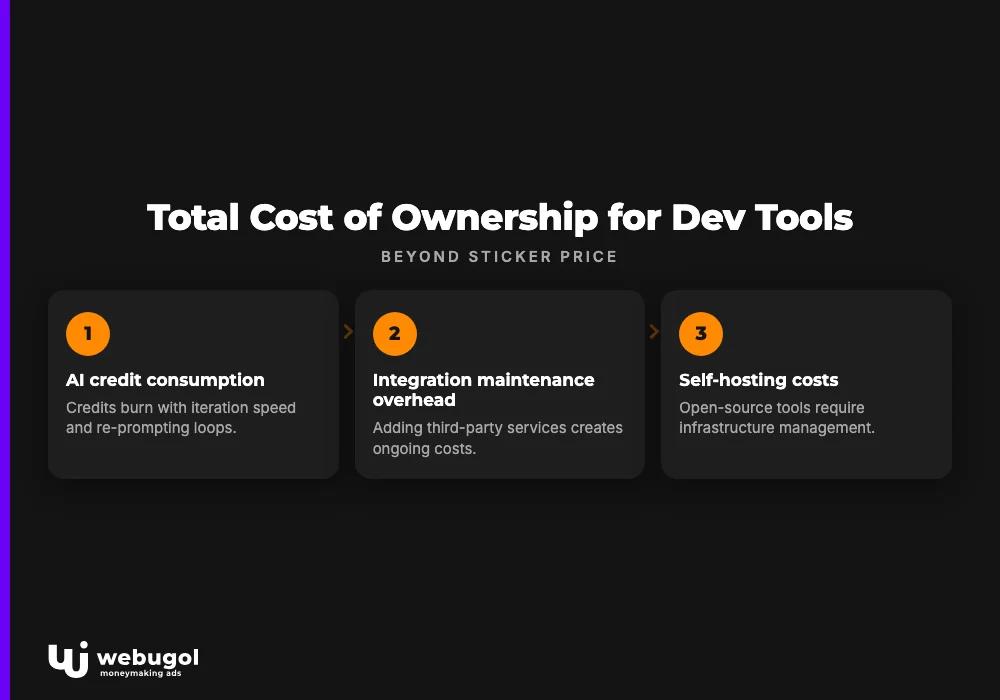
Sticker prices do not reflect what a founder actually spends at scale. Evaluating each lovable alternative on its base price alone misses three cost layers: AI credit consumption as the team iterates, integration-maintenance overhead as the product adds third-party services, and self-hosting costs for open-source tools that trade a subscription for infrastructure management.
| Tool | Base price | Credit model | Estimated monthly cost at 10k MAU | Hidden overhead |
|---|---|---|---|---|
| Lovable | Subscription tiers | Credits per AI edit | Moderate to high: credit burn accelerates with iteration speed | Re-prompting loops consume credits without producing shippable output |
| Bolt.new | Free tier + token-based | Per token / per call | Low at light use; high at heavy iteration | No managed hosting; you provision your own infra |
| Replit | Per-seat subscription | Agent runs consume compute units | Predictable seat cost; Agent runs add variable overhead | Collaboration tooling gaps appear at team scale |
| WeWeb | Per-seat subscription | No AI generation cost post-launch | Predictable; front-end changes free after setup | Backend setup and maintenance costs outside WeWeb |
| Dyad | Open-source, free | Direct AI API billing | Lowest per-call rate; variable at scale | Full infra management; initial setup is a fixed time cost |
| Cursor | Per-seat subscription | AI completions capped per month | Predictable; overages kick in on heavy use | No hosting; full dev environment required |
| UI Bakery | Per-seat subscription | No per-call AI model | Predictable | Requires a data layer you own and maintain |
| Superblocks | Enterprise / quote-based | No per-call model | Custom; volume negotiated at contract | Contract lock-in at the enterprise tier |
The practical takeaway: a tool with a low monthly flat rate and a per-call AI cost can exceed a Lovable subscription once the team runs daily iterations. For any lovable alternative in this table, the break-even depends on iteration frequency, not user count. For a team at the prototype-to-production transition, the hidden overhead that matters most is not the AI bill; it is the integration maintenance burden once three or four third-party services need to talk to each other reliably under production load.

When should you stop using Lovable and hire a dev team?
You should stop using Lovable and hire a development team when the app handles real user data under authentication, requires a payment flow, or depends on an integration Lovable cannot wire reliably. Those three conditions signal that correctness, security, and reliability now matter more than iteration speed. At that stage, no lovable alternative tool changes the calculus, the right move is a development team, not a different platform.
A three-point self-diagnostic before switching tools or hiring:
Schema complexity. If the data model has more than two or three related tables with foreign keys, cascade rules, and row-level policies, a generated schema will likely produce subtle bugs under concurrent writes. That is an architecture problem. No prompt will fix it.
Auth model. If users need different roles with different data access, that logic must live in the database or a trusted API layer, not in front-end conditionals generated by an AI. Front-end role checks can be bypassed; database policies cannot.
Integration surface. Count the external services the app must reliably talk to: a payment processor, an email service, a CRM, a reporting tool. Each integration added to a generated codebase roughly doubles the surface area where something can break silently in production. The complexity compounds quickly.
If your app has crossed that line, Webugol's ai mvp development services takes the scaffold to a production-grade codebase: architecture audit, integrations, security hardening, and deployment as a single accountable package. Starting fresh after a stalled Lovable build, Webugol's mvp development services covers architecture through launch.
How to migrate from Lovable: 5-step checklist
This is the step most comparison articles mention and do not detail. Whether you chose a lovable alternative or are migrating directly, here is the full path from Lovable export to a live, maintainable codebase.
- Export and audit the generated codebase. Use Lovable's GitHub sync or direct export to get every file into a repository you own. Run a dependency audit immediately: check for outdated packages, missing environment variable handling, and any hardcoded secrets. The generated code is usually readable but rarely follows a consistent pattern, so this audit tells you how much cleanup is needed before you change anything else.
- Redesign the data model for a real database. The schema Lovable generated was optimized for the AI to produce quickly, not for the queries your app will run at scale. Map the existing tables against the real access patterns, normalize relationships, add indexes where queries will scan large data sets, and define row-level security policies before any real user data enters the system.
- Wire a production auth layer. Replace role-checking logic that lives in React components with a proper server-side auth layer. Tools like Supabase Auth, Clerk, or Auth.js provide session management, token refresh, and role-based access control that the generated code almost never includes out of the box. This step closes the most common security gap in AI-generated apps.
- Set up a CI/CD pipeline. Even a minimal pipeline that runs linting and a smoke test on every pull request catches regressions before they reach users. GitHub Actions paired with a preview deployment environment gives you the confidence to ship quickly without breaking the live product. Setting up google analytics permissions for your team at this stage ensures the right people can monitor performance without exposing raw event data to every contributor.
- Cut over DNS and monitor error rates. Run the new production deployment in parallel with the Lovable-hosted version for at least 48 hours before switching DNS. Set up error rate alerting in Sentry or a comparable tool. Track the five most critical user flows through the app and confirm they complete without errors under realistic load before decommissioning the original.
Ready to move your app beyond Lovable?
For founders and marketing leads who have validated a concept in Lovable and need a production-grade version, whether after testing a lovable alternative or migrating directly, Webugol owns the full path: architecture audit, integrations, security hardening, and deployment, with SEO and growth built into the product from the start rather than treated as a separate engagement afterward.
The difference between a tool vendor and an accountable partner shows up after go-live. With Webugol, the team that hardens the codebase also owns the acquisition system, which means cost per booking and cost per lead are metrics the team is accountable for, not outputs the founder has to track in a separate dashboard. That is the growth-path model, not the dev-agency model.
Reach out to discuss your architecture and scope. ai mvp development services and mvp development services are both available depending on where you are starting from.
FAQ
What's the best free alternative to Lovable?
Dyad is the closest lovable free alternative: open-source, local-first, and routes AI costs directly to your model provider with no platform markup. Cursor with Claude Code is the alternative for an IDE-native workflow. Both require meaningful setup time compared to Lovable's subscription model, so "free" should be weighed against the actual hours spent on configuration and ongoing maintenance.
What's the best Lovable alternative for agencies?
The best lovable alternative for agencies is WeWeb for client-editable delivery and Bolt.new for white-label repo handoff. For enterprise clients who need security hardening, CI/CD, and production infrastructure, the right model is AI scaffolding combined with professional engineering work, not a tool swap alone.
When should you stop using Lovable and hire a dev team?
Stop when the app requires real user authentication with role-based access, a payment integration, or a multi-service backend that Lovable cannot wire reliably. Those three conditions mean correctness and security now outweigh iteration speed. At that point, moving to a dev team is not an upgrade from Lovable; it is a different product category entirely.
How do you migrate a Lovable project to a production codebase?
Whether you are moving to a lovable alternative or to a custom codebase, export via GitHub sync, audit dependencies and hardcoded secrets, then redesign the data model before writing any new feature code. Add a server-side auth layer, set up a CI/CD pipeline with preview deployments, and run the new environment in parallel with the Lovable-hosted version for 48 hours before cutting DNS. The five-step checklist above covers each stage.
Does moving away from Lovable mean rebuilding the app from scratch?
Not necessarily: if the generated front-end code is reasonably clean, the UI layer is often salvageable with refactoring. What almost always needs rebuilding is the data model, the auth layer, and any backend logic the AI generated as front-end workarounds. A proper code audit at the start of the migration tells you which parts to keep and which to replace before writing a single line of new code.

