



Google Ads for small business: a practical paid search guide
Google Ads for small business is one of the most direct paths to paying customers available online today. The platform puts your ads in front of people actively searching for what you sell, at the exact moment they are ready to decide. You pay only when someone clicks, there is no minimum budget, and you can pause or adjust any campaign at any time. That combination makes it genuinely accessible for businesses operating with limited resources and tight margins.
How Google Ads works
Google Ads runs on a cost-per-click (CPC) auction model. When someone searches a term related to your business, Google holds an instant auction among advertisers targeting that keyword. You set a maximum bid, the most you are willing to pay per click, and Google decides which ads appear based on your bid amount, your Quality Score, and expected relevance to the searcher.
You pay only when a user clicks your ad, not when it appears. That pay-per-click structure is what separates small business paid search from traditional advertising, where spend is committed upfront regardless of whether anyone responds. Every dollar connects directly to a user action.
The auction also factors in Quality Score, a metric that measures how relevant your ad and landing page are to the search query. Advertisers with higher Quality Scores pay less per click than lower-quality competitors, even when bidding less. For businesses watching every dollar, relevance is cheaper than outbidding larger competitors.
Is Google Ads worth it for small business?
Yes. Google Ads is worth it for most small businesses when campaigns are managed consistently and conversion tracking is in place from day one. The pay-per-click model prevents passive waste, and precise keyword targeting means your budget reaches people already searching for your product or service, not a broad and uninterested audience.
Where small businesses run into trouble is under-management. Most underperforming Google Ads accounts share the same pattern: the account is configured once and left to run without regular review. Keyword auctions and bid dynamics shift constantly. A campaign that performs well one week can quietly drain budget the next without incremental adjustments. The businesses that see sustained results from google ads small business campaigns treat them as an ongoing management responsibility, not a one-time launch.
There are situations where the economics will not work. If your service has very low search volume in your area, or if your average transaction value is too small to absorb the cost per click, the platform will underperform regardless of campaign quality. But for most local service businesses, retailers, professional services firms, and B2B companies with clear search intent, Google Ads delivers measurable, trackable results faster than any organic channel.
Understanding how Google Ads supports different business objectives helps you choose the right campaign type and goal before committing any spend.

Key advantages of Google Ads for small businesses
Before comparing costs and setup steps, it helps to understand exactly why this platform works for businesses with tight budgets and limited staff time.
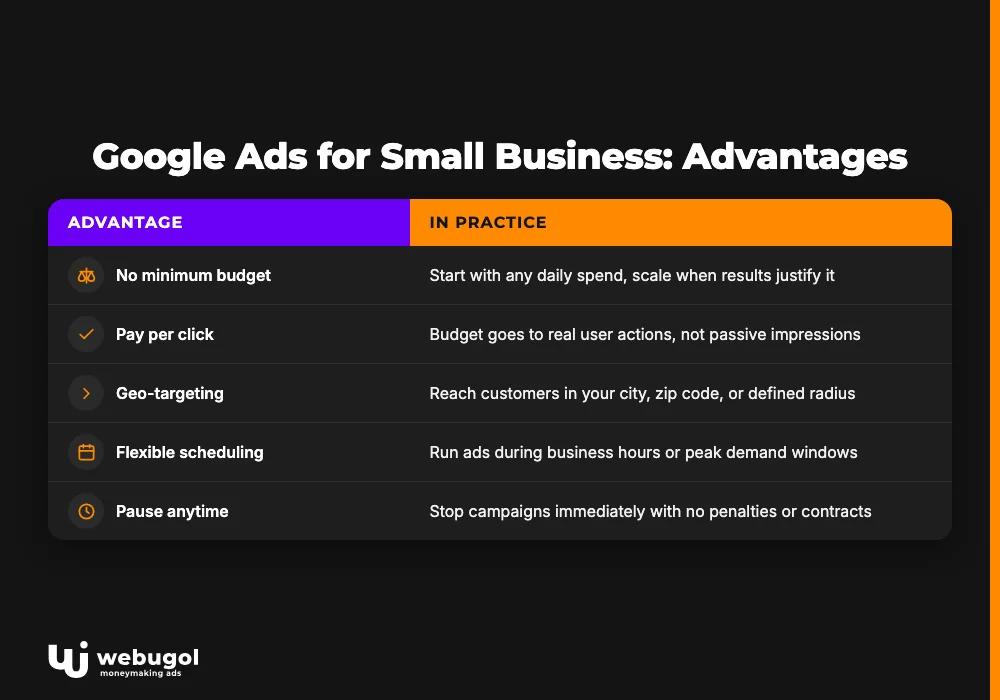
| Advantage | What it means in practice |
|---|---|
| No minimum budget | Start with any daily spend and scale only when results justify it |
| Pay per click only | Budget goes to real user actions, not passive impressions |
| Geo-targeting | Reach customers in your city, zip code, or a defined radius |
| Flexible scheduling | Run ads during business hours or peak demand windows only |
| Pause anytime | Stop campaigns immediately with no penalties or locked contracts |
| Smart Campaigns | Automated setup designed for businesses new to paid search |
| Remarketing | Re-engage visitors who left your site without converting |
| YouTube integration | Manage video and search ads from one Google Ads account |
Each feature addresses a real constraint: tight budget, limited time, and narrow geographic reach. That combination explains why ppc for small business consistently gravitates toward Google Ads over other paid platforms.
How much does Google Ads cost for small business?
Google ads cost small business owners set themselves, there is no fixed price. You set your own daily budget and maximum bid per click, and you pay only when someone clicks your ad. No minimum spend is required to open or maintain an account.
Your daily budget determines how often your ads appear. In a competitive local market, a very low daily budget can mean ads stop showing by midday. The actual cost per click depends on keyword competition and your Quality Score. Higher Quality Scores reduce your effective cost per click, meaning investment in better ad copy and landing page relevance has a direct financial payoff beyond just conversion rate.
That is the core insight behind any practical google ads budget guide approach: relevance is cheaper than raw bid increases, and the platform's auction mechanics reward it consistently.
What is a good Google Ads budget for small business?
A good starting budget depends on your industry, location, and what a new customer is worth to your business. The practical rule across most google ads small business campaigns: do not increase spend until the data supports it. More budget does not automatically produce proportionally better results.
For most local businesses starting out, a tightly managed campaign at a modest daily spend produces the data needed to optimize before scaling. The budget can be increased, decreased, or paused at any moment without disrupting campaign structure. That flexibility distinguishes Google Ads from other paid media formats where commitments are locked in weekly or monthly.
A budget approach that works consistently: start conservatively, monitor performance daily, and reinvest only the spend that generates profitable conversions. The objective is not to maximize impressions. It is to produce conversions at a cost the business can sustain and build on over time.
How to set up Google Ads for small business
Setting up Google Ads for small business correctly starts before you open the campaign interface. The first step is defining what a successful outcome looks like: a phone call, a form submission, an e-commerce purchase, or a store visit. That decision determines your campaign type, your bidding strategy, and how conversion tracking needs to be configured.
Define your goal and set up conversion tracking
Without conversion tracking active from the start, you can see clicks and costs but cannot connect them to actual business results. Paid search ROI is unmeasurable without it. This is the most common setup failure in small business paid search, and it is one that cannot be corrected retroactively without losing data already generated.
Set up conversion tracking before any campaign goes live. It is the single most important step in the entire setup process, and skipping it makes every subsequent optimization decision a guess.
Choose the right campaign type
Search campaigns show text ads when users search your target keywords. They are the right starting point for most small businesses because intent is explicit: the user typed exactly what they are looking for. Display campaigns show image ads across websites in Google's network, which suits brand awareness goals but typically generates fewer direct conversions per dollar at small budget levels.
Smart Campaigns automate targeting, bidding, and ad creation based on your business description and goals. They reduce setup complexity and are a practical entry point for businesses with limited time or no paid search experience. Manual Search campaigns give more granular control over keywords and placements, at the cost of greater ongoing management attention.
YouTube campaigns run through the same Google Ads account. According to data from the original campaign research, 64% of users are more likely to purchase online after watching a video. YouTube can reach audiences earlier in the decision process, sometimes at lower cost per impression than search, though the conversion path is typically longer.
Research keywords and build your negative keyword list
Keyword selection determines who sees your ads. Long-tail keywords, more specific three-to-five-word phrases, tend to cost less per click and attract users closer to a purchase decision than broad single-word terms. They also face less competition in the auction.
Negative keywords are equally critical. They prevent your ads from triggering for searches that match your keywords technically but do not represent actual potential customers. A landscaping company targeting "lawn care" does not want clicks from someone searching "DIY lawn care tools." Building a thorough negative keyword list at launch is one of the highest-return activities in initial google ads small business campaign setup.
Match your ad to your landing page precisely
The page users reach after clicking must deliver exactly what the ad promised. If your ad says "same-day HVAC repair," the landing page should confirm that promise within the first few seconds, without requiring navigation to find relevant information.
A mismatch between ad message and landing page raises bounce rate and lowers Quality Score. Lower Quality Score raises cost per click over time. Keeping ad and page tightly aligned is both a conversion improvement and a sustained cost reduction strategy.
Managing Google Ads for consistent results
Daily review is a core component of any successful google ads small business program. Keyword auction dynamics change, competitor bids shift, and search behavior fluctuates week to week. The campaigns that produce consistent results are the ones where bids, keywords, and ad copy are adjusted regularly based on actual performance data, not left on autopilot.
This is where the time investment becomes real. Running ppc for small business profitably requires consistent management attention. If your internal team lacks that capacity, a google ads management service addresses the gap directly. Under-managed campaigns consistently underperform their potential, and the issue is almost never the platform itself.
Local businesses should combine geo-targeting with dayparting, running ads only during the hours when your business is reachable and can actually respond to inquiries. Together, these two settings can substantially improve cost efficiency without reducing traffic quality.
For businesses in specific service verticals, campaign optimization approaches differ in meaningful ways. Optimizing paid search campaigns for home service businesses covers the keyword structures, bidding tactics, and account configurations that consistently produce strong results in high-intent local categories.
Measuring paid search ROI
Paid search ROI tells you whether your google ads small business investment is generating more value than it costs. With conversion tracking in place, the calculation is direct: total value from ad-driven conversions divided by total ad spend.
If your average customer is worth $600 and your cost per conversion is $50, the campaign is profitable and scaling makes sense. If cost per conversion exceeds customer value, the keyword targeting, landing page experience, or bid strategy needs adjustment before any budget increase.
Google Ads provides conversion tracking natively. It connects clicks to outcomes: phone calls, completed forms, e-commerce transactions, or any other action your business defines as valuable. Without that data, budget decisions are based on guesses rather than evidence.
The remarketing feature within google ads small business accounts targets users who visited your site but did not convert. Because these visitors have already shown interest, they convert at higher rates than cold traffic and typically at lower cost per conversion. Remarketing is an efficient way to extract additional value from budget already spent driving initial site traffic.
The Google Display Network adds a brand awareness layer, placing image ads across relevant websites before potential customers begin actively searching. For most small businesses with limited budgets, Display works best as a supplement to Search once baseline campaigns are running profitably, not as a starting point.
Four criteria to evaluate before launching Google Ads
Not every business is positioned to run profitable Google Ads campaigns immediately. These four factors determine whether the timing is right.
Search volume: Does your target customer actively search online for what you offer? Niche services or highly local businesses where referrals dominate may not generate enough search traffic to sustain a cost-effective campaign at any budget level.
Customer value versus cost per click: In competitive categories, cost per click can be substantial. If your average sale is $60 and clicks in your market average $12, you need a 25% conversion rate to break even, which is unrealistic for most businesses. If your average customer is worth $3,000, the same cost per click is a minor input cost.
Conversion infrastructure: Your website and phone handling need to be ready for the traffic you are paying for. A slow-loading page, broken contact form, or unreturned callback wastes every dollar of ad spend regardless of how well the campaigns themselves are built.
Management capacity: Campaigns without regular attention consistently underperform their potential. Honestly assessing whether your team can commit to daily monitoring, or whether working with a google ads management service makes more operational sense, should happen before launch rather than after budget has been spent discovering the answer.

What a long-term paid search strategy looks like
Google Ads generates immediate traffic and conversion data. That data reveals which keywords and messages connect with your actual customers. Over time, those signals inform other parts of your marketing: organic content strategy, landing page copy, and even how you position your services to new prospects.
Small businesses that track google ads small business ROI as the primary success metric and manage campaigns with that discipline find the platform grows more efficient over time, not less. Quality Scores improve as ad relevance and landing page experience improve. Negative keyword lists become more comprehensive. Bidding strategies sharpen as historical conversion data accumulates.
Our team at Webugol works with small businesses across service and professional verticals to turn Google Ads accounts into reliable revenue channels. The pattern that consistently produces results: tighter keyword targeting at launch, modest initial budgets, daily optimization reviews, and gradual scaling of what the data validates.
Ready to build profitable Google Ads campaigns for your business?
Running Google Ads for small business profitably takes careful initial setup, consistent management, and a tracking system that connects spend to real outcomes. If you are ready to generate measurable leads and revenue from paid search, contact our team to discuss a campaign strategy aligned with your specific business goals and budget.
Frequently asked questions
Does Google Ads work for small businesses with very limited budgets?
Yes. Google Ads has no minimum budget requirement, so you can start with a modest daily spend and scale based on results. The pay-per-click model means you only pay when someone clicks your ad, which controls waste even at low budget levels.
How long does it take to see results from Google Ads?
Search campaigns can generate clicks and leads within hours of launching, making paid search one of the fastest advertising channels available to small businesses. Meaningful optimization data typically takes two to four weeks to accumulate, after which performance can be refined with much greater precision.
What is the difference between Search campaigns and Smart Campaigns?
Search campaigns give you full control over keywords, bids, and placements, but require consistent hands-on management. Smart Campaigns automate most of those decisions using machine learning. Smart Campaigns are a practical starting point for businesses without paid search experience; manual Search campaigns suit businesses that need granular control over how budget is allocated.
Can I manage Google Ads without a specialist?
Smart Campaigns are designed for self-management and handle most technical decisions automatically. Manual Search campaigns require daily attention, keyword research, and ongoing bid adjustments. Many small businesses start self-managed and move to a google ads management service once campaigns grow in budget or complexity.
How do I know if my Google Ads campaign is profitable?
The primary metric is cost per conversion: what you pay for each phone call, form submission, or purchase the campaign generates. If that cost is below the profit value of a new customer, the campaign is profitable. Track cost per conversion alongside Quality Score and click-through rate to identify where to improve efficiency.