



New website SEO: a complete guide to ranking from day one
New website SEO is the process of building search visibility into your site from launch rather than retrofitting a weak foundation later. The core steps are confirming Google can crawl your pages, setting up measurement tools, applying on-page SEO tips for each page, mapping keywords before publishing, and creating content that earns external links over time. Most new sites with these foundations in place see consistent organic traffic within three to six months. This guide walks through the full sequence in the order that produces results.
What is the first step in SEO for a new website?
The first step is confirming that Google can find, crawl, and correctly render your pages. Without this baseline, every other new website SEO task you complete has no surface to land on.
Start by setting up Google Search Console and submitting your XML sitemap. Then use the URL Inspection tool to test how Googlebot renders your homepage, a service or category page, and one sample post. Rendering failures caused by JavaScript-heavy builds are a common and overlooked reason why new sites stall in search for months before anyone identifies the problem.
After confirming crawlability, complete these tasks before moving on to content or link building:
- Submit your XML sitemap under Indexing > Sitemaps in Google Search Console.
- Review your robots.txt to confirm no important directories are blocked.
- Request indexing for your highest-priority pages using the URL Inspection tool.
- Set your preferred domain (www or non-www) and confirm that all HTTP traffic redirects to HTTPS.
These tasks take under an hour. Skipping them and publishing content on a site Google cannot properly read is a common and costly mistake, and one that often goes undetected until a site owner wonders why nothing is ranking after three months of publishing.
Google Analytics completes the measurement setup alongside Search Console. Search Console shows how Google finds and processes your pages. Analytics shows what users do after they arrive. Running both from day one means every optimization decision is based on actual data rather than assumptions.
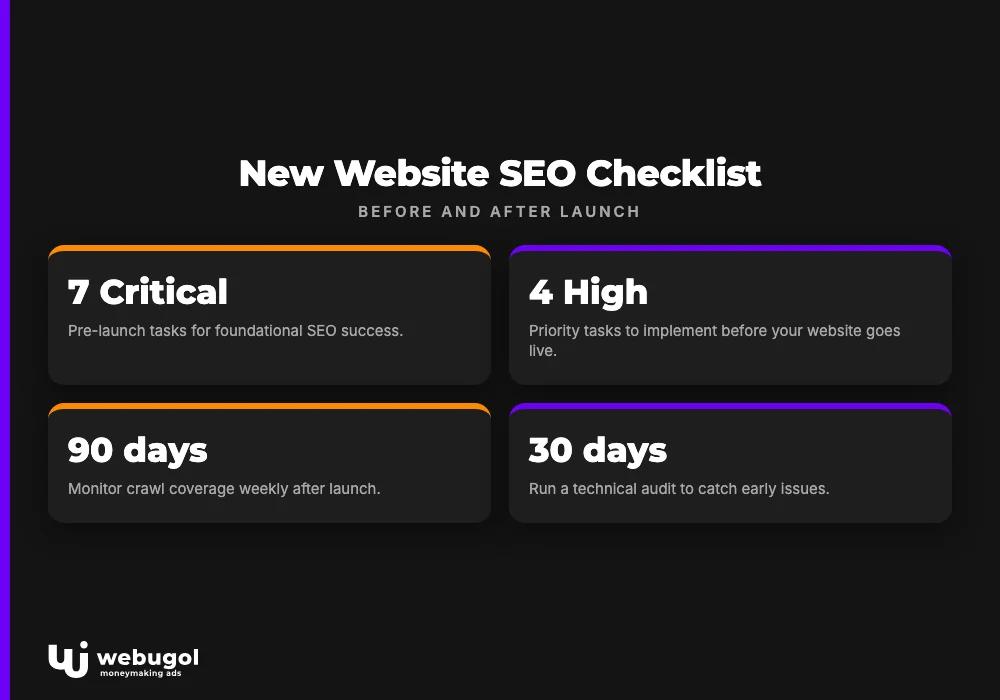
New website SEO checklist: before and after launch
A clear website SEO checklist keeps priorities in order and prevents the kind of technical debt that costs significantly more to address at month twelve than it would have before launch.
| Task | Phase | Priority |
|---|---|---|
| Set up Google Search Console and Google Analytics | Pre-launch | Critical |
| Define site architecture and URL structure | Pre-launch | Critical |
| Configure robots.txt and XML sitemap | Pre-launch | Critical |
| Map primary keywords to each page | Pre-launch | High |
| Write unique title tags and meta descriptions | Pre-launch | High |
| Compress images and write descriptive alt text | Pre-launch | High |
| Configure HTTPS and set preferred domain | Pre-launch | Critical |
| Submit sitemap and request indexing | Post-launch | Critical |
| Monitor crawl coverage weekly for 90 days | Post-launch | High |
| Publish content targeting priority keywords | Post-launch | High |
| Build initial backlinks from partners and directories | Post-launch | Medium |
| Run a technical audit at 30 days | Post-launch | Medium |
The sequence matters as much as the individual tasks. Architecture and keyword mapping happen before the first page is published. Content and link building begin only after you have confirmed Google is crawling the site correctly.
At the 30-day mark, a first-month technical SEO audit surfaces crawl issues, thin pages, and missed keyword opportunities early enough to address without major rework.
Website architecture optimization
Architecture is the system of connections between your pages and the hierarchy in which they sit. For new website SEO, this is the decision that either scales cleanly for years or creates compounding technical debt that demands expensive restructuring later. URL structure and site hierarchy are far harder to change after pages are indexed, so getting architecture right before launch matters more than almost any other early decision.
Logical site hierarchy
A clean hierarchy places the homepage at the top, core service or category pages one level below, and individual posts or products one level below that. No important page should require more than three clicks to reach from the homepage.
This three-click rule matters for two reasons. It shortens the crawl path, allowing Google to reach every page efficiently without wasting crawl budget on unnecessary depth. It also signals authority: pages closer to the homepage in link distance typically accumulate more ranking strength than pages buried several levels deep.
Website architecture optimization also means committing to your URL structure before publishing anything. Descriptive URLs like /services/seo-audit are easier for both users and crawlers to interpret than /p?id=4823. Changing URLs after indexing requires 301 redirects, and every redirect carries a real risk of losing some of the ranking signals that page has accumulated. For content-heavy or e-commerce sites, plan your full category taxonomy before writing a single page. A site that launches with disorganized URLs typically faces months of remediation before it can compete effectively.
Internal linking for a new website
Internal links are the connections between pages on your own site. They pass authority from established pages to newer ones, guide users toward your most important content, and give search engines a clear signal about which pages you consider most valuable.
For a new site, an effective internal linking approach starts simple: every page should receive at least one internal link from a contextually relevant page. Your homepage should point to core service or category pages. Each blog post should link to at least one service page and two or three related posts.
Anchor text matters. Descriptive anchors that tell the reader what the linked page covers carry more SEO value than generic anchors like "click here" or "learn more." Those generic phrases waste the authority that flows through every internal link. Specific, accurate anchors improve user experience and strengthen the relevance signal for the destination page. A practical internal linking guide for a new site keeps anchors varied, descriptive, and accurate to what the destination actually covers.
Internal links have a significant impact on how search engines evaluate individual page authority. A page with no internal links pointing to it is effectively invisible to Google regardless of content quality. Fixing orphaned pages is consistently one of the fastest, lowest-cost wins in new website SEO.
How many keywords should a new website target?
A new website should target one primary keyword per page and two to four closely related supporting terms. Targeting many unrelated keywords on a single page dilutes focus, weakens the relevance signal, and produces content that satisfies no specific user intent well.
Keyword research basics for a new site
Keyword research basics start with intent, not search volume. A keyword with 200 monthly searches that precisely matches what your service page offers will convert better than a broad term with 5,000 monthly searches where most of the audience is at an early browsing stage. Ranking for the right query matters more than ranking for the most popular one.
For a new domain with no authority history, prioritize long-tail keywords: phrases of three or more words, with specific intent and lower competition. A new site cannot out-rank established domains on broad head terms in year one by publishing a page and waiting. Long-tail phrases are where new sites win early organic traffic, and that early traffic builds the authority needed to compete on harder terms in year two and beyond.
Organize your keyword research into a mapping document before writing anything: one primary keyword per planned page, the intent type (informational, transactional, or navigational), and two to four supporting terms that fit naturally into the content. This keyword map becomes your SEO strategy guide for content development across the first twelve months, keeping each new page targeted rather than duplicating intent across similar URLs.
A practical rule for a site launching with ten pages: target ten distinct primary keywords across ten distinct intent clusters rather than ten variations of the same phrase. Spreading across different intent types gives search engines more signals about the range of your site's coverage, which can accelerate topical authority in your niche.
How do I set up Google Search Console for a new site?
Google search console setup is the single most valuable technical action in early new website SEO. The tool shows which pages Google has indexed, which queries generate impressions before you rank, where crawl errors are blocking progress, and which pages have coverage issues requiring attention.
Follow these steps:
- Sign in to Google Search Console using a Google account that will remain accessible long-term. For a business or client property, use a shared team account rather than a personal one.
- Add a property. The Domain property type captures all subdomains and protocols in a single view. If you use URL-prefix instead, add separate entries for both the www and non-www versions of your domain.
- Verify ownership. The DNS TXT record method is the most reliable because it covers all protocols simultaneously without requiring changes to the site itself. HTML file upload and the Google Analytics tag also work.
- Submit your sitemap. Navigate to Indexing > Sitemaps and enter your sitemap URL, typically yourdomain.com/sitemap.xml.
- Set your preferred domain and confirm that HTTPS is the active default for all URL variants.
Once the property is active, check the Coverage report weekly for the first three months. New sites commonly show "Discovered - currently not indexed" pages, which means Google found the URL but has not yet decided it is worth crawling. Publishing substantive content on those pages and adding internal links pointing to them is the most reliable way to move them into the indexed pool.
The Performance report shows which queries trigger impressions before you rank on page one. These are your highest-priority pages for the next content update cycle. Treating google search console setup as an ongoing practice rather than a one-time configuration is what separates sites that improve steadily from sites that stall and never understand why.

On-page SEO tips for a new website
On-page SEO covers everything you control within each individual page: title tags, heading structure, content depth, image optimization, and page speed. Applying on-page seo tips from the first published page is far more efficient than remediating a live site months later.
Title tags, H1s, and meta descriptions
Every page needs a unique title tag between 55 and 60 characters with the primary keyword near the beginning. The H1 should reflect the same topic as the title without being word-for-word identical. The meta description, between 120 and 155 characters, should describe the page clearly and include the primary keyword near the start.
New sites frequently launch with duplicate title tags across similar pages, missing meta descriptions, or H1 headings that do not match what the page actually covers. These three elements are among the first signals a search engine reads when deciding what a page is about. Fix them before requesting indexing to avoid re-indexing corrected pages after the fact.
Quality content as an SEO signal
Relevant, accurate content is a necessary part of search engine optimization for any website. Volume matters less than quality: a site with twenty pages of substantive, specific content will consistently out-rank a site with two hundred pages of thin rewrites.
Be consistent in publishing and avoid duplicate content, which splits authority across near-identical pages and makes it harder for Google to determine which version to rank. A new site's content plan should function as an SEO strategy guide: start with the pages that support your core commercial intent, then expand to informational content that builds topical authority over time.
Each page should answer a specific question clearly and completely. Structure the content with the most important answer near the top, supporting detail in the body, and a clear next step at the end. This structure works for human readers and for crawlers alike, and it aligns with how AI answer engines extract information to populate AI Overviews and similar features that now appear above traditional search results.
New website SEO content strategy is not about publishing the maximum number of pages as quickly as possible. It is about giving the pages you publish a real chance to rank by making each one useful, well-structured, and targeted at a specific query with identifiable intent.
Page speed and core web vitals
Website download speed is one of the main factors Google uses for ranking decisions. A brand-new site is in the best position to address this because you are building from scratch rather than untangling years of accumulated plugins and uncompressed assets.
The most common speed problems on new sites are oversized images, render-blocking scripts, and hosting plans that cannot handle actual traffic volumes. Compress images before uploading, defer non-essential JavaScript, and select hosting infrastructure that matches your expected load.
For a detailed walkthrough of evaluating and improving page load speed, Google's PageSpeed Insights is a free starting point. The two Core Web Vitals most directly connected to ranking are Largest Contentful Paint (LCP) and Cumulative Layout Shift (CLS). Fix those two first before addressing secondary performance metrics.
Does a new website need backlinks to rank?
Yes. A new website needs backlinks to rank competitively, and the quality of those links matters far more than the number. A small set of links from relevant, authoritative sites in your industry carries more ranking weight than hundreds of links from unrelated or low-credibility sources.
Trust in a website depends not only on its content and internal structure but also on how it connects with reputable external sources. For a brand-new domain with no ranking history, external links are the primary mechanism for establishing authority in the early months. Publishing quality content creates the surface that earns links; outreach and relationship-building create the initial momentum.
Practical starting points for a new site:
- Partner businesses and industry suppliers are the easiest early links. A link from a supplier's resources page requires only a direct request and delivers a legitimate, relevant signal.
- Local and industry directories that your target audience actually uses carry more weight than generic web directories built solely for link accumulation.
- Guest contributions to established publications in your niche earn links from sites with accumulated domain authority and an engaged readership.
- Charity sponsorships and community partnerships often produce links from pages that have built authority over years through consistent citation.
Not all external relationships carry equal value. Beyond the number of links, consider the credibility and topical relevance of the source. A link from a trade association's news section will move rankings more than ten links from unrelated blogs. Our guide to evaluating link sources for a new site walks through how to assess whether a prospective source is worth the outreach effort.
Treat link acquisition as a continuous background activity, not a one-time sprint. Consistent outreach across twelve months produces compounding results and keeps a site's link profile growing in a natural pattern that avoids the sudden spikes that can attract algorithmic scrutiny.
How long does SEO take for a new website?
New website SEO typically produces visible organic traffic within three to six months when the technical foundation is solid and content is published consistently. Competitive, high-volume keywords in established niches take twelve months or longer to reach page one.
The timeline depends primarily on three factors: how well the technical setup is executed, how competitive the target keywords are, and how consistently the site publishes and earns links. A new site targeting long-tail keywords in an underserved local niche can rank within six to eight weeks. A site entering a market dominated by established, high-authority domains with decades of backlink history is looking at a multi-year process on broad terms.
Month one should focus entirely on technical setup and confirming Google is indexing the site correctly. Weeks five through twelve are best spent publishing core service and category pages and building the first backlinks. From month four onward, the focus shifts to content expansion and link acquisition at consistent volume.
New website SEO is a compounding investment. Work completed in month two often does not produce measurable ranking movement until months five or six. That delay is not a sign the strategy is failing. It reflects the time search engines take to evaluate new domains, gather behavioral signals, and assign positions based on accumulated evidence. Setting this expectation early prevents premature strategy changes driven by impatience rather than data.

Keeping your technical foundation clean
Most content management systems accumulate plugins, redundant scripts, and bloated code as sites grow. A new website is the opportunity to start clean, and maintaining a lean codebase from day one pays dividends in page speed, maintainability, and crawl efficiency across the life of the site.
If you are choosing a platform for a new site with expected high traffic or complex content requirements, consider custom development over a plugin-heavy CMS. A custom-built site gives you direct control over every line of code that runs on each page. That control makes ongoing new website SEO work faster and less risky, because fewer moving parts can break after a platform update.
For sites built on established CMS platforms, install only the plugins you actively use and audit them on a regular schedule. Every plugin adds code the browser must load, parse, and execute. Unnecessary scripts slow the page and create potential conflict points that can break functionality after updates.
Clean code also makes the site far easier for any developer or SEO specialist who touches it later. Technical debt that accumulates in year one compounds into significant remediation costs by year three. Starting with a well-organized, minimal codebase is one of the most undervalued decisions in new website SEO: it costs nothing extra upfront and prevents expensive restructuring later.
Ready to build search visibility for your new website?
Search visibility for a new website is built through consistent execution across technical setup, content, and link development over months, not weeks. The sites that rank well a year after launch are almost always the ones that configured Google Search Console correctly from the start, mapped keywords before writing, structured architecture with long-term growth in mind, and treated content quality as a non-negotiable standard from the first published page.
Webugol builds and manages SEO for new and growing websites across a range of industries. If you want a technical and content plan built around your specific business goals, contact us and we can put together a roadmap for your first year in search.
FAQ
What is the first thing to do for SEO on a new website?
Set up Google Search Console and submit your XML sitemap before anything else. This confirms Google can access your pages and creates the baseline data source you need to measure every subsequent improvement.
How long does it take for a new website to rank on Google?
Most new websites with a solid technical setup and consistent content see meaningful organic traffic in three to six months. Competitive keywords in crowded niches typically take twelve months or more to reach page one.
How many keywords should I target per page on a new website?
Target one primary keyword per page and two to four closely related supporting terms. Keeping each page focused on a specific user query gives search engines a clear signal about the page's purpose and makes the content more useful for the reader.
Does a new website need backlinks to rank?
Yes, but quality matters far more than quantity. A few links from authoritative, relevant sources in your industry carry more ranking impact than dozens of links from unrelated or low-credibility sites.
Why is my new website not showing up in Google Search?
The most common reasons are that key pages have not been submitted for indexing, the robots.txt file is blocking crawlers, or the content is too thin for Google to consider worth indexing. Use the URL Inspection tool in Google Search Console to identify the specific issue.