


Google ads marketing: what it is and how it works
Google ads marketing is a paid search advertising system that places your business at the top of Google search results the moment a campaign goes live. Advertisers bid on keywords, pay only when someone clicks, and control the daily budget entirely. For businesses that need immediate visibility, it is one of the most direct forms of pay per click management available. This guide covers how the system works, the core campaign types, what it costs, and when to bring in a dedicated adwords agency.
Search engine marketing: SEO vs. paid search advertising
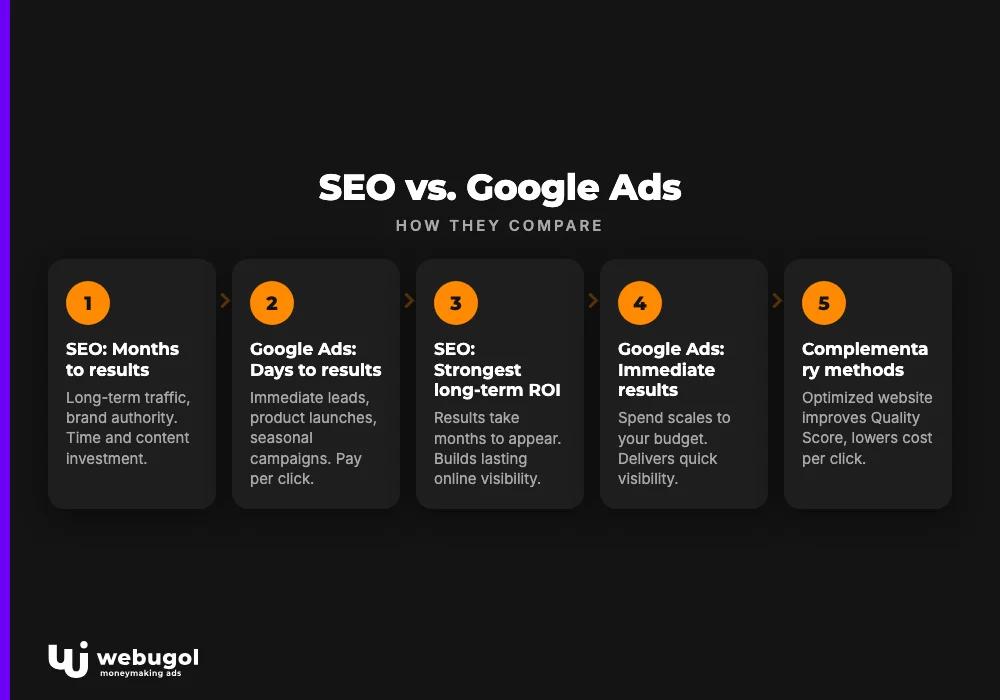
Online visibility comes from two directions: organic search (SEO) and paid search advertising through Google Ads. Most businesses benefit from both, but they work through different mechanisms and serve different timelines.
| Approach | Time to results | Cost model | Best for |
|---|---|---|---|
| SEO | Months | Time and content investment | Long-term traffic, brand authority |
| Google Ads | Days | Pay per click | Immediate leads, product launches, seasonal campaigns |
SEO delivers the strongest return on investment over the long run, but results take months to appear. Google Ads pay per click management delivers results almost immediately, and spend scales exactly to your budget. The two methods are complementary, not competing: a well-optimized website improves Quality Score in Google Ads, which lowers cost per click and makes campaigns more efficient over time.
How does Google Ads work for small business?
Small businesses pay only when a user clicks their ad, which makes the entry cost controllable from day one. You set a daily budget, select keywords that match what customers search, and write ads that appear when those queries happen.
The ad auction runs in milliseconds. Google evaluates your bid, your Quality Score (which reflects ad relevance and landing page quality), and your ad format to determine placement. A higher Quality Score can win better positions at a lower cost per click, so a focused small-business campaign can compete against larger advertisers without matching their budgets dollar for dollar.
Google search campaigns can be narrowed by geography, device, time of day, and audience segment, keeping spend concentrated on users most likely to convert. For an overview of how google ads marketing supports different stages of the buyer journey, the guide on different ways Google Ads drives business growth covers the full funnel in detail.
Campaign types in google ads marketing
Google Ads includes several distinct campaign formats. Each targets a different stage of the buyer journey and performs best in specific business contexts.
Search campaigns: the foundation of paid search advertising
Traditional google search campaigns target users who are actively searching for a product or service. Ads appear next to Google results and on partner sites that carry Google's search engine. They fire when a query matches a keyword in your account.
Keyword selection determines campaign efficiency. A specific phrase like "home delivery of fresh flowers" reaches more qualified buyers than a broad term like "flowers." Four elements define how well search campaigns perform:
- Match types determine how closely a search query must align with your keyword. Broad, phrase, and exact match each serve different targeting strategies and traffic volumes.
- Negative keywords block irrelevant queries before they cost money. Removing bad search terms each month is one of the highest-leverage actions in ppc management, and it is often underprioritized in self-managed accounts.
- Intent-based ad groups (IBAG) organize keywords by what the searcher actually wants to do: compare prices, request a quote, or buy immediately. This approach produces stronger Quality Scores than grouping by product category alone, because ad copy can address a specific stage of intent.
- Semantic core depth expands keyword coverage to lower-competition terms, which typically reduces average cost per click across the account without sacrificing reach.
Dynamic search ads
Dynamic search ads complement standard text campaigns rather than replacing them. Google's crawler reads your website, generates ad headlines based on page content, and selects the destination URL automatically. No keyword lists are required.
This format works best for large, well-organized websites and e-commerce stores with broad product ranges. It captures search queries that standard keyword lists miss. Dynamically generated headlines can run longer than standard text ads, which increases ad visibility in the results page.
Google Shopping campaigns
Google Shopping is built for e-commerce. Product images, prices, and store names appear directly in search results, giving shoppers a clear preview before they click. Shopping campaigns run on Google's automated algorithm, which adjusts bids based on your product feed data rather than manual keyword selections.
This format suits businesses of all sizes. A small store can run Shopping campaigns without a dedicated advertising manager, and a large retailer can use them to promote tens of thousands of products simultaneously.
Google Display Network
The Google Display Network reaches users across more than 2 million websites and 650,000 applications, including YouTube and Gmail (Google). Approximately 90% of internet users worldwide are reachable through this network (Google).
Display ads appear as static images, animated banners, or responsive ads that adapt to available ad spaces. Targeting options include demographic, interest, topic, and specific placement. Display advertising is most effective at the awareness stage, when the goal is to reach users before they start searching. Responsive display ads remove the need to produce banners in multiple sizes: you supply headlines, descriptions, and images, and Google assembles the combinations automatically for each placement.
Remarketing
Remarketing shows ads to people who have already visited your website. A user browses a product page, leaves without converting, and then sees your ad on other sites they visit. This format targets warm audiences and typically produces higher conversion rates than cold-audience display campaigns.
The same principle extends to YouTube. Users who watched a specific video on your channel can be added to a remarketing list and served a follow-up ad. Sequential remarketing can layer a complete message across multiple touchpoints, reaching each subsequent ad only to users who engaged with the previous one.
Video advertising
Video ads on YouTube build brand recognition, but they require well-produced content and precise audience setup. Poorly targeted video campaigns spend budget on viewers who will never convert. Remarketing targeting can also be applied to YouTube campaigns, making it possible to re-engage users who visited your website or watched earlier videos on your channel.
What is the difference between Google Ads and SEO?
Google Ads and SEO both put your business in front of searchers, but they operate through different mechanisms. Google Ads is a paid auction where position is purchased through bids and Quality Scores. SEO earns position through content quality, relevance, and domain authority built over months or years.
The practical difference is speed and sustainability. Google Ads generates traffic the day a campaign goes live; SEO typically takes months to produce meaningful ranking movement. Google Ads stops producing traffic the moment you pause spending; SEO continues generating visits as long as the content remains relevant and the site maintains its authority.
A second difference is data access. Google Ads provides immediate, granular data on which keywords convert and at what cost. SEO produces slower feedback and is harder to attribute to specific business outcomes in the short term.
Businesses that invest in both benefit from a compound effect. An optimized website improves Quality Score, which lowers advertising costs. The paid campaigns generate immediate leads while organic authority builds in the background. Choosing one over the other forces a false trade-off; distributing investment across both produces better overall results.

How much does Google Ads cost per month?
Google Ads has no fixed price. You set a daily budget, and the platform spends up to that amount each day. Monthly cost is the sum of daily budgets across the campaign period, shaped by actual click volume and keyword competitiveness.
Cost per click varies significantly by industry. Some markets see averages below one dollar per click; highly competitive categories compete at tens of dollars per click. The useful measure is cost per lead rather than cost per click, because it accounts for your conversion rate and the value of a new customer.
Several factors drive cost beyond industry competition: keyword specificity, geographic targeting, time-of-day scheduling, and Quality Score all affect what you pay. Campaigns with high relevance and well-structured landing pages consistently pay less per click than poorly organized accounts competing on the same keywords.
Before committing any budget, a market analysis can estimate realistic cost per lead for your specific business category and geography. Webugol provides this analysis at no charge as part of its ppc advertising services intake process, giving businesses an accurate picture before a campaign goes live.
When should you use Google Ads instead of SEO?
Google Ads is the right choice when speed matters more than long-term efficiency. Three situations where paid search advertising is the clearest starting point:
- Your business launched recently and has no organic ranking history to draw on, making immediate traffic through google search campaigns the fastest path to leads.
- A competitor already captures high-intent searches and you need to appear alongside them while organic rankings build over time.
- You are testing a new product, offer, or market and need market feedback within weeks, not months.
SEO is the better long-term investment when you can afford to wait for results to compound and want traffic that does not stop when the budget does. Strong sem agency strategies use paid search to cover immediate revenue needs while organic authority builds in parallel, rather than treating the two as mutually exclusive choices.
Service businesses competing in local markets often find that a narrow, geo-targeted campaign delivers qualified leads faster than any other channel. For a look at how paid campaigns are structured specifically for this type of business, the guide on paid advertising for local service companies outlines the structures that work in competitive local markets.

Is hiring a Google Ads agency worth it?
Hiring an adwords agency is worth it when the cost of mismanaged campaigns exceeds the agency fee. Google Ads accounts managed without expertise routinely lose budget to irrelevant clicks, poor keyword structure, and unchecked bidding. The gap between a well-run and a poorly-run account widens over time as daily optimizations compound.
Webugol's data across client accounts shows that incremental daily improvements of 0.2% to 1% translate to 200 to 300% performance improvement over a year of consistent ppc management. That rate of gain is difficult to sustain without dedicated account attention.
Specific areas where agency expertise adds measurable value:
- Keyword research beyond the standard tools. Webugol uses multiple research platforms to find high-value, lower-competition terms that self-managed accounts typically miss. Google's own keyword planner is only one of several sources.
- Pre-campaign market analysis. Cost per lead can be modeled before a single dollar is spent, which eliminates budget surprises and sets realistic expectations from the start.
- Negative keyword management. Webugol removes 500 to 2,000 bad search terms per client account each month. This is one of the most impactful recurring actions in pay per click management, directly cutting spend on queries that will never convert.
- Business model alignment. Targeting and landing page strategy are matched to how a specific business actually closes leads, whether through inbound calls, contact forms, or direct purchases, so the campaign structure reflects real conversion paths.
For a structured walkthrough of account-level improvements, the guide on step-by-step Google Ads performance improvements covers the core optimization levers used across high-performing accounts.
Conversion tracking: the layer that makes google ads marketing work
Running google ads marketing without conversion tracking means you cannot tell which keywords generate leads, which ads drive calls, or which landing pages convert. Every meaningful user action should be tracked: phone calls, form submissions, chat initiations, and email clicks.
Conversion data informs every bidding and budget decision. Without it, optimization relies on impressions and clicks, which measure activity but not revenue. Configuring tracking correctly, especially for call tracking and multi-step conversion funnels, requires technical setup that many self-managed accounts skip or configure incorrectly. Getting it right from the start is more efficient than retrofitting it after months of uncollected data.
When all conversion types are tracked accurately, it becomes possible to calculate cost per lead, compare it against customer lifetime value, and make budget allocation decisions based on what campaigns actually return rather than what they spend.
Start your google ads marketing campaign today
Google ads marketing delivers immediate visibility, but managing it profitably requires expertise that compounds over time. A poorly structured account wastes budget from the first day. A well-managed account grows more efficient each month as optimizations accumulate across keywords, bids, and audience targeting.
Webugol offers professional pay per click management backed by a free digital market analysis that shows the realistic cost per lead for your business before any budget is committed. Contact us to request the analysis and see what a targeted campaign would cost in your specific market.
Frequently asked questions
What is google ads marketing?
Google ads marketing is a paid system where businesses bid to appear at the top of Google search results. Advertisers pay per click, set their own budget, and reach users actively searching for their products or services.
How long does it take to see results from Google Ads?
Ads go live within hours of campaign approval. Meaningful performance data typically accumulates over two to four weeks, depending on search volume and daily budget.
What is a Quality Score in Google Ads?
Quality Score is Google's rating of how relevant your ad, keywords, and landing page are to a user's search. A higher score results in better ad placement and a lower cost per click.
Should I run Google Ads and SEO at the same time?
Running both simultaneously is the most effective approach. An optimized website improves Quality Score, which lowers advertising costs, while paid campaigns generate immediate traffic as organic rankings build.
How do I know if my Google Ads campaigns are working?
Conversion tracking is the primary measure. Track all lead actions including calls, form fills, and chat starts, and compare cost per conversion against the value of a new customer to determine whether campaigns are profitable.