



SEO for small business: rank on Google and grow your revenue
SEO for small business is the process of optimizing your website so it appears higher in Google's organic results, connecting you with customers who are already searching for what you sell. Unlike paid ads, it builds a compounding traffic channel that keeps delivering after the initial investment. The three core areas are technical site health, relevant content, and credibility signals like backlinks. Businesses that work consistently on all three outrank competitors in their target markets over time.
What does SEO for small business actually involve?
Most small business owners first encounter SEO as a vague promise: "We'll get you to page one." Understanding what the work actually covers helps you evaluate whether you are receiving real optimization or a website refresh with a different label.
SEO divides into three interconnected areas. On-page SEO covers everything within your website: page speed, mobile usability, content structure, and whether each page answers what searchers actually need. Off-page SEO builds authority through backlinks from reputable external sites, local directory listings, and third-party credibility signals. Technical SEO handles the infrastructure: crawlability, indexation, load speed, and structured data.
These areas work together. A technically flawed site undercuts great content. Strong content with no off-page credibility rarely climbs past page two. Your small business online presence depends on all three functioning at the same time.
Core SEO areas at a glance
| SEO area | What it covers | DIY-friendly? |
|---|---|---|
| On-page content | Keywords, headings, meta tags, readability | Yes |
| Technical health | Page speed, mobile usability, crawlability | Partly |
| Local SEO | Google Business Profile, local directory citations | Yes |
| Link building | Backlinks from reputable external sites | Partly |
| Site structure | URL hierarchy, internal linking | Partly |
Understanding this breakdown matters when comparing agency proposals. A quote covering only one column of this table is incomplete work, regardless of what the agency calls it.
Is SEO worth it for a small business?
Yes. Organic search is the main source of website traffic for most businesses, according to Webugol's client data. Paid advertising stops working the moment the budget runs out. SEO compounds: a well-ranked page keeps delivering traffic without additional cost per click.
The income case is direct. A high Google ranking in your target market significantly improves conversion rates because visitors arriving through relevant searches already intend to buy or inquire. That intent gap between organic and paid traffic is substantial, and it shifts the economics of customer acquisition.
The brand effect runs in parallel. Users associate top organic results with authority. A business Google ranks highly appears more credible than one appearing only in paid positions. That perception increases purchase decisions in your favor and is difficult to replicate through ad spend alone.
For small businesses competing with larger companies, SEO creates a practical path to outranking them. A focused seo content strategy targeting specific searches your competitors ignore can place a small business above national brands on queries that actually drive revenue.

How much does SEO cost for a small business?
Good SEO carries a high price in competitive markets, but small businesses do not always need heavy investment. If your site is genuinely useful to customers, loads fast, and is well-structured, ongoing maintenance costs stay manageable. Where costs rise is in markets with strong competition, where content production, link building, and technical audits require sustained professional attention.
A detailed breakdown of what drives pricing is available in our guide on how much SEO costs for your business.
When evaluating quotes, ask what the work specifically includes. Many companies offer affordable seo services that, on closer inspection, are website development with an SEO label. Development improves how your site looks and functions, which is valuable, but it does not build the off-page authority or content depth that earns organic rankings. Those require ongoing, separate work.
A practical test: if an agency cannot separately describe what they will do for on-page content, off-page authority, and technical health, the proposal is incomplete. Complete seo for small business work addresses all three.
How long does SEO take to show results?
SEO for small business produces results gradually and grows stronger with sustained, consistent effort. The timeline depends on your starting point, how competitive your market is, and how consistently the work continues after the initial setup.
A new website with no existing authority takes longer to move than an established site receiving its first proper optimization. If top competitors have invested in SEO for years, closing the gap requires sustained effort rather than a single campaign.
Consistency is the variable you control most directly. Irregular SEO activity produces irregular results. Regular content publication, ongoing technical fixes, and steady link acquisition build the compounding growth that makes SEO a reliable channel.
Local SEO responds faster than broader organic search. Fully optimizing your Google Business Profile and local directory presence often produces visible improvements in local pack rankings considerably faster than competing for non-local search terms.
What SEO tasks can a small business handle itself?
A significant share of seo for small business is accessible without a professional agency, particularly in the early stages. The following tasks are practical for most business owners:
Keyword research. You do not need expensive software to find what your customers search for. Google's autocomplete, the "People also ask" box, and your own customer conversations reveal the exact language your market uses. Build a list of specific phrases, then match each phrase to the page on your site that should target it.
On-page optimization. Each page should have a title that includes the relevant keyword, a meta description summarizing the page, and headings that structure the content logically. Most website builders allow editing these fields without any technical background.
This is where practical google ranking tips pay off immediately: accurate titles, clear descriptions, and well-structured pages signal to Google precisely what each page covers.
Google Business Profile. Completing your Google Business Profile fully is free and consistently one of the highest-return local SEO actions for businesses serving local customers. Add your address, phone number, hours, photos, and a detailed service description. Request reviews from satisfied customers after each transaction.
Content creation. Publishing content that genuinely answers customer questions earns rankings, attracts backlinks, and builds your social audience. The core website optimization tips here: write to answer one specific question, use clear headings, and link new content to related existing pages on your site.
Internal linking. Every time you publish something new, link to it from relevant older pages. This distributes authority across your site and helps Google identify which pages are most important.
Where professional help typically pays off: competitive link acquisition, diagnosing complex technical problems, implementing structured data, and keyword strategy in crowded markets. Specialized industries benefit from sector-specific expertise. Health and wellness businesses, for example, face both competitive search markets and content standards that niche-specific SEO for service businesses handles more effectively than a generic approach.

How Google rankings build brand recognition
Ranking near the top of Google delivers more than traffic. It builds brand recognition at a scale that most other channels cannot match for the same investment.
Search engines are the primary source of website visits for most businesses. When your business appears consistently at the top for relevant searches, customers encounter your brand name repeatedly, even on visits where they do not click through. That repeated exposure accumulates into recognition that converts when they are ready to buy.
There is also a credibility transfer effect. Users associate high organic rankings with authority and trustworthiness. A business that Google ranks highly appears more credible than one appearing only in paid ad positions. That association strengthens purchase intent and creates an advantage over lower-ranked competitors that extends beyond the search results page.
The visibility effect reaches social media too. Better organic search results mean more people discover your content. When that content is genuinely useful, a portion follow your social profiles and share your pages. That social activity drives additional traffic and reinforces your rankings. SEO and social media amplification work in a feedback loop that grows stronger over time.
What an SEO agency actually does for your small business
When you hire an agency for seo for small business, the work divides into two tracks: on-site and off-site. Understanding both helps you recognize whether an engagement is complete or addresses only part of the challenge.
On-site SEO work
On-site work covers the internal optimization of your website. A thorough agency starts with a technical site audit to identify crawling issues, duplicate content, broken links, and page speed problems. They then assess user experience, checking whether visitors can navigate to what they need without friction.
They analyze the site structure and internal link hierarchy to ensure Google's crawlers can reach every important page. Each page receives a properly formatted title, meta description, and image alt text. The content on each page gets aligned to the keywords your business needs to rank for, structured to answer the questions your target audience is asking.
Off-site SEO work
Off-site work builds the authority your site has relative to competitors. This includes domain authority analysis, monitoring load speed and server response times against competitors, and acquiring backlinks from reputable sites in your industry or local area.
Backlinks from high-authority external sites are a direct ranking signal to Google. They indicate that other credible sources find your content worth referencing. On-site optimization alone cannot replace this signal.
A complete seo for small business engagement runs both tracks simultaneously. On-site work without off-site authority hits a ceiling. Off-site work built on a technically broken site wastes the link equity it earns. The best results come from running both in parallel.
Businesses in sector-specific markets often benefit from providers who understand their industry's search patterns. The sector-specific SEO approaches developed for industrial marketing demonstrate how niche targeting and audience-aware content can outperform generic optimization even on smaller budgets.
How to choose the right SEO agency for your small business
Every agency claims to deliver results. The claim itself carries no information. What does carry information is evidence: completed client projects, verifiable rankings, and third-party reviews that describe the actual experience of working with them.
Green flags to look for
A trustworthy agency demonstrates its work rather than only describing it:
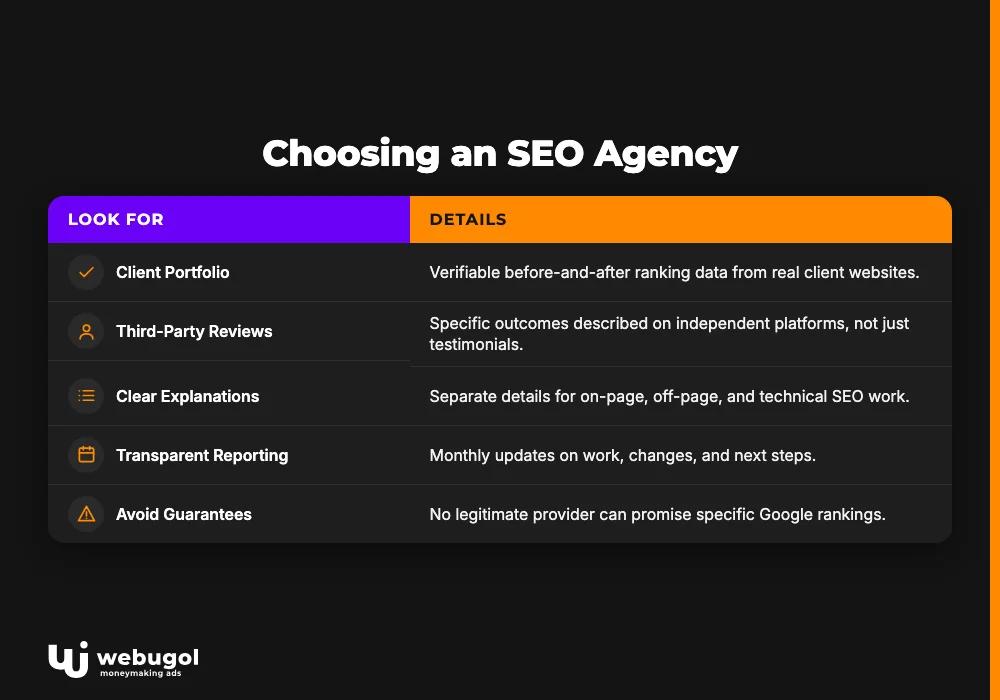
- A portfolio of real client websites with verifiable before-and-after ranking data
- Reviews on third-party platforms describing specific outcomes, not only curated testimonials on the agency's own site
- A clear, separate explanation of on-page content work, off-page authority building, and technical health improvements
- Transparent monthly reporting covering what was done, what changed, and what comes next
- A willingness to keep you informed and partially train you throughout the engagement, so you understand where your budget goes
Red flags to avoid
Avoid agencies that:
- Show no completed client projects, reviews, or verifiable client recommendations on their website
- Describe website design or development work as SEO without separately addressing content strategy, backlinks, and technical health
- Promise guaranteed rankings in Google, which no legitimate provider can deliver
- Focus on only one part of the SEO work while ignoring the others
- Cannot explain in plain language how their work will improve your organic traffic
Many small business owners approach SEO services with skepticism because of past experiences where an agency delivered a website rebuild labeled as SEO. The development work was real, but website development and SEO are different disciplines. Knowing that difference protects your budget and helps you identify providers doing complete work.
Building an seo content strategy that sustains rankings
Content is what feeds everything else in seo for small business. Pages that genuinely answer customer questions earn organic rankings, attract backlinks from other sites, and build the audience that eventually follows your brand across channels.
An effective seo content strategy for small businesses rests on three foundations.
Topic relevance means covering what your business actually does and what your customers are actively searching for. Content that directly addresses specific customer needs converts at a higher rate than tangentially related content that captures traffic without matching intent.
Search intent alignment means matching your content's format and depth to what searchers expect. A searcher asking "how to fix X" expects a step-by-step guide. A searcher asking "X service near me" wants contact details and an indication of response time. Mismatching format to intent is one of the most common reasons well-written content fails to rank.
Publishing consistency matters because Google's assessment of your site improves with regular, useful additions. Updating existing pages when information changes is equally important and frequently overlooked. Your website optimization tips apply at the practical level too: compress images, write descriptive alt text, link new pages to related existing ones, and verify that every page loads quickly on a mobile connection.
Start building a stronger small business online presence today
SEO for small business is not a single fix. It is a system of technical health, relevant content, and earned credibility that compounds over time into a reliable source of customers and revenue. The businesses that benefit most treat it as an ongoing investment rather than a one-time project.
Webugol works with small businesses to build that system from the ground up: initial site audit, content planning, local optimization, and transparent monthly reporting. We prioritize the highest-impact work first, keeping costs manageable while building results that last.
Discover how Webugol helps small businesses grow online or reach out to start with a brief site analysis and a clear plan for what comes next.
FAQ
Does SEO really work for very small businesses?
Yes. Smaller businesses often benefit more from SEO than large ones because local and niche search terms carry less competition. A focused seo for small business strategy targeting the specific searches your customers make can deliver consistent traffic and qualified leads without ongoing ad spend.
How much should a small business budget for SEO?
Budget depends on market competitiveness and how much initial work your site requires. A well-structured site with good existing content needs less upfront work and more investment in ongoing content and link building. Our guide to SEO costs outlines what drives pricing across different market types.
What is the difference between SEO and local SEO?
Standard SEO targets searches nationally or globally. Local SEO targets searches with geographic intent, such as "plumber near me" or "dentist in [city]." Most small businesses benefit from both: local SEO for nearby customers and broader SEO to rank for product or service searches without a location term.
Can a small business do its own SEO without hiring anyone?
Many core tasks are genuinely DIY-accessible: keyword research, on-page optimization, Google Business Profile setup, and content creation. Competitive link building and complex technical fixes typically require professional help. Starting with the tasks you can handle and bringing in specialist support for the rest is the most practical approach for most small businesses.
How often should a small business update its website content for SEO?
Publishing useful content consistently matters more than posting frequently. Regular quality additions build search authority faster than irregular publishing, even if the irregular pieces are individually stronger. Updating existing pages when the information changes is equally important and often overlooked.